





 Chat with AI

Deck 18: Developmental Genetics
Full screen (f)

Question

Question
Question
Question
Question
Question
Question
Question
Question
Question
Question
Question
Question
Question
Question
Question
Question
Question
Question
Question
Question
Question
Question
Question
Question
Question
Question
Question
Question
Below is a microarray analysis of gene expression among developmentally significant categories (tissues and organs) in the model organism Arabidopsis thaliana (Schmid et al., 2005). Relative gene activities are presented on the ordinate, while several tissue types are presented on the abscissa.
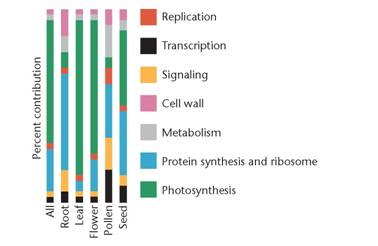
(a) Are gene-expression patterns reasonably compatible with expectations?
(b) The general developmental program of plants contrasts with that of animals in that plants develop continuously, with new organs being added throughout their life span. How much does such a developmental program help explain the expression of photosynthetic genes in flowers and seeds?
(c) Typically, single or small numbers of genes are studied to determine their impact on development. Here, genome-wide analysis reveals output from general classes containing many genes. How might such a global approach further our understanding of the role of genes in development?
(a) Are gene-expression patterns reasonably compatible with expectations?
(b) The general developmental program of plants contrasts with that of animals in that plants develop continuously, with new organs being added throughout their life span. How much does such a developmental program help explain the expression of photosynthetic genes in flowers and seeds?
(c) Typically, single or small numbers of genes are studied to determine their impact on development. Here, genome-wide analysis reveals output from general classes containing many genes. How might such a global approach further our understanding of the role of genes in development?
Question

Unlock Deck
Sign up to unlock the cards in this deck!
Unlock Deck
Unlock Deck
1/30

Play

Full screen (f)
Deck 18: Developmental Genetics
1
In humans the HOXD homeotic gene cluster plays a critical role in limb development. In one large family, 16 of 36 members expressed one of two dominantly inherited malformations of the feet known as rocker bottom foot (CVT) or claw foot (CMT). One individual had one foot with CVT and the other with CMT. Genomic analysis identified a missense mutation in the HOXD10 gene, resulting in a single amino acid substitution in the homeodomain of the encoded transcription factor. This region is crucial for making contact and binding to the target genes controlled by this protein. All family members with the foot malformations were heterozygotes; all unaffected members were homozygous for the normal allele.
Given that affected heterozygotes carry one normal allele of the HOXD10 gene, how might a dominant mutation in a gene encoding a transcription factor lead to a developmental malformation?
Given that affected heterozygotes carry one normal allele of the HOXD10 gene, how might a dominant mutation in a gene encoding a transcription factor lead to a developmental malformation?
A dominant mutation in a heterozygote has one mutant allele and one normal allele. The mutant phenotype is expressed, in spite of the normal functioning allele. This is because most dominant mutations are gain-of-function mutations in which the mutant gene is overexpressed or produces a gene product that is more active than the gene product produced by the normal allele. Therefore, the mutant gene product "beats" the normal gene product and the mutant phenotype is observed.
In the case of the mutated HOXD10 gene, the binding domain of the transcription factor is mutated. Most likely the mutation increases the binding affinity of the transcription factor. This would cause the mutated transcription factor to bind deoxyribonucleic acid (DNA) or other proteins more readily than the normal transcription factor, resulting in the mutant phenotype being expressed.
In the case of the mutated HOXD10 gene, the binding domain of the transcription factor is mutated. Most likely the mutation increases the binding affinity of the transcription factor. This would cause the mutated transcription factor to bind deoxyribonucleic acid (DNA) or other proteins more readily than the normal transcription factor, resulting in the mutant phenotype being expressed.
2
In this chapter, we have focused on large-scale as well as the inter- and intracellular events that take place during embryo-genesis and the formation of adult structures. In particular, we discussed how the adult body plan is laid down by a cascade of gene expression, and the role of cell-cell communication in development. Based on your knowledge of these topics, answer several fundamental questions:
(a) How do we know how many genes control development in an organism like Drosophila ?
(b) What experimental evidence demonstrates that molecular gradients in the egg control development?
(c) How did we discover that selector genes specify which adult structures will be formed by body segments?
(d) How did we learn about the levels of gene regulation involved in vulval development in C. elegans ?
(e) How do we know that eye formation in all animals is controlled by a binary switch gene?
(a) How do we know how many genes control development in an organism like Drosophila ?
(b) What experimental evidence demonstrates that molecular gradients in the egg control development?
(c) How did we discover that selector genes specify which adult structures will be formed by body segments?
(d) How did we learn about the levels of gene regulation involved in vulval development in C. elegans ?
(e) How do we know that eye formation in all animals is controlled by a binary switch gene?
There is significant experimental evidence which indicates that molecular gradients in the egg control development. Maternal effect genes are placed in the egg which is developing and then monitored. Concentrations of the genes and proteins can also be altered or monitored to study the effects of these gradients on development. Using a control fly which is homozygous for deleterious recessive maternal effect genes are sterile, which indicates that molecular gradients are significant.
The fact that selector genes specify which adult structures will be formed by body segments was discovered using the mutant phenotypes. When one segment is transformed, the genes involved in those transformations are studied to elucidate which genes specify which adult structures are formed.
The levels of gene regulation involved in vulval development in C. elegans were determined using a Drosophila mutant. The Notch pathway, which is the pathway used to develop the vulva, worked through direct cell to cell contact. The signal and the receptor are both proteins embedded in the plasma membrane. These proteins are controlled by a gene and were studied through altering the gene and controlling the interaction f the neighboring cells as well as the position of these cells to each other and the secreted signal proteins.
The genes which control eye development are controlled by a binary switch. This was understood via the examination of the relationship between eyeless organisms and the specific gene used to produce the eye. The Drosophila also carried copies of a functional gene and led to the understanding that the gene was a switch gene which was capable of being turned on or off.
The fact that selector genes specify which adult structures will be formed by body segments was discovered using the mutant phenotypes. When one segment is transformed, the genes involved in those transformations are studied to elucidate which genes specify which adult structures are formed.
The levels of gene regulation involved in vulval development in C. elegans were determined using a Drosophila mutant. The Notch pathway, which is the pathway used to develop the vulva, worked through direct cell to cell contact. The signal and the receptor are both proteins embedded in the plasma membrane. These proteins are controlled by a gene and were studied through altering the gene and controlling the interaction f the neighboring cells as well as the position of these cells to each other and the secreted signal proteins.
The genes which control eye development are controlled by a binary switch. This was understood via the examination of the relationship between eyeless organisms and the specific gene used to produce the eye. The Drosophila also carried copies of a functional gene and led to the understanding that the gene was a switch gene which was capable of being turned on or off.
3
In humans the HOXD homeotic gene cluster plays a critical role in limb development. In one large family, 16 of 36 members expressed one of two dominantly inherited malformations of the feet known as rocker bottom foot (CVT) or claw foot (CMT). One individual had one foot with CVT and the other with CMT. Genomic analysis identified a missense mutation in the HOXD10 gene, resulting in a single amino acid substitution in the homeodomain of the encoded transcription factor. This region is crucial for making contact and binding to the target genes controlled by this protein. All family members with the foot malformations were heterozygotes; all unaffected members were homozygous for the normal allele.
How can two clinically different disorders result from the same mutation?
How can two clinically different disorders result from the same mutation?
The HOXD10 gene is a homeotic gene that plays a large role in limb formation during embryogenesis. It encodes a transcription factor which binds deoxyribonucleic acid (DNA) or other proteins causing activation or inactivation. Development involves the complex interaction of multiple genes and the transcription factor encoded by the HOXD10 gene probably serves multiple purposes during limb development. Therefore, the mutated transcription factor would be capable of producing multiple mutant phenotypes.
This is particularly apparent in the individual with congenital vertical talus (CVT) in one foot and Charcot-Marie-Tooth (CMT) disease in the other foot. Both feet are affected by a mutated transcription factor during limb development, but each foot was affected in a slightly different way.
This is particularly apparent in the individual with congenital vertical talus (CVT) in one foot and Charcot-Marie-Tooth (CMT) disease in the other foot. Both feet are affected by a mutated transcription factor during limb development, but each foot was affected in a slightly different way.
4
Review the Chapter Concepts list. These all center around concepts related to stages of development. Write a short essay based on these concepts that outlines the role of differential transcription, gene control of cell fate, and the role of signaling systems in development.
▪Gene expression during development is based on the differential transcription of selected genes.
▪Animals use a small number of shared signaling systems and regulatory networks to construct a wide range of adult body forms from the zygote. These shared properties make it possible to use animal models to study human development.
▪Differentiation is controlled by cascades of gene expression that are a consequence of events that specify and determine the developmental fate of cells.
▪Plants independently evolved developmental regulatory mechanisms that parallel those of animals.
▪In many organisms, binary switch genes program the developmental fate of embryonic cells.
▪Gene expression during development is based on the differential transcription of selected genes.
▪Animals use a small number of shared signaling systems and regulatory networks to construct a wide range of adult body forms from the zygote. These shared properties make it possible to use animal models to study human development.
▪Differentiation is controlled by cascades of gene expression that are a consequence of events that specify and determine the developmental fate of cells.
▪Plants independently evolved developmental regulatory mechanisms that parallel those of animals.
▪In many organisms, binary switch genes program the developmental fate of embryonic cells.
Unlock Deck
Unlock for access to all 30 flashcards in this deck.
Unlock Deck
k this deck
5
In humans the HOXD homeotic gene cluster plays a critical role in limb development. In one large family, 16 of 36 members expressed one of two dominantly inherited malformations of the feet known as rocker bottom foot (CVT) or claw foot (CMT). One individual had one foot with CVT and the other with CMT. Genomic analysis identified a missense mutation in the HOXD10 gene, resulting in a single amino acid substitution in the homeodomain of the encoded transcription factor. This region is crucial for making contact and binding to the target genes controlled by this protein. All family members with the foot malformations were heterozygotes; all unaffected members were homozygous for the normal allele.
What might we learn about the control of developmental processes from an understanding of how this mutation works?
What might we learn about the control of developmental processes from an understanding of how this mutation works?
Unlock Deck
Unlock for access to all 30 flashcards in this deck.
Unlock Deck
k this deck
6
Carefully distinguish between the terms differentiation and determination. Which phenomenon occurs initially during development?
Unlock Deck
Unlock for access to all 30 flashcards in this deck.
Unlock Deck
k this deck
7
Nuclei from almost any source may be injected into Xenopus oocytes. Studies have shown that these nuclei remain active in transcription and translation. How can such an experimental system be useful in developmental genetic studies?
Unlock Deck
Unlock for access to all 30 flashcards in this deck.
Unlock Deck
k this deck
8
Distinguish between the syncytial blastoderm stage and the cellular blastoderm stage in Drosophila embryogenesis.
Unlock Deck
Unlock for access to all 30 flashcards in this deck.
Unlock Deck
k this deck
9
What are maternal-effect genes?
(b) When are gene products from these genes made, and where are they located?
(c) What aspects of development do maternal-effect genes control?
(d) What is the phenotype of maternal-effect mutations?
(b) When are gene products from these genes made, and where are they located?
(c) What aspects of development do maternal-effect genes control?
(d) What is the phenotype of maternal-effect mutations?
Unlock Deck
Unlock for access to all 30 flashcards in this deck.
Unlock Deck
k this deck
10
What are zygotic genes, and when are their gene products made?
(b) What is the phenotype associated with zygotic gene mutations?
(c) Does the maternal genotype contain zygotic genes?
(b) What is the phenotype associated with zygotic gene mutations?
(c) Does the maternal genotype contain zygotic genes?
Unlock Deck
Unlock for access to all 30 flashcards in this deck.
Unlock Deck
k this deck
11
List the main classes of zygotic genes. What is the function of each class of these genes?
Unlock Deck
Unlock for access to all 30 flashcards in this deck.
Unlock Deck
k this deck
12
Experiments have shown that any nuclei placed in the polar cytoplasm at the posterior pole of the Drosophila egg will differentiate into germ cells. If polar cytoplasm is transplanted into the anterior end of the egg just after fertilization, what will happen to nuclei that migrate into this cytoplasm at the anterior pole?
Unlock Deck
Unlock for access to all 30 flashcards in this deck.
Unlock Deck
k this deck
13
How can you determine whether a particular gene is being transcribed in different cell types?
Unlock Deck
Unlock for access to all 30 flashcards in this deck.
Unlock Deck
k this deck
14
You observe that a particular gene is being transcribed during development. How can you tell whether the expression of this gene is under transcriptional or translational control?
Unlock Deck
Unlock for access to all 30 flashcards in this deck.
Unlock Deck
k this deck
15
The homeotic mutation Antennapedia causes mutant Drosophila to have legs in place of antennae and is a dominant gain-of-function mutation. What are the properties of such mutations? How does the Antennapedia gene change antennae into legs?
Unlock Deck
Unlock for access to all 30 flashcards in this deck.
Unlock Deck
k this deck
16
The Drosophila homeotic mutation spineless aristapedia ( ss a ) results in the formation of a miniature tarsal structure (normally part of the leg) on the end of the antenna. What insight is provided by ( ss a ) concerning the role of genes during determination?
Unlock Deck
Unlock for access to all 30 flashcards in this deck.
Unlock Deck
k this deck
17
Embryogenesis and oncogenesis (generation of cancer) share a number of features including cell proliferation, apoptosis, cell migration and invasion, formation of new blood vessels, and differential gene activity. Embryonic cells are relatively undifferentiated, and cancer cells appear to be undifferentiated or dedifferentiated. Homeotic gene expression directs early development, and mutant expression leads to loss of the differentiated state or an alternative cell identity. M. T. Lewis (2000. Breast Can. Res. 2: 158-169) suggested that breast cancer may be caused by the altered expression of homeotic genes. When he examined 11 such genes in cancers, 8 were underexpressed while 3 were over-expressed compared with controls. Given what you know about homeotic genes, could they be involved in oncogenesis?
Unlock Deck
Unlock for access to all 30 flashcards in this deck.
Unlock Deck
k this deck
18
Early development depends on the temporal and spatial interplay between maternally supplied material and mRNA and the onset of zygotic gene expression. Maternally encoded mRNAs must be produced, positioned, and degraded (Surdej and Jacobs-Lorena, 1998. Mol. Cell Biol. 18: 2892-2900). For example, transcription of the bicoid gene that determines anterior-posterior polarity in Drosophila is maternal. The mRNA is synthesized in the ovary by nurse cells and then transported to the oocyte, where it localizes to the anterior ends of oocytes. After egg deposition, bicoid mRNA is translated and unstable bicoid protein forms a decreasing concentration gradient from the anterior end of the embryo. At the start of gastrulation, bicoid mRNA has been degraded. Consider two models to explain the degradation of bicoid mRNA: (1) degradation may result from signals within the mRNA (intrinsic model), or (2) degradation may result from the mRNA's position within the egg (extrinsic model). Experimentally, how could one distinguish between these two models?
Unlock Deck
Unlock for access to all 30 flashcards in this deck.
Unlock Deck
k this deck
19
Formation of germ cells in Drosophila and many other embryos is dependent on their position in the embryo and their exposure to localized cytoplasmic determinants. Nuclei exposed to cytoplasm in the posterior end of Drosophila eggs (the pole plasm) form cells that develop into germ cells under the direction of maternally derived components. R. Amikura et al. (2001. Proc. Nat. Acad. Sci. ( USA ) 98: 9133-9138) consistently found mitochondria-type ribosomes outside mitochondria in the germ plasma of Drosophila embryos and postulated that they are intimately related to germ-cell specification. If you were studying this phenomenon, what would you want to know about the activity of these ribosomes?
Unlock Deck
Unlock for access to all 30 flashcards in this deck.
Unlock Deck
k this deck
20
One of the most interesting aspects of early development is the remodeling ofthe cell cycle from rapid cell divisions, apparently lacking G1 and G2 phases, to slower cell cycles with measurable G1 and G2 phases and checkpoints. During this remodeling, maternal mRNAs that specify cyclins are deadenylated, and zygotic genes are activated to produce cyclins. Audic et al. (2001. Mol. and Cell. Biol. 21: 1662-1671) suggest that dead-enylation requires transcription of zygotic genes. Present a diagram that captures the significant features of these findings.
Unlock Deck
Unlock for access to all 30 flashcards in this deck.
Unlock Deck
k this deck
21
A number of genes that control expression of Hox genes in Drosophila have been identified. One of these homozygous mutants is extra sex combs , where some of the head and all of the thorax and abdominal segments develop as the last abdominal segment. In other words, all affected segments develop as posterior segments. What does this phenotype tell you about which set of Hox genes is controlled by the extra sex combs gene ?
Unlock Deck
Unlock for access to all 30 flashcards in this deck.
Unlock Deck
k this deck
22
The apterous gene in Drosophila encodes a protein required for wing patterning and growth. It is also known to function in nerve development, fertility, and viability. When human and mouse genes whose protein products closely resemble apterous were used to generate transgenic Drosophila (Rincon-Limas et al. 1999. Proc. Nat. Acad. Sci. [ USA ] 96: 2165-2170), the apterous mutant phenotype was rescued. In addition, the whole-body expression patterns in the transgenic Drosophila were similar to normal apterous.
(a) What is meant by the term rescued in this context?
(b) What do these results indicate about the molecular nature of development?
(a) What is meant by the term rescued in this context?
(b) What do these results indicate about the molecular nature of development?
Unlock Deck
Unlock for access to all 30 flashcards in this deck.
Unlock Deck
k this deck
23
In Arabidopsis , flower development is controlled by sets of homeotic genes. How many classes of these genes are there, and what structures are formed by their individual and combined expression?
Unlock Deck
Unlock for access to all 30 flashcards in this deck.
Unlock Deck
k this deck
24
The floral homeotic genes of Arabidopsis belong to the MADS-box gene family, while in Drosophila , homeotic genes belong to the homeobox gene family. In both Arabidopsis and Drosophila , members of the Polycomb gene family control expression of these divergent homeotic genes. How do Polycomb genes control expression of two very different sets of homeotic genes?
Unlock Deck
Unlock for access to all 30 flashcards in this deck.
Unlock Deck
k this deck
25
The identification and characterization of genes that control sex determination has been a focus of investigators working with C. elegans. As with Drosophila , sex in this organism is determined by the ratio of X chromosomes to sets of auto-somes. A diploid wild-type male has one X chromosome and a diploid wild-type hermaphrodite has two X chromosomes. Many different mutations have been identified that affect sex determination. Loss-of-function mutations in a gene called her - 1 cause an XO nematode to develop into a hermaphrodite and have no effect on XX development. (That is, XX nematodes are normal hermaphrodites.) In contrast, loss-of-function mutations in a gene called tra - 1 cause an XX nematode to develop into a male. Deduce the roles of these genes in wild-type sex determination from this information.
Unlock Deck
Unlock for access to all 30 flashcards in this deck.
Unlock Deck
k this deck
26
Vulval development in C. elegans is dependent on the response of some of the central epidermal progenitor cells in the region of the developing vulva to a chemical signal from the gonad. Signaling from the gonad is blocked by action of the vulvaless mutant let-23 so that none of the central progenitor cells form vulval structures. In the vulvaless mutant, n300 , the central progenitor cells do not form.
(a) Which gene is likely to act earlier in the vulval developmental pathway?
(b) What phenotype (vulva formed or vulvaless) would you expect from the double mutant? Why?
(a) Which gene is likely to act earlier in the vulval developmental pathway?
(b) What phenotype (vulva formed or vulvaless) would you expect from the double mutant? Why?
Unlock Deck
Unlock for access to all 30 flashcards in this deck.
Unlock Deck
k this deck
27
Based on the information in Problem and the analysis of the phenotypes of single-and double-mutant strains, a model for sex determination in C. elegans has been generated. This model proposes that the her-1 gene controls sex determination by establishing the level of activity of the tra-1 gene, which, in turn, controls the expression of genes involved in generating the various sexually dimorphic tissues. Given this information,
(a) does the her-1 gene product have a negative or a positive effect on the activity of the tra-1 gene?
(b) What would be the phenotype of a tra-1 , her-1 double mutant?
The identification and characterization of genes that control sex determination has been a focus of investigators working with C. elegans. As with Drosophila , sex in this organism is determined by the ratio of X chromosomes to sets of auto-somes. A diploid wild-type male has one X chromosome and a diploid wild-type hermaphrodite has two X chromosomes. Many different mutations have been identified that affect sex determination. Loss-of-function mutations in a gene called her - 1 cause an XO nematode to develop into a hermaphrodite and have no effect on XX development. (That is, XX nematodes are normal hermaphrodites.) In contrast, loss-of-function mutations in a gene called tra - 1 cause an XX nematode to develop into a male. Deduce the roles of these genes in wild-type sex determination from this information.
(a) does the her-1 gene product have a negative or a positive effect on the activity of the tra-1 gene?
(b) What would be the phenotype of a tra-1 , her-1 double mutant?
The identification and characterization of genes that control sex determination has been a focus of investigators working with C. elegans. As with Drosophila , sex in this organism is determined by the ratio of X chromosomes to sets of auto-somes. A diploid wild-type male has one X chromosome and a diploid wild-type hermaphrodite has two X chromosomes. Many different mutations have been identified that affect sex determination. Loss-of-function mutations in a gene called her - 1 cause an XO nematode to develop into a hermaphrodite and have no effect on XX development. (That is, XX nematodes are normal hermaphrodites.) In contrast, loss-of-function mutations in a gene called tra - 1 cause an XX nematode to develop into a male. Deduce the roles of these genes in wild-type sex determination from this information.
Unlock Deck
Unlock for access to all 30 flashcards in this deck.
Unlock Deck
k this deck
28
Much ofwhat we know about gene interactions in development has been learned using nematodes, yeast, flies, and bacteria. This is due, in part, to the relative ease of genetic manipulation of these well-characterized genomes. However, of great interest are gene interactions involving complex diseases in humans. Wang and White (2011. Nature Methods 8(4) 341-346) describe work using RNAi to examine the interactive proteome in mammalian cells. They mention that knockdown inefficiencies and off-target effects of introduced RNAi species are areas that need particular improvement if the methodology is to be fruitful.
(a) How might one use RNAi to study developmental pathways?
(b) Comment on how "knockdown inefficiencies" and "off-target effects" would influence the interpretation of results.
(a) How might one use RNAi to study developmental pathways?
(b) Comment on how "knockdown inefficiencies" and "off-target effects" would influence the interpretation of results.
Unlock Deck
Unlock for access to all 30 flashcards in this deck.
Unlock Deck
k this deck
29
Below is a microarray analysis of gene expression among developmentally significant categories (tissues and organs) in the model organism Arabidopsis thaliana (Schmid et al., 2005). Relative gene activities are presented on the ordinate, while several tissue types are presented on the abscissa.
(a) Are gene-expression patterns reasonably compatible with expectations?
(b) The general developmental program of plants contrasts with that of animals in that plants develop continuously, with new organs being added throughout their life span. How much does such a developmental program help explain the expression of photosynthetic genes in flowers and seeds?
(c) Typically, single or small numbers of genes are studied to determine their impact on development. Here, genome-wide analysis reveals output from general classes containing many genes. How might such a global approach further our understanding of the role of genes in development?
(a) Are gene-expression patterns reasonably compatible with expectations?
(b) The general developmental program of plants contrasts with that of animals in that plants develop continuously, with new organs being added throughout their life span. How much does such a developmental program help explain the expression of photosynthetic genes in flowers and seeds?
(c) Typically, single or small numbers of genes are studied to determine their impact on development. Here, genome-wide analysis reveals output from general classes containing many genes. How might such a global approach further our understanding of the role of genes in development?
Unlock Deck
Unlock for access to all 30 flashcards in this deck.
Unlock Deck
k this deck
30
Dominguez et al. (2004) suggest that by studying genes that determine growth and tissue specification in the eye of Drosophila, much can be learned about human eye development.
(a) What evidence suggests that genetic eye determinants in Drosophila are also found in humans? Include a discussion of orthologous genes in your answer.
(b) What evidence indicates that the eyeless gene is part of a developmental network?
(c) Are genetic networks likely to specify developmental processes in general? Explain fully and provide an example.
(a) What evidence suggests that genetic eye determinants in Drosophila are also found in humans? Include a discussion of orthologous genes in your answer.
(b) What evidence indicates that the eyeless gene is part of a developmental network?
(c) Are genetic networks likely to specify developmental processes in general? Explain fully and provide an example.
Unlock Deck
Unlock for access to all 30 flashcards in this deck.
Unlock Deck
k this deck
Unlock Deck
Unlock for access to all 30 flashcards in this deck.







