





 Chat with AI

Deck 17: Regulation of Gene Expression in Eukaryotes
Full screen (f)

Question

Question
Question
Question
Question
Question
Question
Question
Question
Question
Question
Question
Question
Question
Question
Question
Question
Question
Question
Question
Question
Question
Question
Question
Question
Question
Question
Question
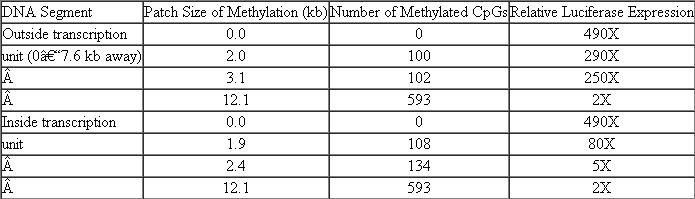
DNA methylation is commonly associated with a reduction of transcription. The following data come from a study of the impact of the location and extent of DNA methylation on gene activity in human cells. A bacterial gene, luciferase, was cloned next to eukaryotic promoter fragments that were methylated to various degrees, in vitro. The chimeric plasmids were then introduced into tissue culture cells, and the lucif-erase activity was assayed. These data compare the degree of expression of luciferase with differences in the location of DNA methylation (Irvine et al., 2002. Mol. and Cell. Biol. 22: 6689-6696). What general conclusions can be drawn from these data?
Question
Question
Question
Question
Question

Unlock Deck
Sign up to unlock the cards in this deck!
Unlock Deck
Unlock Deck
1/33

Play

Full screen (f)
Deck 17: Regulation of Gene Expression in Eukaryotes
1
A man in his early 30s suddenly developed weakness in his hands and neck, followed a few weeks later by burning muscle pain-all symptoms of late-onset muscular dystrophy. His internist ordered genetic tests to determine whether he had one of the inherited muscular dystrophies, focusing on Becker muscular dystrophy, myotonic dystrophy Type I, and myotonic dystrophy Type II. These tests were designed to detect mutations in the related dystrophin , DMPK , and ZNF9 genes. The testing ruled out Becker muscular dystrophy. While awaiting the results of the DMPK and ZNF9 gene tests, the internist explained that the possible mutations were due to expanded tri-and tetranucleotide repeats, but not in the protein-coding portions of the genes. She went on to say that the resulting disorders were the result not of changes in the encoded proteins, which appear to be normal, but instead of altered RNA splicing patterns, whereby the RNA splicing remnants containing the nucleotide repeats disrupt normal splicing of the transcripts of other genes. This discussion raises several interesting questions about the diagnosis and genetic basis of the disorders.
What is alternative splicing, where does it occur, and how could disrupting it affect the expression of the affected gene(s)?
What is alternative splicing, where does it occur, and how could disrupting it affect the expression of the affected gene(s)?
Alternative splicing is a process that enables one gene to make many different proteins. Genes are composed of both coding (exons) and noncoding (introns) regions. After transcription, introns are removed from the pre-mRNA (messenger ribonucleic acid) strand and exons are joined. This process is called splicing. In alternative splicing, exons may be excluded or cut at different splice sites to produce different combinations of transcripts. All of these events occur in the nucleus of a cell.
Disruptions in alternative splicing can affect the protein product of a gene as well as disrupt transcript translation and stability. However, disruptions in alternative splicing have no effect on increasing or decreasing levels of gene expression.
In many cases, different binding domains of a protein are encoded by different exons. Splicing disruptions could remove a crucial binding domain, disrupting normal protein function leading to disease. Point mutations in introns may alter the sequence so that it is no longer recognized by splicing proteins. This may produce a dysfunctional protein product or no product at all.
Disruptions in alternative splicing can affect the protein product of a gene as well as disrupt transcript translation and stability. However, disruptions in alternative splicing have no effect on increasing or decreasing levels of gene expression.
In many cases, different binding domains of a protein are encoded by different exons. Splicing disruptions could remove a crucial binding domain, disrupting normal protein function leading to disease. Point mutations in introns may alter the sequence so that it is no longer recognized by splicing proteins. This may produce a dysfunctional protein product or no product at all.
2
In this chapter, we focused on how eukaryotic genes are regulated at different steps in their expression, from chromatin modifications to control of protein stability. At the same time, we found many opportunities to consider the methods and reasoning by which much of this information was acquired. From the explanations given in the chapter,
(a) How do we know that promoter and enhancer sequences control the initiation of transcription in eukaryotes?
(b) How do we know that eukaryotic transcription factors bind to DNA sequences at or near promoter regions?
(c) How do we know that double-stranded RNA molecules can control gene expression?
(a) How do we know that promoter and enhancer sequences control the initiation of transcription in eukaryotes?
(b) How do we know that eukaryotic transcription factors bind to DNA sequences at or near promoter regions?
(c) How do we know that double-stranded RNA molecules can control gene expression?
(a)
Experimental studies with mutations in promoter and enhancer sequences have elucidated their control of transcription initiation. Point mutations in promoter sequences disrupt transcriptional efficiencies while deleting promoter sequences alters the transcriptional start site.
Mutations in enhancer sequences exhibit decreased transcription (often significant) indicating enhancer regions influence transcription rates, but are not required. In addition, through recombinant technology, enhancer sequences have been inserted near genes which then exhibit increased transcription.
(b)Analysis of transcription factor proteins have shown structural motifs that are known to be involved in deoxyribonucleic acid (DNA) binding, such as helix-turn-helix motifs. Other studies have shown that transcription factor activity is lost when promoter regions (including surrounding transcription factor binding regions) of DNA are deleted. In addition, transcription factors have been shown to have cis- regulating properties suggesting they must bind DNA at or near the promoter.
(c)Small double-stranded molecules of ribonucleic acid (RNA) were injected into roundworm cells and were shown to degrade mRNA (messenger RNA) and repress translation. It was expected that injection of single-stranded RNA complementary to a specific gene's mRNA would suppress gene expression, but not double-stranded RNA. This post-translational regulation is called RNA interference (RNAi). Additional studies have shown translation repression by short RNA molecules via chromatin alterations in the nucleus.
Experimental studies with mutations in promoter and enhancer sequences have elucidated their control of transcription initiation. Point mutations in promoter sequences disrupt transcriptional efficiencies while deleting promoter sequences alters the transcriptional start site.
Mutations in enhancer sequences exhibit decreased transcription (often significant) indicating enhancer regions influence transcription rates, but are not required. In addition, through recombinant technology, enhancer sequences have been inserted near genes which then exhibit increased transcription.
(b)Analysis of transcription factor proteins have shown structural motifs that are known to be involved in deoxyribonucleic acid (DNA) binding, such as helix-turn-helix motifs. Other studies have shown that transcription factor activity is lost when promoter regions (including surrounding transcription factor binding regions) of DNA are deleted. In addition, transcription factors have been shown to have cis- regulating properties suggesting they must bind DNA at or near the promoter.
(c)Small double-stranded molecules of ribonucleic acid (RNA) were injected into roundworm cells and were shown to degrade mRNA (messenger RNA) and repress translation. It was expected that injection of single-stranded RNA complementary to a specific gene's mRNA would suppress gene expression, but not double-stranded RNA. This post-translational regulation is called RNA interference (RNAi). Additional studies have shown translation repression by short RNA molecules via chromatin alterations in the nucleus.
3
A man in his early 30s suddenly developed weakness in his hands and neck, followed a few weeks later by burning muscle pain-all symptoms of late-onset muscular dystrophy. His internist ordered genetic tests to determine whether he had one of the inherited muscular dystrophies, focusing on Becker muscular dystrophy, myotonic dystrophy Type I, and myotonic dystrophy Type II. These tests were designed to detect mutations in the related dystrophin , DMPK , and ZNF9 genes. The testing ruled out Becker muscular dystrophy. While awaiting the results of the DMPK and ZNF9 gene tests, the internist explained that the possible mutations were due to expanded tri-and tetranucleotide repeats, but not in the protein-coding portions of the genes. She went on to say that the resulting disorders were the result not of changes in the encoded proteins, which appear to be normal, but instead of altered RNA splicing patterns, whereby the RNA splicing remnants containing the nucleotide repeats disrupt normal splicing of the transcripts of other genes. This discussion raises several interesting questions about the diagnosis and genetic basis of the disorders.
What role might the expanded tri-and tetranucleotide repeats play in the altered splicing?
What role might the expanded tri-and tetranucleotide repeats play in the altered splicing?
Expanded tri- and tetranucleotide repeats disrupt other transcript splicing through several possible mechanisms. Normally, the spliced repeats would be degraded after being spliced from the pre-mRNA (messenger ribonucleic acid). However, the mutant expanded nucleotide repeats may not be recognized by degradation enzymes. The remnant nucleotides could interact negatively with the spliceosome complex, thereby altering its normal splicing patterns and producing dysfunctional proteins.
4
Review the Chapter Concepts list. These concepts relate to the many different regulatory steps that contribute to gene expression in eukaryotic organisms. The fifth concept summarizes several of the steps in posttranscriptional regulation. Write a short essay describing how the recent data emerging from the ENCODE project influence our views of the relative importance of transcriptional and posttranscriptional gene regulation in humans.
▪Expression of genetic information is regulated by mechanisms that exert control over transcription, mRNA processing, export from the nucleus, mRNA stability, translation, and posttranslational modifications.
▪Chromatin remodeling, as well as modifications to DNA and histones, play important roles in regulating gene expression in eukaryotes.
▪Eukaryotic transcription initiation requires the assembly of transcription regulatory proteins at cis -acting DNA sites known as promoters, enhancers, and silencers.
▪Transcription activators and repressors stimulate the association of the general transcription factors into pre-initiation complexes at gene promoters.
▪Eukaryotic gene expression is also regulated by multiple posttranscriptional mechanisms, including alternative splicing of pre-mRNA, export from the nucleus, control of mRNA stability, translation regulation, and posttranslational processing.
▪RNA-induced gene silencing controls gene expression in several ways and is being harnessed for scientific research and medical treatments.
▪Programmed DNA rearrangements contribute to gene regulation in a small number of genes.
▪Expression of genetic information is regulated by mechanisms that exert control over transcription, mRNA processing, export from the nucleus, mRNA stability, translation, and posttranslational modifications.
▪Chromatin remodeling, as well as modifications to DNA and histones, play important roles in regulating gene expression in eukaryotes.
▪Eukaryotic transcription initiation requires the assembly of transcription regulatory proteins at cis -acting DNA sites known as promoters, enhancers, and silencers.
▪Transcription activators and repressors stimulate the association of the general transcription factors into pre-initiation complexes at gene promoters.
▪Eukaryotic gene expression is also regulated by multiple posttranscriptional mechanisms, including alternative splicing of pre-mRNA, export from the nucleus, control of mRNA stability, translation regulation, and posttranslational processing.
▪RNA-induced gene silencing controls gene expression in several ways and is being harnessed for scientific research and medical treatments.
▪Programmed DNA rearrangements contribute to gene regulation in a small number of genes.
Unlock Deck
Unlock for access to all 33 flashcards in this deck.
Unlock Deck
k this deck
5
A man in his early 30s suddenly developed weakness in his hands and neck, followed a few weeks later by burning muscle pain-all symptoms of late-onset muscular dystrophy. His internist ordered genetic tests to determine whether he had one of the inherited muscular dystrophies, focusing on Becker muscular dystrophy, myotonic dystrophy Type I, and myotonic dystrophy Type II. These tests were designed to detect mutations in the related dystrophin , DMPK , and ZNF9 genes. The testing ruled out Becker muscular dystrophy. While awaiting the results of the DMPK and ZNF9 gene tests, the internist explained that the possible mutations were due to expanded tri-and tetranucleotide repeats, but not in the protein-coding portions of the genes. She went on to say that the resulting disorders were the result not of changes in the encoded proteins, which appear to be normal, but instead of altered RNA splicing patterns, whereby the RNA splicing remnants containing the nucleotide repeats disrupt normal splicing of the transcripts of other genes. This discussion raises several interesting questions about the diagnosis and genetic basis of the disorders.
3. How does this contrast with other types of muscular dystrophy, such as Becker muscular dystrophy and Duchenne muscular dystrophy?
3. How does this contrast with other types of muscular dystrophy, such as Becker muscular dystrophy and Duchenne muscular dystrophy?
Unlock Deck
Unlock for access to all 33 flashcards in this deck.
Unlock Deck
k this deck
6
Why is gene regulation more complex in a multicellular eukaryote than in a prokaryote? Why is the study of this phenomenon in eukaryotes more difficult?
Unlock Deck
Unlock for access to all 33 flashcards in this deck.
Unlock Deck
k this deck
7
Provide a definition of chromatin remodeling, and give two examples of this phenomenon.
Unlock Deck
Unlock for access to all 33 flashcards in this deck.
Unlock Deck
k this deck
8
Describe the organization of the interphase nucleus. Include in your presentation a description of chromosome territories, interchromosomal domains, and transcription factories.
Unlock Deck
Unlock for access to all 33 flashcards in this deck.
Unlock Deck
k this deck
9
A number of experiments have demonstrated that areas of the genome that are relatively inert transcriptionally are resistant to DNase I digestion; however, those areas that are transcriptionally active are DNase I sensitive. Describe how DNase I resistance or sensitivity might indicate transcriptional activity.
Unlock Deck
Unlock for access to all 33 flashcards in this deck.
Unlock Deck
k this deck
10
Provide a brief description of two different types of histone modification.
Unlock Deck
Unlock for access to all 33 flashcards in this deck.
Unlock Deck
k this deck
11
Present an overview of the manner in which chromatin can be remodeled. Describe the manner in which these remodeling processes influence transcription.
Unlock Deck
Unlock for access to all 33 flashcards in this deck.
Unlock Deck
k this deck
12
Distinguish between the cis -acting regulatory elements referred to as promoters and enhancers.
Unlock Deck
Unlock for access to all 33 flashcards in this deck.
Unlock Deck
k this deck
13
Describe the manner in which activators and repressors influence the rate of transcription initiation. How might chromatin structure be involved in such regulation?
Unlock Deck
Unlock for access to all 33 flashcards in this deck.
Unlock Deck
k this deck
14
Compare the control of gene regulation in eukaryotes and prokaryotes at the level of initiation of transcription. How do the regulatory mechanisms work? What are the similarities and differences in these two types of organisms in terms of the specific components of the regulatory mechanisms?
Unlock Deck
Unlock for access to all 33 flashcards in this deck.
Unlock Deck
k this deck
15
Many promoter regions contain CAAT boxes containing consensus sequences CAAT or CCAAT approximately 70 to 80 bases upstream from the transcription start site. How might one determine the influence of CAAT boxes on the transcription rate of a given gene?
Unlock Deck
Unlock for access to all 33 flashcards in this deck.
Unlock Deck
k this deck
16
Recent research indicates that promoters may fall into one of two classes: focused or dispersed. How do these differ, and which genes tend to be associated with each?
Unlock Deck
Unlock for access to all 33 flashcards in this deck.
Unlock Deck
k this deck
17
Present an overview of RNA-induced gene silencing achieved through RNA interference (RNAi). How do the silencing processes begin, and what major components participate?
Unlock Deck
Unlock for access to all 33 flashcards in this deck.
Unlock Deck
k this deck
18
How does the inherent imprecision of recombination events during immunoglobulin gene rearrangement contribute to the diversity of the immune response?
Unlock Deck
Unlock for access to all 33 flashcards in this deck.
Unlock Deck
k this deck
19
Explain the structural features of the Initiator (Inr) elements, BREs, DPEs, and MTEs of focused promoters.
Unlock Deck
Unlock for access to all 33 flashcards in this deck.
Unlock Deck
k this deck
20
DNA supercoiling, which occurs when coiling tension is generated ahead of the replication fork, is relieved by DNA gyrase. Supercoiling may also be involved in transcription regulation. Researchers discovered that transcriptional enhancers operating over a long distance (2500 base pairs) are dependent on DNA supercoiling, while enhancers operating over shorter distances (110 base pairs) are not so dependent (Liu et al., 2001. Proc. Natl. Acad. Sci. [USA] 98: 14,883-14,888). Using a diagram, suggest a way in which supercoiling may positively influence enhancer activity over long distances.
Unlock Deck
Unlock for access to all 33 flashcards in this deck.
Unlock Deck
k this deck
21
In some organisms, including mammals, there is an inverse relationship between the presence of 5-methylcytosine (m 5 C) in CpG sequences and gene activity. In addition, m 5 C may be involved in the recruitment of proteins that convert chromatin regions from transcriptionally active to inactive states. Overall, genomic DNA is relatively poor in CpG sequences due to the conversion of m 5 C to thymine; however, unmethylated CpG islands are often associated with active genes. Researchers have determined that patterns of DNA methylation in spermatozoa vary with age in rats and suggest that such age-related alterations in DNA methylation may be one mechanism underlying age-related abnormalities in mammals (Oakes et al., 2003. Proc. Natl. Acad. Sci. 100: 1775-1780). In light of the above information, provide an explanation that relates paternal age-related alterations in DNA methylation to birth abnormalities.
Unlock Deck
Unlock for access to all 33 flashcards in this deck.
Unlock Deck
k this deck
22
In the hypothetical extraterrestrial organism, the Quagarre, the immunoglobulin genes undergo rearrangements similar to those in humans, with two main differences. One difference is that the ? light-chain V regions are located on chromosome 4 and the other ? light-chain regions are located on chromosome 10. Another difference is that the Quagarre immunoglobulin genes do not rearrange until the creature is 13 years old. By examining a mitotic spread of chromosomes from a Quagarre B cell, how could you estimate the creature's age?
Unlock Deck
Unlock for access to all 33 flashcards in this deck.
Unlock Deck
k this deck
23
Because the degree of DNA methylation appears to be a relatively reliable genetic marker for some forms of cancer, researchers have explored the possibility of altering DNA methylation as a form of cancer therapy. Initial studies indicate that while hypomethylation suppresses the formation of some tumors, other tumors thrive. Why would one expect different cancers to respond differently to either hypomethyl-ation or hypermethylation therapies?
Unlock Deck
Unlock for access to all 33 flashcards in this deck.
Unlock Deck
k this deck
24
Explain how the following mutations would affect the transcription of the yeast GAL1 gene.
(a) A deletion within the GAL4 gene that removes the region encoding amino acids 1 to 100.
(b) A deletion of the entire GAL3 gene.
(c) A mutation within the GAL80 gene that blocks the ability of Gal80 protein to interact with Gal3p.
(d) A deletion of one of the four UAS G elements upstream from the GAL1 gene.
(e) A point mutation in the GAL1 core promoter that alters the sequence of the TATA box.
(a) A deletion within the GAL4 gene that removes the region encoding amino acids 1 to 100.
(b) A deletion of the entire GAL3 gene.
(c) A mutation within the GAL80 gene that blocks the ability of Gal80 protein to interact with Gal3p.
(d) A deletion of one of the four UAS G elements upstream from the GAL1 gene.
(e) A point mutation in the GAL1 core promoter that alters the sequence of the TATA box.
Unlock Deck
Unlock for access to all 33 flashcards in this deck.
Unlock Deck
k this deck
25
The interphase nucleus appears to be a highly structured organelle with chromosome territories, interchromosomal domains, and transcription factories. In cultured human cells, researchers have identified approximately 8000 transcription factories per cell, each containing an average of eight tightly associated RNAP II molecules actively transcribing RNA. If each RNAP II molecule is transcribing a different gene, how might such a transcription factory appear? Provide a simple diagram that shows eight different genes being transcribed in a transcription factory and include the promoters, structural genes, and nascent transcripts in your presentation.
Unlock Deck
Unlock for access to all 33 flashcards in this deck.
Unlock Deck
k this deck
26
A particular type of anemia in humans, called ? -thalassemia, results from a severe reduction or absence of a normal ? chain of hemoglobin. A variety of studies have explored the use of 5-azacytidine for the treatment of such patients. How might administration of 5-azacytidine be an effective treatment for ? -thalassemia? Would you consider adverse side-effects likely? Why?
Unlock Deck
Unlock for access to all 33 flashcards in this deck.
Unlock Deck
k this deck
27
The addition of a "5?-cap" and a "3? poly-A" tail to many nuclear RNA species occurs prior to export of mature mRNAs to the cytoplasm. Such modifications appear to influence mRNA stability. Many assays for gene regulation involve the use of reporter genes such as luciferase from the North American firefly ( Photinus pyralis ). When the luciferase gene is transcribed and translated, the protein product can be easily assayed in a test tube. In the presence of luciferin, ATP, and oxygen, the luciferase enzyme produces light that can be easily quantified. Assuming that luciferase mRNA can be obtained and differentially modified (5?-capped, poly-A tailed) in a test tube, suggest an assay system that would allow you to determine the influence of 5?-capping and poly-A tail addition on mRNA stability.
Unlock Deck
Unlock for access to all 33 flashcards in this deck.
Unlock Deck
k this deck
28
DNA methylation is commonly associated with a reduction of transcription. The following data come from a study of the impact of the location and extent of DNA methylation on gene activity in human cells. A bacterial gene, luciferase, was cloned next to eukaryotic promoter fragments that were methylated to various degrees, in vitro. The chimeric plasmids were then introduced into tissue culture cells, and the lucif-erase activity was assayed. These data compare the degree of expression of luciferase with differences in the location of DNA methylation (Irvine et al., 2002. Mol. and Cell. Biol. 22: 6689-6696). What general conclusions can be drawn from these data?
Unlock Deck
Unlock for access to all 33 flashcards in this deck.
Unlock Deck
k this deck
29
Incorrectly spliced RNAs often lead to human pathologies. Scientists have examined human cancer cells for splice-specific changes and found that many of the changes disrupt tumor-suppressor gene function (Xu and Lee, 2003. Nucl. Acids Res. 31: 5635-5643). In general, what would be the effects of splicing changes on these RNAs and the function of tumor-suppressor gene function? How might loss of splicing specificity be associated with cancer?
Unlock Deck
Unlock for access to all 33 flashcards in this deck.
Unlock Deck
k this deck
30
In a classical genetic analysis, scientists create mutations within or surrounding cloned gene sequences. They then introduce these mutated gene sequences into cell cultures or model organisms and examine the phenotypes. Geneticists are now adding RNA-induced gene silencing to their gene-analysis toolbox. Describe how you would use RNA-induced gene silencing to study the role of the Drosophila tra gene in sex determination. Next, describe how you would study tra function, using a classical genetic analysis. What are the advantages and limitations of each research approach?
Unlock Deck
Unlock for access to all 33 flashcards in this deck.
Unlock Deck
k this deck
31
Approximately 75 percent of all breast cancers are "ER positive" in that they grow when exposed to estrogen. In addition, over half of these ER-positive cancers are also "PR positive" in that they grow in response to progesterone. Suggest steps by which hormones such as estrogen or progesterone might enhance cell proliferation. Tamoxifen is commonly used to treat ER-positive cancer patients. Speculate on the role of Tamoxifen at the molecular level.
Unlock Deck
Unlock for access to all 33 flashcards in this deck.
Unlock Deck
k this deck
32
During an examination of the genomic sequences surrounding the human ? -globin gene, you discover a region of DNA that bears sequence resemblance to the GRE of the human metallothionein IIA ( hMTIIA ) gene. Describe experiments that you would design to test (1) whether this sequence was necessary for accurate ? -globin gene expression and (2) whether this sequence acted in the same way as the hMTIIA gene's GRE.
Unlock Deck
Unlock for access to all 33 flashcards in this deck.
Unlock Deck
k this deck
33
Transcription factors play key roles in the regulation of gene expression, but to do so, they must act within the nucleus. Like most proteins, however, transcription factors are translated in the cytoplasm. To enter the nucleus, transcription factors contain nuclear location signals, which in some cases can only work when bound to some other molecule such as a steroid hormone. After entering the nucleus, transcription factors must bind to appropriate DNA sites and must interact with other transcription proteins at promoters, enhancers, and silencers. Transcription factors then activate or repress transcription through their activation or repression domains. Many drug therapies target transcription factors. Based on the information provided above, suggest three specific mechanisms through which a successful drug therapy, targeted to a transcription factor, might work.
Unlock Deck
Unlock for access to all 33 flashcards in this deck.
Unlock Deck
k this deck
Unlock Deck
Unlock for access to all 33 flashcards in this deck.







