





 Chat with AI

Deck 12: DNA Organization in Chromosomes
Full screen (f)

Question

Question
Question
Question
Question
Question
Question
Question
Question
Question
Question
Question
Question
Question
Question
Question
Question
Question
Question
Question
Question
Question
Question
Question
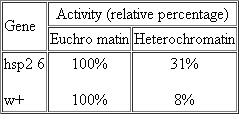
In a study of Drosophila , two normally active genes, w + (wild-type allele of the white - eye gene) and hsp 26 (a heat-shock gene), were introduced (using a plasmid vector) into euchro-matic and heterochromatic chromosomal regions, and the relative activity of each gene was assessed (Sun et al., 2002). An approximation of the resulting data is shown in the following table. Which characteristic or characteristics of heterochromatin are supported by the experimental data?
Question
Question
Question
Question
Question
Tandemly repeated DNA sequences with a repeat sequence of one to six base pairs-for example, (GACA) n -are called microsatellites and are common in eukaryotes. A particular subset of such sequences, the trinucleotide repeat, is of great interest because of the role such repeats play in human neurodegenerative disorders (Huntington disease, myotonic dystrophy, spinal-bulbar muscular atrophy, spinocerebellar ataxia, and fragile-X syndrome). Following are data (modified from Toth et al., 2000) regarding the location of microsatellites within and between genes. What general conclusions can be drawn from these data?
Percentage of Microsatellite DNA Sequences within Genes and between Genes
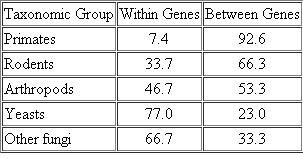
Percentage of Microsatellite DNA Sequences within Genes and between Genes
Question
More information from the research effort in Problem 26 produced data regarding the pattern of the length of such repeats within genes. Each value in the following table represents the number of times a microsatellite of a particular sequence length, one to six bases long, is found within genes. For instance, in primates, a dinucleotide sequence (GC, for example) is found 10 times, while a trinucleotide is found 1126 times. In fungi, a repeat motif composed of 6 nucleotides (GACACC, for example) is found 219 times, whereas a tetra-nucleotide repeat (GACA, for example) is found only 2 times. Analyze and interpret these data by indicating what general pattern is apparent for the distribution of various microsatellite lengths within genes. Of what significance might this general pattern be?
Distribution of Microsatellites by Unit Length within Genes
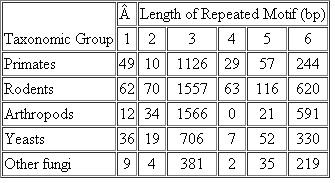
Distribution of Microsatellites by Unit Length within Genes
Question
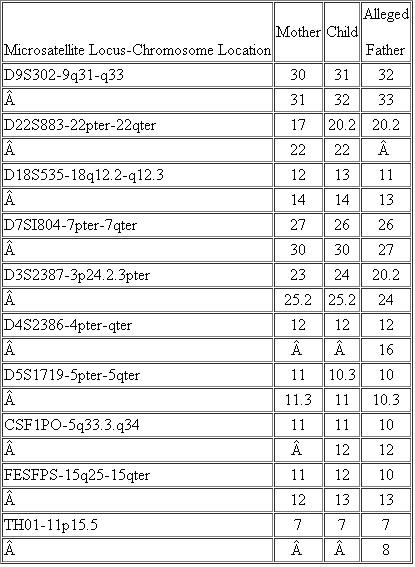
Microsatellites are currently exploited as markers for paternity testing. A sample paternity test is shown in the following table in which ten microsatellite markers were used to test samples from a mother, her child, and an alleged father. The name of the microsatellite locus is given in the left-hand column, and the genotype of each individual is recorded as the number of repeats he or she carries at that locus. For example, at locus D9S302, the mother carries 30 repeats on one of her chromosomes and 31 on the other. In cases where an individual carries the same number of repeats on both chromosomes, only a single number is recorded. (Some of the numbers are followed by a decimal point, for example, 20.2, to indicate a partial repeat in addition to the complete repeats.) Assuming that these markers are inherited in a simple Mendelian fashion, can the alleged father be excluded as the source of the sperm that produced the child? Why or why not? Explain.
Question

Unlock Deck
Sign up to unlock the cards in this deck!
Unlock Deck
Unlock Deck
1/32

Play

Full screen (f)
Deck 12: DNA Organization in Chromosomes
1
A genetics student visiting a museum saw a painting by Goya showing a woman with a newborn baby in her lap who had very short arms and legs along with some facial abnormalities. Wondering whether this condition might be a genetic disorder, the student went online, learning that the baby might have Roberts syndrome (RBS), a rare autosomal recessive trait. She read that cells in RBS have mitotic errors, including the premature separation of centromeres and other heterochromatic regions of homologs in metaphase instead of anaphase. As a result, metaphase chromosomes have a rigid, or "railroad track" appearance. RBS has been shown to be caused by mutant alleles of the ESCO2 gene, which functions during cell division.
The student wrote a list of questions to investigate in an attempt to better understand this condition. How would you answer these questions?
What do centromeres and other heterochromatic regions have in common that might cause this appearance?
The student wrote a list of questions to investigate in an attempt to better understand this condition. How would you answer these questions?
What do centromeres and other heterochromatic regions have in common that might cause this appearance?
It is the heterochromatic region or the non-coding region of the genome that harbors the centeromeric region in them. It is only at this part of the genome that the centromere attaches to, during genome replication.
Both the centeromeric region and the heterochromatic region are said to be non-coding regions. When there is a mutation in the centeromeric region, it results in the detachment of centromere and thus the maintenance of sister chromatids in place becomes a problem leading to a reduction in the replication of cells.
Cells that take long time for replication would be destroyed forming a reduction in the number of cells formed, thus giving the characteristic appearance of the reduction in the size of the limbs.
Both the centeromeric region and the heterochromatic region are said to be non-coding regions. When there is a mutation in the centeromeric region, it results in the detachment of centromere and thus the maintenance of sister chromatids in place becomes a problem leading to a reduction in the replication of cells.
Cells that take long time for replication would be destroyed forming a reduction in the number of cells formed, thus giving the characteristic appearance of the reduction in the size of the limbs.
2
In this chapter, we focused on how DNA is organized at the chromosomal level. Along the way, we found many opportunities to consider the methods and reasoning by which much of this information was acquired. From the explanations given in the chapter, what answers would you propose to the following fundamental questions:
(a) How do we know that viral and bacterial chromosomes most often consist of circular DNA molecules devoid of protein?
(b) What is the experimental basis for concluding that puffs in polytene chromosomes and loops in lampbrush chromosomes are areas of intense transcription of RNA?
(c) How did we learn that eukaryotic chromatin exists in the form of repeating nucleosomes, each consisting of about 200 base pairs and an octamer of histones?
(d) How do we know that satellite DNA consists of repetitive sequences and has been derived from regions of the centromere?
(a) How do we know that viral and bacterial chromosomes most often consist of circular DNA molecules devoid of protein?
(b) What is the experimental basis for concluding that puffs in polytene chromosomes and loops in lampbrush chromosomes are areas of intense transcription of RNA?
(c) How did we learn that eukaryotic chromatin exists in the form of repeating nucleosomes, each consisting of about 200 base pairs and an octamer of histones?
(d) How do we know that satellite DNA consists of repetitive sequences and has been derived from regions of the centromere?
a)Scientists may lyse, destroying membrane or protein coat, the cells of viruses and bacteria, and remove their chromosomes to examine them under the electron microscope. Electron microscope has a higher resolution and magnification than light microscope allowing DNA structure to be visible. Viewing the viral and bacterial DNA reveals a circular DNA structure without proteins, unlike linear chromosomes in eukaryotic cells in which DNA are wound around protein structures called histones
b)
Polytene chromosomes are found in larvae of flies, and some protozoans and plants cells during mitosis. Puffs are uncoiled regions discovered in polytene chromosomes. Puffs regions are highly transcribed. Transcription activity was found by using radioactively labelled RNA precursors. High activity of transcription would have high volume of radioactivity from RNA precursors.
Lampbrush chromosomes are found in oocytes, most vertebrate and insect spermatocytes during meiosis. Investigation of uncoiled loop regions in lampbrush chromosomes shows high level of transcription. These findings in polytene and lampbrush chromosomes suggest that uncoiling help promote transcription of a gene.
c)
Chromatin digestion by endonucleases yield fragments of DNA of about 200 base pairs in length proving that chromatin has repeated sequences. Electron microscopic studies revealed chromatins that appeared as "beads on a string" where the "beads" were seen evenly distributed. This further confirms chromatins are of repeating units. Chemical analysis of DNA and histones showed that there are five proteins in histones, H1, H2A, H2B, H3 and H4. The histone complex are formed by (H2A) 2 •(H2B) 2 and (H3) 2 •(H4) 2. H1 links separate nucleosome units through linker DNA. Every nucleosome unit contains two of each tetramer yielding an octomer.
Furthermore chemical analysis showed that each nucleosome was 200 base pairs long. X-ray diffraction analysis proved that histones contributed to the chromatin structure. A special diffracting ring pattern was seen when histones were present and without them, the diffraction scattered. Neuron scattering analysis also contributed to chromatin structure.
d)
Mary Lou Pardue and Joe Gall analyzed satellite DNA by using the situ molecular hybridization technique. A fluorescent DNA or RNA probe searched for the region of complement. Then autoradiography located the centromere region of chromosomes as the area of complement to the probe. This gave them the sequences of satellite DNA which they discovered were repeats of a few base pairs e.g. GCGCGCGCGC... (repeats of two base pairs of GC).
b)
Polytene chromosomes are found in larvae of flies, and some protozoans and plants cells during mitosis. Puffs are uncoiled regions discovered in polytene chromosomes. Puffs regions are highly transcribed. Transcription activity was found by using radioactively labelled RNA precursors. High activity of transcription would have high volume of radioactivity from RNA precursors.
Lampbrush chromosomes are found in oocytes, most vertebrate and insect spermatocytes during meiosis. Investigation of uncoiled loop regions in lampbrush chromosomes shows high level of transcription. These findings in polytene and lampbrush chromosomes suggest that uncoiling help promote transcription of a gene.
c)
Chromatin digestion by endonucleases yield fragments of DNA of about 200 base pairs in length proving that chromatin has repeated sequences. Electron microscopic studies revealed chromatins that appeared as "beads on a string" where the "beads" were seen evenly distributed. This further confirms chromatins are of repeating units. Chemical analysis of DNA and histones showed that there are five proteins in histones, H1, H2A, H2B, H3 and H4. The histone complex are formed by (H2A) 2 •(H2B) 2 and (H3) 2 •(H4) 2. H1 links separate nucleosome units through linker DNA. Every nucleosome unit contains two of each tetramer yielding an octomer.
Furthermore chemical analysis showed that each nucleosome was 200 base pairs long. X-ray diffraction analysis proved that histones contributed to the chromatin structure. A special diffracting ring pattern was seen when histones were present and without them, the diffraction scattered. Neuron scattering analysis also contributed to chromatin structure.
d)
Mary Lou Pardue and Joe Gall analyzed satellite DNA by using the situ molecular hybridization technique. A fluorescent DNA or RNA probe searched for the region of complement. Then autoradiography located the centromere region of chromosomes as the area of complement to the probe. This gave them the sequences of satellite DNA which they discovered were repeats of a few base pairs e.g. GCGCGCGCGC... (repeats of two base pairs of GC).
3
A genetics student visiting a museum saw a painting by Goya showing a woman with a newborn baby in her lap who had very short arms and legs along with some facial abnormalities. Wondering whether this condition might be a genetic disorder, the student went online, learning that the baby might have Roberts syndrome (RBS), a rare autosomal recessive trait. She read that cells in RBS have mitotic errors, including the premature separation of centromeres and other heterochromatic regions of homologs in metaphase instead of anaphase. As a result, metaphase chromosomes have a rigid, or "railroad track" appearance. RBS has been shown to be caused by mutant alleles of the ESCO2 gene, which functions during cell division.
The student wrote a list of questions to investigate in an attempt to better understand this condition. How would you answer these questions?
What might be the role of the protein encoded by ESCO2 , which in mutant form could cause these changes in mitotic chromosomes?
The student wrote a list of questions to investigate in an attempt to better understand this condition. How would you answer these questions?
What might be the role of the protein encoded by ESCO2 , which in mutant form could cause these changes in mitotic chromosomes?
The ESCO2 gene produces a protein that acts as glue between the chromosomes, therefore controlling separation of chromosomes. A mutation of the ESCO2 gene causes the chromosomes to be held by weak bonds causing premature separation of the two chromatids during the metaphase instead of anaphase of mitosis a possible cause of Robert's Syndrome.
4
Review the Chapter Concepts list. These all relate to how DNA is organized in viral, prokaryote, and eukaryote chromosomes. Write a short essay that contrasts the major differences between the organization of DNA in viruses and bacteria versus eukaryotes.
▪Genetic information in viruses, bacteria, mitochondria, and chloroplasts, with some exceptions, is contained in a short, circular DNA molecule relatively free of associated proteins.
▪Eukaryotic cells, in contrast to viruses and bacteria, contain large amounts of DNA that during most of the cell cycle is organized into nucleosomes and is present as either uncoiled chromatin fibers or more condensed structures.
▪The uncoiled chromatin fibers characteristic of interphase coil up and condense into chromosomes during the stages of eukaryotic cell division.
▪Whereas prokaryotic genomes consist of mostly unique DNA sequences coding for proteins, eukaryotic genomes contain a mixture of both unique and repetitive DNA sequences.
▪Eukaryotic genomes consist mostly of noncoding DNA sequences.
▪Genetic information in viruses, bacteria, mitochondria, and chloroplasts, with some exceptions, is contained in a short, circular DNA molecule relatively free of associated proteins.
▪Eukaryotic cells, in contrast to viruses and bacteria, contain large amounts of DNA that during most of the cell cycle is organized into nucleosomes and is present as either uncoiled chromatin fibers or more condensed structures.
▪The uncoiled chromatin fibers characteristic of interphase coil up and condense into chromosomes during the stages of eukaryotic cell division.
▪Whereas prokaryotic genomes consist of mostly unique DNA sequences coding for proteins, eukaryotic genomes contain a mixture of both unique and repetitive DNA sequences.
▪Eukaryotic genomes consist mostly of noncoding DNA sequences.
Unlock Deck
Unlock for access to all 32 flashcards in this deck.
Unlock Deck
k this deck
5
A genetics student visiting a museum saw a painting by Goya showing a woman with a newborn baby in her lap who had very short arms and legs along with some facial abnormalities. Wondering whether this condition might be a genetic disorder, the student went online, learning that the baby might have Roberts syndrome (RBS), a rare autosomal recessive trait. She read that cells in RBS have mitotic errors, including the premature separation of centromeres and other heterochromatic regions of homologs in metaphase instead of anaphase. As a result, metaphase chromosomes have a rigid, or "railroad track" appearance. RBS has been shown to be caused by mutant alleles of the ESCO2 gene, which functions during cell division.
The student wrote a list of questions to investigate in an attempt to better understand this condition. How would you answer these questions?
How could premature separation of centromeres cause the problems seen in RBS?
The student wrote a list of questions to investigate in an attempt to better understand this condition. How would you answer these questions?
How could premature separation of centromeres cause the problems seen in RBS?
Unlock Deck
Unlock for access to all 32 flashcards in this deck.
Unlock Deck
k this deck
6
Contrast the size of the single chromosome in bacteriophage ? and T2 with that of E. coli. How does this relate to the relative size and complexity of phages and bacteria?
Unlock Deck
Unlock for access to all 32 flashcards in this deck.
Unlock Deck
k this deck
7
Describe the structure of giant polytene chromosomes and how they arise.
Unlock Deck
Unlock for access to all 32 flashcards in this deck.
Unlock Deck
k this deck
8
What genetic process is occurring in a puff of a polytene chromosome? How do we know this experimentally?
Unlock Deck
Unlock for access to all 32 flashcards in this deck.
Unlock Deck
k this deck
9
During what genetic process are lampbrush chromosomes present in vertebrates?
Unlock Deck
Unlock for access to all 32 flashcards in this deck.
Unlock Deck
k this deck
10
Why might we predict that the organization of eukaryotic genetic material will be more complex than that of viruses or bacteria?
Unlock Deck
Unlock for access to all 32 flashcards in this deck.
Unlock Deck
k this deck
11
Describe the sequence of research findings that led to the development of the model of chromatin structure.
Unlock Deck
Unlock for access to all 32 flashcards in this deck.
Unlock Deck
k this deck
12
Describe the molecular composition and arrangement of the components in the nucleosome.
Unlock Deck
Unlock for access to all 32 flashcards in this deck.
Unlock Deck
k this deck
13
Describe the transitions that occur as nucleosomes are coiled and folded, ultimately forming a chromatid.
Unlock Deck
Unlock for access to all 32 flashcards in this deck.
Unlock Deck
k this deck
14
Provide a comprehensive definition of heterochromatin and list as many examples as you can.
Unlock Deck
Unlock for access to all 32 flashcards in this deck.
Unlock Deck
k this deck
15
Mammals contain a diploid genome consisting of at least 10 9 bp. If this amount of DNA is present as chromatin fibers, where each group of 200 bp of DNA is combined with 9 histones into a nucleosome and each group of 6 nucleosomes is combined into a solenoid, achieving a final packing ratio of 50, determine (a) the total number of nucleosomes in all fibers, (b) the total number of histone molecules combined with DNA in the diploid genome, and (c) the combined length of all fibers.
Unlock Deck
Unlock for access to all 32 flashcards in this deck.
Unlock Deck
k this deck
16
Assume that a viral DNA molecule is a 50- ? m-long circular strand with a uniform 20-Å diameter. If this molecule is contained in a viral head that is a 0.08-mm-diameter sphere, will the DNA molecule fit into the viral head, assuming complete flexibility of the molecule? Justify your answer mathematically.
Unlock Deck
Unlock for access to all 32 flashcards in this deck.
Unlock Deck
k this deck
17
How many base pairs are in a molecule of phage T2 DNA 52 ? m long?
Unlock Deck
Unlock for access to all 32 flashcards in this deck.
Unlock Deck
k this deck
18
Examples of histone modifications are acetylation (by histone acetyltransferase, or HAT), which is often linked to gene activation, and deacetylation (by histone deacetylases, or HDACs), which often leads to gene silencing typical of heterochromatin. Such heterochromatinization is initiated from a nucleation site and spreads bidirectionally until encountering boundaries that delimit the silenced areas. Recall from earlier in the text the brief discussion of position effect, where repositioning of the w + allele in Drosophila by translocation or inversion near heterochromatin produces intermittent w + activity. In the heterozygous state ( w + / w ), a variegated eye is produced, with white and red patches. How might one explain position-effect variegation in terms of histone acetylation and/or deacetylation?
Unlock Deck
Unlock for access to all 32 flashcards in this deck.
Unlock Deck
k this deck
19
Contrast the structure of SINE and LINE DNA sequences. Why are LINEs referred to as retrotransposons?
Unlock Deck
Unlock for access to all 32 flashcards in this deck.
Unlock Deck
k this deck
20
Variable number tandem repeats (VNTRs) are repeating DNA sequences of about 15 to 100 bp in length, found both within and between genes. Why are they commonly used in forensics?
Unlock Deck
Unlock for access to all 32 flashcards in this deck.
Unlock Deck
k this deck
21
A number of recent studies have determined that disease pathogenesis, whether it be related to viruses, cancer, aging, or a host of other causes, is often associated with specific changes in DNA methylation. If such patterns are to be considered as biomarkers for disease diagnosis what requisite criteria would you consider essential to their use?
Unlock Deck
Unlock for access to all 32 flashcards in this deck.
Unlock Deck
k this deck
22
It has been shown that infectious agents such as viruses often exert a dramatic effect on their host cell's genome architecture. In many cases, viruses induce methylation of host DNA sequences in order to enhance their infectivity. What specific host gene functions would you consider as strong candidates for such methylation by infecting viruses?
Unlock Deck
Unlock for access to all 32 flashcards in this deck.
Unlock Deck
k this deck
23
Cancer can be defined as an abnormal proliferation of cells that defy the normal regulatory controls observed by normal cells. Recently, histone deacetylation therapies have been attempted in the treatment of certain cancers (reviewed by Delcuve et al., 2009). Specifically, the FDA has approved histone deacetylation (HDAC) inhibitors for the treatment of cutaneous T-cell lymphoma. Explain why histone acetylation might be associated with cancer and what the rationale is for the use of HDAC inhibitors in the treatment of certain forms of cancer.
Unlock Deck
Unlock for access to all 32 flashcards in this deck.
Unlock Deck
k this deck
24
In a study of Drosophila , two normally active genes, w + (wild-type allele of the white - eye gene) and hsp 26 (a heat-shock gene), were introduced (using a plasmid vector) into euchro-matic and heterochromatic chromosomal regions, and the relative activity of each gene was assessed (Sun et al., 2002). An approximation of the resulting data is shown in the following table. Which characteristic or characteristics of heterochromatin are supported by the experimental data?
Unlock Deck
Unlock for access to all 32 flashcards in this deck.
Unlock Deck
k this deck
25
While much remains to be learned about the role of nucleosomes and chromatin structure and function, recent research indicates that in vivo chemical modification of histones is associated with changes in gene activity. One study determined that acetylation of H3 and H4 is associated with 21.1 percent and 13.8 percent increases in yeast gene activity, respectively, and that yeast heterochromatin is hypomethylated relative to the genome average (Bernstein et al., 2000). Speculate on the significance of these findings in terms of nucleosome-DNA interactions and gene activity.
Unlock Deck
Unlock for access to all 32 flashcards in this deck.
Unlock Deck
k this deck
26
An article entitled "Nucleosome Positioning at the Replication Fork" states: "both the 'old' randomly segregated nucleosomes as well as the 'new' assembled histone octamers rapidly position themselves (within seconds) on the newly replicated DNA strands" (Lucchini et al., 2002). Given this statement, how would one compare the distribution of nucleosomes and DNA in newly replicated chromatin? How could one experimentally test the distribution of nucleosomes on newly replicated chromosomes?
Unlock Deck
Unlock for access to all 32 flashcards in this deck.
Unlock Deck
k this deck
27
The human genome contains approximately 10 6 copies of an Alu sequence, one of the best-studied classes of short interspersed elements (SINEs), per haploid genome. Individual Alu units share a 282-nucleotide consensus sequence followed by a 3?-adenine-rich tail region (Schmid, 1998). Given that there are approximately 3 × 10 9 base pairs per human haploid genome, about how many base pairs are spaced between each Alu sequence?
Unlock Deck
Unlock for access to all 32 flashcards in this deck.
Unlock Deck
k this deck
28
Following is a diagram of the general structure of the bacteriophage ? chromosome. Speculate on the mechanism by which it forms a closed ring upon infection of the host cell.
5' GGGCGGCGACCT-double-stranded region-3'
3'-double-stranded region-CCCGCCGCTGGA 5'
5' GGGCGGCGACCT-double-stranded region-3'
3'-double-stranded region-CCCGCCGCTGGA 5'
Unlock Deck
Unlock for access to all 32 flashcards in this deck.
Unlock Deck
k this deck
29
Tandemly repeated DNA sequences with a repeat sequence of one to six base pairs-for example, (GACA) n -are called microsatellites and are common in eukaryotes. A particular subset of such sequences, the trinucleotide repeat, is of great interest because of the role such repeats play in human neurodegenerative disorders (Huntington disease, myotonic dystrophy, spinal-bulbar muscular atrophy, spinocerebellar ataxia, and fragile-X syndrome). Following are data (modified from Toth et al., 2000) regarding the location of microsatellites within and between genes. What general conclusions can be drawn from these data?
Percentage of Microsatellite DNA Sequences within Genes and between Genes
Percentage of Microsatellite DNA Sequences within Genes and between Genes
Unlock Deck
Unlock for access to all 32 flashcards in this deck.
Unlock Deck
k this deck
30
More information from the research effort in Problem 26 produced data regarding the pattern of the length of such repeats within genes. Each value in the following table represents the number of times a microsatellite of a particular sequence length, one to six bases long, is found within genes. For instance, in primates, a dinucleotide sequence (GC, for example) is found 10 times, while a trinucleotide is found 1126 times. In fungi, a repeat motif composed of 6 nucleotides (GACACC, for example) is found 219 times, whereas a tetra-nucleotide repeat (GACA, for example) is found only 2 times. Analyze and interpret these data by indicating what general pattern is apparent for the distribution of various microsatellite lengths within genes. Of what significance might this general pattern be?
Distribution of Microsatellites by Unit Length within Genes
Distribution of Microsatellites by Unit Length within Genes
Unlock Deck
Unlock for access to all 32 flashcards in this deck.
Unlock Deck
k this deck
31
Microsatellites are currently exploited as markers for paternity testing. A sample paternity test is shown in the following table in which ten microsatellite markers were used to test samples from a mother, her child, and an alleged father. The name of the microsatellite locus is given in the left-hand column, and the genotype of each individual is recorded as the number of repeats he or she carries at that locus. For example, at locus D9S302, the mother carries 30 repeats on one of her chromosomes and 31 on the other. In cases where an individual carries the same number of repeats on both chromosomes, only a single number is recorded. (Some of the numbers are followed by a decimal point, for example, 20.2, to indicate a partial repeat in addition to the complete repeats.) Assuming that these markers are inherited in a simple Mendelian fashion, can the alleged father be excluded as the source of the sperm that produced the child? Why or why not? Explain.
Unlock Deck
Unlock for access to all 32 flashcards in this deck.
Unlock Deck
k this deck
32
At the end of the short arm of human chromosome 16 (16p), several genes associated with disease are present, including thalassemia and polycystic kidney disease. When that region of chromosome 16 was sequenced, gene-coding regions were found to be very close to the telomere-associated sequences. Could there be a possible link between the location of these genes and the presence of the telomere-associated sequences? What further information concerning the disease genes would be useful in your analysis?
Unlock Deck
Unlock for access to all 32 flashcards in this deck.
Unlock Deck
k this deck
Unlock Deck
Unlock for access to all 32 flashcards in this deck.







