





 Chat with AI

Deck 11: DNA Replication and Recombination
Full screen (f)

Question

Question
Question
Question
Question
Question
Question
Question
Question
Question
Question
Question
Question
Question
Question
Question
Question
Question
Question
Question
Question
Question
Question
Question
Question
Question
Question
Question
Question
Question
Assume a hypothetical organism in which DNA replication is conservative. Design an experiment similar to that of Taylor, Woods, and Hughes that will unequivocally establish this fact. Using the format established in Figure, draw sister chromatids and illustrate the expected results establishing this mode of replication.
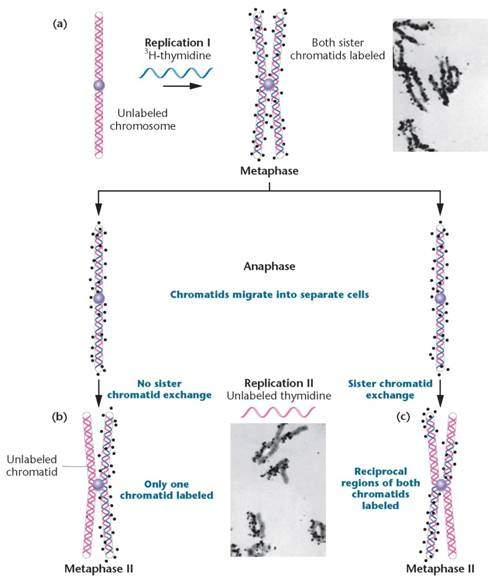
FIGURE The Taylor-Woods-Hughes experiment, demonstrating the semiconservative mode of replication of DNA in root tips of Vicia faba. (a) An unlabeled chromosome proceeds through the cell cycle in the presence of 3 H-thymidine. As it enters mitosis, both sister chromatids of the chromosome are labeled, as shown, by autoradiography. After a second round of replication (b), this time in the absence of 3 H-thymidine, only one chromatid of each chromosome is expected to be surrounded by grains. Except where a reciprocal exchange has occurred between sister chromatids (c), the expectation was upheld. the micrographs are of the actual autoradiograms obtained in the experiment.
FIGURE The Taylor-Woods-Hughes experiment, demonstrating the semiconservative mode of replication of DNA in root tips of Vicia faba. (a) An unlabeled chromosome proceeds through the cell cycle in the presence of 3 H-thymidine. As it enters mitosis, both sister chromatids of the chromosome are labeled, as shown, by autoradiography. After a second round of replication (b), this time in the absence of 3 H-thymidine, only one chromatid of each chromosome is expected to be surrounded by grains. Except where a reciprocal exchange has occurred between sister chromatids (c), the expectation was upheld. the micrographs are of the actual autoradiograms obtained in the experiment.
Question
Question
Question
Assume that the sequence of bases given in this problem is present on one nucleotide chain of a DNA duplex and that the chain has opened up at a replication fork. Synthesis of an RNA primer occurs on this template starting at the base that is underlined.
(a) If the RNA primer consists of eight nucleotides, what is its base sequence?
(b) In the intact RNA primer, which nucleotide has a free 3'-OH terminus?

(a) If the RNA primer consists of eight nucleotides, what is its base sequence?
(b) In the intact RNA primer, which nucleotide has a free 3'-OH terminus?
Question
Question
Question
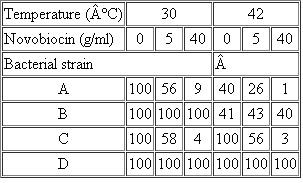
The following table (data adapted from Khodursky et al., 2000) presents the percentage of DNA synthesis after 15 minutes from initiation for four strains of Escherichia coli grown under permissive (30°C) and restrictive (42°C) temperatures and various concentrations of the gyrase inhibitor novobiocin. The strains have the following characteristics and genotypes: wild type, temperature-sensitive gyrase mutation ( gyr ts ), novobiocin resistant ( gyr r ), and the double mutant ( gyr ts , r ). Based on data contained in the table, assign the appropriate genotypes to the strains labeled A, B, C, and D.
Question
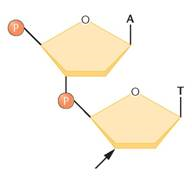
Consider the drawing of a dinucleotide below.
(a) Is it DNA or RNA?
(b) Is the arrow closest to the 5? or the 3? end?
(c) Suppose that the molecule was cleaved with the enzyme spleen diesterase, which breaks the covalent bond connecting the phosphate to C-5?. After cleavage, to which nucleoside is the phosphate now attached (A or T)?
(a) Is it DNA or RNA?
(b) Is the arrow closest to the 5? or the 3? end?
(c) Suppose that the molecule was cleaved with the enzyme spleen diesterase, which breaks the covalent bond connecting the phosphate to C-5?. After cleavage, to which nucleoside is the phosphate now attached (A or T)?
Question
To gauge the fidelity of DNA synthesis, Arthur Kornberg and colleagues devised a technique called nearest-neighbor analysis, which determines the frequency with which any two bases occur adjacent to each other along the polynucleotide chain ( J. Biol. Chem. 236: 864-875). This test relies on the enzyme spleen phosphodiesterase (see the problem). As we saw in Figure, DNA is synthesized by polymerization of 5?-nucleotides-that is, each nucleotide is added with the phosphate on the C-5? of deoxyribose. However, as shown in the accompanying figure, the phosphodiesterase enzyme cleaves DNA between the phosphate and the C-5? atom, thereby producing 3?-nucleotides. In this test, the phosphates on only one of the four nucleotide precursors of DNA (cytidylic acid, for example) are made radioactive with 32 P, and DNA is synthesized. Then the DNA is subjected to enzymatic cleavage, in which the radioactive phosphate is transferred to the base that is the "nearest neighbor" on the 5? side of all cytidylic acid nucleotides.
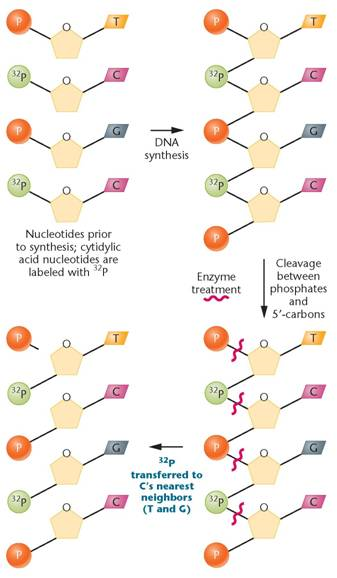
Following four separate experiments, in each of which a different one of the four nucleotide types is radioactive, the frequency of all 16 possible nearest neighbors can be calculated. When Kornberg applied the nearest-neighbor frequency test to the DNA template and resultant product from a variety of experiments, he found general agreement between the nearest-neighbor frequencies of the two.
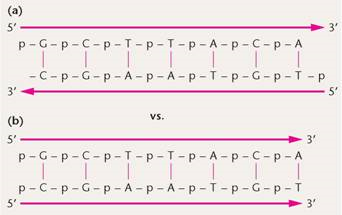
Analysis of nearest-neighbor data led Kornberg to conclude that the two strands of the double helix are in opposite polarity to one another. Demonstrate this approach by determining the outcome of such an analysis if the strands of DNA shown here are (a) antiparallel versus (b) parallel:
Problem
Consider the drawing of a dinucleotide below.
(a) Is it DNA or RNA?
(b) Is the arrow closest to the 5? or the 3? end?
(c) Suppose that the molecule was cleaved with the enzyme spleen diesterase, which breaks the covalent bond connecting the phosphate to C-5?. After cleavage, to which nucleoside is the phosphate now attached (A or T)?
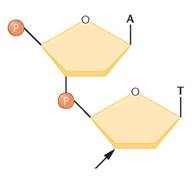
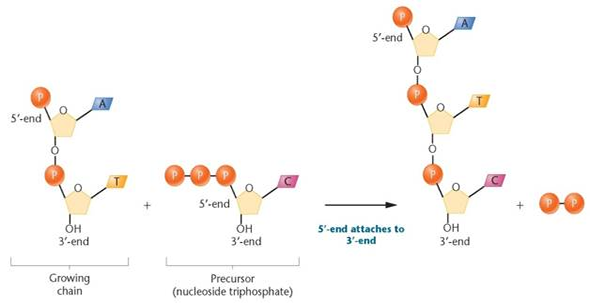
FIGURE Demonstration of 5? to 3? synthesis of DNA.
Following four separate experiments, in each of which a different one of the four nucleotide types is radioactive, the frequency of all 16 possible nearest neighbors can be calculated. When Kornberg applied the nearest-neighbor frequency test to the DNA template and resultant product from a variety of experiments, he found general agreement between the nearest-neighbor frequencies of the two.
Analysis of nearest-neighbor data led Kornberg to conclude that the two strands of the double helix are in opposite polarity to one another. Demonstrate this approach by determining the outcome of such an analysis if the strands of DNA shown here are (a) antiparallel versus (b) parallel:
Problem
Consider the drawing of a dinucleotide below.
(a) Is it DNA or RNA?
(b) Is the arrow closest to the 5? or the 3? end?
(c) Suppose that the molecule was cleaved with the enzyme spleen diesterase, which breaks the covalent bond connecting the phosphate to C-5?. After cleavage, to which nucleoside is the phosphate now attached (A or T)?
FIGURE Demonstration of 5? to 3? synthesis of DNA.
Question

Unlock Deck
Sign up to unlock the cards in this deck!
Unlock Deck
Unlock Deck
1/39

Play

Full screen (f)
Deck 11: DNA Replication and Recombination
1
A researcher was asked if his work on the genetic control of human telomere replication was related to any genetic disorders. He replied that one might think that any mutations involving replication would be lethal during early development, and thus unavailable for study. But, in fact, a rare human genetic disorder affecting telomeres is known. This disorder, dyskeratosis congenita (DKC), is associated with mutations in the protein subunits of telomerase, the enzyme responsible for replicating the ends of eukaryotic chromosomes. Initial symptoms appear in tissues derived from rapidly dividing cells, including the skin, nails, and bone marrow, and first affect children between the ages of 5 and 15 years.
This disorder raises several interesting questions.
How could such individuals survive?
This disorder raises several interesting questions.
How could such individuals survive?
Individuals with the dyskeratosis congenital (DKC) disorder can survive childhood because the telomeres at the end of the chromosomes are composed of tandem repeats. These repeats act as a buffer protecting the gene coding regions of the genome from being degraded. When the patients are young their cells are replicating and removing pieces of the telomeres instead of important regions of the deoxyribonucleic acid (DNA). Therefore, no important genes are degraded yet even without the activity of telomerase.
2
In this chapter, we focused on how DNA is replicated and synthesized. We also discussed recombination at the DNA level and the phenomenon of gene conversion. Along the way, we encountered many opportunities to consider how this information was acquired. On the basis of these discussions, what answers would you propose to the following fundamental questions?
(a) What is the experimental basis for concluding that DNA replicates semiconservatively in both prokaryotes and eukaryotes?
(b) How was it demonstrated that DNA synthesis occurs under the direction of DNA polymerase III and not polymerase I?
(c) How do we know that in vivo DNA synthesis occurs in the 5? to 3? direction?
(d) How do we know that DNA synthesis is discontinuous on one of the two template strands?
(e) What observations reveal that a "telomere problem" exists during eukaryotic DNA replication, and how did we learn of the solution to this problem?
(a) What is the experimental basis for concluding that DNA replicates semiconservatively in both prokaryotes and eukaryotes?
(b) How was it demonstrated that DNA synthesis occurs under the direction of DNA polymerase III and not polymerase I?
(c) How do we know that in vivo DNA synthesis occurs in the 5? to 3? direction?
(d) How do we know that DNA synthesis is discontinuous on one of the two template strands?
(e) What observations reveal that a "telomere problem" exists during eukaryotic DNA replication, and how did we learn of the solution to this problem?
a)
E. coli was used using density labeling to determine that bacteria replicate DNA using a semiconservative nature. Vieia faba was a key organism in using radioisotope labeling to help identify the eukaryotic nature of DNA replication. In both cases of DNA replication, the daughter double helix strands produced after a replication event contain one new strand and one old strand.
b)
▪mutant version of DNA polymerase I was able polymerase DNA. Although a wild type DNA polymerase I was not able to synthesize new DNA, this fact was used to conclude that there was another enzyme capable of polymerizing DNA, which turned out to be polymerase III.
c)
Kornberg discovered that DNA polymerase III could only add nucleotides to the 3' end of a nucleotide chain in laboratory conditions, or in vitro. It is the two phosphates of the incoming nucleotide that provide the energy for DNA polymerase to work. It turned out that polymerase III works exactly the same in a biological system, or in vivo.
d)
Evidence for a discontinuous strand in double helix DNA replication comes from E. coli. A strain of E. coli that had a defected ligase enzyme would build up fragments of short nucleotides. More evidence came from the fact that newly formed DNA fragments are hydrogen bonded to the template strand, giving other enzymes time to bind their fragmented backbones.
e)
Since, DNA has terminal ends (it is not circular), and DNA polymerase III cannot spontaneously start replication without a free 3' hydroxyl group end, the problem of DNA shortening came about. But the discovery of the telomerase enzyme and the discovery of many terminal repeats at the end of chromosomes seemed to solve the problem of chromosomal fraying and shortening because telomerase could add more telomere repeats to the end of chromosomes.
E. coli was used using density labeling to determine that bacteria replicate DNA using a semiconservative nature. Vieia faba was a key organism in using radioisotope labeling to help identify the eukaryotic nature of DNA replication. In both cases of DNA replication, the daughter double helix strands produced after a replication event contain one new strand and one old strand.
b)
▪mutant version of DNA polymerase I was able polymerase DNA. Although a wild type DNA polymerase I was not able to synthesize new DNA, this fact was used to conclude that there was another enzyme capable of polymerizing DNA, which turned out to be polymerase III.
c)
Kornberg discovered that DNA polymerase III could only add nucleotides to the 3' end of a nucleotide chain in laboratory conditions, or in vitro. It is the two phosphates of the incoming nucleotide that provide the energy for DNA polymerase to work. It turned out that polymerase III works exactly the same in a biological system, or in vivo.
d)
Evidence for a discontinuous strand in double helix DNA replication comes from E. coli. A strain of E. coli that had a defected ligase enzyme would build up fragments of short nucleotides. More evidence came from the fact that newly formed DNA fragments are hydrogen bonded to the template strand, giving other enzymes time to bind their fragmented backbones.
e)
Since, DNA has terminal ends (it is not circular), and DNA polymerase III cannot spontaneously start replication without a free 3' hydroxyl group end, the problem of DNA shortening came about. But the discovery of the telomerase enzyme and the discovery of many terminal repeats at the end of chromosomes seemed to solve the problem of chromosomal fraying and shortening because telomerase could add more telomere repeats to the end of chromosomes.
3
A researcher was asked if his work on the genetic control of human telomere replication was related to any genetic disorders. He replied that one might think that any mutations involving replication would be lethal during early development, and thus unavailable for study. But, in fact, a rare human genetic disorder affecting telomeres is known. This disorder, dyskeratosis congenita (DKC), is associated with mutations in the protein subunits of telomerase, the enzyme responsible for replicating the ends of eukaryotic chromosomes. Initial symptoms appear in tissues derived from rapidly dividing cells, including the skin, nails, and bone marrow, and first affect children between the ages of 5 and 15 years.
This disorder raises several interesting questions.
Why are the tissues derived from rapidly dividing cells initially affected?
This disorder raises several interesting questions.
Why are the tissues derived from rapidly dividing cells initially affected?
Rapidly dividing cells are usually the first cells to show symptoms of dyskeratosis congenita (DKC) because the telomeres at the ends of the chromosomes have been removed.
After each replication event the tandem repeats at the end of the chromosomes, that is the telomeres, gets cut off little by little. Without the telomerase function segments of deoxyribonucleic acid (DNA) will continue to be cut off the ends. After the telomeres are removed the gene coding sequences will start to be removed as well.
Therefore, the cells that have more replication cycles cut off more of their DNA and irreversibly destroy the gene coding sequences necessary for the viability of the cell after the telomeres have been removed. These cells would then be affected first compared to cells with slower replication rates.
After each replication event the tandem repeats at the end of the chromosomes, that is the telomeres, gets cut off little by little. Without the telomerase function segments of deoxyribonucleic acid (DNA) will continue to be cut off the ends. After the telomeres are removed the gene coding sequences will start to be removed as well.
Therefore, the cells that have more replication cycles cut off more of their DNA and irreversibly destroy the gene coding sequences necessary for the viability of the cell after the telomeres have been removed. These cells would then be affected first compared to cells with slower replication rates.
4
Review the Chapter Concepts list. These are concerned with the replication and synthesis of DNA. Write a short essay that distinguishes between the terms replication and synthesis, as applied to DNA. Which of the two is most closely allied with the field of biochemistry?
▪Genetic continuity between parental and progeny cells is maintained by semiconservative replication of DNA, as predicted by the Watson-Crick model.
▪Semiconservative replication uses each strand of the parent double helix as a template, and each newly replicated double helix includes one "old" and one "new" strand of DNA.
▪DNA synthesis is a complex but orderly process, occurring under the direction of a myriad of enzymes and other proteins.
▪DNA synthesis involves the polymerization of nucleotides into polynucleotide chains.
▪DNA synthesis is similar in prokaryotes and eukaryotes, but more complex in eukaryotes.
▪In eukaryotes, DNA synthesis at the ends of chromosomes (telomeres) poses a special problem, overcome by a unique RNA-containing enzyme, telomerase.
▪Genetic recombination, an important process leading to the exchange of segments between DNA molecules, occurs under the direction of a group of enzymes.
▪Genetic continuity between parental and progeny cells is maintained by semiconservative replication of DNA, as predicted by the Watson-Crick model.
▪Semiconservative replication uses each strand of the parent double helix as a template, and each newly replicated double helix includes one "old" and one "new" strand of DNA.
▪DNA synthesis is a complex but orderly process, occurring under the direction of a myriad of enzymes and other proteins.
▪DNA synthesis involves the polymerization of nucleotides into polynucleotide chains.
▪DNA synthesis is similar in prokaryotes and eukaryotes, but more complex in eukaryotes.
▪In eukaryotes, DNA synthesis at the ends of chromosomes (telomeres) poses a special problem, overcome by a unique RNA-containing enzyme, telomerase.
▪Genetic recombination, an important process leading to the exchange of segments between DNA molecules, occurs under the direction of a group of enzymes.
Unlock Deck
Unlock for access to all 39 flashcards in this deck.
Unlock Deck
k this deck
5
A researcher was asked if his work on the genetic control of human telomere replication was related to any genetic disorders. He replied that one might think that any mutations involving replication would be lethal during early development, and thus unavailable for study. But, in fact, a rare human genetic disorder affecting telomeres is known. This disorder, dyskeratosis congenita (DKC), is associated with mutations in the protein subunits of telomerase, the enzyme responsible for replicating the ends of eukaryotic chromosomes. Initial symptoms appear in tissues derived from rapidly dividing cells, including the skin, nails, and bone marrow, and first affect children between the ages of 5 and 15 years.
This disorder raises several interesting questions.
Is this disorder likely to impact the life span?
This disorder raises several interesting questions.
Is this disorder likely to impact the life span?
Unlock Deck
Unlock for access to all 39 flashcards in this deck.
Unlock Deck
k this deck
6
Compare conservative, semiconservative, and dispersive modes of DNA replication.
Unlock Deck
Unlock for access to all 39 flashcards in this deck.
Unlock Deck
k this deck
7
A researcher was asked if his work on the genetic control of human telomere replication was related to any genetic disorders. He replied that one might think that any mutations involving replication would be lethal during early development, and thus unavailable for study. But, in fact, a rare human genetic disorder affecting telomeres is known. This disorder, dyskeratosis congenita (DKC), is associated with mutations in the protein subunits of telomerase, the enzyme responsible for replicating the ends of eukaryotic chromosomes. Initial symptoms appear in tissues derived from rapidly dividing cells, including the skin, nails, and bone marrow, and first affect children between the ages of 5 and 15 years.
This disorder raises several interesting questions.
Would you predict that mutations in the RNA component of telomerase might also cause DKC?
This disorder raises several interesting questions.
Would you predict that mutations in the RNA component of telomerase might also cause DKC?
Unlock Deck
Unlock for access to all 39 flashcards in this deck.
Unlock Deck
k this deck
8
Describe the role of 15 N in the Meselson-Stahl experiment.
Unlock Deck
Unlock for access to all 39 flashcards in this deck.
Unlock Deck
k this deck
9
Predict the results of the experiment by Taylor, Woods, and Hughes if replication were (a) conservative and (b) dispersive.
Unlock Deck
Unlock for access to all 39 flashcards in this deck.
Unlock Deck
k this deck
10
What are the requirements for in vitro synthesis of DNA under the direction of DNA polymerase I?
Unlock Deck
Unlock for access to all 39 flashcards in this deck.
Unlock Deck
k this deck
11
In Kornberg's initial experiments, it was rumored that he grew E. coli in Anheuser-Busch beer vats. (Kornberg was working at Washington University in St. Louis.) Why do you think this might have been helpful to the experiment?
Unlock Deck
Unlock for access to all 39 flashcards in this deck.
Unlock Deck
k this deck
12
How did Kornberg assess the fidelity of DNA polymerase I in copying a DNA template?
Unlock Deck
Unlock for access to all 39 flashcards in this deck.
Unlock Deck
k this deck
13
Which characteristics of DNA polymerase I raised doubts that its in vivo function is the synthesis of DNA leading to complete replication?
Unlock Deck
Unlock for access to all 39 flashcards in this deck.
Unlock Deck
k this deck
14
Kornberg showed that nucleotides are added to the 3? end of each growing DNA strand. In what way does an exposed 3?-OH group participate in strand elongation?
Unlock Deck
Unlock for access to all 39 flashcards in this deck.
Unlock Deck
k this deck
15
What was the significance of the polA 1 mutation?
Unlock Deck
Unlock for access to all 39 flashcards in this deck.
Unlock Deck
k this deck
16
Summarize and compare the properties of DNA polymerase I, II, and III.
Unlock Deck
Unlock for access to all 39 flashcards in this deck.
Unlock Deck
k this deck
17
List and describe the function of the ten subunits constituting DNA polymerase III. Distinguish between the holoenzyme and the core enzyme.
Unlock Deck
Unlock for access to all 39 flashcards in this deck.
Unlock Deck
k this deck
18
Distinguish between (a) unidirectional and bidirectional synthesis, and (b) continuous and discontinuous synthesis of DNA.
Unlock Deck
Unlock for access to all 39 flashcards in this deck.
Unlock Deck
k this deck
19
List the proteins that unwind DNA during in vivo DNA synthesis. How do they function?
Unlock Deck
Unlock for access to all 39 flashcards in this deck.
Unlock Deck
k this deck
20
Define and indicate the significance of (a) Okazaki fragments, (b) DNA ligase, and (c) primer RNA during DNA replication.
Unlock Deck
Unlock for access to all 39 flashcards in this deck.
Unlock Deck
k this deck
21
Outline the current model for DNA synthesis.
Unlock Deck
Unlock for access to all 39 flashcards in this deck.
Unlock Deck
k this deck
22
Why is DNA synthesis expected to be more complex in eukaryotes than in bacteria? How is DNA synthesis similar in the two types of organisms?
Unlock Deck
Unlock for access to all 39 flashcards in this deck.
Unlock Deck
k this deck
23
Suppose that E. coli synthesizes DNA at a rate of 100,000 nucleotides per minute and takes 40 minutes to replicate its chromosome.
(a) How many base pairs are present in the entire E. coli chromosome?
(b) What is the physical length of the chromosome in its helical configuration-that is, what is the circumference of the chromosome if it were opened into a circle?
(a) How many base pairs are present in the entire E. coli chromosome?
(b) What is the physical length of the chromosome in its helical configuration-that is, what is the circumference of the chromosome if it were opened into a circle?
Unlock Deck
Unlock for access to all 39 flashcards in this deck.
Unlock Deck
k this deck
24
Several temperature-sensitive mutant strains of E. coli display the following characteristics. Predict what enzyme or function is being affected by each mutation.
(a) Newly synthesized DNA contains many mismatched base pairs.
(b) Okazaki fragments accumulate, and DNA synthesis is never completed.
(c) No initiation occurs.
(d) Synthesis is very slow.
(e) Supercoiled strands remain after replication, which is never completed.
(a) Newly synthesized DNA contains many mismatched base pairs.
(b) Okazaki fragments accumulate, and DNA synthesis is never completed.
(c) No initiation occurs.
(d) Synthesis is very slow.
(e) Supercoiled strands remain after replication, which is never completed.
Unlock Deck
Unlock for access to all 39 flashcards in this deck.
Unlock Deck
k this deck
25
While many commonly used antibiotics interfere with protein synthesis or cell wall formation, clorobiocin, one of several antibiotics in the aminocoumarin class, inhibits the activity of bacterial DNA gyrase. Similar drugs have been tested as treatments for human cancer. How might such drugs be effective against bacteria as well as cancer?
Unlock Deck
Unlock for access to all 39 flashcards in this deck.
Unlock Deck
k this deck
26
Define gene conversion, and describe how this phenomenon is related to genetic recombination.
Unlock Deck
Unlock for access to all 39 flashcards in this deck.
Unlock Deck
k this deck
27
Many of the gene products involved in DNA synthesis were initially defined by studying mutant E. coli strains that could not synthesize DNA.
(a) The dnaE gene encodes the a subunit of DNA polymerase III. What effect is expected from a mutation in this gene? How could the mutant strain be maintained?
(b) The dnaQ gene encodes the e subunit of DNA polymerase. What effect is expected from a mutation in this gene?
(a) The dnaE gene encodes the a subunit of DNA polymerase III. What effect is expected from a mutation in this gene? How could the mutant strain be maintained?
(b) The dnaQ gene encodes the e subunit of DNA polymerase. What effect is expected from a mutation in this gene?
Unlock Deck
Unlock for access to all 39 flashcards in this deck.
Unlock Deck
k this deck
28
In 1994, telomerase activity was discovered in human cancer cell lines. Although telomerase is not active in human somatic tissue, this discovery indicated that humans do contain the genes for telomerase proteins and telomerase RNA. Since inappropriate activation of telomerase may contribute to cancer, why do you think the genes coding for this enzyme have been maintained in the human genome throughout evolution? Are there any types of human body cells where telomerase activation would be advantageous or even necessary? Explain.
Unlock Deck
Unlock for access to all 39 flashcards in this deck.
Unlock Deck
k this deck
29
The genome of D. melanogaster consists of approximately 1.7 × 10 8 base pairs. DNA synthesis occurs at a rate of 30 base pairs per second. In the early embryo, the entire genome is replicated in five minutes. How many bidirectional origins of synthesis are required to accomplish this feat?
Unlock Deck
Unlock for access to all 39 flashcards in this deck.
Unlock Deck
k this deck
30
Assume a hypothetical organism in which DNA replication is conservative. Design an experiment similar to that of Taylor, Woods, and Hughes that will unequivocally establish this fact. Using the format established in Figure, draw sister chromatids and illustrate the expected results establishing this mode of replication.
FIGURE The Taylor-Woods-Hughes experiment, demonstrating the semiconservative mode of replication of DNA in root tips of Vicia faba. (a) An unlabeled chromosome proceeds through the cell cycle in the presence of 3 H-thymidine. As it enters mitosis, both sister chromatids of the chromosome are labeled, as shown, by autoradiography. After a second round of replication (b), this time in the absence of 3 H-thymidine, only one chromatid of each chromosome is expected to be surrounded by grains. Except where a reciprocal exchange has occurred between sister chromatids (c), the expectation was upheld. the micrographs are of the actual autoradiograms obtained in the experiment.
FIGURE The Taylor-Woods-Hughes experiment, demonstrating the semiconservative mode of replication of DNA in root tips of Vicia faba. (a) An unlabeled chromosome proceeds through the cell cycle in the presence of 3 H-thymidine. As it enters mitosis, both sister chromatids of the chromosome are labeled, as shown, by autoradiography. After a second round of replication (b), this time in the absence of 3 H-thymidine, only one chromatid of each chromosome is expected to be surrounded by grains. Except where a reciprocal exchange has occurred between sister chromatids (c), the expectation was upheld. the micrographs are of the actual autoradiograms obtained in the experiment.
Unlock Deck
Unlock for access to all 39 flashcards in this deck.
Unlock Deck
k this deck
31
DNA polymerases in all organisms add only 5? nucleotides to the 3? end of a growing DNA strand, never to the 5? end. One possible reason for this is the fact that most DNA polymerases have a proofreading function that would not be energetically possible if DNA synthesis occurred in the 3? to 5? direction.
(a) Sketch the reaction that DNA polymerase would have to catalyze if DNA synthesis occurred in the 3? to 5? direction.
(b) Consider the information in your sketch and speculate as to why proofreading would be problematic.
(a) Sketch the reaction that DNA polymerase would have to catalyze if DNA synthesis occurred in the 3? to 5? direction.
(b) Consider the information in your sketch and speculate as to why proofreading would be problematic.
Unlock Deck
Unlock for access to all 39 flashcards in this deck.
Unlock Deck
k this deck
32
An alien organism was investigated that demonstrated the "telomere problem" during DNA synthesis, but on only one end of each chromosome. Create a model of DNA that is compatible with this observation. Is this organism a prokaryote or eukaryote?
Unlock Deck
Unlock for access to all 39 flashcards in this deck.
Unlock Deck
k this deck
33
Assume that the sequence of bases given in this problem is present on one nucleotide chain of a DNA duplex and that the chain has opened up at a replication fork. Synthesis of an RNA primer occurs on this template starting at the base that is underlined.
(a) If the RNA primer consists of eight nucleotides, what is its base sequence?
(b) In the intact RNA primer, which nucleotide has a free 3'-OH terminus?
(a) If the RNA primer consists of eight nucleotides, what is its base sequence?
(b) In the intact RNA primer, which nucleotide has a free 3'-OH terminus?
Unlock Deck
Unlock for access to all 39 flashcards in this deck.
Unlock Deck
k this deck
34
Prokaryotic Okazaki fragments are in the range of 1200 nucleotides, while eukaryotic fragments are much shorter, more in the range of 100-150 nucleotides. Balakrishnan and Bambara (2013) suggest that the shorter length of Okazaki fragments is determined by nucleosome periodicity. Design an experiment to determine whether or not the length of Okazaki fragments in eukaryotes is dependent on nucleosomes being present on DNA during replication.
Unlock Deck
Unlock for access to all 39 flashcards in this deck.
Unlock Deck
k this deck
35
Reiji and Tuneko Okazaki conducted a now classic experiment in 1968 in which they discovered a population of short fragments synthesized during DNA replication. They introduced a short pulse of 3 H-thymidine into a culture of E. coli and extracted DNA from the cells at various intervals. In analyzing the DNA after centrifugation in denaturing gradients, they noticed that as the interval between the time of 3 H-thymidine introduction and the time of centrifugation increased, the proportion of short strands decreased and more labeled DNA was found in larger strands. What would account for this observation?
Unlock Deck
Unlock for access to all 39 flashcards in this deck.
Unlock Deck
k this deck
36
The following table (data adapted from Khodursky et al., 2000) presents the percentage of DNA synthesis after 15 minutes from initiation for four strains of Escherichia coli grown under permissive (30°C) and restrictive (42°C) temperatures and various concentrations of the gyrase inhibitor novobiocin. The strains have the following characteristics and genotypes: wild type, temperature-sensitive gyrase mutation ( gyr ts ), novobiocin resistant ( gyr r ), and the double mutant ( gyr ts , r ). Based on data contained in the table, assign the appropriate genotypes to the strains labeled A, B, C, and D.
Unlock Deck
Unlock for access to all 39 flashcards in this deck.
Unlock Deck
k this deck
37
Consider the drawing of a dinucleotide below.
(a) Is it DNA or RNA?
(b) Is the arrow closest to the 5? or the 3? end?
(c) Suppose that the molecule was cleaved with the enzyme spleen diesterase, which breaks the covalent bond connecting the phosphate to C-5?. After cleavage, to which nucleoside is the phosphate now attached (A or T)?
(a) Is it DNA or RNA?
(b) Is the arrow closest to the 5? or the 3? end?
(c) Suppose that the molecule was cleaved with the enzyme spleen diesterase, which breaks the covalent bond connecting the phosphate to C-5?. After cleavage, to which nucleoside is the phosphate now attached (A or T)?
Unlock Deck
Unlock for access to all 39 flashcards in this deck.
Unlock Deck
k this deck
38
To gauge the fidelity of DNA synthesis, Arthur Kornberg and colleagues devised a technique called nearest-neighbor analysis, which determines the frequency with which any two bases occur adjacent to each other along the polynucleotide chain ( J. Biol. Chem. 236: 864-875). This test relies on the enzyme spleen phosphodiesterase (see the problem). As we saw in Figure, DNA is synthesized by polymerization of 5?-nucleotides-that is, each nucleotide is added with the phosphate on the C-5? of deoxyribose. However, as shown in the accompanying figure, the phosphodiesterase enzyme cleaves DNA between the phosphate and the C-5? atom, thereby producing 3?-nucleotides. In this test, the phosphates on only one of the four nucleotide precursors of DNA (cytidylic acid, for example) are made radioactive with 32 P, and DNA is synthesized. Then the DNA is subjected to enzymatic cleavage, in which the radioactive phosphate is transferred to the base that is the "nearest neighbor" on the 5? side of all cytidylic acid nucleotides.
Following four separate experiments, in each of which a different one of the four nucleotide types is radioactive, the frequency of all 16 possible nearest neighbors can be calculated. When Kornberg applied the nearest-neighbor frequency test to the DNA template and resultant product from a variety of experiments, he found general agreement between the nearest-neighbor frequencies of the two.
Analysis of nearest-neighbor data led Kornberg to conclude that the two strands of the double helix are in opposite polarity to one another. Demonstrate this approach by determining the outcome of such an analysis if the strands of DNA shown here are (a) antiparallel versus (b) parallel:
Problem
Consider the drawing of a dinucleotide below.
(a) Is it DNA or RNA?
(b) Is the arrow closest to the 5? or the 3? end?
(c) Suppose that the molecule was cleaved with the enzyme spleen diesterase, which breaks the covalent bond connecting the phosphate to C-5?. After cleavage, to which nucleoside is the phosphate now attached (A or T)?
FIGURE Demonstration of 5? to 3? synthesis of DNA.
Following four separate experiments, in each of which a different one of the four nucleotide types is radioactive, the frequency of all 16 possible nearest neighbors can be calculated. When Kornberg applied the nearest-neighbor frequency test to the DNA template and resultant product from a variety of experiments, he found general agreement between the nearest-neighbor frequencies of the two.
Analysis of nearest-neighbor data led Kornberg to conclude that the two strands of the double helix are in opposite polarity to one another. Demonstrate this approach by determining the outcome of such an analysis if the strands of DNA shown here are (a) antiparallel versus (b) parallel:
Problem
Consider the drawing of a dinucleotide below.
(a) Is it DNA or RNA?
(b) Is the arrow closest to the 5? or the 3? end?
(c) Suppose that the molecule was cleaved with the enzyme spleen diesterase, which breaks the covalent bond connecting the phosphate to C-5?. After cleavage, to which nucleoside is the phosphate now attached (A or T)?
FIGURE Demonstration of 5? to 3? synthesis of DNA.
Unlock Deck
Unlock for access to all 39 flashcards in this deck.
Unlock Deck
k this deck
39
Reconsider Problem. In the model you proposed, could the molecule be replicated semiconservatively? Why? Would other modes of replication work?
Newsdate: March 1, 2030. A unique creature has been discovered during exploration of outer space. Recently, its genetic material has been isolated and analyzed. This material is similar in some ways to DNA in its chemical makeup. It contains in abundance the 4-carbon sugar erythrose and a molar equivalent of phosphate groups. In addition, it contains six nitrogenous bases: adenine (A), guanine (G), thymine (T), cytosine (C), hypoxanthine (H), and xanthine (X). These bases exist in the following relative proportions:
▪= T = H and C = G = X
X-ray diffraction studies have established a regularity in the molecule and a constant diameter of about 30 Å. Together, these data have suggested a model for the structure of this molecule.
(a) Propose a general model of this molecule. Describe it briefly.
(b) What base-pairing properties must exist for H and for X in the model?
(c) Given the constant diameter of 30 Å, do you think that either (i) both H and X are purines or both pyrimidines, or (ii) one is a purine and one is a pyrimidine?
Newsdate: March 1, 2030. A unique creature has been discovered during exploration of outer space. Recently, its genetic material has been isolated and analyzed. This material is similar in some ways to DNA in its chemical makeup. It contains in abundance the 4-carbon sugar erythrose and a molar equivalent of phosphate groups. In addition, it contains six nitrogenous bases: adenine (A), guanine (G), thymine (T), cytosine (C), hypoxanthine (H), and xanthine (X). These bases exist in the following relative proportions:
▪= T = H and C = G = X
X-ray diffraction studies have established a regularity in the molecule and a constant diameter of about 30 Å. Together, these data have suggested a model for the structure of this molecule.
(a) Propose a general model of this molecule. Describe it briefly.
(b) What base-pairing properties must exist for H and for X in the model?
(c) Given the constant diameter of 30 Å, do you think that either (i) both H and X are purines or both pyrimidines, or (ii) one is a purine and one is a pyrimidine?
Unlock Deck
Unlock for access to all 39 flashcards in this deck.
Unlock Deck
k this deck
Unlock Deck
Unlock for access to all 39 flashcards in this deck.







