





 Chat with AI

Deck 14: Translation and Proteins
Full screen (f)

Question

Question
In this chapter, we focused on the translation of mRNA into proteins as well as on protein structure and function. Along the way, we found many opportunities to consider the methods and reasoning by which much of this information was acquired. From the explanations given in the chapter, what answers would you propose to the following fundamental questions:
(a) What experimentally derived information led to Holley's proposal of the two-dimensional cloverleaf model of tRNA?
(b) What experimental information verifies that certain codons in mRNA specify chain termination during translation?
(c) How do we know, based on studies of Neurospora nutritional mutations, that one gene specifies one enzyme?
(d) On what basis have we concluded that proteins are the end products of genetic expression?
(e) What experimental information directly confirms that the genetic code, as shown in Figure, is correct?
(f) How do we know that the structure of a protein is intimately related to the function of that protein?
Figure
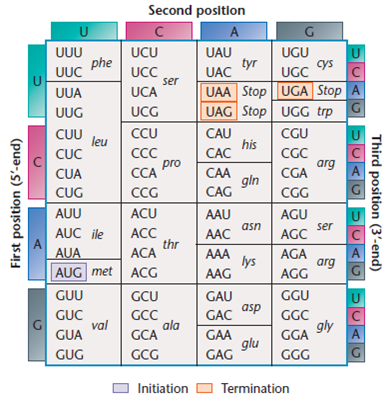
The coding dictionary. AUG encodes methionine, which initiates most polypeptide chains. All other amino acids except tryptophan, which is encoded only by UGG, are represented by two to six triplets. The triplets UAA, UAG, and UGA are termination signals and do not encode any amino acids.
(a) What experimentally derived information led to Holley's proposal of the two-dimensional cloverleaf model of tRNA?
(b) What experimental information verifies that certain codons in mRNA specify chain termination during translation?
(c) How do we know, based on studies of Neurospora nutritional mutations, that one gene specifies one enzyme?
(d) On what basis have we concluded that proteins are the end products of genetic expression?
(e) What experimental information directly confirms that the genetic code, as shown in Figure, is correct?
(f) How do we know that the structure of a protein is intimately related to the function of that protein?
Figure
The coding dictionary. AUG encodes methionine, which initiates most polypeptide chains. All other amino acids except tryptophan, which is encoded only by UGG, are represented by two to six triplets. The triplets UAA, UAG, and UGA are termination signals and do not encode any amino acids.
Question
Question
Question
Question
Question
Question
Question
Question
Question
Question
Question
Question
Question
Question
Question
Question
Question
The study of biochemical mutants in organisms such as Neurospora has demonstrated that some pathways are branched. The data shown here illustrate the branched nature of the pathway resulting in the synthesis of thiamine:
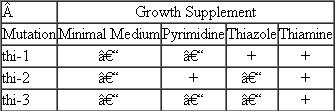 Why don't the data support a linear pathway? Can you postulate a pathway for the synthesis of thiamine in Neurospora ?
Why don't the data support a linear pathway? Can you postulate a pathway for the synthesis of thiamine in Neurospora ? Question
Question
Question
Question
Question
Question
Question
Question
Shown below are several amino acid substitutions in the ? and ? chains of human hemoglobin:
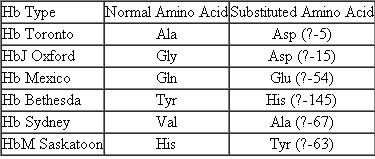 Using the code table (Figure), determine how many of them can occur as a result of a single-nucleotide change.
Figure
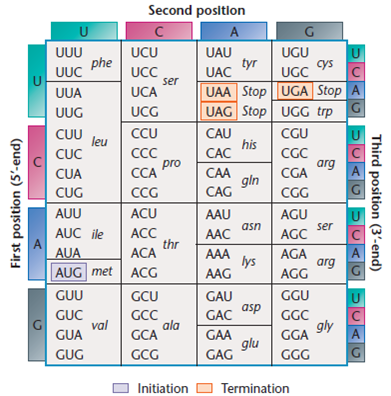
The coding dictionary. AUG encodes methionine, which initiates most polypeptide chains. All other amino acids except tryptophan, which is encoded only by UGG, are represented by two to six triplets. The triplets UAA, UAG, and UGA are termination signals and do not encode any amino acids.
Using the code table (Figure), determine how many of them can occur as a result of a single-nucleotide change.Figure
The coding dictionary. AUG encodes methionine, which initiates most polypeptide chains. All other amino acids except tryptophan, which is encoded only by UGG, are represented by two to six triplets. The triplets UAA, UAG, and UGA are termination signals and do not encode any amino acids.
Question
Question
Question
Question
Question
Question
Question
Question
Three independently assorting genes are known to control the following biochemical pathway that provides the basis for flower color in a hypothetical plant:

Three homozygous recessive mutations are also known, each of which interrupts a different one of these steps. Determine the phenotypic results in the F 1 and F 2 generations resulting from the P 1 crosses of true-breeding plants listed here:
(a) speckled (AABBCC) × yellow (AAbbCC)
(b) yellow (AAbbCC) × green (AABBcc)
(c) colorless (aaBBCC) × green (AABBcc)
Three homozygous recessive mutations are also known, each of which interrupts a different one of these steps. Determine the phenotypic results in the F 1 and F 2 generations resulting from the P 1 crosses of true-breeding plants listed here:
(a) speckled (AABBCC) × yellow (AAbbCC)
(b) yellow (AAbbCC) × green (AABBcc)
(c) colorless (aaBBCC) × green (AABBcc)
Question
Question
Deep in a previously unexplored South American rain forest, a species of plants was discovered with true-breeding varieties whose flowers were pink, rose, orange, or purple. A very astute plant geneticist made a single cross, carried to the F 2 generation, as shown:
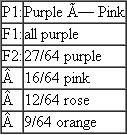 Based solely on these data, he was able to propose both a mode of inheritance for flower pigmentation and a biochemical pathway for the synthesis of these pigments.
Carefully study the data. Create a hypothesis of your own to explain the mode of inheritance. Then propose a biochemical pathway consistent with your hypothesis. How could you test the hypothesis by making other crosses?
Based solely on these data, he was able to propose both a mode of inheritance for flower pigmentation and a biochemical pathway for the synthesis of these pigments.Carefully study the data. Create a hypothesis of your own to explain the mode of inheritance. Then propose a biochemical pathway consistent with your hypothesis. How could you test the hypothesis by making other crosses?
Question
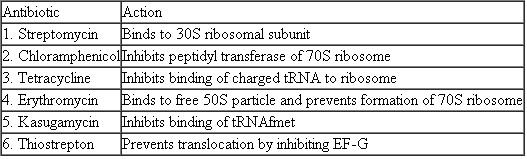
The emergence of antibiotic-resistant strains of Enterococci and transfer of resistant genes to other bacterial pathogens have highlighted the need for new generations of antibiotics to combat serious infections. To grasp the range of potential sites for the action of existing antibiotics, sketch the components of the translation machinery (e.g., see Step 3 of Figure), and using a series of numbered pointers, indicate the specific location for the action of the antibiotics shown in the following table.
 Figure
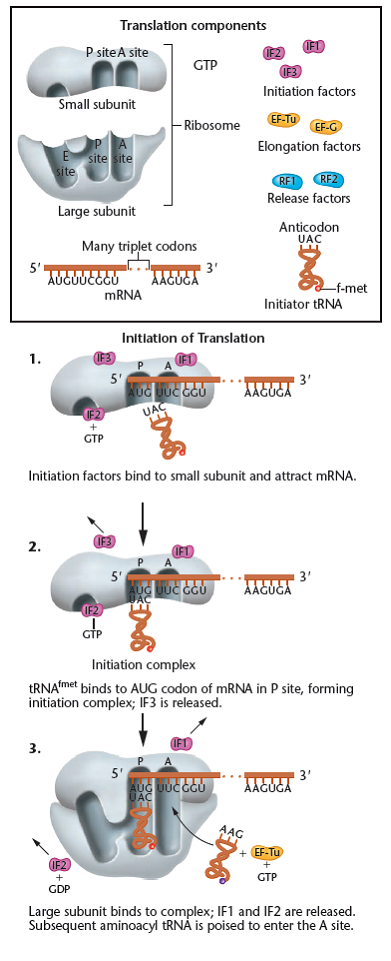
Initiation of translation. The separate components are depicted at the left of the figure.
Figure Initiation of translation. The separate components are depicted at the left of the figure.
Question
The development of antibiotic resistance by pathogenic bacteria represents a major health concern. One potential new antibiotic is evernimicin, which was isolated from Micromonospora carbonacea? Evernimicin is an oligosaccharide with antibiotic activity against a broad range of gram-positive pathogenic bacteria. To determine the mode of action of this drug, researchers have analyzed 23S ribosomal DNA mutants that showed reduced sensitivity to evernimicin (e.g., Adrian et al., 2000. Antimicrob. Ag. and Chemo. 44: 3101-3106). They discovered two classes of mutants that conferred resistance: In one class, the mutation occurs in 23 S rRNA nucleotides 2475-2483; in the other class, it occurs in ribosomal protein L16. This suggests that these two ribosomal components are structurally and functionally linked. It turns out that the tRNA anticodon stem-loop appears to bind to the A site of the ribosome at rRNA bases 2465-2485. This finding conforms to the proposed function of L16, which appears to be involved in attracting the aminoacyl stem of the tRNA to the ribosome at its A site. Using your sketch of the translation machinery from Problem 35 along with this information, designate where the proposed antibacterial action of evernimicin is likely to occur.
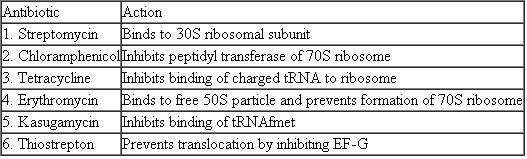
The emergence of antibiotic-resistant strains of Enterococci and transfer of resistant genes to other bacterial pathogens have highlighted the need for new generations of antibiotics to combat serious infections. To grasp the range of potential sites for the action of existing antibiotics, sketch the components of the translation machinery (e.g., see Step 3 of Figure), and using a series of numbered pointers, indicate the specific location for the action of the antibiotics shown in the following table.
 Figure
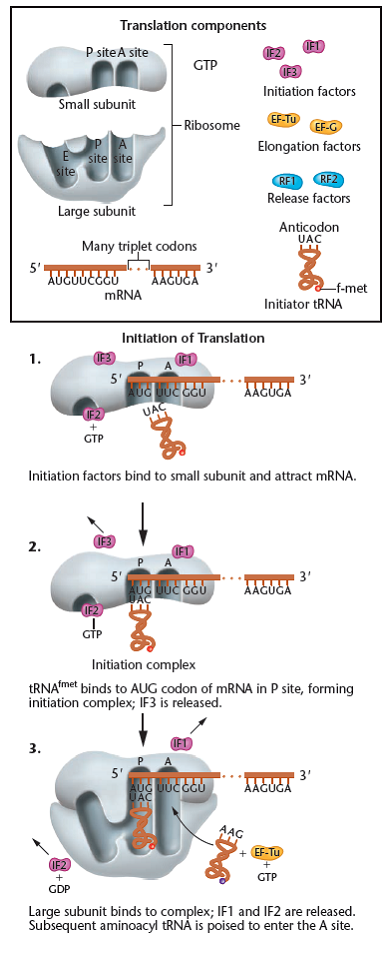
Initiation of translation. The separate components are depicted at the left of the figure.
The emergence of antibiotic-resistant strains of Enterococci and transfer of resistant genes to other bacterial pathogens have highlighted the need for new generations of antibiotics to combat serious infections. To grasp the range of potential sites for the action of existing antibiotics, sketch the components of the translation machinery (e.g., see Step 3 of Figure), and using a series of numbered pointers, indicate the specific location for the action of the antibiotics shown in the following table.
Figure Initiation of translation. The separate components are depicted at the left of the figure.
Question
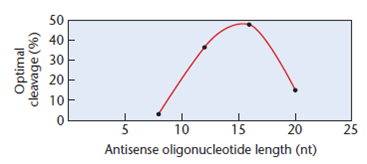
The flow of genetic information from DNA to protein is mediated by messenger RNA. If you introduce short DNA strands (called antisense oligonucleotides) that are complementary to mRNAs, hydrogen bonding may occur and "label" the DNA/RNA hybrid for ribonuclease-H degradation of the RNA. One study compared the effect of different-length antisense oligonucleotides upon ribonuclease-H-mediated degradation of tumor necrosis factor (TNF ? ) mRNA. TNF ? exhibits antitumor and proinflammatory activities (Lloyd et al., 2001. Nuc. Acids Res. 29: 3664-3673). The following graph indicates the efficacy of various-sized antisense oligonucleotides in causing ribonuclease-H cleavage.
(a) Describe how antisense oligonucleotides interrupt the flow of genetic information in a cell.
(b) What general conclusion can be drawn from the graph?
(c) What factors other than oligonucleotide length are likely to influence antisense efficacy in vivo?
(a) Describe how antisense oligonucleotides interrupt the flow of genetic information in a cell.
(b) What general conclusion can be drawn from the graph?
(c) What factors other than oligonucleotide length are likely to influence antisense efficacy in vivo?
Question
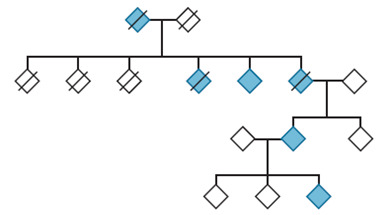
The fidelity of translation is dependent on the reliable action of aminoacyl tRNA synthetases that ensure the association of only one type of amino acid with a specific tRNA. Two relatively rare human conditions, Charcot-Marie-Tooth disease 2D (CMT2D) and distal spinal muscular atrophy type V (dSMA-V), are neuropathologies of the peripheral axons that map to a well-defined region of the short arm of chromosome 7, as does the gene for glycyl tRNA synthetase. Families with CMT2D or dSMA-V have been identified with missense mutations in the gene for glycyl tRNA synthetase; and the mutations present in CMT2D and dSMA-V have been found to result in a loss of activity of glycyl tRNA synthetase (Antonellis et al., 2003). A sample pedigree (from Antonellis et al., 2003) is presented here (to maintain anonymity, sexes are not provided).
(a) Considering the following pedigree and the function of aminoacyl tRNA synthetases in general, would you conclude that the genes causing these diseases are dominant or recessive in their action?
(b) Considering the vital role that synthetases play in protein synthesis, speculate as to how individuals might survive with such a defect in translational efficiency.
(c) Why might some tissues (neural) be more affected than others?
(a) Considering the following pedigree and the function of aminoacyl tRNA synthetases in general, would you conclude that the genes causing these diseases are dominant or recessive in their action?
(b) Considering the vital role that synthetases play in protein synthesis, speculate as to how individuals might survive with such a defect in translational efficiency.
(c) Why might some tissues (neural) be more affected than others?
Question
Knowing the quaternary structure of proteins, specifically their surface properties, provides novel opportunities for enhancing the development of targeted drug therapies.
(a) Referring to Figure and the accompanying discussion, predict the class(es) of amino acids likely to reside on the surface of a protein within a cell.
(b) Assuming that Glu, Arg, and Asp exist in a functional site of a receptor molecule on the surface of a cell, provide an amino acid sequence that is likely to be effective in blocking that site.
(c) The androgen receptor associated with prostate cancer has recently been targeted using synthetic molecules known generally as peptidomimetics, many of which incorporate D-amino acid stereoisomers rather than the more naturally occurring L-amino acid stereoisomers. Why might D-amino acid stereoisomers be especially useful for inhibiting a functional site of the androgen receptor, or any deleterious functional site for that matter?
(d) Rational drug design is a relatively recent approach to the design of targeted therapeutic agents. Predict how knowledge of protein structure, especially surface properties, might be used in rational drug design as compared with the more classical "trial-and-error" approach.
Figure
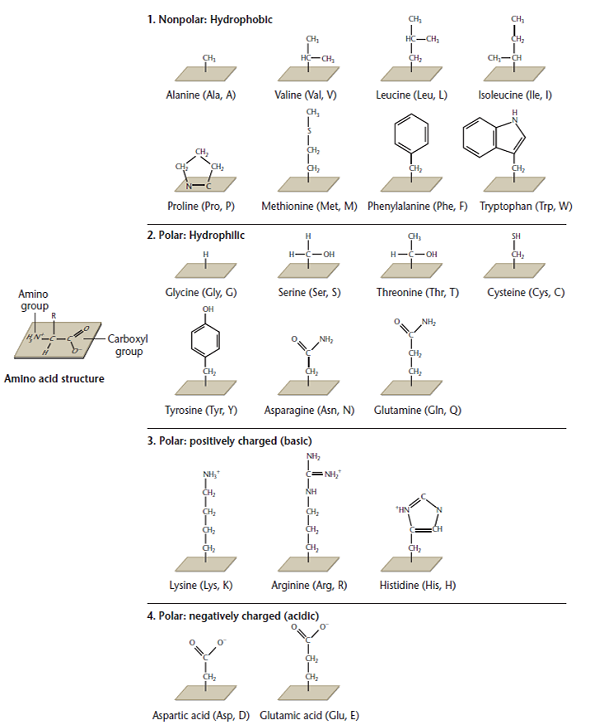 Chemical structures and designations of the 20 amino acids encoded by living organisms, divided into four major categories. Each amino acid has two abbreviations in universal use; for example, alanine is designated either Ala or A.
(a) Referring to Figure and the accompanying discussion, predict the class(es) of amino acids likely to reside on the surface of a protein within a cell.
(b) Assuming that Glu, Arg, and Asp exist in a functional site of a receptor molecule on the surface of a cell, provide an amino acid sequence that is likely to be effective in blocking that site.
(c) The androgen receptor associated with prostate cancer has recently been targeted using synthetic molecules known generally as peptidomimetics, many of which incorporate D-amino acid stereoisomers rather than the more naturally occurring L-amino acid stereoisomers. Why might D-amino acid stereoisomers be especially useful for inhibiting a functional site of the androgen receptor, or any deleterious functional site for that matter?
(d) Rational drug design is a relatively recent approach to the design of targeted therapeutic agents. Predict how knowledge of protein structure, especially surface properties, might be used in rational drug design as compared with the more classical "trial-and-error" approach.
Figure
Chemical structures and designations of the 20 amino acids encoded by living organisms, divided into four major categories. Each amino acid has two abbreviations in universal use; for example, alanine is designated either Ala or A.
Unlock Deck
Sign up to unlock the cards in this deck!
Unlock Deck
Unlock Deck
1/42

Play

Full screen (f)
Deck 14: Translation and Proteins
1
Diamond Blackfan anemia (DBA) is a rare, dominantly inherited syndrome characterized by bone marrow failure, birth defects, and a significant predisposition to cancer. Those affected with DBA usually develop anemia in the first year of life, have abnormal numbers of cell types in their bone marrow, and have an increased risk of developing leukemia and bone cancer. At the molecular level, DBA is caused by a mutation in any of 11 genes that encode ribosomal proteins. The common feature of all these mutations is the disruption of ribosome formation, ultimately affecting the stability or function of ribosomes.
Given the central importance of ribosomes in maintaining life, how is it possible that individuals carrying mutations in ribosomal protein genes survive?
Given the central importance of ribosomes in maintaining life, how is it possible that individuals carrying mutations in ribosomal protein genes survive?
In others, sometimes the missense (altered amino acid) can be somewhat structurally similar for the original protein and only alter protein synthesis slightly (if at all). These individuals also have low expression of the mutations. However, larger mutations can alter ribosomal function and lead to dysfunction in protein translation. Such mutations can lead to several types of disorders which cause serious problems in humans, even if life is maintained.
2
In this chapter, we focused on the translation of mRNA into proteins as well as on protein structure and function. Along the way, we found many opportunities to consider the methods and reasoning by which much of this information was acquired. From the explanations given in the chapter, what answers would you propose to the following fundamental questions:
(a) What experimentally derived information led to Holley's proposal of the two-dimensional cloverleaf model of tRNA?
(b) What experimental information verifies that certain codons in mRNA specify chain termination during translation?
(c) How do we know, based on studies of Neurospora nutritional mutations, that one gene specifies one enzyme?
(d) On what basis have we concluded that proteins are the end products of genetic expression?
(e) What experimental information directly confirms that the genetic code, as shown in Figure, is correct?
(f) How do we know that the structure of a protein is intimately related to the function of that protein?
Figure
The coding dictionary. AUG encodes methionine, which initiates most polypeptide chains. All other amino acids except tryptophan, which is encoded only by UGG, are represented by two to six triplets. The triplets UAA, UAG, and UGA are termination signals and do not encode any amino acids.
(a) What experimentally derived information led to Holley's proposal of the two-dimensional cloverleaf model of tRNA?
(b) What experimental information verifies that certain codons in mRNA specify chain termination during translation?
(c) How do we know, based on studies of Neurospora nutritional mutations, that one gene specifies one enzyme?
(d) On what basis have we concluded that proteins are the end products of genetic expression?
(e) What experimental information directly confirms that the genetic code, as shown in Figure, is correct?
(f) How do we know that the structure of a protein is intimately related to the function of that protein?
Figure
The coding dictionary. AUG encodes methionine, which initiates most polypeptide chains. All other amino acids except tryptophan, which is encoded only by UGG, are represented by two to six triplets. The triplets UAA, UAG, and UGA are termination signals and do not encode any amino acids.
a. Cloverleaf Model is the 2D model that explains the tRNA structure. It looks as such 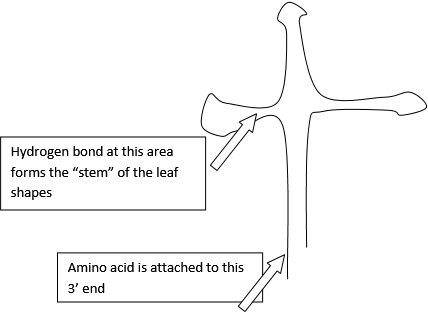 The researcher found that tRNA was a result of modified after transcription from DNA. The modification led it to have hydrogen bonds to its own chain resulting in loop structures that resembles a cloverleaf.
b. It was shown that mutation of some codons to stop codon would terminate translation. For example, if a simple unmutated mRNA along with its amino acid is given below:
AUG|UUU|UAU|CUU|UAA
Met-Phe-Tyr-Leu-Stop
However, if UAU was mutated to UAA this would cause it to stop translation resulting in:
AUG|UUU|UA A |CUU|UAA
Met-Phe-Stop
In result, the CUU codon for leucine will not be translated.
c. The researchers did an experiment as follows:
▪Various spores of neurospora were mutated with different nutritional mutation.
▪These nutritional mutations would hinder the growth of the spores.
▪Researchers discovered that mutation that affected one gene led to one of the nutrition not being able to be processed. They know that nutrition must be processed by enzymes.
▪Thus, they concluded that one enzyme is a result of one gene.
d. The experiments dealing with neurospora and human hemoglobin showed that they were a result of genes being expressed. Genes that were not express may fail to have any protein products.
e. The genetic code was verified by actually translating the mRNA into amino acid sequence by ribosomes. Furthermore, the tRNA would contain anticodon which have the correct amino acid. For example, tRNA has the UAC anticodon with attached methionine, which verifies that AUG (its complementary sequence) is the codon for methionine.
f. This relates to the study of sickle cell anemia. In normal blood individuals, hemoglobin results in blood cells having a concaved shaped. But, sickle cell hemoglobin has a different structure which makes them coalesce in the blood cells resulting in a sickle shaped blood cell.
The researcher found that tRNA was a result of modified after transcription from DNA. The modification led it to have hydrogen bonds to its own chain resulting in loop structures that resembles a cloverleaf.b. It was shown that mutation of some codons to stop codon would terminate translation. For example, if a simple unmutated mRNA along with its amino acid is given below:
AUG|UUU|UAU|CUU|UAA
Met-Phe-Tyr-Leu-Stop
However, if UAU was mutated to UAA this would cause it to stop translation resulting in:
AUG|UUU|UA A |CUU|UAA
Met-Phe-Stop
In result, the CUU codon for leucine will not be translated.
c. The researchers did an experiment as follows:
▪Various spores of neurospora were mutated with different nutritional mutation.
▪These nutritional mutations would hinder the growth of the spores.
▪Researchers discovered that mutation that affected one gene led to one of the nutrition not being able to be processed. They know that nutrition must be processed by enzymes.
▪Thus, they concluded that one enzyme is a result of one gene.
d. The experiments dealing with neurospora and human hemoglobin showed that they were a result of genes being expressed. Genes that were not express may fail to have any protein products.
e. The genetic code was verified by actually translating the mRNA into amino acid sequence by ribosomes. Furthermore, the tRNA would contain anticodon which have the correct amino acid. For example, tRNA has the UAC anticodon with attached methionine, which verifies that AUG (its complementary sequence) is the codon for methionine.
f. This relates to the study of sickle cell anemia. In normal blood individuals, hemoglobin results in blood cells having a concaved shaped. But, sickle cell hemoglobin has a different structure which makes them coalesce in the blood cells resulting in a sickle shaped blood cell.
3
Diamond Blackfan anemia (DBA) is a rare, dominantly inherited syndrome characterized by bone marrow failure, birth defects, and a significant predisposition to cancer. Those affected with DBA usually develop anemia in the first year of life, have abnormal numbers of cell types in their bone marrow, and have an increased risk of developing leukemia and bone cancer. At the molecular level, DBA is caused by a mutation in any of 11 genes that encode ribosomal proteins. The common feature of all these mutations is the disruption of ribosome formation, ultimately affecting the stability or function of ribosomes.
Why might some cells in the body, such as those in bone marrow, be more susceptible to ribosomal protein mutations than other cell types?
Why might some cells in the body, such as those in bone marrow, be more susceptible to ribosomal protein mutations than other cell types?
Some cells are more susceptible to ribosomal protein mutations than other cells because of how quickly they develop. Bone marrow cells are fast dividing and have complex functions in maintaining physiological functions. This requirement of fast division, replication, transcription, and translation make these cells more susceptible to errors and mutations all around, leaving them also more at risk for ribosome mutations.
4
Review the Chapter Concepts list. These all relate to the translation of genetic information stored in mRNA into proteins and how chemical information in proteins impart function to those molecules. Write a brief essay that discusses the role of ribosomes in the process of translation as it relates to these concepts.
Chapter Concepts
▪The ribonucleotide sequence of messenger RNA (mRNA) reflects genetic information stored in the DNA of genes and corresponds to the amino acid sequences in proteins encoded by those genes.
▪The process of translation decodes the information in mRNA, leading to the synthesis of polypeptide chains.
▪Translation involves the interactions of mRNA, tRNA, ribosomes, and a variety of translation factors essential to the initiation, elongation, and termination of the polypeptide chain.
▪Proteins, the final product of most genes, achieve a three-dimensional conformation that arises from the primary amino acid sequences of the polypeptide chains making up each protein.
▪The function of any protein is closely tied to its three-dimensional structure, which can be disrupted by mutation.
Chapter Concepts
▪The ribonucleotide sequence of messenger RNA (mRNA) reflects genetic information stored in the DNA of genes and corresponds to the amino acid sequences in proteins encoded by those genes.
▪The process of translation decodes the information in mRNA, leading to the synthesis of polypeptide chains.
▪Translation involves the interactions of mRNA, tRNA, ribosomes, and a variety of translation factors essential to the initiation, elongation, and termination of the polypeptide chain.
▪Proteins, the final product of most genes, achieve a three-dimensional conformation that arises from the primary amino acid sequences of the polypeptide chains making up each protein.
▪The function of any protein is closely tied to its three-dimensional structure, which can be disrupted by mutation.
Unlock Deck
Unlock for access to all 42 flashcards in this deck.
Unlock Deck
k this deck
5
Diamond Blackfan anemia (DBA) is a rare, dominantly inherited syndrome characterized by bone marrow failure, birth defects, and a significant predisposition to cancer. Those affected with DBA usually develop anemia in the first year of life, have abnormal numbers of cell types in their bone marrow, and have an increased risk of developing leukemia and bone cancer. At the molecular level, DBA is caused by a mutation in any of 11 genes that encode ribosomal proteins. The common feature of all these mutations is the disruption of ribosome formation, ultimately affecting the stability or function of ribosomes.
DBA exhibits variable penetrance with significant differences in the clinical symptoms. How does this provide a way of studying the molecular events that cause this disorder?
DBA exhibits variable penetrance with significant differences in the clinical symptoms. How does this provide a way of studying the molecular events that cause this disorder?
Unlock Deck
Unlock for access to all 42 flashcards in this deck.
Unlock Deck
k this deck
6
Contrast the roles of tRNA and mRNA during translation and list all enzymes that participate in the transcription and translation process.
Unlock Deck
Unlock for access to all 42 flashcards in this deck.
Unlock Deck
k this deck
7
Francis Crick proposed the "adaptor hypothesis" for the function of tRNA. Why did he choose that description?
Unlock Deck
Unlock for access to all 42 flashcards in this deck.
Unlock Deck
k this deck
8
During translation, what molecule bears the codon? the anticodon?
Unlock Deck
Unlock for access to all 42 flashcards in this deck.
Unlock Deck
k this deck
9
The ? chain of eukaryotic hemoglobin is composed of 141 amino acids. What is the minimum number of nucleotides in an mRNA coding for this polypeptide chain?
Unlock Deck
Unlock for access to all 42 flashcards in this deck.
Unlock Deck
k this deck
10
Assuming that each nucleotide is 0.34 nm long in the mRNA, how many triplet codes can occupy at one time the space in a ribosome that is 20 nm in diameter?
Unlock Deck
Unlock for access to all 42 flashcards in this deck.
Unlock Deck
k this deck
11
Summarize the steps involved in charging tRNAs with their appropriate amino acids.
Unlock Deck
Unlock for access to all 42 flashcards in this deck.
Unlock Deck
k this deck
12
To carry out its role, each transfer RNA requires at least four specific recognition sites that must be inherent in its tertiary structure. What are they?
Unlock Deck
Unlock for access to all 42 flashcards in this deck.
Unlock Deck
k this deck
13
What are isoaccepting tRNAs? Assuming that there are only 20 different aminoacyl tRNA synthetases but 31 different tRNAs, speculate on parameters that might be used to ensure that each charged tRNA has received the correct amino acid.
Unlock Deck
Unlock for access to all 42 flashcards in this deck.
Unlock Deck
k this deck
14
Discuss the potential difficulties of designing a diet to alleviate the symptoms of phenylketonuria.
Unlock Deck
Unlock for access to all 42 flashcards in this deck.
Unlock Deck
k this deck
15
Phenylketonurics cannot convert phenylalanine to tyrosine. Why don't these individuals exhibit a deficiency of tyrosine?
Unlock Deck
Unlock for access to all 42 flashcards in this deck.
Unlock Deck
k this deck
16
Phenylketonurics are often more lightly pigmented than are normal individuals. Can you suggest a reason why this is so?
Unlock Deck
Unlock for access to all 42 flashcards in this deck.
Unlock Deck
k this deck
17
Early detection and adherence to a strict dietary regime have prevented much of the mental retardation that used to occur in those afflicted with phenylketonuria (PKU). Affected individuals now often lead normal lives and have families. For various reasons, such individuals adhere less rigorously to their diet as they get older. Predict the effect that mothers with PKU who neglect their diets might have on newborns.
Unlock Deck
Unlock for access to all 42 flashcards in this deck.
Unlock Deck
k this deck
18
The synthesis of flower pigments is known to be dependent on enzymatically controlled biosynthetic pathways. For the crosses shown here, postulate the role of mutant genes and their products in producing the observed phenotypes:
(a) P 1 : white strain A × white strain B
▪1 : all purple
▪2 : 9/16 purple: 7/16 white
(b) P 1 : white × pink
▪1 : all purple
▪2 : 9/16 purple: 3/16 pink: 4/16 white
(a) P 1 : white strain A × white strain B
▪1 : all purple
▪2 : 9/16 purple: 7/16 white
(b) P 1 : white × pink
▪1 : all purple
▪2 : 9/16 purple: 3/16 pink: 4/16 white
Unlock Deck
Unlock for access to all 42 flashcards in this deck.
Unlock Deck
k this deck
19
The study of biochemical mutants in organisms such as Neurospora has demonstrated that some pathways are branched. The data shown here illustrate the branched nature of the pathway resulting in the synthesis of thiamine:
Why don't the data support a linear pathway? Can you postulate a pathway for the synthesis of thiamine in Neurospora ?
Why don't the data support a linear pathway? Can you postulate a pathway for the synthesis of thiamine in Neurospora ? Unlock Deck
Unlock for access to all 42 flashcards in this deck.
Unlock Deck
k this deck
20
Explain why the one-gene:one-enzyme concept is not considered totally accurate today.
Unlock Deck
Unlock for access to all 42 flashcards in this deck.
Unlock Deck
k this deck
21
Why is an alteration of electrophoretic mobility interpreted as a change in the primary structure of the protein under study?
Unlock Deck
Unlock for access to all 42 flashcards in this deck.
Unlock Deck
k this deck
22
Contrast the polypeptide-chain components of each of the hemoglobin molecules found in humans.
Unlock Deck
Unlock for access to all 42 flashcards in this deck.
Unlock Deck
k this deck
23
Using sickle-cell anemia as an example, describe what is meant by a molecular or genetic disease. What are the similarities and dissimilarities between this type of a disorder and a disease caused by an invading microorganism?
Unlock Deck
Unlock for access to all 42 flashcards in this deck.
Unlock Deck
k this deck
24
Contrast the contributions of Pauling and Ingram to our understanding of the genetic basis for sickle-cell anemia.
Unlock Deck
Unlock for access to all 42 flashcards in this deck.
Unlock Deck
k this deck
25
Hemoglobins from two individuals are compared by electrophoresis and by fingerprinting. Electrophoresis reveals no difference in migration, but fingerprinting shows an amino acid difference. How is this possible?
Unlock Deck
Unlock for access to all 42 flashcards in this deck.
Unlock Deck
k this deck
26
HbS results in anemia and resistance to malaria, whereas in those with HbA, the parasite Plasmodium falciparum invades red blood cells and causes the disease. Predict whether those with HbC are likely to be anemic and whether they would be resistant to malaria.
Unlock Deck
Unlock for access to all 42 flashcards in this deck.
Unlock Deck
k this deck
27
Shown below are several amino acid substitutions in the ? and ? chains of human hemoglobin:
Using the code table (Figure), determine how many of them can occur as a result of a single-nucleotide change.
Figure
The coding dictionary. AUG encodes methionine, which initiates most polypeptide chains. All other amino acids except tryptophan, which is encoded only by UGG, are represented by two to six triplets. The triplets UAA, UAG, and UGA are termination signals and do not encode any amino acids.
Using the code table (Figure), determine how many of them can occur as a result of a single-nucleotide change.Figure
The coding dictionary. AUG encodes methionine, which initiates most polypeptide chains. All other amino acids except tryptophan, which is encoded only by UGG, are represented by two to six triplets. The triplets UAA, UAG, and UGA are termination signals and do not encode any amino acids.
Unlock Deck
Unlock for access to all 42 flashcards in this deck.
Unlock Deck
k this deck
28
Certain mutations called amber in bacteria and viruses result in premature termination of polypeptide chains during translation. Many amber mutations have been detected at different points along the gene coding for a head protein in phage T4. How might this system be further investigated to demonstrate and support the concept of colinearity?
Unlock Deck
Unlock for access to all 42 flashcards in this deck.
Unlock Deck
k this deck
29
Describe what colinearity means. Of what significance is the concept of colinearity in the study of genetics?
Unlock Deck
Unlock for access to all 42 flashcards in this deck.
Unlock Deck
k this deck
30
Does Yanofsky's work with the trpA locus in E. coli (discussed in this chapter) constitute more or less direct evidence in support of colinearity than Fiers's work with phage MS2 (discussed in Chapter 13)? Explain.
Unlock Deck
Unlock for access to all 42 flashcards in this deck.
Unlock Deck
k this deck
31
Define and compare the four levels of protein organization.
Unlock Deck
Unlock for access to all 42 flashcards in this deck.
Unlock Deck
k this deck
32
List as many different categories of protein functions as you can. Wherever possible, give an example of each category.
Unlock Deck
Unlock for access to all 42 flashcards in this deck.
Unlock Deck
k this deck
33
How does an enzyme function? Why are enzymes essential for living organisms on Earth?
Unlock Deck
Unlock for access to all 42 flashcards in this deck.
Unlock Deck
k this deck
34
Exon shuffling is a proposal that relates exons in DNA to the repositioning of functional domains in proteins. What evidence exists in support of exon shuffling? Two schools of thought have emerged concerning the origin of exons, "intron-early" and "intron-late." Briefly describe both theories and present support for each.
Unlock Deck
Unlock for access to all 42 flashcards in this deck.
Unlock Deck
k this deck
35
Three independently assorting genes are known to control the following biochemical pathway that provides the basis for flower color in a hypothetical plant:
Three homozygous recessive mutations are also known, each of which interrupts a different one of these steps. Determine the phenotypic results in the F 1 and F 2 generations resulting from the P 1 crosses of true-breeding plants listed here:
(a) speckled (AABBCC) × yellow (AAbbCC)
(b) yellow (AAbbCC) × green (AABBcc)
(c) colorless (aaBBCC) × green (AABBcc)
Three homozygous recessive mutations are also known, each of which interrupts a different one of these steps. Determine the phenotypic results in the F 1 and F 2 generations resulting from the P 1 crosses of true-breeding plants listed here:
(a) speckled (AABBCC) × yellow (AAbbCC)
(b) yellow (AAbbCC) × green (AABBcc)
(c) colorless (aaBBCC) × green (AABBcc)
Unlock Deck
Unlock for access to all 42 flashcards in this deck.
Unlock Deck
k this deck
36
How would the results vary in cross of Problem if genes A and B were linked with no crossing over between them? How would the results of cross (a) vary if genes A and B were linked and 20 map units (mu) apart?
Problem
speckled (AABBCC) × yellow (AAbbCC)
Problem
speckled (AABBCC) × yellow (AAbbCC)
Unlock Deck
Unlock for access to all 42 flashcards in this deck.
Unlock Deck
k this deck
37
Deep in a previously unexplored South American rain forest, a species of plants was discovered with true-breeding varieties whose flowers were pink, rose, orange, or purple. A very astute plant geneticist made a single cross, carried to the F 2 generation, as shown:
Based solely on these data, he was able to propose both a mode of inheritance for flower pigmentation and a biochemical pathway for the synthesis of these pigments.
Carefully study the data. Create a hypothesis of your own to explain the mode of inheritance. Then propose a biochemical pathway consistent with your hypothesis. How could you test the hypothesis by making other crosses?
Based solely on these data, he was able to propose both a mode of inheritance for flower pigmentation and a biochemical pathway for the synthesis of these pigments.Carefully study the data. Create a hypothesis of your own to explain the mode of inheritance. Then propose a biochemical pathway consistent with your hypothesis. How could you test the hypothesis by making other crosses?
Unlock Deck
Unlock for access to all 42 flashcards in this deck.
Unlock Deck
k this deck
38
The emergence of antibiotic-resistant strains of Enterococci and transfer of resistant genes to other bacterial pathogens have highlighted the need for new generations of antibiotics to combat serious infections. To grasp the range of potential sites for the action of existing antibiotics, sketch the components of the translation machinery (e.g., see Step 3 of Figure), and using a series of numbered pointers, indicate the specific location for the action of the antibiotics shown in the following table.
Figure
Initiation of translation. The separate components are depicted at the left of the figure.
Figure Initiation of translation. The separate components are depicted at the left of the figure.
Unlock Deck
Unlock for access to all 42 flashcards in this deck.
Unlock Deck
k this deck
39
The development of antibiotic resistance by pathogenic bacteria represents a major health concern. One potential new antibiotic is evernimicin, which was isolated from Micromonospora carbonacea? Evernimicin is an oligosaccharide with antibiotic activity against a broad range of gram-positive pathogenic bacteria. To determine the mode of action of this drug, researchers have analyzed 23S ribosomal DNA mutants that showed reduced sensitivity to evernimicin (e.g., Adrian et al., 2000. Antimicrob. Ag. and Chemo. 44: 3101-3106). They discovered two classes of mutants that conferred resistance: In one class, the mutation occurs in 23 S rRNA nucleotides 2475-2483; in the other class, it occurs in ribosomal protein L16. This suggests that these two ribosomal components are structurally and functionally linked. It turns out that the tRNA anticodon stem-loop appears to bind to the A site of the ribosome at rRNA bases 2465-2485. This finding conforms to the proposed function of L16, which appears to be involved in attracting the aminoacyl stem of the tRNA to the ribosome at its A site. Using your sketch of the translation machinery from Problem 35 along with this information, designate where the proposed antibacterial action of evernimicin is likely to occur.
The emergence of antibiotic-resistant strains of Enterococci and transfer of resistant genes to other bacterial pathogens have highlighted the need for new generations of antibiotics to combat serious infections. To grasp the range of potential sites for the action of existing antibiotics, sketch the components of the translation machinery (e.g., see Step 3 of Figure), and using a series of numbered pointers, indicate the specific location for the action of the antibiotics shown in the following table.
Figure
Initiation of translation. The separate components are depicted at the left of the figure.
The emergence of antibiotic-resistant strains of Enterococci and transfer of resistant genes to other bacterial pathogens have highlighted the need for new generations of antibiotics to combat serious infections. To grasp the range of potential sites for the action of existing antibiotics, sketch the components of the translation machinery (e.g., see Step 3 of Figure), and using a series of numbered pointers, indicate the specific location for the action of the antibiotics shown in the following table.
Figure Initiation of translation. The separate components are depicted at the left of the figure.
Unlock Deck
Unlock for access to all 42 flashcards in this deck.
Unlock Deck
k this deck
40
The flow of genetic information from DNA to protein is mediated by messenger RNA. If you introduce short DNA strands (called antisense oligonucleotides) that are complementary to mRNAs, hydrogen bonding may occur and "label" the DNA/RNA hybrid for ribonuclease-H degradation of the RNA. One study compared the effect of different-length antisense oligonucleotides upon ribonuclease-H-mediated degradation of tumor necrosis factor (TNF ? ) mRNA. TNF ? exhibits antitumor and proinflammatory activities (Lloyd et al., 2001. Nuc. Acids Res. 29: 3664-3673). The following graph indicates the efficacy of various-sized antisense oligonucleotides in causing ribonuclease-H cleavage.
(a) Describe how antisense oligonucleotides interrupt the flow of genetic information in a cell.
(b) What general conclusion can be drawn from the graph?
(c) What factors other than oligonucleotide length are likely to influence antisense efficacy in vivo?
(a) Describe how antisense oligonucleotides interrupt the flow of genetic information in a cell.
(b) What general conclusion can be drawn from the graph?
(c) What factors other than oligonucleotide length are likely to influence antisense efficacy in vivo?
Unlock Deck
Unlock for access to all 42 flashcards in this deck.
Unlock Deck
k this deck
41
The fidelity of translation is dependent on the reliable action of aminoacyl tRNA synthetases that ensure the association of only one type of amino acid with a specific tRNA. Two relatively rare human conditions, Charcot-Marie-Tooth disease 2D (CMT2D) and distal spinal muscular atrophy type V (dSMA-V), are neuropathologies of the peripheral axons that map to a well-defined region of the short arm of chromosome 7, as does the gene for glycyl tRNA synthetase. Families with CMT2D or dSMA-V have been identified with missense mutations in the gene for glycyl tRNA synthetase; and the mutations present in CMT2D and dSMA-V have been found to result in a loss of activity of glycyl tRNA synthetase (Antonellis et al., 2003). A sample pedigree (from Antonellis et al., 2003) is presented here (to maintain anonymity, sexes are not provided).
(a) Considering the following pedigree and the function of aminoacyl tRNA synthetases in general, would you conclude that the genes causing these diseases are dominant or recessive in their action?
(b) Considering the vital role that synthetases play in protein synthesis, speculate as to how individuals might survive with such a defect in translational efficiency.
(c) Why might some tissues (neural) be more affected than others?
(a) Considering the following pedigree and the function of aminoacyl tRNA synthetases in general, would you conclude that the genes causing these diseases are dominant or recessive in their action?
(b) Considering the vital role that synthetases play in protein synthesis, speculate as to how individuals might survive with such a defect in translational efficiency.
(c) Why might some tissues (neural) be more affected than others?
Unlock Deck
Unlock for access to all 42 flashcards in this deck.
Unlock Deck
k this deck
42
Knowing the quaternary structure of proteins, specifically their surface properties, provides novel opportunities for enhancing the development of targeted drug therapies.
(a) Referring to Figure and the accompanying discussion, predict the class(es) of amino acids likely to reside on the surface of a protein within a cell.
(b) Assuming that Glu, Arg, and Asp exist in a functional site of a receptor molecule on the surface of a cell, provide an amino acid sequence that is likely to be effective in blocking that site.
(c) The androgen receptor associated with prostate cancer has recently been targeted using synthetic molecules known generally as peptidomimetics, many of which incorporate D-amino acid stereoisomers rather than the more naturally occurring L-amino acid stereoisomers. Why might D-amino acid stereoisomers be especially useful for inhibiting a functional site of the androgen receptor, or any deleterious functional site for that matter?
(d) Rational drug design is a relatively recent approach to the design of targeted therapeutic agents. Predict how knowledge of protein structure, especially surface properties, might be used in rational drug design as compared with the more classical "trial-and-error" approach.
Figure
Chemical structures and designations of the 20 amino acids encoded by living organisms, divided into four major categories. Each amino acid has two abbreviations in universal use; for example, alanine is designated either Ala or A.
(a) Referring to Figure and the accompanying discussion, predict the class(es) of amino acids likely to reside on the surface of a protein within a cell.
(b) Assuming that Glu, Arg, and Asp exist in a functional site of a receptor molecule on the surface of a cell, provide an amino acid sequence that is likely to be effective in blocking that site.
(c) The androgen receptor associated with prostate cancer has recently been targeted using synthetic molecules known generally as peptidomimetics, many of which incorporate D-amino acid stereoisomers rather than the more naturally occurring L-amino acid stereoisomers. Why might D-amino acid stereoisomers be especially useful for inhibiting a functional site of the androgen receptor, or any deleterious functional site for that matter?
(d) Rational drug design is a relatively recent approach to the design of targeted therapeutic agents. Predict how knowledge of protein structure, especially surface properties, might be used in rational drug design as compared with the more classical "trial-and-error" approach.
Figure
Chemical structures and designations of the 20 amino acids encoded by living organisms, divided into four major categories. Each amino acid has two abbreviations in universal use; for example, alanine is designated either Ala or A. Unlock Deck
Unlock for access to all 42 flashcards in this deck.
Unlock Deck
k this deck
Unlock Deck
Unlock for access to all 42 flashcards in this deck.







