





 Chat with AI

Deck 13: The Genetic Code and Transcription
Full screen (f)

Question

Question
Question
Question
Question
Question
Question
Question
Question
In a coding experiment using repeating copolymers (as demonstrated in Table), the following data were obtained:
 AGG is known to code for arginine. Taking into account the wobble hypothesis, assign each of the four codons produced in the experiment to its correct amino acid.
Table
Amino Acids Incorporated Using Repeated Synthetic Copolymers of RNA
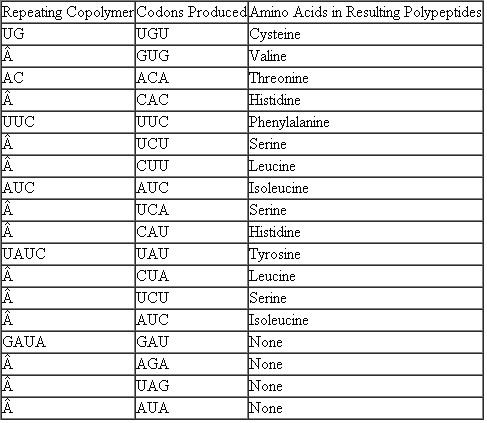
AGG is known to code for arginine. Taking into account the wobble hypothesis, assign each of the four codons produced in the experiment to its correct amino acid.Table
Amino Acids Incorporated Using Repeated Synthetic Copolymers of RNA
Question
Question
Question
In studies of the amino acid sequence of wild-type and mutant forms of tryptophan synthetase in E. coli , the following changes have been observed:
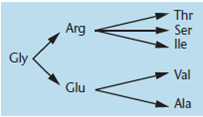
Determine a set of triplet codes in which only a single-nucleotide change produces each amino acid change.
Determine a set of triplet codes in which only a single-nucleotide change produces each amino acid change.
Question
Question
Refer to Table Can you hypothesize why a mixture of poly U + poly A would not stimulate incorporation of 14 C-phenylalanine into protein?
Table
Incorporation of 14 C-Phenylalanine into Protein
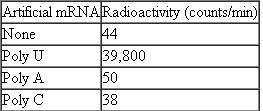 Source : After Nirenberg and Matthaei (1961).
Table
Incorporation of 14 C-Phenylalanine into Protein
Source : After Nirenberg and Matthaei (1961). Question
Question
A short RNA molecule was isolated that demonstrated a hyperchromic shift, indicating secondary structure. Its sequence was determined to be
5?-AGGCGCCGACUCUACU-3?
(a) Propose a two-dimensional model for this molecule.
(b) What DNA sequence would give rise to this RNA molecule through transcription?
(c) If the molecule were a tRNA fragment containing a CGA anticodon, what would the corresponding codon be?
(d) If the molecule were an internal part of a message, what amino acid sequence would result from it following translation? (Refer to the code chart in Figure.)Figure
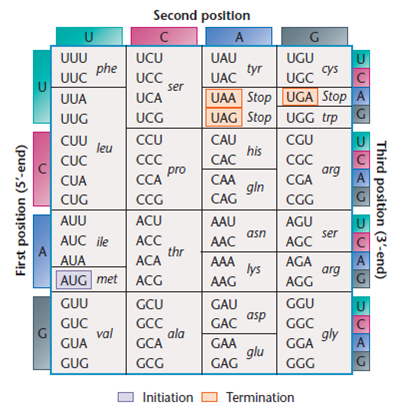
The coding dictionary. AUG encodes methionine, which initiates most polypeptide chains. All other amino acids except tryptophan, which is encoded only by UGG, are represented by two to six triplets. The triplets UAA, UAG, and UGA are termination signals and do not encode any amino acids.
5?-AGGCGCCGACUCUACU-3?
(a) Propose a two-dimensional model for this molecule.
(b) What DNA sequence would give rise to this RNA molecule through transcription?
(c) If the molecule were a tRNA fragment containing a CGA anticodon, what would the corresponding codon be?
(d) If the molecule were an internal part of a message, what amino acid sequence would result from it following translation? (Refer to the code chart in Figure.)Figure
The coding dictionary. AUG encodes methionine, which initiates most polypeptide chains. All other amino acids except tryptophan, which is encoded only by UGG, are represented by two to six triplets. The triplets UAA, UAG, and UGA are termination signals and do not encode any amino acids.
Question
Question
Refer to Figure to respond to the following:
(a) Shown here is a hypothetical viral mRNA sequence:
5?-AUGCAUACCUAUGAGACCCUUGGA-3?
Assuming that it could arise from overlapping genes, how many different polypeptide sequences can be produced? What are the sequences?
(b) A base-substitution mutation that altered the sequence in (a) eliminated the synthesis of all but one polypeptide. The altered sequence is shown here:
5?-AUGCAUACCUAUGUGACCCUUGGA-3?
Determine why.
Figure
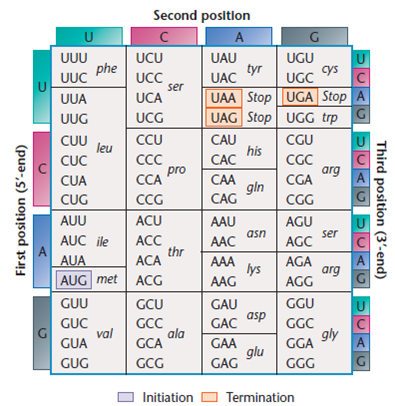
The coding dictionary. AUG encodes methionine, which initiates most polypeptide chains. All other amino acids except tryptophan, which is encoded only by UGG, are represented by two to six triplets. The triplets UAA, UAG, and UGA are termination signals and do not encode any amino acids.
(a) Shown here is a hypothetical viral mRNA sequence:
5?-AUGCAUACCUAUGAGACCCUUGGA-3?
Assuming that it could arise from overlapping genes, how many different polypeptide sequences can be produced? What are the sequences?
(b) A base-substitution mutation that altered the sequence in (a) eliminated the synthesis of all but one polypeptide. The altered sequence is shown here:
5?-AUGCAUACCUAUGUGACCCUUGGA-3?
Determine why.
Figure
The coding dictionary. AUG encodes methionine, which initiates most polypeptide chains. All other amino acids except tryptophan, which is encoded only by UGG, are represented by two to six triplets. The triplets UAA, UAG, and UGA are termination signals and do not encode any amino acids.
Question
Question
Question
Question
Question
Question
Question
Question
Question
Question
Question
Question
Question
In a mixed copolymer experiment, messages were created with either 4/5C:1/5A or 4/5A:1/5C. These messages yielded proteins with the following amino acid compositions.
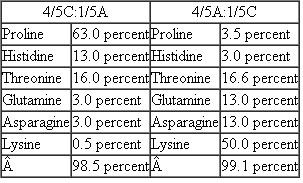 Using these data, predict the most specific coding composition for each amino acid.
Using these data, predict the most specific coding composition for each amino acid. Question
Shown here are the amino acid sequences of the wild-type and three mutant forms of a short protein. Use this information to answer the following questions:
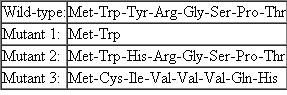 (a) Using Figure, predict the type of mutation that led to each altered protein.
(b) For each mutant protein, determine the specific ribonucleotide change that led to its synthesis.
(c) The wild-type RNA consists of nine triplets. What is the role of the ninth triplet?
(d) Of the first eight wild-type triplets, which, if any, can you determine specifically from an analysis of the mutant proteins? In each case, explain why or why not.
(e) Another mutation (Mutant 4) is isolated. Its amino acid sequence is unchanged, but the mutant cells produce abnormally low amounts of the wild-type proteins. As specifically as you can, predict where this mutation exists in the gene.
Figure
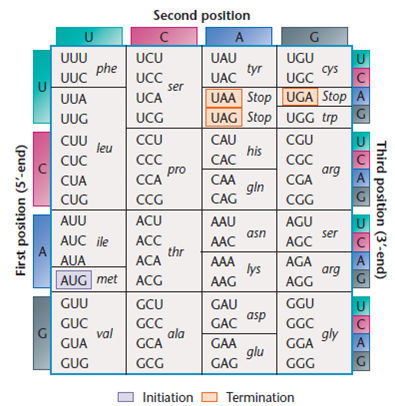
The coding dictionary. AUG encodes methionine, which initiates most polypeptide chains. All other amino acids except tryptophan, which is encoded only by UGG, are represented by two to six triplets. The triplets UAA, UAG, and UGA are termination signals and do not encode any amino acids.
(a) Using Figure, predict the type of mutation that led to each altered protein.(b) For each mutant protein, determine the specific ribonucleotide change that led to its synthesis.
(c) The wild-type RNA consists of nine triplets. What is the role of the ninth triplet?
(d) Of the first eight wild-type triplets, which, if any, can you determine specifically from an analysis of the mutant proteins? In each case, explain why or why not.
(e) Another mutation (Mutant 4) is isolated. Its amino acid sequence is unchanged, but the mutant cells produce abnormally low amounts of the wild-type proteins. As specifically as you can, predict where this mutation exists in the gene.
Figure
The coding dictionary. AUG encodes methionine, which initiates most polypeptide chains. All other amino acids except tryptophan, which is encoded only by UGG, are represented by two to six triplets. The triplets UAA, UAG, and UGA are termination signals and do not encode any amino acids.
Question
The genetic code is degenerate. Amino acids are encoded by either 1, 2, 3, 4, or 6 triplet codons. (See Figure.) An interesting question is whether the number of triplet codes for a given amino acid is in any way correlated with the frequency with which that amino acid appears in proteins. That is, is the genetic code optimized for its intended use? Some approximations of the frequency of appearance of nine amino acids in proteins in E. coli are given in the following:
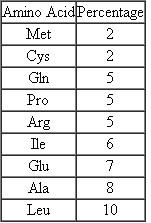 (a) Determine how many triplets encode each amino acid.
(b) Devise a way to graphically compare the two sets of information (data).
(c) Analyze your data to determine what, if any, correlations can be drawn between the relative frequency of amino acids making up proteins and the number of codons for each. Write a paragraph that states your specific and general conclusions.
(d) How would you proceed with your analysis if you wanted to pursue this problem further?
Figure
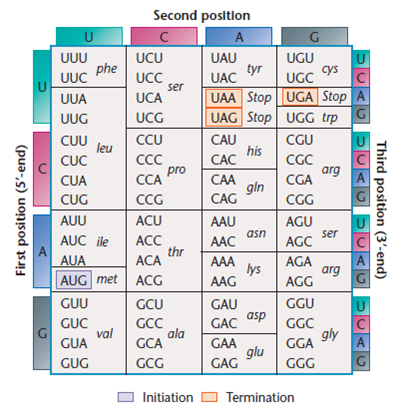
The coding dictionary. AUG encodes methionine, which initiates most polypeptide chains. All other amino acids except tryptophan, which is encoded only by UGG, are represented by two to six triplets. The triplets UAA, UAG, and UGA are termination signals and do not encode any amino acids.
(a) Determine how many triplets encode each amino acid.(b) Devise a way to graphically compare the two sets of information (data).
(c) Analyze your data to determine what, if any, correlations can be drawn between the relative frequency of amino acids making up proteins and the number of codons for each. Write a paragraph that states your specific and general conclusions.
(d) How would you proceed with your analysis if you wanted to pursue this problem further?
Figure
The coding dictionary. AUG encodes methionine, which initiates most polypeptide chains. All other amino acids except tryptophan, which is encoded only by UGG, are represented by two to six triplets. The triplets UAA, UAG, and UGA are termination signals and do not encode any amino acids.
Question
Question
Question

Unlock Deck
Sign up to unlock the cards in this deck!
Unlock Deck
Unlock Deck
1/36

Play

Full screen (f)
Deck 13: The Genetic Code and Transcription
1
A 30-year-old woman with ? -thalassemia, a recessively inherited genetic disorder caused by absence of the hemoglobin ? chain, had been treated with blood transfusions since the age of 7. However, in spite of the transfusions, her health was declining. As an alternative treatment, her physician administered 5-azacytidine to induce transcription of the fetal ? hemoglobin chain to replace her missing ? chain. This drug activates gene transcription by removing methyl groups from DNA. Addition of methyl groups silences genes. However, the physician expressed concern that approximately 40 percent of all human genes are normally silenced by methylation. Nevertheless, after several weeks of 5-azacytidine treatment, the patient's condition improved dramatically. Although the treatment was successful, use of this drug raises several important questions.
Why was her physician concerned that a high percentage of human genes are transcriptionally silenced by methylation?
Why was her physician concerned that a high percentage of human genes are transcriptionally silenced by methylation?
A high percentage of genes are silenced by methylation. 5-azacytidine would remove the methyl group of the fetal ß hemoglobin chain including many other genes. Every cell in the body contains all the genetic material to make up every organ in the body. Only a few genes are expressed in certain organs. Activation of genes that should be silenced in a particular organ may lead to abnormal organ function.
2
In this chapter, we focused on the genetic code and the transcription of genetic information stored in DNA into complementary RNA molecules. Along the way, we found many opportunities to consider the methods and reasoning by which much of this information was acquired. From the explanations given in the chapter, what answers would you propose to the following fundamental questions:
(a) Why did geneticists believe, even before direct experimental evidence was obtained, that the genetic code would turn out to be composed of triplet sequences and be nonoverlapping? Experimentally, how were these suppositions shown to be correct?
(b) What experimental evidence provided the initial insights into the compositions of codons encoding specific amino acids?
(c) How were the specific sequences of triplet codes determined experimentally?
(d) How were the experimentally derived triplet codon assignments verified in studies using bacteriophage MS2?
(e) What evidence do we have that the expression of the information encoded in DNA involves an RNA intermediate?
(f) How do we know that the initial transcript of a eukaryotic gene contains noncoding sequences that must be removed before accurate translation into proteins can occur?
(a) Why did geneticists believe, even before direct experimental evidence was obtained, that the genetic code would turn out to be composed of triplet sequences and be nonoverlapping? Experimentally, how were these suppositions shown to be correct?
(b) What experimental evidence provided the initial insights into the compositions of codons encoding specific amino acids?
(c) How were the specific sequences of triplet codes determined experimentally?
(d) How were the experimentally derived triplet codon assignments verified in studies using bacteriophage MS2?
(e) What evidence do we have that the expression of the information encoded in DNA involves an RNA intermediate?
(f) How do we know that the initial transcript of a eukaryotic gene contains noncoding sequences that must be removed before accurate translation into proteins can occur?
(a) Even before the codon was determined for each amino acid, the researchers found that adding or deleting certain multiple of bases change the reading frame of the codon sequences. For example, they found adding or deleting multiple of 1 and 2 bases changed the reading frame, but adding or deleting multiple of 3 bases did not. Thus, they determined the nucleotide sequences must be read in 3s.
(b) Subsequent work found that the codons must be read in a non-overlapping way. For example, the codon CAGUGG, can only be read as CAG|UGG but not as CAG |GUG| UGG, in which the middle 3 rd G is shared.
(c) The amino acids which the codon determined were explored by making polynucleotides, which were nucleotides consisting usually of one or two bases, such as AAA…. or AGAGAGAGGGAAA… and etc. Because, polynucleotide bases only code for either one amino acid if it contains one nucleotide or a few if it contains two, it can be deduced which codons coded for which amino acid. For example, researchers may have found that AAA bases only coded for lysine.
(d) The bacteriophage MS2 was a virus with only 3500 ribonucleotides (RNA), and it coded for only 3 genes. The amino acids of their gene's products were used to confirm (or refute) the possible amino acid coded by the codons.
(e) It was found that DNA didn't directly produce proteins but instead mRNA transcript is utilized first. Researchers found the RNA in viruses was used instead of DNA, to form a protein product.
(f) Researchers observed the splicing activities on RNA in eukaryotic cells. They also found that RNA contains characteristics giving them enzymatic properties to splice themselves. This eventually led to the discovery the RNA required to be spliced before leaving the nucleus.
(b) Subsequent work found that the codons must be read in a non-overlapping way. For example, the codon CAGUGG, can only be read as CAG|UGG but not as CAG |GUG| UGG, in which the middle 3 rd G is shared.
(c) The amino acids which the codon determined were explored by making polynucleotides, which were nucleotides consisting usually of one or two bases, such as AAA…. or AGAGAGAGGGAAA… and etc. Because, polynucleotide bases only code for either one amino acid if it contains one nucleotide or a few if it contains two, it can be deduced which codons coded for which amino acid. For example, researchers may have found that AAA bases only coded for lysine.
(d) The bacteriophage MS2 was a virus with only 3500 ribonucleotides (RNA), and it coded for only 3 genes. The amino acids of their gene's products were used to confirm (or refute) the possible amino acid coded by the codons.
(e) It was found that DNA didn't directly produce proteins but instead mRNA transcript is utilized first. Researchers found the RNA in viruses was used instead of DNA, to form a protein product.
(f) Researchers observed the splicing activities on RNA in eukaryotic cells. They also found that RNA contains characteristics giving them enzymatic properties to splice themselves. This eventually led to the discovery the RNA required to be spliced before leaving the nucleus.
3
A 30-year-old woman with ? -thalassemia, a recessively inherited genetic disorder caused by absence of the hemoglobin ? chain, had been treated with blood transfusions since the age of 7. However, in spite of the transfusions, her health was declining. As an alternative treatment, her physician administered 5-azacytidine to induce transcription of the fetal ? hemoglobin chain to replace her missing ? chain. This drug activates gene transcription by removing methyl groups from DNA. Addition of methyl groups silences genes. However, the physician expressed concern that approximately 40 percent of all human genes are normally silenced by methylation. Nevertheless, after several weeks of 5-azacytidine treatment, the patient's condition improved dramatically. Although the treatment was successful, use of this drug raises several important questions.
What genes might raise the greatest concern?
What genes might raise the greatest concern?
Abnormal functioning of genes that control the basic functions of cells and life would raise the great concern if inactive. For example, genes that help regulate cell growth and division can prevent cancer. Genes that control sensory functions such as touch, smell, hearing, and sight are also highly important and can give us input on our surroundings.
4
Review the Chapter Concepts list. These all center around how genetic information is stored in DNA and transferred to RNA prior to translation into proteins. Write a short essay that summarizes the key properties of the genetic code and the process by which RNA is transcribed on a DNA template.
Chapter Concepts
▪Genetic information is stored in DNA by means of a triplet code that is nearly universal to all living things on Earth.
▪The genetic code is initially transferred from DNA to RNA, in the process of transcription.
▪Once transferred to RNA, the genetic code exists as triplet codons, which are sets of three nucleotides in which each nucleotide is one of the four kinds of ribonucleotides composing RNA.
▪RNA's four ribonucleotides, analogous to an alphabet of four "letters," can be arranged into 64 different three-letter sequences. Most of the triplets in RNA encode one of the 20 amino acids present in proteins, which are the end products of most genes.
▪Several codons act as signals that initiate or terminate protein synthesis.
▪In eukaryotes, the process of transcription is similar to, but more complex than, that in prokaryotes and in the bacteriophages that infect them.
Chapter Concepts
▪Genetic information is stored in DNA by means of a triplet code that is nearly universal to all living things on Earth.
▪The genetic code is initially transferred from DNA to RNA, in the process of transcription.
▪Once transferred to RNA, the genetic code exists as triplet codons, which are sets of three nucleotides in which each nucleotide is one of the four kinds of ribonucleotides composing RNA.
▪RNA's four ribonucleotides, analogous to an alphabet of four "letters," can be arranged into 64 different three-letter sequences. Most of the triplets in RNA encode one of the 20 amino acids present in proteins, which are the end products of most genes.
▪Several codons act as signals that initiate or terminate protein synthesis.
▪In eukaryotes, the process of transcription is similar to, but more complex than, that in prokaryotes and in the bacteriophages that infect them.
Unlock Deck
Unlock for access to all 36 flashcards in this deck.
Unlock Deck
k this deck
5
A 30-year-old woman with ? -thalassemia, a recessively inherited genetic disorder caused by absence of the hemoglobin ? chain, had been treated with blood transfusions since the age of 7. However, in spite of the transfusions, her health was declining. As an alternative treatment, her physician administered 5-azacytidine to induce transcription of the fetal ? hemoglobin chain to replace her missing ? chain. This drug activates gene transcription by removing methyl groups from DNA. Addition of methyl groups silences genes. However, the physician expressed concern that approximately 40 percent of all human genes are normally silenced by methylation. Nevertheless, after several weeks of 5-azacytidine treatment, the patient's condition improved dramatically. Although the treatment was successful, use of this drug raises several important questions.
What criteria would you use when deciding to administer a drug such as 5-azacytidine?
What criteria would you use when deciding to administer a drug such as 5-azacytidine?
Unlock Deck
Unlock for access to all 36 flashcards in this deck.
Unlock Deck
k this deck
6
In their studies of frameshift mutations, Crick, Barnett, Brenner, and Watts-Tobin found that either three "pluses" or three "minuses" restored the correct reading frame. (a) Assuming the code is a triplet, what effect would the addition or loss of six nucleotides have on the reading frame? (b) If the code were a sextuplet (consisting of six nucleotides), would the reading frame be restored by the addition or loss of three, six, or nine nucleotides?
Unlock Deck
Unlock for access to all 36 flashcards in this deck.
Unlock Deck
k this deck
7
The mRNA formed from the repeating tetranucleotide UUAC incorporates only three amino acids, but the use of UAUC incorporates four amino acids. Why?
Unlock Deck
Unlock for access to all 36 flashcards in this deck.
Unlock Deck
k this deck
8
In studies using repeating copolymers, AC… incorporates threonine and histidine, and CAACAA… incorporates glutamine, asparagine, and threonine. What triplet code can definitely be assigned to threonine?
Unlock Deck
Unlock for access to all 36 flashcards in this deck.
Unlock Deck
k this deck
9
In a coding experiment using repeating copolymers (as demonstrated in Table), the following data were obtained:
AGG is known to code for arginine. Taking into account the wobble hypothesis, assign each of the four codons produced in the experiment to its correct amino acid.
Table
Amino Acids Incorporated Using Repeated Synthetic Copolymers of RNA
AGG is known to code for arginine. Taking into account the wobble hypothesis, assign each of the four codons produced in the experiment to its correct amino acid.Table
Amino Acids Incorporated Using Repeated Synthetic Copolymers of RNA
Unlock Deck
Unlock for access to all 36 flashcards in this deck.
Unlock Deck
k this deck
10
In the triplet-binding technique, radioactivity remains on the filter when the amino acid corresponding to the codon is labeled. Explain the rationale for this technique.
Unlock Deck
Unlock for access to all 36 flashcards in this deck.
Unlock Deck
k this deck
11
When the amino acid sequences of insulin isolated from different organisms were determined, differences were noted. For example, alanine was substituted for threonine, serine for glycine, and valine for isoleucine at corresponding positions in the protein. List the single-base changes that could occur in codons of the genetic code to produce these amino acid changes.
Unlock Deck
Unlock for access to all 36 flashcards in this deck.
Unlock Deck
k this deck
12
In studies of the amino acid sequence of wild-type and mutant forms of tryptophan synthetase in E. coli , the following changes have been observed:
Determine a set of triplet codes in which only a single-nucleotide change produces each amino acid change.
Determine a set of triplet codes in which only a single-nucleotide change produces each amino acid change.
Unlock Deck
Unlock for access to all 36 flashcards in this deck.
Unlock Deck
k this deck
13
Why doesn't polynucleotide phosphorylase (Ochoa's enzyme) synthesize RNA in vivo ?
Unlock Deck
Unlock for access to all 36 flashcards in this deck.
Unlock Deck
k this deck
14
Refer to Table Can you hypothesize why a mixture of poly U + poly A would not stimulate incorporation of 14 C-phenylalanine into protein?
Table
Incorporation of 14 C-Phenylalanine into Protein
Source : After Nirenberg and Matthaei (1961).
Table
Incorporation of 14 C-Phenylalanine into Protein
Source : After Nirenberg and Matthaei (1961). Unlock Deck
Unlock for access to all 36 flashcards in this deck.
Unlock Deck
k this deck
15
Predict the amino acid sequence produced during translation by the following short hypothetical mRNA sequences (note that the second sequence was formed from the first by a deletion of only one nucleotide):
Sequence 1: 5?-AUGCCGGAUUAUAGUUGA-3?
Sequence 2: 5?-AUGCCGGAUUAAGUUGA-3?
What type of mutation gave rise to Sequence 2?
Sequence 1: 5?-AUGCCGGAUUAUAGUUGA-3?
Sequence 2: 5?-AUGCCGGAUUAAGUUGA-3?
What type of mutation gave rise to Sequence 2?
Unlock Deck
Unlock for access to all 36 flashcards in this deck.
Unlock Deck
k this deck
16
A short RNA molecule was isolated that demonstrated a hyperchromic shift, indicating secondary structure. Its sequence was determined to be
5?-AGGCGCCGACUCUACU-3?
(a) Propose a two-dimensional model for this molecule.
(b) What DNA sequence would give rise to this RNA molecule through transcription?
(c) If the molecule were a tRNA fragment containing a CGA anticodon, what would the corresponding codon be?
(d) If the molecule were an internal part of a message, what amino acid sequence would result from it following translation? (Refer to the code chart in Figure.)Figure
The coding dictionary. AUG encodes methionine, which initiates most polypeptide chains. All other amino acids except tryptophan, which is encoded only by UGG, are represented by two to six triplets. The triplets UAA, UAG, and UGA are termination signals and do not encode any amino acids.
5?-AGGCGCCGACUCUACU-3?
(a) Propose a two-dimensional model for this molecule.
(b) What DNA sequence would give rise to this RNA molecule through transcription?
(c) If the molecule were a tRNA fragment containing a CGA anticodon, what would the corresponding codon be?
(d) If the molecule were an internal part of a message, what amino acid sequence would result from it following translation? (Refer to the code chart in Figure.)Figure
The coding dictionary. AUG encodes methionine, which initiates most polypeptide chains. All other amino acids except tryptophan, which is encoded only by UGG, are represented by two to six triplets. The triplets UAA, UAG, and UGA are termination signals and do not encode any amino acids.
Unlock Deck
Unlock for access to all 36 flashcards in this deck.
Unlock Deck
k this deck
17
A glycine residue is in position 210 of the tryptophan synthetase enzyme of wild-type E. coli. If the codon specifying glycine is GGA, how many single-base substitutions will result in an amino acid substitution at position 210? What are they? How many will result if the wild-type codon is GGU?
Unlock Deck
Unlock for access to all 36 flashcards in this deck.
Unlock Deck
k this deck
18
Refer to Figure to respond to the following:
(a) Shown here is a hypothetical viral mRNA sequence:
5?-AUGCAUACCUAUGAGACCCUUGGA-3?
Assuming that it could arise from overlapping genes, how many different polypeptide sequences can be produced? What are the sequences?
(b) A base-substitution mutation that altered the sequence in (a) eliminated the synthesis of all but one polypeptide. The altered sequence is shown here:
5?-AUGCAUACCUAUGUGACCCUUGGA-3?
Determine why.
Figure
The coding dictionary. AUG encodes methionine, which initiates most polypeptide chains. All other amino acids except tryptophan, which is encoded only by UGG, are represented by two to six triplets. The triplets UAA, UAG, and UGA are termination signals and do not encode any amino acids.
(a) Shown here is a hypothetical viral mRNA sequence:
5?-AUGCAUACCUAUGAGACCCUUGGA-3?
Assuming that it could arise from overlapping genes, how many different polypeptide sequences can be produced? What are the sequences?
(b) A base-substitution mutation that altered the sequence in (a) eliminated the synthesis of all but one polypeptide. The altered sequence is shown here:
5?-AUGCAUACCUAUGUGACCCUUGGA-3?
Determine why.
Figure
The coding dictionary. AUG encodes methionine, which initiates most polypeptide chains. All other amino acids except tryptophan, which is encoded only by UGG, are represented by two to six triplets. The triplets UAA, UAG, and UGA are termination signals and do not encode any amino acids.
Unlock Deck
Unlock for access to all 36 flashcards in this deck.
Unlock Deck
k this deck
19
Most proteins have more leucine than histidine residues, but more histidine than tryptophan residues. Correlate the number of codons for these three amino acids with this information.
Unlock Deck
Unlock for access to all 36 flashcards in this deck.
Unlock Deck
k this deck
20
Define the process of transcription. Where does this process fit into the central dogma of molecular genetics (DNA makes RNA makes protein)?
Unlock Deck
Unlock for access to all 36 flashcards in this deck.
Unlock Deck
k this deck
21
What was the initial evidence for the existence of mRNA?
Unlock Deck
Unlock for access to all 36 flashcards in this deck.
Unlock Deck
k this deck
22
Describe the structure of RNA polymerase in bacteria. What is the core enzyme? What is the role of the ? subunit?
Unlock Deck
Unlock for access to all 36 flashcards in this deck.
Unlock Deck
k this deck
23
Write a paragraph describing the abbreviated chemical reactions that summarize RNA polymerase-directed transcription.
Unlock Deck
Unlock for access to all 36 flashcards in this deck.
Unlock Deck
k this deck
24
Messenger RNA molecules are very difficult to isolate in prokaryotes because they are rather quickly degraded in the cell. Can you suggest a reason why this occurs? Eukaryotic mRNAs are more stable and exist longer in the cell than do prokaryotic mRNAs. Is this an advantage or a disadvantage for a pancreatic cell making large quantities of insulin?
Unlock Deck
Unlock for access to all 36 flashcards in this deck.
Unlock Deck
k this deck
25
Present an overview of various forms of posttranscriptional processing in eukaryotes. For each, provide an example.
Unlock Deck
Unlock for access to all 36 flashcards in this deck.
Unlock Deck
k this deck
26
One form of posttranscriptional modification of most eukaryotic RNA transcripts is the addition of a poly-A sequence at the 3? end. The absence of a poly-A sequence leads to rapid degradation of the transcript. Poly-A sequences of various lengths are also added to many prokaryotic RNA transcripts where, instead of promoting stability, they enhance degradation. In both cases, RNA secondary structures, stabilizing proteins, or degrading enzymes interact with poly-A sequences. Considering the activities of RNAs, what might be general functions of 3?-polyadenylation?
Unlock Deck
Unlock for access to all 36 flashcards in this deck.
Unlock Deck
k this deck
27
Describe the role of two forms of RNA editing that lead to changes in the size and sequence of pre-mRNAs. Briefly describe several examples of each form of editing, including their impact on respective protein products.
Unlock Deck
Unlock for access to all 36 flashcards in this deck.
Unlock Deck
k this deck
28
Substitution RNA editing is known to involve either C-to-U or A-to-I conversions. What common chemical event accounts for each?
Unlock Deck
Unlock for access to all 36 flashcards in this deck.
Unlock Deck
k this deck
29
It has been suggested that the present-day triplet genetic code evolved from a doublet code when there were fewer amino acids available for primitive protein synthesis.
(a) Can you find any support for the doublet code notion in the existing coding dictionary?
(b) The amino acids Ala, Val, Gly, Asp, and Glu are all early members of biosynthetic pathways (Taylor and Coates, 1989) and are more evolutionarily conserved than other amino acids (Brooks and Fresco, 2003). They therefore probably represent "early" amino acids. Of what significance is this information in terms of the evolution of the genetic code? Also, which base, of the first two, would likely have been the more significant in originally specifying these amino acids?
(c) As determined by comparisons of ancient and recently evolved proteins, cysteine, tyrosine, and phenylalanine appear to be late-arriving amino acids. In addition, they are considered to have been absent in the abiotic earth (Miller, 1987). All three of these amino acids have only two codons each, while many others, earlier in origin, have more. Is this mere coincidence, or might there be some underlying explanation?
(a) Can you find any support for the doublet code notion in the existing coding dictionary?
(b) The amino acids Ala, Val, Gly, Asp, and Glu are all early members of biosynthetic pathways (Taylor and Coates, 1989) and are more evolutionarily conserved than other amino acids (Brooks and Fresco, 2003). They therefore probably represent "early" amino acids. Of what significance is this information in terms of the evolution of the genetic code? Also, which base, of the first two, would likely have been the more significant in originally specifying these amino acids?
(c) As determined by comparisons of ancient and recently evolved proteins, cysteine, tyrosine, and phenylalanine appear to be late-arriving amino acids. In addition, they are considered to have been absent in the abiotic earth (Miller, 1987). All three of these amino acids have only two codons each, while many others, earlier in origin, have more. Is this mere coincidence, or might there be some underlying explanation?
Unlock Deck
Unlock for access to all 36 flashcards in this deck.
Unlock Deck
k this deck
30
An early proposal by George Gamow in 1954 regarding the genetic code considered the possibility that DNA served directly as the template for polypeptide synthesis. In eukaryotes, what difficulties would such a system pose? What observations and theoretical considerations argue against such a proposal?
Unlock Deck
Unlock for access to all 36 flashcards in this deck.
Unlock Deck
k this deck
31
In a mixed copolymer experiment, messages were created with either 4/5C:1/5A or 4/5A:1/5C. These messages yielded proteins with the following amino acid compositions.
Using these data, predict the most specific coding composition for each amino acid.
Using these data, predict the most specific coding composition for each amino acid. Unlock Deck
Unlock for access to all 36 flashcards in this deck.
Unlock Deck
k this deck
32
Shown here are the amino acid sequences of the wild-type and three mutant forms of a short protein. Use this information to answer the following questions:
(a) Using Figure, predict the type of mutation that led to each altered protein.
(b) For each mutant protein, determine the specific ribonucleotide change that led to its synthesis.
(c) The wild-type RNA consists of nine triplets. What is the role of the ninth triplet?
(d) Of the first eight wild-type triplets, which, if any, can you determine specifically from an analysis of the mutant proteins? In each case, explain why or why not.
(e) Another mutation (Mutant 4) is isolated. Its amino acid sequence is unchanged, but the mutant cells produce abnormally low amounts of the wild-type proteins. As specifically as you can, predict where this mutation exists in the gene.
Figure
The coding dictionary. AUG encodes methionine, which initiates most polypeptide chains. All other amino acids except tryptophan, which is encoded only by UGG, are represented by two to six triplets. The triplets UAA, UAG, and UGA are termination signals and do not encode any amino acids.
(a) Using Figure, predict the type of mutation that led to each altered protein.(b) For each mutant protein, determine the specific ribonucleotide change that led to its synthesis.
(c) The wild-type RNA consists of nine triplets. What is the role of the ninth triplet?
(d) Of the first eight wild-type triplets, which, if any, can you determine specifically from an analysis of the mutant proteins? In each case, explain why or why not.
(e) Another mutation (Mutant 4) is isolated. Its amino acid sequence is unchanged, but the mutant cells produce abnormally low amounts of the wild-type proteins. As specifically as you can, predict where this mutation exists in the gene.
Figure
The coding dictionary. AUG encodes methionine, which initiates most polypeptide chains. All other amino acids except tryptophan, which is encoded only by UGG, are represented by two to six triplets. The triplets UAA, UAG, and UGA are termination signals and do not encode any amino acids.
Unlock Deck
Unlock for access to all 36 flashcards in this deck.
Unlock Deck
k this deck
33
The genetic code is degenerate. Amino acids are encoded by either 1, 2, 3, 4, or 6 triplet codons. (See Figure.) An interesting question is whether the number of triplet codes for a given amino acid is in any way correlated with the frequency with which that amino acid appears in proteins. That is, is the genetic code optimized for its intended use? Some approximations of the frequency of appearance of nine amino acids in proteins in E. coli are given in the following:
(a) Determine how many triplets encode each amino acid.
(b) Devise a way to graphically compare the two sets of information (data).
(c) Analyze your data to determine what, if any, correlations can be drawn between the relative frequency of amino acids making up proteins and the number of codons for each. Write a paragraph that states your specific and general conclusions.
(d) How would you proceed with your analysis if you wanted to pursue this problem further?
Figure
The coding dictionary. AUG encodes methionine, which initiates most polypeptide chains. All other amino acids except tryptophan, which is encoded only by UGG, are represented by two to six triplets. The triplets UAA, UAG, and UGA are termination signals and do not encode any amino acids.
(a) Determine how many triplets encode each amino acid.(b) Devise a way to graphically compare the two sets of information (data).
(c) Analyze your data to determine what, if any, correlations can be drawn between the relative frequency of amino acids making up proteins and the number of codons for each. Write a paragraph that states your specific and general conclusions.
(d) How would you proceed with your analysis if you wanted to pursue this problem further?
Figure
The coding dictionary. AUG encodes methionine, which initiates most polypeptide chains. All other amino acids except tryptophan, which is encoded only by UGG, are represented by two to six triplets. The triplets UAA, UAG, and UGA are termination signals and do not encode any amino acids.
Unlock Deck
Unlock for access to all 36 flashcards in this deck.
Unlock Deck
k this deck
34
Klemke et al. (2001) discovered an interesting coding phenomenon in which an exon within a neurologic hormone receptor gene in mammals appears to produce two different protein entities (XL ? s, ALEX). Following is the DNA sequence of the exon's 5? end derived from a rat. The lowercase letters represent the initial coding portion for the XL ? s protein, and the uppercase letters indicate the portion where the ALEX entity is initiated. (For simplicity, and to correspond with the RNA coding dictionary, it is customary to represent the noncoding, nontemplate strand of the DNA segment.)5?-gtcccaaccatgcccaccgatcttccgcctgcttctgaagATGCGGGCCCAG
(a) Convert the noncoding DNA sequence to the coding RNA sequence.
(b) Locate the initiator codon within the XL ? s segment.
(c) Locate the initiator codon within the ALEX segment. Are the two initiator codons in frame?
(d) Provide the amino acid sequence for each coding sequence. In the region of overlap, are the two amino acid sequences the same?
(e) Are there any evolutionary advantages to having the same DNA sequence code for two protein products? Are there any disadvantages?
(a) Convert the noncoding DNA sequence to the coding RNA sequence.
(b) Locate the initiator codon within the XL ? s segment.
(c) Locate the initiator codon within the ALEX segment. Are the two initiator codons in frame?
(d) Provide the amino acid sequence for each coding sequence. In the region of overlap, are the two amino acid sequences the same?
(e) Are there any evolutionary advantages to having the same DNA sequence code for two protein products? Are there any disadvantages?
Unlock Deck
Unlock for access to all 36 flashcards in this deck.
Unlock Deck
k this deck
35
The concept of consensus sequences of DNA was defined in this chapter as sequences that are similar (homologous) in different genes of the same organism or in genes of different organisms. Examples were the Pribnow box and the ?35 region in prokaryotes and the TATA-box region in eukaryotes. One study found that among 73 isolates from the virus HIV-Type 1C (a major contributor to the AIDS epidemic), a GGGNNNNNCC consensus sequence exists (where N equals any nitrogenous base) in the promoter-enhancer region of the NF- ? B transcription factor, a cis -acting element that is critical for initiating HIV transcription in human macrophages (Novitsky et al., 2002). The authors contend that finding this and other conserved sequences may be of value in designing an AIDS vaccine. What advantages would knowing these consensus sequences confer? Are there disadvantages as a vaccine is designed?
Unlock Deck
Unlock for access to all 36 flashcards in this deck.
Unlock Deck
k this deck
36
Recent observations indicate that alternative splicing is a common way for eukaryotes to expand their repertoire of gene functions. Studies indicate that approximately 50 percent of human genes exhibit alternative splicing and approximately 15 percent of disease-causing mutations involve aberrant alternative splicing. Different tissues show remarkably different frequencies of alternative splicing, with the brain accounting for approximately 18 percent of such events (Xu et al., 2002. Nuc. Acids Res. 30: 3754-3766).
(a) Define alternative splicing and speculate on the evolutionary strategy alternative splicing offers to organisms.
(b) Why might some tissues engage in more alternative splicing than others?
(a) Define alternative splicing and speculate on the evolutionary strategy alternative splicing offers to organisms.
(b) Why might some tissues engage in more alternative splicing than others?
Unlock Deck
Unlock for access to all 36 flashcards in this deck.
Unlock Deck
k this deck
Unlock Deck
Unlock for access to all 36 flashcards in this deck.







