





 Chat with AI

Deck 8: Chromosome Mutations: Variation in Number and Arrangement
Full screen (f)

Question

Question
Question
Question
Question
Question
Question
Question
Question
Question
Question
Question
Question
Question
Question
Question
Question
Question
Question
Question
Question
Question
Question
Question
Question
Question
In a cross in Drosophila, a female heterozygous for the autosomally linked genes a , b , c , d , and e ( abode / + + + + + ) was testcrossed with a male homozygous for all recessive alleles. Even though the distance between each of the loci was at least 3 map units, only four phenotypes were recovered, yielding the following data:
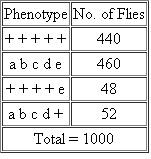 Why are many expected crossover phenotypes missing? Can any of these loci be mapped from the data given here? If so, determine map distances.
Why are many expected crossover phenotypes missing? Can any of these loci be mapped from the data given here? If so, determine map distances. Question
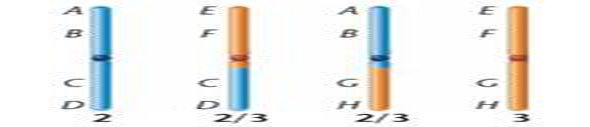
A woman who sought genetic counseling is found to be heterozygous for a chromosomal rearrangement between the second and third chromosomes. Her chromosomes, compared to those in a normal karyotype, are diagrammed to the right.
(a) What kind of chromosomal aberration is shown?
(b) Using a drawing, demonstrate how these chromosomes would pair during meiosis. Be sure to label the different segments of the chromosomes.
(c) This woman is phenotypically normal. Does this surprise you? Why or why not? Under what circumstances might you expect a phenotypic effect of such a rearrangement?
(a) What kind of chromosomal aberration is shown?
(b) Using a drawing, demonstrate how these chromosomes would pair during meiosis. Be sure to label the different segments of the chromosomes.
(c) This woman is phenotypically normal. Does this surprise you? Why or why not? Under what circumstances might you expect a phenotypic effect of such a rearrangement?
Question
Question
Question
Question
Question
To investigate the origin of nondisjunction, 200 human oocytes that had failed to be fertilized during in vitro fertilization procedures were subsequently examined (Angel, R. 1997. Am. J. Hum. Genet. 61: 23-32). These oocytes had completed meiosis I and were arrested in metaphase II (MII). The majority (67 percent) had a normal MII-metaphase complement, showing 23 chromosomes, each consisting of two sister chromatids joined at a common centromere. The remaining oocytes all had abnormal chromosome compositions. Surprisingly, when trisomy was considered, none of the abnormal oocytes had 24 chromosomes.
(a) Interpret these results in regard to the origin of trisomy, as it relates to nondisjunction, and when it occurs. Why are the results surprising?
(b) A large number of the abnormal oocytes contained 22 1 / 2 chromosomes; that is, 22 chromosomes plus a single chromatid representing the 1 / 2 chromosome. What chromosome compositions will result in the zygote if such oocytes proceed through meiosis and are fertilized by normal sperm?
(c) How could the complement of 22 1 / 2 chromosomes arise? Provide a drawing that includes several pairs of MII chromosomes.
(d) Do your answers support or dispute the generally accepted theory regarding nondisjunction and trisomy, as outlined in Figure?
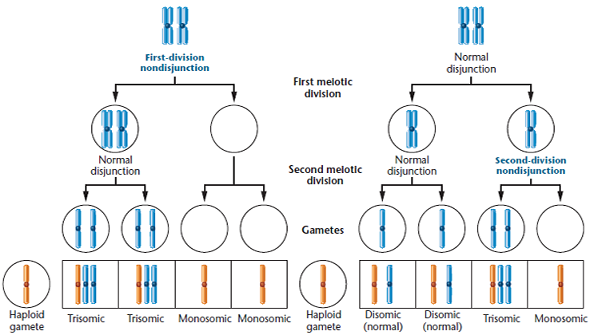
Figure Nondisjunction during the first and second meiotic divisions. In both cases, some of the gametes that are formed either contain two members of a specific chromosome or lack that chromosome. After fertilization by a gamete with a normal haploid content, monosomic, disomic (normal), or trisomic zygotes are produced.
(a) Interpret these results in regard to the origin of trisomy, as it relates to nondisjunction, and when it occurs. Why are the results surprising?
(b) A large number of the abnormal oocytes contained 22 1 / 2 chromosomes; that is, 22 chromosomes plus a single chromatid representing the 1 / 2 chromosome. What chromosome compositions will result in the zygote if such oocytes proceed through meiosis and are fertilized by normal sperm?
(c) How could the complement of 22 1 / 2 chromosomes arise? Provide a drawing that includes several pairs of MII chromosomes.
(d) Do your answers support or dispute the generally accepted theory regarding nondisjunction and trisomy, as outlined in Figure?
Figure Nondisjunction during the first and second meiotic divisions. In both cases, some of the gametes that are formed either contain two members of a specific chromosome or lack that chromosome. After fertilization by a gamete with a normal haploid content, monosomic, disomic (normal), or trisomic zygotes are produced.
Question
Question
Question

Unlock Deck
Sign up to unlock the cards in this deck!
Unlock Deck
Unlock Deck
1/35

Play

Full screen (f)
Deck 8: Chromosome Mutations: Variation in Number and Arrangement
1
Aquatic vegetation overgrowth, usually controlled by dredging or herbicides, represents a significant issue in maintaining private and public waterways. In 1963, diploid grass carp were introduced in Arkansas to consume vegetation, but they reproduced prodigiously and spread to eventually become a hazard to aquatic ecosystems in 35 states. In the 1980s, many states adopted triploid grass carp as an alternative because of their high, but not absolute, sterility level and their longevity of seven to ten years. Today, most states require permits for vegetation control by triploid carp, requiring their containment in the body of water to which they are introduced. Genetic modifications of organisms to achieve specific outcomes will certainly become more common in the future and raise several interesting questions.
Taking triploid carp as an example, what controversies may emerge as similar modified species become available for widespread use?
Taking triploid carp as an example, what controversies may emerge as similar modified species become available for widespread use?
If a similar genetically modified organism was to become available many controversies can arise. The organism may:
▪Compete with native species
▪Eliminate desirable vegetation
▪Carry diseases or parasites that can threaten the ecosystem
▪Escape to unauthorized ecosystems, environments, or water bodies
▪Alter food webs, trophic structures, and ecosystem equilibriums
Example:
When triploid carp are added to a lake, they disturb sediment and produce excess fecal matter. These extra nutrients lead to an increase in the population of algae, moss, and milfoil. When these organisms become overgrown, they can cloud the lake, changing the water from clear to green. This cloudiness can block sunlight and disturb plant growth. Fewer plants lead to less oxygen in the water. Oxygen levels are vital for a healthy lake.
The addition of the carp indirectly led to major changes in the ecosystem through a cascade of causes and effects.
▪Compete with native species
▪Eliminate desirable vegetation
▪Carry diseases or parasites that can threaten the ecosystem
▪Escape to unauthorized ecosystems, environments, or water bodies
▪Alter food webs, trophic structures, and ecosystem equilibriums
Example:
When triploid carp are added to a lake, they disturb sediment and produce excess fecal matter. These extra nutrients lead to an increase in the population of algae, moss, and milfoil. When these organisms become overgrown, they can cloud the lake, changing the water from clear to green. This cloudiness can block sunlight and disturb plant growth. Fewer plants lead to less oxygen in the water. Oxygen levels are vital for a healthy lake.
The addition of the carp indirectly led to major changes in the ecosystem through a cascade of causes and effects.
2
In this chapter, we have focused on chromosomal mutations resulting from a change in number or arrangement of chromosomes. In our discussions, we found many opportunities to consider the methods and reasoning by which much of this information was acquired. From the explanations given in the chapter, what answers would you propose to the following fundamental questions?
(a) How do we know that the extra chromosome causing Down syndrome is usually maternal in origin?
(b) How do we know that human aneuploidy for each of the 22 autosomes occurs at conception, even though most often human aneuploids do not survive embryonic or fetal development and thus are never observed at birth?
(c) How do we know that specific mutant phenotypes are due to changes in chromosome number or structure?
(d) How do we know that the mutant Bar-eye phenotype in Drosophila is due to a duplicated gene region rather than to a change in the nucleotide sequence of a gene?
(a) How do we know that the extra chromosome causing Down syndrome is usually maternal in origin?
(b) How do we know that human aneuploidy for each of the 22 autosomes occurs at conception, even though most often human aneuploids do not survive embryonic or fetal development and thus are never observed at birth?
(c) How do we know that specific mutant phenotypes are due to changes in chromosome number or structure?
(d) How do we know that the mutant Bar-eye phenotype in Drosophila is due to a duplicated gene region rather than to a change in the nucleotide sequence of a gene?
a)
There is a strong positive correlation between the mother's age and incidence. Older women tend to have children with more frequent incidences of Down syndrome. Using today's techniques, polymorphic markers are used to trace the origin of a chromosome to the parent who contributed it. The polymorphic markers physically attach themselves to the genetic material, which is traced. These polymorphic markers are used to determine that the extra chromosome that takes part in trisomy 21 (the trisomy that causes Down syndrome) is usually inherited from the mother.
b)
There is a strong relationship between aneuploidy in the 22 autosomes of humans and spontaneously aborted fetuses. When karyotypes are taken of spontaneously aborted fetus, we see a significant percentage of those abortuses to express aneuploidy, especially trisomies. The aneuploidy is seen to occur throughout the 22 autosomes.
c)
Studies on Drosophila , or the common fruit fly, produced a significant contribution to the realization that mutant phenotypes are due to changes in chromosome structure and/or number. Many studies, especially on the polytene chromosomes, in the flies lead to the realization that there is a relationship between phenotype and chromosome mutation.
d)
The mutated Bar-eye phenotype in Drosophila is caused by a duplicated gene region one of its chromosomes. This is in contrast to other types of mutations that may be caused by a mutation in the nucleotide sequence of a gene. Bridges and Muller were able to conclude that a duplicated gene region caused the Bar-eye phenotype by studying polytene chromosomes in these flies. They found that duplication in the 16A region, found in the X chromosome lead to the Bar-eye phenotype.
There is a strong positive correlation between the mother's age and incidence. Older women tend to have children with more frequent incidences of Down syndrome. Using today's techniques, polymorphic markers are used to trace the origin of a chromosome to the parent who contributed it. The polymorphic markers physically attach themselves to the genetic material, which is traced. These polymorphic markers are used to determine that the extra chromosome that takes part in trisomy 21 (the trisomy that causes Down syndrome) is usually inherited from the mother.
b)
There is a strong relationship between aneuploidy in the 22 autosomes of humans and spontaneously aborted fetuses. When karyotypes are taken of spontaneously aborted fetus, we see a significant percentage of those abortuses to express aneuploidy, especially trisomies. The aneuploidy is seen to occur throughout the 22 autosomes.
c)
Studies on Drosophila , or the common fruit fly, produced a significant contribution to the realization that mutant phenotypes are due to changes in chromosome structure and/or number. Many studies, especially on the polytene chromosomes, in the flies lead to the realization that there is a relationship between phenotype and chromosome mutation.
d)
The mutated Bar-eye phenotype in Drosophila is caused by a duplicated gene region one of its chromosomes. This is in contrast to other types of mutations that may be caused by a mutation in the nucleotide sequence of a gene. Bridges and Muller were able to conclude that a duplicated gene region caused the Bar-eye phenotype by studying polytene chromosomes in these flies. They found that duplication in the 16A region, found in the X chromosome lead to the Bar-eye phenotype.
3
Aquatic vegetation overgrowth, usually controlled by dredging or herbicides, represents a significant issue in maintaining private and public waterways. In 1963, diploid grass carp were introduced in Arkansas to consume vegetation, but they reproduced prodigiously and spread to eventually become a hazard to aquatic ecosystems in 35 states. In the 1980s, many states adopted triploid grass carp as an alternative because of their high, but not absolute, sterility level and their longevity of seven to ten years. Today, most states require permits for vegetation control by triploid carp, requiring their containment in the body of water to which they are introduced. Genetic modifications of organisms to achieve specific outcomes will certainly become more common in the future and raise several interesting questions.
If you were a state employee in charge of a specific waterway, what questions would you ask before you approved the introduction of a laboratory-produced, polyploid species into your waterway?
If you were a state employee in charge of a specific waterway, what questions would you ask before you approved the introduction of a laboratory-produced, polyploid species into your waterway?
Some questions a state employee would ask before allowing laboratory-produced fish into the waterway would be:
▪What do they eat?
▪How likely are they to reproduce?
▪If their population gets out of hand, is it controllable?
▪Is there a natural predator?
▪How will it affect the natural species?
▪How much will it cost?
▪What do they eat?
▪How likely are they to reproduce?
▪If their population gets out of hand, is it controllable?
▪Is there a natural predator?
▪How will it affect the natural species?
▪How much will it cost?
4
Review the Chapter Concepts list. These all center around chromosome aberrations that create variations from the "normal" diploid genome. Write a short essay that discusses five altered phenotypes that result from specific chromosomal aberrations.
▪The failure of chromosomes to properly separate during meiosis results in variation in the chromosome content of gametes and subsequently in offspring arising from such gametes.
▪Plants often tolerate an abnormal genetic content, but, as a result, they often manifest unique phenotypes.
Such genetic variation has been an important factor in the evolution of plants.
▪In animals, genetic information is in a delicate equilibrium whereby the gain or loss of a chromosome, or part of a chromosome, in an otherwise diploid organism often leads to lethality or to an abnormal phenotype.
▪The rearrangement of genetic information within the genome of a diploid organism may be tolerated by that organism but may affect the viability of gametes and the phenotypes of organisms arising from those gametes.
▪Chromosomes in humans contain fragile sites-regions susceptible to breakage, which lead to abnormal phenotypes.
▪The failure of chromosomes to properly separate during meiosis results in variation in the chromosome content of gametes and subsequently in offspring arising from such gametes.
▪Plants often tolerate an abnormal genetic content, but, as a result, they often manifest unique phenotypes.
Such genetic variation has been an important factor in the evolution of plants.
▪In animals, genetic information is in a delicate equilibrium whereby the gain or loss of a chromosome, or part of a chromosome, in an otherwise diploid organism often leads to lethality or to an abnormal phenotype.
▪The rearrangement of genetic information within the genome of a diploid organism may be tolerated by that organism but may affect the viability of gametes and the phenotypes of organisms arising from those gametes.
▪Chromosomes in humans contain fragile sites-regions susceptible to breakage, which lead to abnormal phenotypes.
Unlock Deck
Unlock for access to all 35 flashcards in this deck.
Unlock Deck
k this deck
5
Aquatic vegetation overgrowth, usually controlled by dredging or herbicides, represents a significant issue in maintaining private and public waterways. In 1963, diploid grass carp were introduced in Arkansas to consume vegetation, but they reproduced prodigiously and spread to eventually become a hazard to aquatic ecosystems in 35 states. In the 1980s, many states adopted triploid grass carp as an alternative because of their high, but not absolute, sterility level and their longevity of seven to ten years. Today, most states require permits for vegetation control by triploid carp, requiring their containment in the body of water to which they are introduced. Genetic modifications of organisms to achieve specific outcomes will certainly become more common in the future and raise several interesting questions.
Why would the creation and use of a tetraploid carp species be less desirable in the above situation?
Why would the creation and use of a tetraploid carp species be less desirable in the above situation?
Unlock Deck
Unlock for access to all 35 flashcards in this deck.
Unlock Deck
k this deck
6
Define these pairs of terms, and distinguish between them.
aneuploidy/euploidy
monosomy/trisomy
Patau syndrome/Edwards syndrome
autopolyploidy/allopolyploidy
autotetraploid/amphidiploid
paracentric inversion/pericentric inversion
aneuploidy/euploidy
monosomy/trisomy
Patau syndrome/Edwards syndrome
autopolyploidy/allopolyploidy
autotetraploid/amphidiploid
paracentric inversion/pericentric inversion
Unlock Deck
Unlock for access to all 35 flashcards in this deck.
Unlock Deck
k this deck
7
For a species with a diploid number of 18, indicate how many chromosomes will be present in the somatic nuclei of individuals that are haploid, triploid, tetraploid, trisomic, and monosomic.
Unlock Deck
Unlock for access to all 35 flashcards in this deck.
Unlock Deck
k this deck
8
What evidence suggests that Down syndrome is more often the result of nondisjunction during oogenesis rather than during spermatogenesis?
Unlock Deck
Unlock for access to all 35 flashcards in this deck.
Unlock Deck
k this deck
9
What evidence indicates that humans with aneuploid karyotypes occur at conception but are usually inviable?
Unlock Deck
Unlock for access to all 35 flashcards in this deck.
Unlock Deck
k this deck
10
Contrast the fertility of an allotetraploid with an autotriploid and an autotetraploid.
Unlock Deck
Unlock for access to all 35 flashcards in this deck.
Unlock Deck
k this deck
11
Describe the origin of cultivated American cotton.
Unlock Deck
Unlock for access to all 35 flashcards in this deck.
Unlock Deck
k this deck
12
Predict how the synaptic configurations of homologous pairs of chromosomes might appear when one member is normal and the other member has sustained a deletion or duplication.
Unlock Deck
Unlock for access to all 35 flashcards in this deck.
Unlock Deck
k this deck
13
Inversions are said to "suppress crossing over." Is this terminology technically correct? If not, restate the description accurately.
Unlock Deck
Unlock for access to all 35 flashcards in this deck.
Unlock Deck
k this deck
14
Contrast the genetic composition of gametes derived from tetrads of inversion heterozygotes where crossing over occurs within a paracentric versus a pericentric inversion.
Unlock Deck
Unlock for access to all 35 flashcards in this deck.
Unlock Deck
k this deck
15
Human adult hemoglobin is a tetramer containing two alpha ( ? ) and two beta ( ? ) polypeptide chains. The ? gene cluster on chromosome 16 and the ? gene cluster on chromosome 11 share amino acid similarities such that 61 of the amino acids of the ? -globin polypeptide (141 amino acids long) are shared in identical sequence with the b-globin polypeptide (146 amino acids long). How might one explain the existence of two polypeptides with partially shared function and structure on two different chromosomes?
Unlock Deck
Unlock for access to all 35 flashcards in this deck.
Unlock Deck
k this deck
16
Discuss Ohno's hypothesis on the role of gene duplication in the process of evolution. What evidence supports this hypothesis?
Unlock Deck
Unlock for access to all 35 flashcards in this deck.
Unlock Deck
k this deck
17
What roles have inversions and translocations played in the evolutionary process?
Unlock Deck
Unlock for access to all 35 flashcards in this deck.
Unlock Deck
k this deck
18
The primrose, Primula kewensis , has 36 chromosomes that are similar in appearance to the chromosomes in two related species, P. floribunda (2 n = 18) and P. verticillata (2 n = 18). How could P. kewensis arise from these species? How would you describe P. kewensis in genetic terms?
Unlock Deck
Unlock for access to all 35 flashcards in this deck.
Unlock Deck
k this deck
19
Certain varieties of chrysanthemums contain 18, 36, 54, 72, and 90 chromosomes; all are multiples of a basic set of nine chromosomes. How would you describe these varieties genetically? What feature do the karyotypes of each variety share? A variety with 27 chromosomes has been discovered, but it is sterile. Why?
Unlock Deck
Unlock for access to all 35 flashcards in this deck.
Unlock Deck
k this deck
20
Drosophila may be monosomic for chromosome 4, yet remain fertile. Contrast the F 1 and F 2 results of the following crosses involving the recessive chromosome 4 trait, bent bristles: (a) monosomic IV, bent bristles × diploid, normal bristles; (b) monosomic IV, normal bristles × diploid, bent bristles.
Unlock Deck
Unlock for access to all 35 flashcards in this deck.
Unlock Deck
k this deck
21
Mendelian ratios are modified in crosses involving auto-tetraploids. Assume that one plant expresses the dominant trait green seeds and is homozygous ( WWWW ). This plant is crossed to one with white seeds that is also homozygous ( wwww ). If only one dominant allele is sufficient to produce green seeds, predict the F 1 and F 2 results of such a cross. Assume that synapsis between chromosome pairs is random during meiosis.
Unlock Deck
Unlock for access to all 35 flashcards in this deck.
Unlock Deck
k this deck
22
Having correctly established the F 2 ratio in Problem 18, predict the F 2 ratio of a "dihybrid" cross involving two independently assorting characteristics (e.g., P 1 = WWWWAAAA × wwwwaaaa ).
Unlock Deck
Unlock for access to all 35 flashcards in this deck.
Unlock Deck
k this deck
23
The mutations called bobbed in Drosophila result from variable reductions (deletions) in the number of amplified genes coding for rRNA. Researchers trying to maintain bobbed stocks have often documented their tendency to revert to wild type in successive generations. Propose a mechanism based on meiotic recombination which could account for this reversion phenomenon. Why would wild-type flies become more prevalent in Drosophila cultures?
Unlock Deck
Unlock for access to all 35 flashcards in this deck.
Unlock Deck
k this deck
24
The outcome of a single crossover between nonsister chromatids in the inversion loop of an inversion heterozygote varies depending on whether the inversion is of the paracentric or pericentric type. What differences are expected?
Unlock Deck
Unlock for access to all 35 flashcards in this deck.
Unlock Deck
k this deck
25
A couple planning their family are aware that through the past three generations on the husband's side a substantial number of stillbirths have occurred and several malformed babies were born who died early in childhood. The wife has studied genetics and urges her husband to visit a genetic counseling clinic, where a complete karyotype-banding analysis is performed. Although the tests show that he has a normal complement of 46 chromosomes, banding analysis reveals that one member of the chromosome 1 pair (in group A) contains an inversion covering 70 percent of its length. The homolog of chromosome 1 and all other chromosomes show the normal banding sequence.
(a) How would you explain the high incidence of past stillbirths?
(b) What can you predict about the probability of abnormality/normality of their future children?
(c) Would you advise the woman that she will have to bring each pregnancy to term to determine whether the fetus is normal? If not, what else can you suggest?
(a) How would you explain the high incidence of past stillbirths?
(b) What can you predict about the probability of abnormality/normality of their future children?
(c) Would you advise the woman that she will have to bring each pregnancy to term to determine whether the fetus is normal? If not, what else can you suggest?
Unlock Deck
Unlock for access to all 35 flashcards in this deck.
Unlock Deck
k this deck
26
In a cross in Drosophila, a female heterozygous for the autosomally linked genes a , b , c , d , and e ( abode / + + + + + ) was testcrossed with a male homozygous for all recessive alleles. Even though the distance between each of the loci was at least 3 map units, only four phenotypes were recovered, yielding the following data:
Why are many expected crossover phenotypes missing? Can any of these loci be mapped from the data given here? If so, determine map distances.
Why are many expected crossover phenotypes missing? Can any of these loci be mapped from the data given here? If so, determine map distances. Unlock Deck
Unlock for access to all 35 flashcards in this deck.
Unlock Deck
k this deck
27
A woman who sought genetic counseling is found to be heterozygous for a chromosomal rearrangement between the second and third chromosomes. Her chromosomes, compared to those in a normal karyotype, are diagrammed to the right.
(a) What kind of chromosomal aberration is shown?
(b) Using a drawing, demonstrate how these chromosomes would pair during meiosis. Be sure to label the different segments of the chromosomes.
(c) This woman is phenotypically normal. Does this surprise you? Why or why not? Under what circumstances might you expect a phenotypic effect of such a rearrangement?
(a) What kind of chromosomal aberration is shown?
(b) Using a drawing, demonstrate how these chromosomes would pair during meiosis. Be sure to label the different segments of the chromosomes.
(c) This woman is phenotypically normal. Does this surprise you? Why or why not? Under what circumstances might you expect a phenotypic effect of such a rearrangement?
Unlock Deck
Unlock for access to all 35 flashcards in this deck.
Unlock Deck
k this deck
28
The woman in Problem 24 has had two miscarriages. She has come to you, an established genetic counselor, with these questions: Is there a genetic explanation of her frequent miscarriages? Should she abandon her attempts to have a child of her own? If not, what is the chance that she could have a normal child? Provide an informed response to her concerns.
Unlock Deck
Unlock for access to all 35 flashcards in this deck.
Unlock Deck
k this deck
29
In a recent cytogenetic study on 1021 cases of Down syndrome, 46 were the result of translocations, the most frequent of which was symbolized as t(14;21). What does this symbol represent, and how many chromosomes would you expect to be present in t(14;21) Down syndrome individuals?
Unlock Deck
Unlock for access to all 35 flashcards in this deck.
Unlock Deck
k this deck
30
A boy with Klinefelter syndrome (47, XXY) is born to a mother who is phenotypically normal and a father who has the X-linked skin condition called anhidrotic ectodermal dysplasia. The mother's skin is completely normal with no signs of the skin abnormality. In contrast, her son has patches of normal skin and patches of abnormal skin.
(a) Which parent contributed the abnormal gamete?
(b) Using the appropriate genetic terminology, describe the meiotic mistake that occurred. Be sure to indicate in which division the mistake occurred.
(c) Using the appropriate genetic terminology, explain the son's skin phenotype.
(a) Which parent contributed the abnormal gamete?
(b) Using the appropriate genetic terminology, describe the meiotic mistake that occurred. Be sure to indicate in which division the mistake occurred.
(c) Using the appropriate genetic terminology, explain the son's skin phenotype.
Unlock Deck
Unlock for access to all 35 flashcards in this deck.
Unlock Deck
k this deck
31
Most cases of Turner syndrome are attributed to nondisjunction of one or more of the sex chromosomes during gametogenesis, from either the male or female parent. However, some females possess a rare form of Turner syndrome in which some of the cells of the body (somatic cells) lack an X chromosome, while other cells have the normal two X chromosomes. Often detected in blood and/or skin cells, such individuals with mosaic Turner syndrome may exhibit relatively mild symptoms. An individual may be specified as 45,X(20)/46,XX(80) if, for example, 20 percent of the cells examined were X monosomic. How might mitotic events cause such mosaicism, and what parameter(s) would likely determine the percentages and distributions of X0 cells?
Unlock Deck
Unlock for access to all 35 flashcards in this deck.
Unlock Deck
k this deck
32
To investigate the origin of nondisjunction, 200 human oocytes that had failed to be fertilized during in vitro fertilization procedures were subsequently examined (Angel, R. 1997. Am. J. Hum. Genet. 61: 23-32). These oocytes had completed meiosis I and were arrested in metaphase II (MII). The majority (67 percent) had a normal MII-metaphase complement, showing 23 chromosomes, each consisting of two sister chromatids joined at a common centromere. The remaining oocytes all had abnormal chromosome compositions. Surprisingly, when trisomy was considered, none of the abnormal oocytes had 24 chromosomes.
(a) Interpret these results in regard to the origin of trisomy, as it relates to nondisjunction, and when it occurs. Why are the results surprising?
(b) A large number of the abnormal oocytes contained 22 1 / 2 chromosomes; that is, 22 chromosomes plus a single chromatid representing the 1 / 2 chromosome. What chromosome compositions will result in the zygote if such oocytes proceed through meiosis and are fertilized by normal sperm?
(c) How could the complement of 22 1 / 2 chromosomes arise? Provide a drawing that includes several pairs of MII chromosomes.
(d) Do your answers support or dispute the generally accepted theory regarding nondisjunction and trisomy, as outlined in Figure?
Figure Nondisjunction during the first and second meiotic divisions. In both cases, some of the gametes that are formed either contain two members of a specific chromosome or lack that chromosome. After fertilization by a gamete with a normal haploid content, monosomic, disomic (normal), or trisomic zygotes are produced.
(a) Interpret these results in regard to the origin of trisomy, as it relates to nondisjunction, and when it occurs. Why are the results surprising?
(b) A large number of the abnormal oocytes contained 22 1 / 2 chromosomes; that is, 22 chromosomes plus a single chromatid representing the 1 / 2 chromosome. What chromosome compositions will result in the zygote if such oocytes proceed through meiosis and are fertilized by normal sperm?
(c) How could the complement of 22 1 / 2 chromosomes arise? Provide a drawing that includes several pairs of MII chromosomes.
(d) Do your answers support or dispute the generally accepted theory regarding nondisjunction and trisomy, as outlined in Figure?
Figure Nondisjunction during the first and second meiotic divisions. In both cases, some of the gametes that are formed either contain two members of a specific chromosome or lack that chromosome. After fertilization by a gamete with a normal haploid content, monosomic, disomic (normal), or trisomic zygotes are produced.
Unlock Deck
Unlock for access to all 35 flashcards in this deck.
Unlock Deck
k this deck
33
A 3-year-old child exhibited some early indication of Turner syndrome, which results from a 45, X chromosome composition. Karyotypic analysis demonstrated two cell types: 46, XX (normal) and 45, X. Propose a mechanism for the origin of this mosaicism.
Unlock Deck
Unlock for access to all 35 flashcards in this deck.
Unlock Deck
k this deck
34
A normal female is discovered with 45 chromosomes, one of which exhibits a Robertsonian translocation containing most of chromosomes 15 and 21. Discuss the possible outcomes in her offspring when her husband contains a normal karyotype.
Unlock Deck
Unlock for access to all 35 flashcards in this deck.
Unlock Deck
k this deck
35
Prader-Willi and Angelman syndromes are human conditions that result in part through the process of genomic imprinting, where a particular gene is "marked" during gamete formation in the parent of origin. In the case of these two syndromes, a portion of the long arm of chromosome 15 (15q11 to 15q13) is imprinted. Another condition, Beckwith-Wiedemann syndrome (accelerated growth and increased risk of cancer), is associated with abnormalities of imprinted genes on the short arm of chromosome 11. All three of the above syndromes occur when imprinted sequences become abnormally exposed by some genetic or chromosomal event. One such event is uniparental disomy (UPD), in which a person receives two homologs of one chromosome (or part of a chromosome) from one parent and no homolog from the other. In many cases, UPD is without consequence; however, if chromosome 11 or 15 is involved, then, coupled with genomic imprinting, complications can arise. Listed below are possible origins of UPD. Provide a diagram and explanation for each.
1. Trisomic rescue : loss of a chromosome in a trisomic zygote
2. Monosomic rescue : gain of a chromosome in a monosomic zygote
3. Gamete complementation : fertilization of a gamete with two copies of a chromosome by a gamete with no copies of that chromosome
4. Isochromosome formation : a chromosome that contains two copies of an arm (15q-15q, for example) rather than one.
1. Trisomic rescue : loss of a chromosome in a trisomic zygote
2. Monosomic rescue : gain of a chromosome in a monosomic zygote
3. Gamete complementation : fertilization of a gamete with two copies of a chromosome by a gamete with no copies of that chromosome
4. Isochromosome formation : a chromosome that contains two copies of an arm (15q-15q, for example) rather than one.
Unlock Deck
Unlock for access to all 35 flashcards in this deck.
Unlock Deck
k this deck
Unlock Deck
Unlock for access to all 35 flashcards in this deck.







