





 Chat with AI

Deck 7: Sex Determination and Sex Chromosomes
Full screen (f)

Question

Question
Question
Question
Question
Question
Question
Question
Question
Question
Question
Question
Question
Question
Question
Question
Question
Question
An attached-X female fly,
 ▪(see the "Insights and Solutions" box), expresses the recessive X-linked white -eye mutation. It is crossed to a male fly that expresses the X-linked recessive miniature -wing mutation. Determine the outcome of this cross in terms of sex, eye color, and wing size of the offspring.
▪(see the "Insights and Solutions" box), expresses the recessive X-linked white -eye mutation. It is crossed to a male fly that expresses the X-linked recessive miniature -wing mutation. Determine the outcome of this cross in terms of sex, eye color, and wing size of the offspring. Question
Assume that on rare occasions the attached X chromosomes in female gametes become unattached. Based on the parental phenotypes in Problem , what outcomes in the F 1 generation would indicate that this has occurred during female meiosis?
An attached-X female fly,
 ▪Y (see the "Insights and Solutions" box), expresses the recessive X-linked white -eye mutation. It is crossed to a male fly that expresses the X-linked recessive miniature -wing mutation. Determine the outcome of this cross in terms of sex, eye color, and wing size of the offspring.
An attached-X female fly,
▪Y (see the "Insights and Solutions" box), expresses the recessive X-linked white -eye mutation. It is crossed to a male fly that expresses the X-linked recessive miniature -wing mutation. Determine the outcome of this cross in terms of sex, eye color, and wing size of the offspring. Question
Question
Question
Question
Question
Question
Question
Question
Question
Question
Question
Question
Question
Question
Question
Question
Question
Question
When the cloned cat Carbon Copy (CC) was born (see the Now Solve This question), she had black patches and white patches, but completely lacked any orange patches. The knowledgeable students of genetics were not surprised at this outcome. Starting with the somatic ovarian cell used as the source of the nucleus in the cloning process, explain how this outcome occurred.
NOW SOLVE THIS
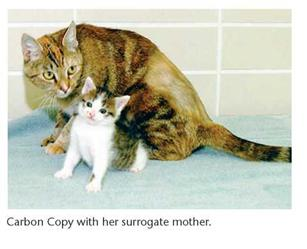
7-3 CC (Carbon Copy), the first cat produced from a clone, was created from an ovarian cell taken from her genetic donor, Rainbow, a calico cat. The diploid nucleus from the cell was extracted and then injected into an enucleated egg. The resulting zygote was then allowed to develop in a petri dish, and the cloned embryo was implanted in the uterus of a surrogate mother cat, who gave birth to CC. CC's surrogate mother was a tabby (see the photo at the end of this chapter). Geneticists were very interested in the outcome of cloning a calico cat, because they were not certain if the cat would have patches of orange and black, just orange, or just black. Taking into account the Lyon hypothesis, explain the basis of the uncertainty. Would you expect CC to appear identical to Rainbow? Explain why or why not.
HINT : This problem involves an understanding of the Lyon hypothesis. The key to its solution is to realize that the donor nucleus was from a differentiated ovarian cell of an adult female cat, which itself had inactivated one of its X chromosomes.
NOW SOLVE THIS
7-3 CC (Carbon Copy), the first cat produced from a clone, was created from an ovarian cell taken from her genetic donor, Rainbow, a calico cat. The diploid nucleus from the cell was extracted and then injected into an enucleated egg. The resulting zygote was then allowed to develop in a petri dish, and the cloned embryo was implanted in the uterus of a surrogate mother cat, who gave birth to CC. CC's surrogate mother was a tabby (see the photo at the end of this chapter). Geneticists were very interested in the outcome of cloning a calico cat, because they were not certain if the cat would have patches of orange and black, just orange, or just black. Taking into account the Lyon hypothesis, explain the basis of the uncertainty. Would you expect CC to appear identical to Rainbow? Explain why or why not.
HINT : This problem involves an understanding of the Lyon hypothesis. The key to its solution is to realize that the donor nucleus was from a differentiated ovarian cell of an adult female cat, which itself had inactivated one of its X chromosomes.
Question
Question
Question

Unlock Deck
Sign up to unlock the cards in this deck!
Unlock Deck
Unlock Deck
1/40

Play

Full screen (f)
Deck 7: Sex Determination and Sex Chromosomes
1
A dog breeder discovers one of her male puppies has abnormal genitalia. After a visit to the veterinary clinic at a nearby university, the breeder learns that the dog's karyotype lacks a Y chromosome, and instead has an XX chromosome pair, with one of the X chromosomes slightly larger than usual (being mammals, male dogs are normally XY and females are XX). The veterinarian tells her that in other breeds, some females display an XY chromosome pair, with the Y chromosome being slightly shorter than normal. These observations raise several interesting questions:
Can you speculate as to how the chromosomal composition of the breeder's dog led to its ambiguous sexuality?
Can you speculate as to how the chromosomal composition of the breeder's dog led to its ambiguous sexuality?
If the dog's genotype is XX and the dog lacks a Y chromosome, this can lead to questionable sexuality. In mammals, the X chromosome is larger than the Y chromosome. If, in the puppy in question, one of the X chromosomes is slightly larger than the other X chromosome, this gives the size illusion of XY relationship, with actual XX genotypes. This confusion can lead to the ambiguous sexuality that the dog actually expresses.
2
In this chapter, we focused on sex differentiation, sex chromosomes, and genetic mechanisms involved in sex determination. At the same time, we found many opportunities to consider the methods and reasoning by which much of this information was acquired. From the explanations given in the chapter, what answers would you propose to the following fundamental questions?
(a) How do we know that specific genes in maize play a role in sexual differentiation?
(b) How do we know whether or not a heteromorphic chromosome such as the Y chromosome plays a crucial role in the determination of sex?
(c) How do we know that in humans the X chromosomes play no role in human sex determination, while the Y chromosome causes maleness and its absence causes femaleness?
(d) How did we learn that, although the sex ratio at birth in humans favors males slightly, the sex ratio at conception favors them much more?
(e) How do we know that Drosophila utilizes a different sex-determination mechanism than mammals, even though it has the same sex-chromosome compositions in males and females?
(f) How do we know that X chromosomal inactivation of either the paternal or maternal homolog is a random event during early development in mammalian females?
(a) How do we know that specific genes in maize play a role in sexual differentiation?
(b) How do we know whether or not a heteromorphic chromosome such as the Y chromosome plays a crucial role in the determination of sex?
(c) How do we know that in humans the X chromosomes play no role in human sex determination, while the Y chromosome causes maleness and its absence causes femaleness?
(d) How did we learn that, although the sex ratio at birth in humans favors males slightly, the sex ratio at conception favors them much more?
(e) How do we know that Drosophila utilizes a different sex-determination mechanism than mammals, even though it has the same sex-chromosome compositions in males and females?
(f) How do we know that X chromosomal inactivation of either the paternal or maternal homolog is a random event during early development in mammalian females?
(a)
Sexual differentiation in maize ( Zea mays ) is controlled by certain genes such as the tassel seed gene, silkless gene or barren stalk gene. It was determined that the genes were necessary for maize sexual differentiation because when the genes were mutated the sexual differentiation was interrupted.
With the tassel seed ( ts1 or ts2 ) mutation the maize plant failed to differentiate male tassels. This created an all-female plant. Likewise, if the plant had a silkless or barren stalk mutation the plant failed to form the pistil. This created an all-male plant.
(b)If a heteromorphic chromosome plays a role in sex determination then during meiosis either the female or the male will produce non-identical gametes. Embryos that contain the Y chromosome develop into a sex different from the embryo that has two X chromosomes.
(c)The sexual determination role of the Y chromosome was determined because of the different aneuoploids humans can have. For instance, humans with Turner syndrome with an XO sex chromosome composition only exhibit female characteristics. Another case, the XXY sex chromosome composition for Klinefelter syndrome, produces humans that have male genitalia, but since there are two X chromosomes the Y chromosome cannot sufficiently suppress all the female sex development.
However, although the X chromosome is not necessary for sexual determination, it contains genes vital to the viability of the embryo. This is why no OO or YO sex chromosome aneuoploids are seen.
(d)Sex determination in humans is dependent upon the composition of the sex chromosomes. XX yields a female and XY yields a male. Some scientists expected that the primary sex ratio, the ratio of males to females conceived, should be 50:50 because the sperm has the same probability of carrying either an X chromosome or a Y chromosome.
The primary sex ratio is determined by recording the sexes of the fetuses after an abortion or miscarriage. These numbers along with the genders of the children that made it to term are all added together to create the ratio.
(e)Drosophila flies generally have the same sex chromosome characteristics of humans, the male flies have X and Y chromosomes and the female has two X chromosomes. However, Calvin Bridges concluded that the sexual determination of the flies was not orchestrated by which sex chromosomes the fly had. Instead, sexual determination was governed based on the ration of X chromosomes compared to the amount of haploid sets of autosomal chromosomes.
Therefore, if a fly has two sets of autosomal chromosomes, but has XXY sex chromosomes the fly would be female because the ratio would be one. A ratio of one is female, while a ratio of 0.5 is male. Any ration in between these two is considered intersex - male and female characteristics.
(f)The inactivation of the X chromosome in female mammals is known to be random because of phenotypic variation. Some coat color genes are located on the X chromosome; either chromosome can have a different color.
Therefore if the inactivation of the X chromosome was not random then the animal would be one single color. However this is not the case. Calico and tortoiseshell cats, which have X-linked coat colors, show many different patterns and mixes of their two colors.
Sexual differentiation in maize ( Zea mays ) is controlled by certain genes such as the tassel seed gene, silkless gene or barren stalk gene. It was determined that the genes were necessary for maize sexual differentiation because when the genes were mutated the sexual differentiation was interrupted.
With the tassel seed ( ts1 or ts2 ) mutation the maize plant failed to differentiate male tassels. This created an all-female plant. Likewise, if the plant had a silkless or barren stalk mutation the plant failed to form the pistil. This created an all-male plant.
(b)If a heteromorphic chromosome plays a role in sex determination then during meiosis either the female or the male will produce non-identical gametes. Embryos that contain the Y chromosome develop into a sex different from the embryo that has two X chromosomes.
(c)The sexual determination role of the Y chromosome was determined because of the different aneuoploids humans can have. For instance, humans with Turner syndrome with an XO sex chromosome composition only exhibit female characteristics. Another case, the XXY sex chromosome composition for Klinefelter syndrome, produces humans that have male genitalia, but since there are two X chromosomes the Y chromosome cannot sufficiently suppress all the female sex development.
However, although the X chromosome is not necessary for sexual determination, it contains genes vital to the viability of the embryo. This is why no OO or YO sex chromosome aneuoploids are seen.
(d)Sex determination in humans is dependent upon the composition of the sex chromosomes. XX yields a female and XY yields a male. Some scientists expected that the primary sex ratio, the ratio of males to females conceived, should be 50:50 because the sperm has the same probability of carrying either an X chromosome or a Y chromosome.
The primary sex ratio is determined by recording the sexes of the fetuses after an abortion or miscarriage. These numbers along with the genders of the children that made it to term are all added together to create the ratio.
(e)Drosophila flies generally have the same sex chromosome characteristics of humans, the male flies have X and Y chromosomes and the female has two X chromosomes. However, Calvin Bridges concluded that the sexual determination of the flies was not orchestrated by which sex chromosomes the fly had. Instead, sexual determination was governed based on the ration of X chromosomes compared to the amount of haploid sets of autosomal chromosomes.
Therefore, if a fly has two sets of autosomal chromosomes, but has XXY sex chromosomes the fly would be female because the ratio would be one. A ratio of one is female, while a ratio of 0.5 is male. Any ration in between these two is considered intersex - male and female characteristics.
(f)The inactivation of the X chromosome in female mammals is known to be random because of phenotypic variation. Some coat color genes are located on the X chromosome; either chromosome can have a different color.
Therefore if the inactivation of the X chromosome was not random then the animal would be one single color. However this is not the case. Calico and tortoiseshell cats, which have X-linked coat colors, show many different patterns and mixes of their two colors.
3
A dog breeder discovers one of her male puppies has abnormal genitalia. After a visit to the veterinary clinic at a nearby university, the breeder learns that the dog's karyotype lacks a Y chromosome, and instead has an XX chromosome pair, with one of the X chromosomes slightly larger than usual (being mammals, male dogs are normally XY and females are XX). The veterinarian tells her that in other breeds, some females display an XY chromosome pair, with the Y chromosome being slightly shorter than normal. These observations raise several interesting questions:
How could such a case be used to locate the gene(s) responsible for maleness?
How could such a case be used to locate the gene(s) responsible for maleness?
By determining which portions of the Y chromosome were recombined with the X chromosome, the regions containing genes important for maleness can be isolated. If a dog was missing a region of its Y chromosome due to recombination in the parent and did not develop normal gonads, it can be concluded that genes necessary for male sexual development were located within that region.
4
Review the Chapter Concepts. These all center around sex determination or the expression of genes encoded on sex chromosomes. Write a short essay that discusses sex chromosomes as they contrast with autosomes.
CHAPTER CONCEPTS
▪A variety of mechanisms have evolved that result in sexual differentiation, leading to sexual dimorphism and greatly enhancing the production of genetic variation within species.
▪Often, specific genes, usually on a single chromosome, cause maleness or femaleness during development.
▪In humans, the presence of extra X or Y chromosomes
beyond the diploid number may be tolerated but often leads to syndromes demonstrating distinctive phenotypes.
▪While segregation of sex-determining chromosomes should theoretically lead to a one-to-one sex ratio of males to females, in humans the actual ratio greatly favors males at conception.
▪In mammals, females inherit two X chromosomes compared to one in males, but the extra genetic information in females is compensated for by random inactivation of one of the X chromosomes early in development.
▪In some reptilian species, temperature during incubation of eggs determines the sex of offspring.
CHAPTER CONCEPTS
▪A variety of mechanisms have evolved that result in sexual differentiation, leading to sexual dimorphism and greatly enhancing the production of genetic variation within species.
▪Often, specific genes, usually on a single chromosome, cause maleness or femaleness during development.
▪In humans, the presence of extra X or Y chromosomes
beyond the diploid number may be tolerated but often leads to syndromes demonstrating distinctive phenotypes.
▪While segregation of sex-determining chromosomes should theoretically lead to a one-to-one sex ratio of males to females, in humans the actual ratio greatly favors males at conception.
▪In mammals, females inherit two X chromosomes compared to one in males, but the extra genetic information in females is compensated for by random inactivation of one of the X chromosomes early in development.
▪In some reptilian species, temperature during incubation of eggs determines the sex of offspring.
Unlock Deck
Unlock for access to all 40 flashcards in this deck.
Unlock Deck
k this deck
5
A dog breeder discovers one of her male puppies has abnormal genitalia. After a visit to the veterinary clinic at a nearby university, the breeder learns that the dog's karyotype lacks a Y chromosome, and instead has an XX chromosome pair, with one of the X chromosomes slightly larger than usual (being mammals, male dogs are normally XY and females are XX). The veterinarian tells her that in other breeds, some females display an XY chromosome pair, with the Y chromosome being slightly shorter than normal. These observations raise several interesting questions:
Suppose you discover a female dog with a normal-sized XY chromosome pair. What kind of mutation might be involved in this case?
Suppose you discover a female dog with a normal-sized XY chromosome pair. What kind of mutation might be involved in this case?
Unlock Deck
Unlock for access to all 40 flashcards in this deck.
Unlock Deck
k this deck
6
Contrast the life cycle of a plant such as Zea mays with an animal such as C. elegans.
Unlock Deck
Unlock for access to all 40 flashcards in this deck.
Unlock Deck
k this deck
7
A dog breeder discovers one of her male puppies has abnormal genitalia. After a visit to the veterinary clinic at a nearby university, the breeder learns that the dog's karyotype lacks a Y chromosome, and instead has an XX chromosome pair, with one of the X chromosomes slightly larger than usual (being mammals, male dogs are normally XY and females are XX). The veterinarian tells her that in other breeds, some females display an XY chromosome pair, with the Y chromosome being slightly shorter than normal. These observations raise several interesting questions:
Suppose you discover a female dog with only a single X chromosome. What predictions might you make about the sex organs and reproductive capacity of this dog?
Suppose you discover a female dog with only a single X chromosome. What predictions might you make about the sex organs and reproductive capacity of this dog?
Unlock Deck
Unlock for access to all 40 flashcards in this deck.
Unlock Deck
k this deck
8
Distinguish between the terms homomorphic and heteromor-phic chromosomes , and between isogamous and heterogamous organisms.
Unlock Deck
Unlock for access to all 40 flashcards in this deck.
Unlock Deck
k this deck
9
Distinguish between the concepts of sexual differentiation and sex determination.
Unlock Deck
Unlock for access to all 40 flashcards in this deck.
Unlock Deck
k this deck
10
Contrast the XX/XY and XX/X0 modes of sex determination.
Unlock Deck
Unlock for access to all 40 flashcards in this deck.
Unlock Deck
k this deck
11
Describe the major difference between sex determination in Drosophila and in humans.
Unlock Deck
Unlock for access to all 40 flashcards in this deck.
Unlock Deck
k this deck
12
How do mammals, including humans, solve the "dosage problem" caused by the presence of an X and Y chromosome in one sex and two X chromosomes in the other sex?
Unlock Deck
Unlock for access to all 40 flashcards in this deck.
Unlock Deck
k this deck
13
The phenotype of an early-stage human embryo is considered sexually indifferent. Explain why this is so even though the embryo's genotypic sex is already fixed.
Unlock Deck
Unlock for access to all 40 flashcards in this deck.
Unlock Deck
k this deck
14
What specific observations (evidence) support the conclusions about sex determination in Drosophila and humans?
Unlock Deck
Unlock for access to all 40 flashcards in this deck.
Unlock Deck
k this deck
15
Describe how nondisjunction in human female gametes can give rise to Klinefelter and Turner syndrome offspring following fertilization by a normal male gamete.
Unlock Deck
Unlock for access to all 40 flashcards in this deck.
Unlock Deck
k this deck
16
An insect species is discovered in which the heterogametic sex is unknown. An X-linked recessive mutation for reduced wing (rw) is discovered. Contrast the F1 and F2 generations from a cross between a female with reduced wings and a male with normal-sized wings when
(a) the female is the heterogametic sex.
(b) the male is the heterogametic sex.
(a) the female is the heterogametic sex.
(b) the male is the heterogametic sex.
Unlock Deck
Unlock for access to all 40 flashcards in this deck.
Unlock Deck
k this deck
17
When cows have twin calves of unlike sex (fraternal twins), the female twin is usually sterile and has masculinized reproductive organs. This calf is referred to as a freemartin. In cows, twins may share a common placenta and thus fetal circulation. Predict why a freemartin develops.
Unlock Deck
Unlock for access to all 40 flashcards in this deck.
Unlock Deck
k this deck
18
An attached-X female fly,
▪(see the "Insights and Solutions" box), expresses the recessive X-linked white -eye mutation. It is crossed to a male fly that expresses the X-linked recessive miniature -wing mutation. Determine the outcome of this cross in terms of sex, eye color, and wing size of the offspring.
▪(see the "Insights and Solutions" box), expresses the recessive X-linked white -eye mutation. It is crossed to a male fly that expresses the X-linked recessive miniature -wing mutation. Determine the outcome of this cross in terms of sex, eye color, and wing size of the offspring. Unlock Deck
Unlock for access to all 40 flashcards in this deck.
Unlock Deck
k this deck
19
Assume that on rare occasions the attached X chromosomes in female gametes become unattached. Based on the parental phenotypes in Problem , what outcomes in the F 1 generation would indicate that this has occurred during female meiosis?
An attached-X female fly,
▪Y (see the "Insights and Solutions" box), expresses the recessive X-linked white -eye mutation. It is crossed to a male fly that expresses the X-linked recessive miniature -wing mutation. Determine the outcome of this cross in terms of sex, eye color, and wing size of the offspring.
An attached-X female fly,
▪Y (see the "Insights and Solutions" box), expresses the recessive X-linked white -eye mutation. It is crossed to a male fly that expresses the X-linked recessive miniature -wing mutation. Determine the outcome of this cross in terms of sex, eye color, and wing size of the offspring. Unlock Deck
Unlock for access to all 40 flashcards in this deck.
Unlock Deck
k this deck
20
It has been suggested that any male-determining genes contained on the Y chromosome in humans cannot be located in the limited region that synapses with the X chromosome during meiosis. What might be the outcome if such genes were located in this region?
Unlock Deck
Unlock for access to all 40 flashcards in this deck.
Unlock Deck
k this deck
21
What is a Barr body, and where is it found in a cell?
Unlock Deck
Unlock for access to all 40 flashcards in this deck.
Unlock Deck
k this deck
22
Indicate the expected number of Barr bodies in interphase cells of individuals with Klinefelter syndrome; Turner syndrome; and karyotypes 47,XYY, 47,XXX, and 48,XXXX.
Unlock Deck
Unlock for access to all 40 flashcards in this deck.
Unlock Deck
k this deck
23
Define the Lyon hypothesis.
Unlock Deck
Unlock for access to all 40 flashcards in this deck.
Unlock Deck
k this deck
24
Can the Lyon hypothesis be tested in a human female who is homozygous for one allele of the X-linked G6PD gene? Why, or why not?
Unlock Deck
Unlock for access to all 40 flashcards in this deck.
Unlock Deck
k this deck
25
Predict the potential effect of the Lyon hypothesis on the retina of a human female heterozygous for the X-linked red-green color blindness trait.
Unlock Deck
Unlock for access to all 40 flashcards in this deck.
Unlock Deck
k this deck
26
Cat breeders are aware that kittens expressing the X-linked calico coat pattern and tortoiseshell pattern are almost invariably females. Why are they certain of this?
Unlock Deck
Unlock for access to all 40 flashcards in this deck.
Unlock Deck
k this deck
27
What does the apparent need for dosage compensation mechanisms suggest about the expression of genetic information in normal diploid individuals?
Unlock Deck
Unlock for access to all 40 flashcards in this deck.
Unlock Deck
k this deck
28
How does X chromosome dosage compensation in Drosophila differ from that process in humans?
Unlock Deck
Unlock for access to all 40 flashcards in this deck.
Unlock Deck
k this deck
29
What type of evidence supports the conclusion that the primary sex ratio in humans is much higher than the secondary sex ratio?
Unlock Deck
Unlock for access to all 40 flashcards in this deck.
Unlock Deck
k this deck
30
Devise as many hypotheses as you can that might explain why so many more human male conceptions than human female conceptions occur.
Unlock Deck
Unlock for access to all 40 flashcards in this deck.
Unlock Deck
k this deck
31
In mice, the Sry gene (see Section 7.3) is located on the Y chromosome very close to one of the pseudoautosomal regions that pairs with the X chromosome during male meiosis. Given this information, propose a model to explain the generation of unusual males who have two X chromosomes (with an Sry-containing piece of the Y chromosome attached to one X chromosome).
Unlock Deck
Unlock for access to all 40 flashcards in this deck.
Unlock Deck
k this deck
32
The genes encoding the red-and green-color-detecting proteins of the human eye are located next to one another on the X chromosome and probably evolved from a common ancestral pigment gene. The two proteins demonstrate 76 percent homology in their amino acid sequences. A normal-visioned woman (with both genes present on each of her two X chromosomes) has a red-color-blind son who was shown to have one copy of the green-detecting gene and no copies of the red-detecting gene. Devise an explanation for these observations at the chromosomal level (involving meiosis).
Unlock Deck
Unlock for access to all 40 flashcards in this deck.
Unlock Deck
k this deck
33
What is the role of the enzyme aromatase in sexual differentiation in reptiles?
Unlock Deck
Unlock for access to all 40 flashcards in this deck.
Unlock Deck
k this deck
34
In the wasp Bracon hebetor , a form of parthenogenesis (the development of unfertilized eggs into progeny) resulting in haploid organisms is not uncommon. All haploids are males. When offspring arise from fertilization, females almost invariably result. P. W. Whiting has shown that an X-linked gene with nine multiple alleles (X a , X b , etc.) controls sex determination. Any homozygous or hemizygous condition results in males, and any heterozygous condition results in females. If an X a /X b female mates with an X a male and lays 50 percent fertilized and 50 percent unfertilized eggs, what proportion of male and female offspring will result?
Unlock Deck
Unlock for access to all 40 flashcards in this deck.
Unlock Deck
k this deck
35
Since the mid-1800s, sex in honeybees (Apis mellifera) was thought to be determined by the fertilization (for females) or nonfertilization (for males) of eggs. These conclusions were later supported by cytological observations. However, male honeybees can also be derived from inbred diploid, fertilized eggs, leading to the finding that fertilization also occurs in nature to produce diploid males. Such males are eaten by female worker bees right after hatching from the egg. Based on the method of sex determination in Bracon hebetor , described in Problem 30, suggest a model for sex determination in honeybees that includes the production of diploid male embryos.
Unlock Deck
Unlock for access to all 40 flashcards in this deck.
Unlock Deck
k this deck
36
In mice, the X-linked dominant mutation Testicular feminization (Tfm) eliminates the normal response to the testicular hormone testosterone during sexual differentiation. An XY mouse bearing the Tfm allele on the X chromosome develops testes, but no further male differentiation occurs-the external genitalia of such an animal are female. From this information, what might you conclude about the role of the Tfm gene product and the X and Y chromosomes in sex determination and sexual differentiation in mammals? Can you devise an experiment, assuming you can "genetically engineer" the chromosomes of mice, to test and confirm your explanation?
Unlock Deck
Unlock for access to all 40 flashcards in this deck.
Unlock Deck
k this deck
37
When the cloned cat Carbon Copy (CC) was born (see the Now Solve This question), she had black patches and white patches, but completely lacked any orange patches. The knowledgeable students of genetics were not surprised at this outcome. Starting with the somatic ovarian cell used as the source of the nucleus in the cloning process, explain how this outcome occurred.
NOW SOLVE THIS
7-3 CC (Carbon Copy), the first cat produced from a clone, was created from an ovarian cell taken from her genetic donor, Rainbow, a calico cat. The diploid nucleus from the cell was extracted and then injected into an enucleated egg. The resulting zygote was then allowed to develop in a petri dish, and the cloned embryo was implanted in the uterus of a surrogate mother cat, who gave birth to CC. CC's surrogate mother was a tabby (see the photo at the end of this chapter). Geneticists were very interested in the outcome of cloning a calico cat, because they were not certain if the cat would have patches of orange and black, just orange, or just black. Taking into account the Lyon hypothesis, explain the basis of the uncertainty. Would you expect CC to appear identical to Rainbow? Explain why or why not.
HINT : This problem involves an understanding of the Lyon hypothesis. The key to its solution is to realize that the donor nucleus was from a differentiated ovarian cell of an adult female cat, which itself had inactivated one of its X chromosomes.
NOW SOLVE THIS
7-3 CC (Carbon Copy), the first cat produced from a clone, was created from an ovarian cell taken from her genetic donor, Rainbow, a calico cat. The diploid nucleus from the cell was extracted and then injected into an enucleated egg. The resulting zygote was then allowed to develop in a petri dish, and the cloned embryo was implanted in the uterus of a surrogate mother cat, who gave birth to CC. CC's surrogate mother was a tabby (see the photo at the end of this chapter). Geneticists were very interested in the outcome of cloning a calico cat, because they were not certain if the cat would have patches of orange and black, just orange, or just black. Taking into account the Lyon hypothesis, explain the basis of the uncertainty. Would you expect CC to appear identical to Rainbow? Explain why or why not.
HINT : This problem involves an understanding of the Lyon hypothesis. The key to its solution is to realize that the donor nucleus was from a differentiated ovarian cell of an adult female cat, which itself had inactivated one of its X chromosomes.
Unlock Deck
Unlock for access to all 40 flashcards in this deck.
Unlock Deck
k this deck
38
In a number of organisms, including Drosophila and butterflies, genes that alter the sex ratio have been described. In the pest species Musca domesticus (the house fly), Aedes aegypti (the mosquito that is the vector for yellow fever), and Culex pipiens (the mosquito vector for filariasis and some viral diseases), scientists are especially interested in such genes. Sex in Culex is determined by a single gene pair, Mm being male and mm being female. Males homozygous for the recessive gene dd never produce many female offspring. The dd combination in males causes fragmentation of the m -bearing dyad during the first meiotic division, hence its failure to complete spermatogenesis.
(a) Account for this sex-ratio distortion by drawing labeled chromosome arrangements in primary and secondary spermatocytes for each of the following genotypes: Mm Dd and Mm dd. How do meiotic products differ between Dd and dd genotypes? Note that the diploid chromosome number is 6 in Culex pipiens and both D and M loci are linked on the same chromosome.
(b) How might a sex-ratio distorter such as dd be used to control pest population numbers?
(a) Account for this sex-ratio distortion by drawing labeled chromosome arrangements in primary and secondary spermatocytes for each of the following genotypes: Mm Dd and Mm dd. How do meiotic products differ between Dd and dd genotypes? Note that the diploid chromosome number is 6 in Culex pipiens and both D and M loci are linked on the same chromosome.
(b) How might a sex-ratio distorter such as dd be used to control pest population numbers?
Unlock Deck
Unlock for access to all 40 flashcards in this deck.
Unlock Deck
k this deck
39
In chickens, a key gene involved in sex determination has recently been identified. Called DMRT1 , it is located on the Z chromosome and is absent on the W chromosome. Like SRY in humans, it is male determining. Unlike SRY in humans, however, female chickens (ZW) have a single copy while males (ZZ) have two copies of the gene. Nevertheless, it is transcribed only in the developing testis. Working in the laboratory of Andrew Sinclair (a co-discoverer of the human SRY gene), Craig Smith and colleagues were able to "knock down" expression of DMRT1 in ZZ embryos using RNA interference techniques (see Chapter 17). In such cases, the developing gonads look more like ovaries than testes [ Nature 461: 267 (2009)]. What conclusions can you draw about the role that the DMRT1 gene plays in chickens in contrast to the role the SRY gene plays in humans?
Unlock Deck
Unlock for access to all 40 flashcards in this deck.
Unlock Deck
k this deck
40
The paradigm in vertebrates is that, once sex determination occurs and testes or ovaries are formed, secondary sexual differentiation (male vs. female characteristics) is dependent on male or female hormones that are produced. Recently, D. Zhao and colleagues studied three chickens that were bilateral gynandromorphs, with the right side of the body being clearly female and the left side of the body clearly male [ Nature 464: 237 (2010)]. Propose experimental questions that can be investigated using these chickens to test this paradigm. What alternative interpretation contrasts with the paradigm?
Unlock Deck
Unlock for access to all 40 flashcards in this deck.
Unlock Deck
k this deck
Unlock Deck
Unlock for access to all 40 flashcards in this deck.







