





 Chat with AI

Deck 10: DNA Structure and Analysis
Full screen (f)

Question

Question
Question
Question
Question
Question
Question
Question
Question
Question
Question
Question
Question
Question
Question
Question
Question
Question
Question
Question
What might Watson and Crick have concluded had Chargaffs data from a single source indicated the following?
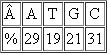 Why would this conclusion be contradictory to Wilkins's and Franklin's data?
Why would this conclusion be contradictory to Wilkins's and Franklin's data? Question
Question
Question
Question
Question
Question
Question
Question
Question
Question
A genetics student was asked to draw the chemical structure of an adenine-and thymine-containing dinucleotide derived from DNA. His answer is shown here:
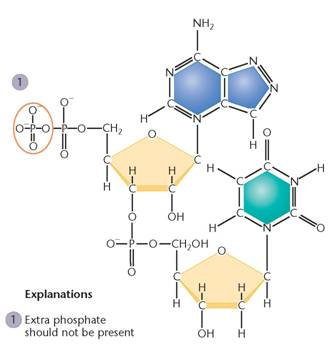
The student made more than six major errors. One of them is circled, numbered 1, and explained. Find five others. Circle them, number them 2 through 6, and briefly explain each in the manner of the example given.
The student made more than six major errors. One of them is circled, numbered 1, and explained. Find five others. Circle them, number them 2 through 6, and briefly explain each in the manner of the example given.
Question
Considering the information in this chapter on B-and Z-DNA and right-and left-handed helices, carefully analyze structures (a) and (b) below and draw conclusions about their helical nature. Which is right handed and which is left handed?
(a)

(b)

(a)
(b)
Question
Question
Question
Question
Question
A primitive eukaryote was discovered that displayed a unique nucleic acid as its genetic material. Analysis provided the following information:
(a) The general X-ray diffraction pattern is similar to that of DNA, but with somewhat different dimensions and more irregularity.
(b) A major hyperchromic shift is evident upon heating and monitoring UV absorption at 260 nm.
(c) Base-composition analysis reveals four bases in the following proportions:
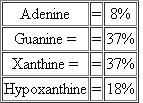 (d) About 75 percent of the sugars are deoxyribose, while 25 percent are ribose.
Postulate a model for the structure of this molecule that is consistent with the foregoing observations.
(a) The general X-ray diffraction pattern is similar to that of DNA, but with somewhat different dimensions and more irregularity.
(b) A major hyperchromic shift is evident upon heating and monitoring UV absorption at 260 nm.
(c) Base-composition analysis reveals four bases in the following proportions:
(d) About 75 percent of the sugars are deoxyribose, while 25 percent are ribose.Postulate a model for the structure of this molecule that is consistent with the foregoing observations.
Question
Question
Question
Question
Question
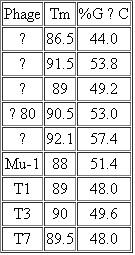
Following is a table (modified from Kropinski, 1973) that presents the T m and chemical composition (%G , C) of DNA from certain bacteriophages. From these data develop a graph that presents %G ? C (ordinate) and T m (abscissa). What is the relationship between T m and %G ? C for these samples? What might be the molecular basis of this relationship? Visit for instructor-assigned tutorials and problems.

Unlock Deck
Sign up to unlock the cards in this deck!
Unlock Deck
Unlock Deck
1/41

Play

Full screen (f)
Deck 10: DNA Structure and Analysis
1
Smallpox, a once highly lethal contagious disease, has been eradicated worldwide. However, research continues with stored samples of variola, the smallpox virus, because it is a potential weapon in bioterrorism. Human cells protect themselves from the variola virus (and other viruses) by activating genes that encode protective proteins. It has recently been discovered that in response to variola, human cells create small transitory stretches of Z-DNA at sites that regulate these genes. The smallpox virus can bypass this cellular defense mechanism by specifically targeting the segments of Z-DNA and inhibiting the synthesis of the protective proteins. This discovery raises some interesting questions:
What is unique about Z-DNA that might make it a specific target during viral infection?
What is unique about Z-DNA that might make it a specific target during viral infection?
Z-DNA (deoxyribonucleic acid) is different from the common right-handed double helix, B-DNA, because the Z-DNA strands are mostly composed of guanine and cytosine base pairs. The lack of variety in the base composition allows the antiparallel strands to form a left-handed double helix. This unique double helix lacks a major groove and creates a zigzag formation that Z-DNA specific DNA binding proteins target.
2
In this chapter, we first focused on the information that showed DNA to be the genetic material and then discussed the structure of DNA as proposed by Watson and Crick. We concluded the chapter by describing various techniques developed to study DNA. Along the way, we found many opportunities to consider the methods and reasoning by which much of this information was acquired. From the explanations given in the chapter, what answers would you propose to the following fundamental questions:
(a) How were scientists able to determine that DNA, and not some other molecule, serves as the genetic material in bacteria and bacteriophages?
(b) How do we know that DNA also serves as the genetic material in eukaryotes such as humans?
(c) How was it determined that the structure of DNA is a double helix with the two strands held together by hydrogen bonds formed between complementary nitrogenous bases?
(d) How do we know that G pairs with C and that A pairs with T as complementary base pairs are formed?
(e) How do we know that repetitive DNA sequences exist in eukaryotes?
(a) How were scientists able to determine that DNA, and not some other molecule, serves as the genetic material in bacteria and bacteriophages?
(b) How do we know that DNA also serves as the genetic material in eukaryotes such as humans?
(c) How was it determined that the structure of DNA is a double helix with the two strands held together by hydrogen bonds formed between complementary nitrogenous bases?
(d) How do we know that G pairs with C and that A pairs with T as complementary base pairs are formed?
(e) How do we know that repetitive DNA sequences exist in eukaryotes?
(a)When researching the identity of genetic information researchers focused on using bacteria and bacteriophages as the model organisms. The experiment by Avery, MacLeod and McCarty experiment tested bacterial transformation. They extracted a filtrate from the bacterial cells that retained transformation properties. After treating the filtrate with deoxyribonuclease (DNase), ribonuclease (RNase) and protease separately, the results showed that only DNase removed the transformation ability. Therefore, DNA must be the transforming material.
Another important experiment was conducted with bacteriophage T2, the Hershey-Chase experiment. The Hershey-Chase experiment labeled either DNA or protein in a phage T2 by mixing the phage in E.coli with either radioactive phosphorus (labels DNA) or sulfur (labels protein). The radioactive phages were then transferred to bacteria without radioactive elements and underwent another reproduction event. The progeny from this reproduction were labeled with radioactive phosphorus and not sulfur. The experimenters concluded that DNA, not protein, was passed on to the progeny cells.
(b)Through previous research it was known that the genetic information was stored where it was needed: the nucleus, chloroplast and mitochondria. DNA was found in all three of these organelles. Comparatively, protein was found in these, as well as in the cytoplasm, and was not specialized to one area of the cell. Furthermore, the genetic information was expected to have its content in the cell reflect the ploidy of the cell. A 2 n cell should have twice as much genetic information as an n cell. DNA levels matched this expectation, while protein levels stayed the same regardless of cell ploidy.
Furthermore, eukaryotic genetic information was known to be mutagenized by ultraviolet (UV) light, and the action spectrum maps the wavelengths that UV light is mutagenic. When compared to the absorption spectrum of DNA it was found that the two spectra overlapped. The protein absorption spectrum, however, did not overlap with the action spectra.
Both of the distribution and the absorption of DNA were indirect evidence for DNA being the genetic information. But finally, DNA was directly found to be the genetic information of eukaryotes when a eukaryotic gene was inserted into the bacterial DNA through recombinant DNA technology, and the bacteria started to produce the corresponding eukaryotic protein.
(c)The structure of DNA was determined from X-ray diffraction, Chargaff's results and Watson and Crick's ingenuity. The results of X-ray diffraction were that the bases were stacked on top each other like a chain and that the DNA was some sort of helix.
Chargaff's experiments concluded that there were four nitrogenous bases that constituted the DNA molecule. They were adenine (A), guanine (G), cytosine (C) and thymine (T). Through base composition analysis Chargaff revealed that the amount of A bases was proportional to the amount of T, and G was proportional to C. Furthermore, there were equal proportions of purines to pyrimidines, (A + G) and (C + T) respectively.
Watson and Crick built models of DNA using the four different bases and the other components of DNA until the final product matched to specs deduced from Chargaff's results and the X-ray diffraction results.
(d)Chargaff's experiment, as explained in part (c), helped determine that the base compositions were proportional to each other. The A and T had equal proportionality as well as the G and C pairing. Also, the sum of A and T was usually not equal to the sum of G and C. This concluded that they all did not pair with each other.
It was finalized that G paired with C and T paired with A, when Watson and Crick constructed the molecular structures and determined that the nitrogenous bases A and T had two potential hydrogen bonds, and C and G had three potential hydrogen bonds.
(e)It was discovered that DNA sequences have repetitive portions because of reassociation kinetics. The protocol for reassociation kinetics includes shearing denatured DNA and then allowing the DNA to renature. The reassociation time for the fragments was measured. Some segments of DNA had a much lower reassociation time than others. This was explained as there being more complimentary fragments available in the mixture, and thus, they were more likely to randomly collide during renaturing. These segments of DNA represented repetitive DNA sequences.
Another important experiment was conducted with bacteriophage T2, the Hershey-Chase experiment. The Hershey-Chase experiment labeled either DNA or protein in a phage T2 by mixing the phage in E.coli with either radioactive phosphorus (labels DNA) or sulfur (labels protein). The radioactive phages were then transferred to bacteria without radioactive elements and underwent another reproduction event. The progeny from this reproduction were labeled with radioactive phosphorus and not sulfur. The experimenters concluded that DNA, not protein, was passed on to the progeny cells.
(b)Through previous research it was known that the genetic information was stored where it was needed: the nucleus, chloroplast and mitochondria. DNA was found in all three of these organelles. Comparatively, protein was found in these, as well as in the cytoplasm, and was not specialized to one area of the cell. Furthermore, the genetic information was expected to have its content in the cell reflect the ploidy of the cell. A 2 n cell should have twice as much genetic information as an n cell. DNA levels matched this expectation, while protein levels stayed the same regardless of cell ploidy.
Furthermore, eukaryotic genetic information was known to be mutagenized by ultraviolet (UV) light, and the action spectrum maps the wavelengths that UV light is mutagenic. When compared to the absorption spectrum of DNA it was found that the two spectra overlapped. The protein absorption spectrum, however, did not overlap with the action spectra.
Both of the distribution and the absorption of DNA were indirect evidence for DNA being the genetic information. But finally, DNA was directly found to be the genetic information of eukaryotes when a eukaryotic gene was inserted into the bacterial DNA through recombinant DNA technology, and the bacteria started to produce the corresponding eukaryotic protein.
(c)The structure of DNA was determined from X-ray diffraction, Chargaff's results and Watson and Crick's ingenuity. The results of X-ray diffraction were that the bases were stacked on top each other like a chain and that the DNA was some sort of helix.
Chargaff's experiments concluded that there were four nitrogenous bases that constituted the DNA molecule. They were adenine (A), guanine (G), cytosine (C) and thymine (T). Through base composition analysis Chargaff revealed that the amount of A bases was proportional to the amount of T, and G was proportional to C. Furthermore, there were equal proportions of purines to pyrimidines, (A + G) and (C + T) respectively.
Watson and Crick built models of DNA using the four different bases and the other components of DNA until the final product matched to specs deduced from Chargaff's results and the X-ray diffraction results.
(d)Chargaff's experiment, as explained in part (c), helped determine that the base compositions were proportional to each other. The A and T had equal proportionality as well as the G and C pairing. Also, the sum of A and T was usually not equal to the sum of G and C. This concluded that they all did not pair with each other.
It was finalized that G paired with C and T paired with A, when Watson and Crick constructed the molecular structures and determined that the nitrogenous bases A and T had two potential hydrogen bonds, and C and G had three potential hydrogen bonds.
(e)It was discovered that DNA sequences have repetitive portions because of reassociation kinetics. The protocol for reassociation kinetics includes shearing denatured DNA and then allowing the DNA to renature. The reassociation time for the fragments was measured. Some segments of DNA had a much lower reassociation time than others. This was explained as there being more complimentary fragments available in the mixture, and thus, they were more likely to randomly collide during renaturing. These segments of DNA represented repetitive DNA sequences.
3
Smallpox, a once highly lethal contagious disease, has been eradicated worldwide. However, research continues with stored samples of variola, the smallpox virus, because it is a potential weapon in bioterrorism. Human cells protect themselves from the variola virus (and other viruses) by activating genes that encode protective proteins. It has recently been discovered that in response to variola, human cells create small transitory stretches of Z-DNA at sites that regulate these genes. The smallpox virus can bypass this cellular defense mechanism by specifically targeting the segments of Z-DNA and inhibiting the synthesis of the protective proteins. This discovery raises some interesting questions:
How might the virus target host-cell Z-DNA formation to block the synthesis of antiviral proteins?
How might the virus target host-cell Z-DNA formation to block the synthesis of antiviral proteins?
A virus can target Z-DNA by producing proteins that bind specifically to DNA that is left-handed. This would block production of antiviral proteins because Z-DNA is located upstream of antiviral genes and the virus' Z-DNA binding protein would block transcription of those genes. Without transcription, there will be no resulting antiviral protein to combat the infection.
4
Review the Chapter Concepts list. Most center around DNA and RNA and their role of serving as the genetic material. Write a short essay that contrasts these molecules, including a comparison of advantages conferred by their structure that each of them has over the other in serving in this role.
▪Except in some viruses, DNA serves as the genetic material in all living organisms on Earth.
▪According to the Watson-Crick model, DNA exists in the form of a right-handed double helix.
▪The strands of the double helix are antiparallel and are held together by hydrogen bonding between complementary nitrogenous bases.
▪The structure of DNA provides the means of storing and expressing genetic information.
▪RNA has many similarities to DNA but exists mostly as a single-stranded molecule.
▪In some viruses, RNA serves as the genetic material.
▪Many techniques have been developed that facilitate the analysis of nucleic acids, most based on detection of the complementarity of nitrogenous bases.
▪Except in some viruses, DNA serves as the genetic material in all living organisms on Earth.
▪According to the Watson-Crick model, DNA exists in the form of a right-handed double helix.
▪The strands of the double helix are antiparallel and are held together by hydrogen bonding between complementary nitrogenous bases.
▪The structure of DNA provides the means of storing and expressing genetic information.
▪RNA has many similarities to DNA but exists mostly as a single-stranded molecule.
▪In some viruses, RNA serves as the genetic material.
▪Many techniques have been developed that facilitate the analysis of nucleic acids, most based on detection of the complementarity of nitrogenous bases.
Unlock Deck
Unlock for access to all 41 flashcards in this deck.
Unlock Deck
k this deck
5
Smallpox, a once highly lethal contagious disease, has been eradicated worldwide. However, research continues with stored samples of variola, the smallpox virus, because it is a potential weapon in bioterrorism. Human cells protect themselves from the variola virus (and other viruses) by activating genes that encode protective proteins. It has recently been discovered that in response to variola, human cells create small transitory stretches of Z-DNA at sites that regulate these genes. The smallpox virus can bypass this cellular defense mechanism by specifically targeting the segments of Z-DNA and inhibiting the synthesis of the protective proteins. This discovery raises some interesting questions:
To study the interaction between viral proteins and Z-DNA, how could Z-DNA-forming DNA be synthesized in the lab?
To study the interaction between viral proteins and Z-DNA, how could Z-DNA-forming DNA be synthesized in the lab?
Unlock Deck
Unlock for access to all 41 flashcards in this deck.
Unlock Deck
k this deck
6
Discuss the reasons proteins were generally favored over DNA as the genetic material before 1940. What was the role of the tetranucleotide hypothesis in this controversy?
Unlock Deck
Unlock for access to all 41 flashcards in this deck.
Unlock Deck
k this deck
7
Smallpox, a once highly lethal contagious disease, has been eradicated worldwide. However, research continues with stored samples of variola, the smallpox virus, because it is a potential weapon in bioterrorism. Human cells protect themselves from the variola virus (and other viruses) by activating genes that encode protective proteins. It has recently been discovered that in response to variola, human cells create small transitory stretches of Z-DNA at sites that regulate these genes. The smallpox virus can bypass this cellular defense mechanism by specifically targeting the segments of Z-DNA and inhibiting the synthesis of the protective proteins. This discovery raises some interesting questions:
How could this research lead to the development of drugs to combat infection by variola and related viruses?
How could this research lead to the development of drugs to combat infection by variola and related viruses?
Unlock Deck
Unlock for access to all 41 flashcards in this deck.
Unlock Deck
k this deck
8
Contrast the various contributions made to an understanding of transformation by Griffith, by Avery and his colleagues, and by Taylor.
Unlock Deck
Unlock for access to all 41 flashcards in this deck.
Unlock Deck
k this deck
9
When Avery and his colleagues had obtained what was concluded to be the transforming factor from the IIIS virulent cells, they treated the fraction with proteases, RNase, and DNase, followed in each case by the assay for retention or loss of transforming ability. What were the purpose and results of these experiments? What conclusions were drawn?
Unlock Deck
Unlock for access to all 41 flashcards in this deck.
Unlock Deck
k this deck
10
Why were 32 P and 35 S chosen for use in the Hershey-Chase experiment? Discuss the rationale and conclusions of this experiment.
Unlock Deck
Unlock for access to all 41 flashcards in this deck.
Unlock Deck
k this deck
11
Does the design of the Hershey-Chase experiment distinguish between DNA and RNA as the molecule serving as the genetic material? Why or why not?
Unlock Deck
Unlock for access to all 41 flashcards in this deck.
Unlock Deck
k this deck
12
What observations are consistent with the conclusion that DNA serves as the genetic material in eukaryotes? List and discuss them.
Unlock Deck
Unlock for access to all 41 flashcards in this deck.
Unlock Deck
k this deck
13
What are the exceptions to the general rule that DNA is the genetic material in all organisms? What evidence supports these exceptions?
Unlock Deck
Unlock for access to all 41 flashcards in this deck.
Unlock Deck
k this deck
14
Draw the chemical structure of the three components of a nucleotide, and then link the three together. What atoms are removed from the structures when the linkages are formed?
Unlock Deck
Unlock for access to all 41 flashcards in this deck.
Unlock Deck
k this deck
15
How are the carbon and nitrogen atoms of the sugars, purines, and pyrimidines numbered?
Unlock Deck
Unlock for access to all 41 flashcards in this deck.
Unlock Deck
k this deck
16
Adenine may also be named 6-amino purine. How would you name the other four nitrogenous bases, using this alternative system? (O is indicated by "oxy-," and CH 3 by "methyl.")
Unlock Deck
Unlock for access to all 41 flashcards in this deck.
Unlock Deck
k this deck
17
Draw the chemical structure of a dinucleotide composed of A and G. Opposite this structure, draw the dinucleotide composed of T and C in an antiparallel (or upside-down) fashion. Form the possible hydrogen bonds.
Unlock Deck
Unlock for access to all 41 flashcards in this deck.
Unlock Deck
k this deck
18
Describe the various characteristics of the Watson-Crick double-helix model for DNA.
Unlock Deck
Unlock for access to all 41 flashcards in this deck.
Unlock Deck
k this deck
19
What evidence did Watson and Crick have at their disposal in 1953? What was their approach in arriving at the structure of DNA?
Unlock Deck
Unlock for access to all 41 flashcards in this deck.
Unlock Deck
k this deck
20
What might Watson and Crick have concluded had Chargaffs data from a single source indicated the following?
Why would this conclusion be contradictory to Wilkins's and Franklin's data?
Why would this conclusion be contradictory to Wilkins's and Franklin's data? Unlock Deck
Unlock for access to all 41 flashcards in this deck.
Unlock Deck
k this deck
21
How do covalent bonds differ from hydrogen bonds? Define base complementarity.
Unlock Deck
Unlock for access to all 41 flashcards in this deck.
Unlock Deck
k this deck
22
List three main differences between DNA and RNA.
Unlock Deck
Unlock for access to all 41 flashcards in this deck.
Unlock Deck
k this deck
23
What are the three major types of RNA molecules? How is each related to the concept of information flow?
Unlock Deck
Unlock for access to all 41 flashcards in this deck.
Unlock Deck
k this deck
24
What component of the nucleotide is responsible for the absorption of ultraviolet light? How is this technique important in the analysis of nucleic acids?
Unlock Deck
Unlock for access to all 41 flashcards in this deck.
Unlock Deck
k this deck
25
What is the physical state of DNA following denaturation?
Unlock Deck
Unlock for access to all 41 flashcards in this deck.
Unlock Deck
k this deck
26
What is the hyperchromic effect? How is it measured? What does T m imply?
Unlock Deck
Unlock for access to all 41 flashcards in this deck.
Unlock Deck
k this deck
27
Why is T m related to base composition?
Unlock Deck
Unlock for access to all 41 flashcards in this deck.
Unlock Deck
k this deck
28
What is the chemical basis of molecular hybridization?
Unlock Deck
Unlock for access to all 41 flashcards in this deck.
Unlock Deck
k this deck
29
What did the Watson-Crick model suggest about the replication of DNA?
Unlock Deck
Unlock for access to all 41 flashcards in this deck.
Unlock Deck
k this deck
30
A genetics student was asked to draw the chemical structure of an adenine-and thymine-containing dinucleotide derived from DNA. His answer is shown here:
The student made more than six major errors. One of them is circled, numbered 1, and explained. Find five others. Circle them, number them 2 through 6, and briefly explain each in the manner of the example given.
The student made more than six major errors. One of them is circled, numbered 1, and explained. Find five others. Circle them, number them 2 through 6, and briefly explain each in the manner of the example given.
Unlock Deck
Unlock for access to all 41 flashcards in this deck.
Unlock Deck
k this deck
31
Considering the information in this chapter on B-and Z-DNA and right-and left-handed helices, carefully analyze structures (a) and (b) below and draw conclusions about their helical nature. Which is right handed and which is left handed?
(a)
(b)
(a)
(b)
Unlock Deck
Unlock for access to all 41 flashcards in this deck.
Unlock Deck
k this deck
32
One of the most common spontaneous lesions that occurs in DNA under physiological conditions is the hydrolysis of the amino group of cytosine, converting the cytosine to uracil. What would be the effect on DNA structure of a uracil group replacing cytosine?
Unlock Deck
Unlock for access to all 41 flashcards in this deck.
Unlock Deck
k this deck
33
In some organisms, cytosine is methylated at carbon 5 of the pyrimidine ring after it is incorporated into DNA. If a 5-methyl cytosine molecule is then hydrolyzed, as described in Problem 28, what base will be generated?
Unlock Deck
Unlock for access to all 41 flashcards in this deck.
Unlock Deck
k this deck
34
Because of its rapid turnaround time, fluorescent in situ hybridization (FISH) is commonly used in hospitals and laboratories as an aneuploid screen of cells retrieved from amniocentesis and chorionic villus sampling (CVS). Chromosomes 13, 18, 21, X, and Y are typically screened for aneuploidy in this way. Explain how FISH might be accomplished using amniotic or CVS samples and why the above chromosomes have been chosen for screening.
Unlock Deck
Unlock for access to all 41 flashcards in this deck.
Unlock Deck
k this deck
35
Assume that you are interested in separating short (200-400 nucleotides) DNA molecules from a pool of longer molecules in the 10,000-20,000 nucleotide range. You have two recipes for making your agarose gels: one recipe uses 1.5 percent agarose and would be considered a "hard gel," while the other uses 0.5 percent agarose and would be considered a loose gel. Which recipe would you consider using and why?
Unlock Deck
Unlock for access to all 41 flashcards in this deck.
Unlock Deck
k this deck
36
A primitive eukaryote was discovered that displayed a unique nucleic acid as its genetic material. Analysis provided the following information:
(a) The general X-ray diffraction pattern is similar to that of DNA, but with somewhat different dimensions and more irregularity.
(b) A major hyperchromic shift is evident upon heating and monitoring UV absorption at 260 nm.
(c) Base-composition analysis reveals four bases in the following proportions:
(d) About 75 percent of the sugars are deoxyribose, while 25 percent are ribose.
Postulate a model for the structure of this molecule that is consistent with the foregoing observations.
(a) The general X-ray diffraction pattern is similar to that of DNA, but with somewhat different dimensions and more irregularity.
(b) A major hyperchromic shift is evident upon heating and monitoring UV absorption at 260 nm.
(c) Base-composition analysis reveals four bases in the following proportions:
(d) About 75 percent of the sugars are deoxyribose, while 25 percent are ribose.Postulate a model for the structure of this molecule that is consistent with the foregoing observations.
Unlock Deck
Unlock for access to all 41 flashcards in this deck.
Unlock Deck
k this deck
37
Newsdate: March 1, 2030. A unique creature has been discovered during exploration of outer space. Recently, its genetic material has been isolated and analyzed. This material is similar in some ways to DNA in its chemical makeup. It contains in abundance the 4-carbon sugar erythrose and a molar equivalent of phosphate groups. In addition, it contains six nitrogenous bases: adenine (A), guanine (G), thymine (T), cytosine (C), hypoxanthine (H), and xanthine (X). These bases exist in the following relative proportions:
▪= T = H and C = G = X
X-ray diffraction studies have established a regularity in the molecule and a constant diameter of about 30 Å. Together, these data have suggested a model for the structure of this molecule.
(a) Propose a general model of this molecule. Describe it briefly.
(b) What base-pairing properties must exist for H and for X in the model?
(c) Given the constant diameter of 30 Å, do you think that either (i) both H and X are purines or both pyrimidines, or (ii) one is a purine and one is a pyrimidine?
▪= T = H and C = G = X
X-ray diffraction studies have established a regularity in the molecule and a constant diameter of about 30 Å. Together, these data have suggested a model for the structure of this molecule.
(a) Propose a general model of this molecule. Describe it briefly.
(b) What base-pairing properties must exist for H and for X in the model?
(c) Given the constant diameter of 30 Å, do you think that either (i) both H and X are purines or both pyrimidines, or (ii) one is a purine and one is a pyrimidine?
Unlock Deck
Unlock for access to all 41 flashcards in this deck.
Unlock Deck
k this deck
38
You are provided with DNA samples from two newly discovered bacterial viruses. Based on the various analytical techniques discussed in this chapter, construct a research protocol that would be useful in characterizing and contrasting the DNA of both viruses. For each technique that you include in the protocol, indicate the type of information you hope to obtain.
Unlock Deck
Unlock for access to all 41 flashcards in this deck.
Unlock Deck
k this deck
39
During gel electrophoresis, DNA molecules can easily be separated according to size because all DNA molecules have the same charge-to-mass ratio and the same shape (long rod). Would you expect RNA molecules to behave in the same manner as DNA during gel electrophoresis? Why or why not?
Unlock Deck
Unlock for access to all 41 flashcards in this deck.
Unlock Deck
k this deck
40
Electrophoresis is an extremely useful procedure when applied to analysis of nucleic acids as it can resolve molecules of different sizes with relative ease and accuracy. Large molecules migrate more slowly than small molecules in agarose gels. However, the fact that nucleic acids of the same length may exist in a variety of conformations can often complicate the interpretation of electrophoretic separations. For instance, when a single species of a bacterial plasmid is isolated from cells, the individual plasmids may exist in three forms (depending on the genotype of their host and conditions of isolation): superhelical/supercoiled (form I), nicked/open circle (form II), and linear (form III). Form I is compact and very tightly coiled, with both DNA strands continuous. Form II exists as a loose circle because one of the two DNA strands has been broken, thus releasing the supercoil. All three have the same mass, but each will migrate at a different rate through a gel. Based on your understanding of gel composition and DNA migration, predict the relative rates of migration of the various DNA structures mentioned above.
Unlock Deck
Unlock for access to all 41 flashcards in this deck.
Unlock Deck
k this deck
41
Following is a table (modified from Kropinski, 1973) that presents the T m and chemical composition (%G , C) of DNA from certain bacteriophages. From these data develop a graph that presents %G ? C (ordinate) and T m (abscissa). What is the relationship between T m and %G ? C for these samples? What might be the molecular basis of this relationship? Visit for instructor-assigned tutorials and problems.
Unlock Deck
Unlock for access to all 41 flashcards in this deck.
Unlock Deck
k this deck
Unlock Deck
Unlock for access to all 41 flashcards in this deck.







