





 Chat with AI

Deck 9: Extranuclear Inheritance
Full screen (f)

Question

Question
Question
Question
Question
Question
Question
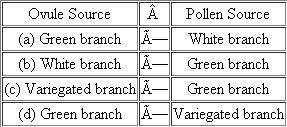
A plant may have green, white, or green-and-white (variegated) leaves on its branches, owing to a mutation in the chloroplast that prevents color from developing. Predict the results of the following crosses:
Question
Question
Question
In Lymnaea, what results would you expect in a cross between a Dd dextrally coiled and a Dd sinistrally coiled snail, assuming cross-fertilization occurs as shown in Figure 9-11? What results would occur if the Dd dextral produced only eggs and the Dd sinistral produced only sperm?
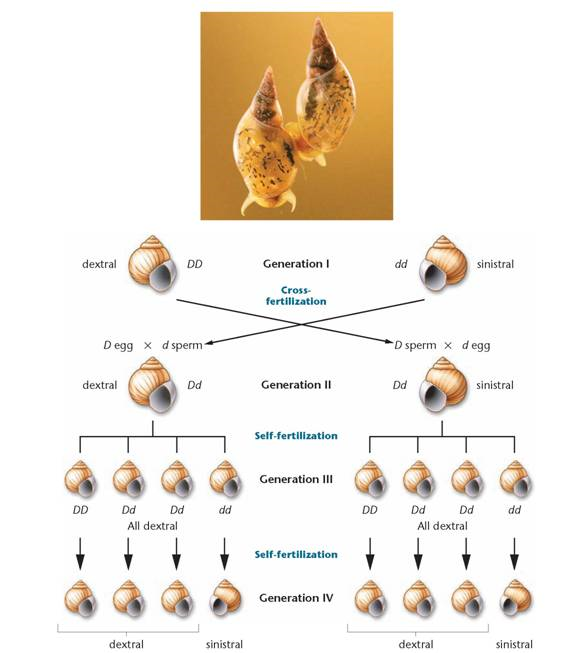
FIGURE Inheritance of coiling in the snail Lymnaeaperegra. Coiling is either dextral (right handed) or sinistral (left handed). A maternal effect is evident in generations II and III, where the genotype of the maternal parent, rather than the offspring's own genotype, controls the phenotype of the offspring. The photograph illustrates right-versus left-handed coiled snails.
FIGURE Inheritance of coiling in the snail Lymnaeaperegra. Coiling is either dextral (right handed) or sinistral (left handed). A maternal effect is evident in generations II and III, where the genotype of the maternal parent, rather than the offspring's own genotype, controls the phenotype of the offspring. The photograph illustrates right-versus left-handed coiled snails.
Question
Question
Question
Question
Question
Question
In an earlier Problems and Discussion section (see Chapter 7, Problem 33), we described CC, the cat created by nuclear transfer cloning, whereby a diploid nucleus from one cell is injected into an enucleated egg cell to create an embryo. Cattle, sheep, rats, dogs, and several other species have been cloned using nuclei from somatic cells. Embryos and adults produced by this approach often show a number of different mitochondrial defects. Explain possible reasons for the prevalence of mitochondrial defects in embryos created by nuclear transfer cloning.
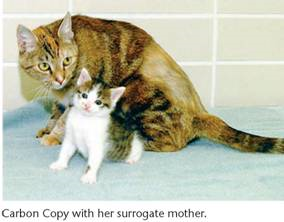
When the cloned cat Carbon Copy (CC) was born (see the Now Solve This question), she had black patches and white patches, but completely lacked any orange patches. The knowledgeable students of genetics were not surprised at this outcome. Starting with the somatic ovarian cell used as the source of the nucleus in the cloning process, explain how this outcome occurred.
NOW SOLVE THIS
CC (Carbon Copy), the first cat produced from a clone, was created from an ovarian cell taken from her genetic donor, Rainbow, a calico cat. The diploid nucleus from the cell was extracted and then injected into an enucleated egg. The resulting zygote was then allowed to develop in a petri dish, and the cloned embryo was implanted in the uterus of a surrogate mother cat, who gave birth to CC. CC's surrogate mother was a tabby (see the photo on page 187 at the end of this chapter). Geneticists were very interested in the outcome of cloning a calico cat, because they were not certain if the cat would have patches of orange and black, just orange, or just black. Taking into account the Lyon hypothesis, explain the basis of the uncertainty. Would you expect CC to appear identical to Rainbow? Explain why or why not.
HINT: This problem involves an understanding of the Lyon hypothesis. The key to its solution is to realize that the donor nucleus was from a differentiated ovarian cell of an adult female cat, which itself had inactivated one of its X chromosomes.
When the cloned cat Carbon Copy (CC) was born (see the Now Solve This question), she had black patches and white patches, but completely lacked any orange patches. The knowledgeable students of genetics were not surprised at this outcome. Starting with the somatic ovarian cell used as the source of the nucleus in the cloning process, explain how this outcome occurred.
NOW SOLVE THIS
CC (Carbon Copy), the first cat produced from a clone, was created from an ovarian cell taken from her genetic donor, Rainbow, a calico cat. The diploid nucleus from the cell was extracted and then injected into an enucleated egg. The resulting zygote was then allowed to develop in a petri dish, and the cloned embryo was implanted in the uterus of a surrogate mother cat, who gave birth to CC. CC's surrogate mother was a tabby (see the photo on page 187 at the end of this chapter). Geneticists were very interested in the outcome of cloning a calico cat, because they were not certain if the cat would have patches of orange and black, just orange, or just black. Taking into account the Lyon hypothesis, explain the basis of the uncertainty. Would you expect CC to appear identical to Rainbow? Explain why or why not.
HINT: This problem involves an understanding of the Lyon hypothesis. The key to its solution is to realize that the donor nucleus was from a differentiated ovarian cell of an adult female cat, which itself had inactivated one of its X chromosomes.
Question
Question
Question
Question
Question
Researchers examined a family with an interesting distribution of Leigh syndrome symptoms. In this disorder, individuals may show a progressive loss of motor function (ataxia, A) with peripheral neuropathy (PN, meaning impairment of the peripheral nerves). A mitochondrial DNA (mtDNA) mutation that reduces ATPase activity was identified in various tissues of affected individuals. The accompanying table summarizes the presence of symptoms in an extended family.
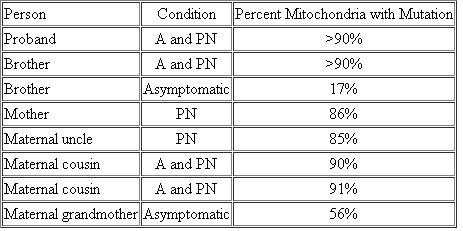 (a) Develop a pedigree that summarizes the information presented in the table.
(b) Provide an explanation for the pattern of inheritance of the disease. What term describes this pattern?
(c) How can some individuals in the same family show such variation in symptoms? What term, as related to organelle heredity, describes such variation?
(d) In what way does a condition caused by mtDNA differ in expression and transmission from a mutation that causes albinism?
(a) Develop a pedigree that summarizes the information presented in the table.(b) Provide an explanation for the pattern of inheritance of the disease. What term describes this pattern?
(c) How can some individuals in the same family show such variation in symptoms? What term, as related to organelle heredity, describes such variation?
(d) In what way does a condition caused by mtDNA differ in expression and transmission from a mutation that causes albinism?
Question

Unlock Deck
Sign up to unlock the cards in this deck!
Unlock Deck
Unlock Deck
1/22

Play

Full screen (f)
Deck 9: Extranuclear Inheritance
1
In 2000, Rocco Baldelli was a first-round draft pick by the Tampa Bay Rays baseball team. Two years later, his early success in professional baseball was followed by disabling muscle injuries and fatigue. His mysterious illness was traced to a disorder called mitochondrial myopathy. This diagnosis brought not only personal clarification to one set of identical twin brothers, but also national awareness of an array of similar disorders that affect thousands of children and adults regardless of age, gender, race, or position in society. For 14 years the twin brothers competed on equal terms until Rocco began to suffer loss of visual acuity and muscularity. Diagnosis of a mitochondrial disorder explained the cause and forecasted supportive treatment, but also raised some important questions.
The parents and other relatives of the twins are apparently healthy, so how could this genetic disorder have arisen?
The parents and other relatives of the twins are apparently healthy, so how could this genetic disorder have arisen?
The parents or relatives of the baseball player do not show any symptoms or have been diagnosed for the mitochondrial disorder. This indicates that the disorder is probably not active in the relatives because there phenotype is being complemented with functioning wild-type mitochondria.
In the player, the disorder may have arisen because the mutation rate in the mitochondrial deoxyribonucleic acid (DNA) molecules is higher compared to nuclear DNA. Since there is such a high mutation rate the mitochondrial DNA may have become mutated later in life.
Mitochondrial heteroplasmy occurs when there is a mixture of more than one mitochondrial genome within a single cell. The mutation may have affected only a few mitochondria. But in the player these few mitochondria dominated the wild-type mitochondria leading to a mitochondrial disorder.
In the player, the disorder may have arisen because the mutation rate in the mitochondrial deoxyribonucleic acid (DNA) molecules is higher compared to nuclear DNA. Since there is such a high mutation rate the mitochondrial DNA may have become mutated later in life.
Mitochondrial heteroplasmy occurs when there is a mixture of more than one mitochondrial genome within a single cell. The mutation may have affected only a few mitochondria. But in the player these few mitochondria dominated the wild-type mitochondria leading to a mitochondrial disorder.
2
In this chapter, we focused on extranuclear inheritance and how traits can be determined by genetic information contained in mitochondria and chloroplasts, and we discussed how expression of maternal genotypes can affect the phenotype of an organism. At the same time, we found many opportunities to consider the methods and reasoning by which much of this information was acquired. From the explanations given in the chapter, what answers would you propose to the following fundamental questions?
(a) How was it established that particular phenotypes are inherited as a result of genetic information present in the chloroplast rather than in the nucleus?
(b) How did the discovery of three categories of petite mutations in yeast lead researchers to postulate extranuclear inheritance of colony size?
(c) What observations support the endosymbiotic theory?
(d) What key observations in crosses between dextrally and sinistrally coiled snails support the explanation that this phenotype is the result of maternal-effect inheritance?
(e) What findings demonstrate a maternal effect as the basis of a mode of inheritance?
(a) How was it established that particular phenotypes are inherited as a result of genetic information present in the chloroplast rather than in the nucleus?
(b) How did the discovery of three categories of petite mutations in yeast lead researchers to postulate extranuclear inheritance of colony size?
(c) What observations support the endosymbiotic theory?
(d) What key observations in crosses between dextrally and sinistrally coiled snails support the explanation that this phenotype is the result of maternal-effect inheritance?
(e) What findings demonstrate a maternal effect as the basis of a mode of inheritance?
a) Carl Correns used four o'clock plants to discover that plants were able to pass non-nucleic genetic information to offspring. He used the fact that chloroplasts are green, and along with their presence in some leaves, to determine that chloroplast inheritance is partly controlled out side the nucleus. He was able to use maternal plants to produce offspring with green leaves, even though the paternal parent did not express a green leaf phenotype. It seemed that the paternal side did not influence some aspects of the progeny, and neither did it contribute cytoplasm.
b) The petite yeast helped researchers realize that extranuclear factors contributed to inheritance. Of the three strains of yeast, two of them did not follow Mendelian inheritance. This meant that researchers could not predict offspring phenotype and genotype ratios using Mendelain tools like the punnett square. This prompted the researches to consider that organelles contained agents of inheritance that were not part of the nucleus.
c) The endosymbiotic theory states that mitochondria evolved into an organelle by the formation of a symbiotic relationship between two unicellular organisms. Evidence that supports this theory are the similarities in mitochondria DNA and bacteria. The DNA in mitochondira is incredibly similar to bacteria DNA under an electron microscope. Furthermore, the ribosomal RNA found in mitochondria resembles prokaryotic (bacterial) ribosomal RNA more than eukaryotic ribosomal RNA.
d) The offspring of a limnaea snail will coil to the side from which the ooplasm of the maternal side coils. So if a snail inherits sinistral ( dd ) alleles, but its maternal parent is dextral ( Dd) , then the snail will be dextral because its maternal ooplasm was inherited with directions for it to coil dextrally. If that same snail is allowed to self-fertilize then its offspring will be sinistral. These are not Mendelian patterns of inheritance, and show that there are factors that are extranuclear which control some aspects of phenotypic inheritance.
e) The findings by Carl Correns that chloroplast phenotypes are inherited by maternal sources, petite yeast colony sizes, and limnaea snail coil twists help demonstrate that a maternal effect will produce offspring regardless of paternal genotype or phenotype. The maternal genotype dictates maternal inheritance patterns for certain offspring phenotypes, which do not follow Mendelian rules of inheritance.
b) The petite yeast helped researchers realize that extranuclear factors contributed to inheritance. Of the three strains of yeast, two of them did not follow Mendelian inheritance. This meant that researchers could not predict offspring phenotype and genotype ratios using Mendelain tools like the punnett square. This prompted the researches to consider that organelles contained agents of inheritance that were not part of the nucleus.
c) The endosymbiotic theory states that mitochondria evolved into an organelle by the formation of a symbiotic relationship between two unicellular organisms. Evidence that supports this theory are the similarities in mitochondria DNA and bacteria. The DNA in mitochondira is incredibly similar to bacteria DNA under an electron microscope. Furthermore, the ribosomal RNA found in mitochondria resembles prokaryotic (bacterial) ribosomal RNA more than eukaryotic ribosomal RNA.
d) The offspring of a limnaea snail will coil to the side from which the ooplasm of the maternal side coils. So if a snail inherits sinistral ( dd ) alleles, but its maternal parent is dextral ( Dd) , then the snail will be dextral because its maternal ooplasm was inherited with directions for it to coil dextrally. If that same snail is allowed to self-fertilize then its offspring will be sinistral. These are not Mendelian patterns of inheritance, and show that there are factors that are extranuclear which control some aspects of phenotypic inheritance.
e) The findings by Carl Correns that chloroplast phenotypes are inherited by maternal sources, petite yeast colony sizes, and limnaea snail coil twists help demonstrate that a maternal effect will produce offspring regardless of paternal genotype or phenotype. The maternal genotype dictates maternal inheritance patterns for certain offspring phenotypes, which do not follow Mendelian rules of inheritance.
3
In 2000, Rocco Baldelli was a first-round draft pick by the Tampa Bay Rays baseball team. Two years later, his early success in professional baseball was followed by disabling muscle injuries and fatigue. His mysterious illness was traced to a disorder called mitochondrial myopathy. This diagnosis brought not only personal clarification to one set of identical twin brothers, but also national awareness of an array of similar disorders that affect thousands of children and adults regardless of age, gender, race, or position in society. For 14 years the twin brothers competed on equal terms until Rocco began to suffer loss of visual acuity and muscularity. Diagnosis of a mitochondrial disorder explained the cause and forecasted supportive treatment, but also raised some important questions.
How could one identical twin have an inherited mitochondrial disorder and not the other?
How could one identical twin have an inherited mitochondrial disorder and not the other?
One identical twin may have a mitochondrial disorder and not the other for one of two reasons.
First, the zygote had many wild-type mitochondria and very few mutant mitochondria. When the twins split apart within the womb one twin received only wild-type mitochondria, while the other received wild-type mitochondria and mutant mitochondria. With the high mutation rate of mitochondria this would lead to the disorder being noticeable in the twin that is mitochondrial heteroplasmic.
Second, both twins may have received the same mitochondria. However, after separating the mutations that occur in each other's mitochondria are different. Therefore, one twin may have more mutations that lead to the mutant disorder than the other twin that has the same amount of mutations except in different regions and areas. Since the mutations are in different spots it affects the functions.
First, the zygote had many wild-type mitochondria and very few mutant mitochondria. When the twins split apart within the womb one twin received only wild-type mitochondria, while the other received wild-type mitochondria and mutant mitochondria. With the high mutation rate of mitochondria this would lead to the disorder being noticeable in the twin that is mitochondrial heteroplasmic.
Second, both twins may have received the same mitochondria. However, after separating the mutations that occur in each other's mitochondria are different. Therefore, one twin may have more mutations that lead to the mutant disorder than the other twin that has the same amount of mutations except in different regions and areas. Since the mutations are in different spots it affects the functions.
4
Review the Chapter Concepts list. The first three center around extranuclear inheritance involving DNA in organelles. The fourth involves what is called maternal effect. Write a short essay that distinguishes between organelle heredity and maternal effect.
▪Extranuclear inheritance occurs when phenotypes result from genetic influence other than the biparental transmission of genes located on chromosomes housed within the nucleus.
▪Organelle heredity, an example of extranuclear inheritance, is due to the transmission of genetic information contained in mitochondria or chloroplasts, most often from only one parent.
▪Traits determined by mitochondrial DNA are most often transmitted uniparentally through the maternal gamete, while traits determined by chloroplast DNA may be transmitted uniparentally or biparentally.
▪Mitochondrial mutations have been linked to many human disease conditions as well as to the aging process.
▪Maternal effect, the expression of the maternal nuclear genotype during gametogenesis and during early development, may have a strong influence on the phenotype of an organism.
▪Extranuclear inheritance occurs when phenotypes result from genetic influence other than the biparental transmission of genes located on chromosomes housed within the nucleus.
▪Organelle heredity, an example of extranuclear inheritance, is due to the transmission of genetic information contained in mitochondria or chloroplasts, most often from only one parent.
▪Traits determined by mitochondrial DNA are most often transmitted uniparentally through the maternal gamete, while traits determined by chloroplast DNA may be transmitted uniparentally or biparentally.
▪Mitochondrial mutations have been linked to many human disease conditions as well as to the aging process.
▪Maternal effect, the expression of the maternal nuclear genotype during gametogenesis and during early development, may have a strong influence on the phenotype of an organism.
Unlock Deck
Unlock for access to all 22 flashcards in this deck.
Unlock Deck
k this deck
5
In 2000, Rocco Baldelli was a first-round draft pick by the Tampa Bay Rays baseball team. Two years later, his early success in professional baseball was followed by disabling muscle injuries and fatigue. His mysterious illness was traced to a disorder called mitochondrial myopathy. This diagnosis brought not only personal clarification to one set of identical twin brothers, but also national awareness of an array of similar disorders that affect thousands of children and adults regardless of age, gender, race, or position in society. For 14 years the twin brothers competed on equal terms until Rocco began to suffer loss of visual acuity and muscularity. Diagnosis of a mitochondrial disorder explained the cause and forecasted supportive treatment, but also raised some important questions.
Will the unaffected brother be guaranteed continued good health?
Will the unaffected brother be guaranteed continued good health?
Unlock Deck
Unlock for access to all 22 flashcards in this deck.
Unlock Deck
k this deck
6
Streptomycin resistance in Chlamydomonas may result from a mutation in either a chloroplast gene or a nuclear gene. What phenotypic results would occur in a cross between a member of an mt + strain resistant in both genes and a member of a strain sensitive to the antibiotic? What results would occur in the reciprocal cross?
Unlock Deck
Unlock for access to all 22 flashcards in this deck.
Unlock Deck
k this deck
7
A plant may have green, white, or green-and-white (variegated) leaves on its branches, owing to a mutation in the chloroplast that prevents color from developing. Predict the results of the following crosses:
Unlock Deck
Unlock for access to all 22 flashcards in this deck.
Unlock Deck
k this deck
8
In diploid yeast strains, sporulation and subsequent meiosis can produce haploid ascospores, which may fuse to reestablish diploid cells. When ascospores from a segregational petite strain fuse with those of a normal wild-type strain, the diploid zygotes are all normal. Following meiosis, ascospores are petite and normal. Is the segregational petite phenotype inherited as a dominant or a recessive trait?
Unlock Deck
Unlock for access to all 22 flashcards in this deck.
Unlock Deck
k this deck
9
Predict the results of a cross between ascospores from a segregational petite strain and a neutral petite strain. Indicate the phenotype of the zygote and the ascospores it may subsequently produce.
Unlock Deck
Unlock for access to all 22 flashcards in this deck.
Unlock Deck
k this deck
10
In Lymnaea, what results would you expect in a cross between a Dd dextrally coiled and a Dd sinistrally coiled snail, assuming cross-fertilization occurs as shown in Figure 9-11? What results would occur if the Dd dextral produced only eggs and the Dd sinistral produced only sperm?
FIGURE Inheritance of coiling in the snail Lymnaeaperegra. Coiling is either dextral (right handed) or sinistral (left handed). A maternal effect is evident in generations II and III, where the genotype of the maternal parent, rather than the offspring's own genotype, controls the phenotype of the offspring. The photograph illustrates right-versus left-handed coiled snails.
FIGURE Inheritance of coiling in the snail Lymnaeaperegra. Coiling is either dextral (right handed) or sinistral (left handed). A maternal effect is evident in generations II and III, where the genotype of the maternal parent, rather than the offspring's own genotype, controls the phenotype of the offspring. The photograph illustrates right-versus left-handed coiled snails.
Unlock Deck
Unlock for access to all 22 flashcards in this deck.
Unlock Deck
k this deck
11
In a cross of Lymnaea, the snail contributing the eggs was dextral but of unknown genotype. Both the genotype and the phenotype of the other snail are unknown. All F 1 offspring exhibited dextral coiling. Ten of the F 1 snails were allowed to undergo self-fertilization. One-half produced only dextrally coiled offspring, whereas the other half produced only sinistrally coiled offspring. What were the genotypes of the original parents?
Unlock Deck
Unlock for access to all 22 flashcards in this deck.
Unlock Deck
k this deck
12
In Drosophila subobscura, the presence of a recessive gene called grandchildless ( gs ) causes the offspring of homozygous females, but not those of homozygous males, to be sterile. Can you offer an explanation as to why females and not males are affected by the mutant gene?
Unlock Deck
Unlock for access to all 22 flashcards in this deck.
Unlock Deck
k this deck
13
A male mouse from a true-breeding strain of hyperactive animals is crossed with a female mouse from a true-breeding strain of lethargic animals. (These are both hypothetical strains.) All the progeny are lethargic. In the F 2 generation, all offspring are lethargic. What is the best genetic explanation for these observations? Propose a cross to test your explanation.
Unlock Deck
Unlock for access to all 22 flashcards in this deck.
Unlock Deck
k this deck
14
Consider the case where a mutation occurs that disrupts translation in a single human mitochondrion found in the oocyte participating in fertilization. What is the likely impact of this mutation on the offspring arising from this oocyte?
Unlock Deck
Unlock for access to all 22 flashcards in this deck.
Unlock Deck
k this deck
15
What is the endosymbiotic theory, and why is this theory relevant to the study of extranuclear DNA in eukaryotic organelles?
Unlock Deck
Unlock for access to all 22 flashcards in this deck.
Unlock Deck
k this deck
16
In an earlier Problems and Discussion section (see Chapter 7, Problem 33), we described CC, the cat created by nuclear transfer cloning, whereby a diploid nucleus from one cell is injected into an enucleated egg cell to create an embryo. Cattle, sheep, rats, dogs, and several other species have been cloned using nuclei from somatic cells. Embryos and adults produced by this approach often show a number of different mitochondrial defects. Explain possible reasons for the prevalence of mitochondrial defects in embryos created by nuclear transfer cloning.
When the cloned cat Carbon Copy (CC) was born (see the Now Solve This question), she had black patches and white patches, but completely lacked any orange patches. The knowledgeable students of genetics were not surprised at this outcome. Starting with the somatic ovarian cell used as the source of the nucleus in the cloning process, explain how this outcome occurred.
NOW SOLVE THIS
CC (Carbon Copy), the first cat produced from a clone, was created from an ovarian cell taken from her genetic donor, Rainbow, a calico cat. The diploid nucleus from the cell was extracted and then injected into an enucleated egg. The resulting zygote was then allowed to develop in a petri dish, and the cloned embryo was implanted in the uterus of a surrogate mother cat, who gave birth to CC. CC's surrogate mother was a tabby (see the photo on page 187 at the end of this chapter). Geneticists were very interested in the outcome of cloning a calico cat, because they were not certain if the cat would have patches of orange and black, just orange, or just black. Taking into account the Lyon hypothesis, explain the basis of the uncertainty. Would you expect CC to appear identical to Rainbow? Explain why or why not.
HINT: This problem involves an understanding of the Lyon hypothesis. The key to its solution is to realize that the donor nucleus was from a differentiated ovarian cell of an adult female cat, which itself had inactivated one of its X chromosomes.
When the cloned cat Carbon Copy (CC) was born (see the Now Solve This question), she had black patches and white patches, but completely lacked any orange patches. The knowledgeable students of genetics were not surprised at this outcome. Starting with the somatic ovarian cell used as the source of the nucleus in the cloning process, explain how this outcome occurred.
NOW SOLVE THIS
CC (Carbon Copy), the first cat produced from a clone, was created from an ovarian cell taken from her genetic donor, Rainbow, a calico cat. The diploid nucleus from the cell was extracted and then injected into an enucleated egg. The resulting zygote was then allowed to develop in a petri dish, and the cloned embryo was implanted in the uterus of a surrogate mother cat, who gave birth to CC. CC's surrogate mother was a tabby (see the photo on page 187 at the end of this chapter). Geneticists were very interested in the outcome of cloning a calico cat, because they were not certain if the cat would have patches of orange and black, just orange, or just black. Taking into account the Lyon hypothesis, explain the basis of the uncertainty. Would you expect CC to appear identical to Rainbow? Explain why or why not.
HINT: This problem involves an understanding of the Lyon hypothesis. The key to its solution is to realize that the donor nucleus was from a differentiated ovarian cell of an adult female cat, which itself had inactivated one of its X chromosomes.
Unlock Deck
Unlock for access to all 22 flashcards in this deck.
Unlock Deck
k this deck
17
The specification of the anterior-posterior axis in Drosophila embryos is initially controlled by various gene products that are synthesized and stored in the mature egg following oogenesis. Mutations in these genes result in abnormalities of the axis during embryogenesis. These mutations illustrate maternal effect. How do such mutations vary from those produced by organelle heredity? Devise a set of parallel crosses and expected outcomes involving mutant genes that contrast maternal effect and organelle heredity.
Unlock Deck
Unlock for access to all 22 flashcards in this deck.
Unlock Deck
k this deck
18
The maternal-effect mutation bicoid ( bcd ) is recessive. In the absence of the bicoid protein product, embryogenesis is not completed. Consider a cross between a female heterozygous for the bicoid alleles ( bcd + / bcd - ) and a male homozygous for the mutation ( bcd - / bcd - ).
(a) How is it possible for a male homozygous for the mutation to exist?
(b) Predict the outcome (normal vs. failed embryogenesis) in the F 1 and F 2 generations of the cross described.
(a) How is it possible for a male homozygous for the mutation to exist?
(b) Predict the outcome (normal vs. failed embryogenesis) in the F 1 and F 2 generations of the cross described.
Unlock Deck
Unlock for access to all 22 flashcards in this deck.
Unlock Deck
k this deck
19
In humans the mitochondrial genome encodes a low number of proteins, rRNAs, and tRNAs but imports approximately 1100 proteins encoded by the nuclear genome. Yet, with such a small proportion from the mitochondrial genome encoding proteins and RNAs, a disproportionately high number of genetic disorders due to mtDNA mutations have been identified (Bigger, B. et al. 1999). What inheritance pattern would you expect in a three-generation pedigree in which the grandfather expresses the initial mtDNA defect? What inheritance pattern would you expect in a three-generation pedigree in which the grandmother expresses the initial mtDNA defect? (b) Considering the description in part (a) above, how would your pedigrees change if you knew that the mutation that caused the mitochondrial defect was recessive and located in the nuclear genome, was successfully transported into mitochondria, and negated a physiologically important mitochondrial function?
Unlock Deck
Unlock for access to all 22 flashcards in this deck.
Unlock Deck
k this deck
20
Mutations in mitochondrial DNA appear to be responsible for a number of neurological disorders, including myoclonic epilepsy and ragged-red fiber disease, Leber's hereditary optic neuropathy, and Kearns-Sayre syndrome. In each case, the disease phenotype is expressed when the ratio of mutant to wild-type mitochondria exceeds a threshold peculiar to each disease, but usually in the 60 to 95 percent range.
(a) Given that these are debilitating conditions, why has no cure been developed? Can you suggest a general approach that might be used to treat, or perhaps even cure, these disorders?
(b) Compared with the vast number of mitochondria in an embryo, the number of mitochondria in an ovum is relatively small. Might such an ooplasmic mitochondrial bottleneck present an opportunity for therapy or cure? Explain.
(a) Given that these are debilitating conditions, why has no cure been developed? Can you suggest a general approach that might be used to treat, or perhaps even cure, these disorders?
(b) Compared with the vast number of mitochondria in an embryo, the number of mitochondria in an ovum is relatively small. Might such an ooplasmic mitochondrial bottleneck present an opportunity for therapy or cure? Explain.
Unlock Deck
Unlock for access to all 22 flashcards in this deck.
Unlock Deck
k this deck
21
Researchers examined a family with an interesting distribution of Leigh syndrome symptoms. In this disorder, individuals may show a progressive loss of motor function (ataxia, A) with peripheral neuropathy (PN, meaning impairment of the peripheral nerves). A mitochondrial DNA (mtDNA) mutation that reduces ATPase activity was identified in various tissues of affected individuals. The accompanying table summarizes the presence of symptoms in an extended family.
(a) Develop a pedigree that summarizes the information presented in the table.
(b) Provide an explanation for the pattern of inheritance of the disease. What term describes this pattern?
(c) How can some individuals in the same family show such variation in symptoms? What term, as related to organelle heredity, describes such variation?
(d) In what way does a condition caused by mtDNA differ in expression and transmission from a mutation that causes albinism?
(a) Develop a pedigree that summarizes the information presented in the table.(b) Provide an explanation for the pattern of inheritance of the disease. What term describes this pattern?
(c) How can some individuals in the same family show such variation in symptoms? What term, as related to organelle heredity, describes such variation?
(d) In what way does a condition caused by mtDNA differ in expression and transmission from a mutation that causes albinism?
Unlock Deck
Unlock for access to all 22 flashcards in this deck.
Unlock Deck
k this deck
22
Payne, B. A. et al. (2013) present evidence that a low level of heteroplasmic mtDNA exists in all tested healthy individuals.
(a) What are two likely sources of such heteroplasmy?
(b) What genetic conditions within a given mitochondrion are likely to contribute to such a variable pool of mitochondria?
(a) What are two likely sources of such heteroplasmy?
(b) What genetic conditions within a given mitochondrion are likely to contribute to such a variable pool of mitochondria?
Unlock Deck
Unlock for access to all 22 flashcards in this deck.
Unlock Deck
k this deck
Unlock Deck
Unlock for access to all 22 flashcards in this deck.







