





 Chat with AI

Deck 4: Extensions of Mendelian Genetics
Full screen (f)

Question

Question
Question
Question
Question
Question
In shorthorn cattle, coat color may be red, white, or roan. Roan is an intermediate phenotype expressed as a mixture of red and white hairs. The following data were obtained from various crosses:
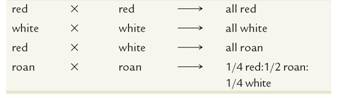
How is coat color inherited? What are the genotypes of parents and offspring for each cross?
How is coat color inherited? What are the genotypes of parents and offspring for each cross?
Question
Question
Question
Question
Question
Question
Question
Question
In rabbits, a series of multiple alleles controls coat color in the following way: C is dominant to all other alleles and causes full color. The chinchilla phenotype is due to the c ch allele, which is dominant to all alleles other than C. The c h allele, dominant only to c a (albino), results in the Himalayan coat color. Thus, the order of dominance is C c ch c h c a. For each of the following three cases, the phenotypes of the P 1 generations of two crosses are shown, as well as the phenotype of one member of the F 1 generation.
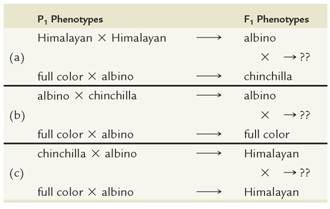
For each case, determine the genotypes of the P 1 generation and the F 1 offspring, and predict the results of making each indicated cross between F 1 individuals.
For each case, determine the genotypes of the P 1 generation and the F 1 offspring, and predict the results of making each indicated cross between F 1 individuals.
Question
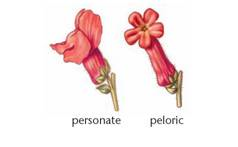
Three gene pairs located on separate autosomes determine flower color and shape as well as plant height. The first pair exhibits incomplete dominance, where the color can be red, pink (the heterozygote), or white. The second pair leads to personate (dominant) or peloric (recessive) flower shape, while the third gene pair produces either the dominant tall trait or the recessive dwarf trait. Homozygous plants that are red, personate, and tall are crossed to those that are white, peloric, and dwarf. Determine the F 1 genotype(s) and phenotype(s). If the F 1 plants are interbred, what proportion of the offspring will exhibit the same phenotype as the F 1 plants?
Question
As in Problem, flower color may be red, white, or pink, and flower shape may be personate or peloric. For the following crosses, determine the P 1 and F 1 genotypes:
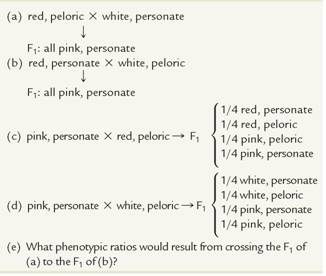
Three gene pairs located on separate autosomes determine flower color and shape as well as plant height. The first pair exhibits incomplete dominance, where the color can be red, pink (the heterozygote), or white. The second pair leads to personate (dominant) or peloric (recessive) flower shape, while the third gene pair produces either the dominant tall trait or the recessive dwarf trait. Homozygous plants that are red, personate, and tall are crossed to those that are white, peloric, and dwarf. Determine the F 1 genotype(s) and phenotype(s). If the F 1 plants are interbred, what proportion of the offspring will exhibit the same phenotype as the F 1 plants?
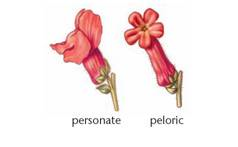
Three gene pairs located on separate autosomes determine flower color and shape as well as plant height. The first pair exhibits incomplete dominance, where the color can be red, pink (the heterozygote), or white. The second pair leads to personate (dominant) or peloric (recessive) flower shape, while the third gene pair produces either the dominant tall trait or the recessive dwarf trait. Homozygous plants that are red, personate, and tall are crossed to those that are white, peloric, and dwarf. Determine the F 1 genotype(s) and phenotype(s). If the F 1 plants are interbred, what proportion of the offspring will exhibit the same phenotype as the F 1 plants?
Question
Horses can be cremello (a light cream color), chestnut (a brownish color), or palomino (a golden color with white in the horse's tail and mane). Of these phenotypes, only palominos never breed true.
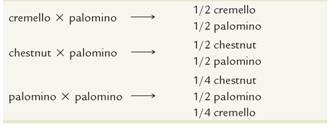
(a) From the results given above, determine the mode of inheritance by assigning gene symbols and indicating which genotypes yield which phenotypes.
(b) Predict the F 1 and F 2 results of many initial matings between cremello and chestnut horses.
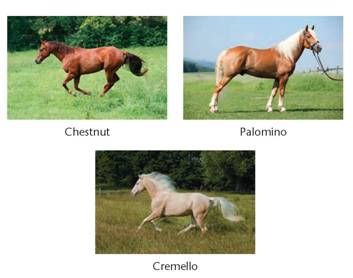
(a) From the results given above, determine the mode of inheritance by assigning gene symbols and indicating which genotypes yield which phenotypes.
(b) Predict the F 1 and F 2 results of many initial matings between cremello and chestnut horses.
Question
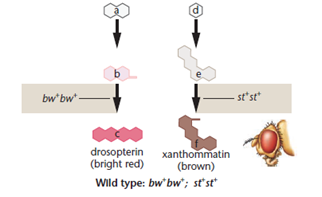
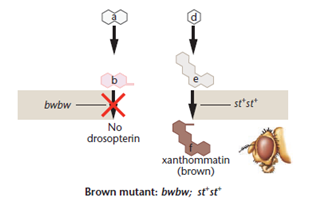
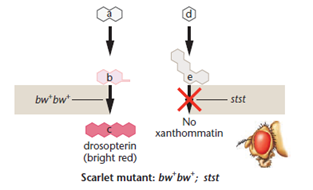
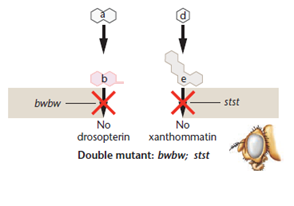
With reference to the eye color phenotypes produced by the recessive, autosomal, unlinked brown and scarlet loci in Drosophila (see Figure), predict the F 1 and F 2 results of the following P 1 crosses. (Recall that when both the brown and scarlet alleles are homozygous, no pigment is produced, and the eyes are white.)(a) wild type × white
(b) wild type × scarlet
(c) brown × white
FIGURE
Figure 4-10 A theoretical explanation of the biochemical basis of the four eye color phenotypes produced in a cross between Drosophila with brown eyes and scarlet eyes. In the presence of at least one wild-type bw + allele, an enzyme is produced that converts substance b to c, and the pigment drosopterin is synthesized. In the presence of at least one wild-type st + allele, substance e is converted to f, and the pigment xanthommatin is synthesized. The homozygous presence of the recessive st or bw mutant allele blocks the synthesis of the respective pigment molecule. Either one, both, or neither of these pathways can be blocked, depending on the genotype.
(b) wild type × scarlet
(c) brown × white
FIGURE
Figure 4-10 A theoretical explanation of the biochemical basis of the four eye color phenotypes produced in a cross between Drosophila with brown eyes and scarlet eyes. In the presence of at least one wild-type bw + allele, an enzyme is produced that converts substance b to c, and the pigment drosopterin is synthesized. In the presence of at least one wild-type st + allele, substance e is converted to f, and the pigment xanthommatin is synthesized. The homozygous presence of the recessive st or bw mutant allele blocks the synthesis of the respective pigment molecule. Either one, both, or neither of these pathways can be blocked, depending on the genotype.
Question
Pigment in mouse fur is only produced when the C allele is present. Individuals of the cc genotype are white. If color is present, it may be determined by the A , a alleles. AA or Aa results in agouti color, while aa results in black coats.
(a) What F 1 and F 2 genotypic and phenotypic ratios are obtained from a cross between AACC and aacc mice?
(b) In three crosses between agouti females whose genotypes were unknown and males of the aacc genotype, the following phenotypic ratios were obtained:
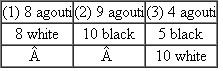 What are the genotypes of these female parents?
(a) What F 1 and F 2 genotypic and phenotypic ratios are obtained from a cross between AACC and aacc mice?
(b) In three crosses between agouti females whose genotypes were unknown and males of the aacc genotype, the following phenotypic ratios were obtained:
What are the genotypes of these female parents? Question
In rats, the following genotypes of two independently assorting autosomal genes determine coat color:
 ▪third gene pair on a separate autosome determines whether or not any color will be produced. The CC and Cc genotypes allow color according to the expression of the A and B alleles. However, the cc genotype results in albino rats regardless of the A and B alleles present. Determine the F 1 phenotypic ratio of the following crosses:
(a) AAbbCC × aaBBcc
(b) AaBBCC × AABbcc
(c) AaBbCc × AaBbcc
(d) AaBBCc × AaBBCc
(e) AABbCc × AABbcc
▪third gene pair on a separate autosome determines whether or not any color will be produced. The CC and Cc genotypes allow color according to the expression of the A and B alleles. However, the cc genotype results in albino rats regardless of the A and B alleles present. Determine the F 1 phenotypic ratio of the following crosses:(a) AAbbCC × aaBBcc
(b) AaBBCC × AABbcc
(c) AaBbCc × AaBbcc
(d) AaBBCc × AaBBCc
(e) AABbCc × AABbcc
Question
Given the inheritance pattern of coat color in rats described in Problem, predict the genotype and phenotype of the parents who produced the following offspring:
(a) 9/16 gray: 3/16 yellow: 3/16 black: 1/16 cream
(b) 9/16 gray: 3/16 yellow: 4/16 albino
(c) 27/64 gray: 16/64 albino: 9/64 yellow: 9/64 black: 3/64 cream
(d) 3/8 black: 3/8 cream: 2/8 albino
(e) 3/8 black: 4/8 albino: 1/8 cream
In rats, the following genotypes of two independently assorting autosomal genes determine coat color:
 ▪third gene pair on a separate autosome determines whether or not any color will be produced. The CC and Cc genotypes allow color according to the expression of the A and B alleles. However, the cc genotype results in albino rats regardless of the A and B alleles present. Determine the F 1 phenotypic ratio of the following crosses:
(a) AAbbCC × aaBBcc
(b) AaBBCC × AABbcc
(c) AaBbCc × AaBbcc
(d) AaBBCc × AaBBCc
(e) AABbCc × AABbcc
(a) 9/16 gray: 3/16 yellow: 3/16 black: 1/16 cream
(b) 9/16 gray: 3/16 yellow: 4/16 albino
(c) 27/64 gray: 16/64 albino: 9/64 yellow: 9/64 black: 3/64 cream
(d) 3/8 black: 3/8 cream: 2/8 albino
(e) 3/8 black: 4/8 albino: 1/8 cream
In rats, the following genotypes of two independently assorting autosomal genes determine coat color:
▪third gene pair on a separate autosome determines whether or not any color will be produced. The CC and Cc genotypes allow color according to the expression of the A and B alleles. However, the cc genotype results in albino rats regardless of the A and B alleles present. Determine the F 1 phenotypic ratio of the following crosses:(a) AAbbCC × aaBBcc
(b) AaBBCC × AABbcc
(c) AaBbCc × AaBbcc
(d) AaBBCc × AaBBCc
(e) AABbCc × AABbcc
Question
In a species of the cat family, eye color can be gray, blue, green, or brown, and each trait is true breeding. In separate crosses involving homozygous parents, the following data were obtained:
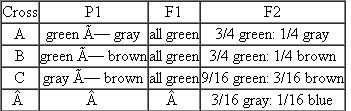 (a) Analyze the data. How many genes are involved? Define gene symbols and indicate which genotypes yield each phenotype.
(b) In a cross between a gray-eyed cat and one of unknown genotype and phenotype, the F 1 generation was not observed. However, the F 2 resulted in the same F 2 ratio as in cross C. Determine the genotypes and phenotypes of the unknown P 1 and F 1 cats.
(a) Analyze the data. How many genes are involved? Define gene symbols and indicate which genotypes yield each phenotype.(b) In a cross between a gray-eyed cat and one of unknown genotype and phenotype, the F 1 generation was not observed. However, the F 2 resulted in the same F 2 ratio as in cross C. Determine the genotypes and phenotypes of the unknown P 1 and F 1 cats.
Question
Question
Question
Five human matings (1-5), identified by both maternal and paternal phenotypes for ABO and MN blood-group antigen status, are shown on the left side of the following table:
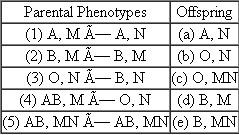 Each mating resulted in one of the five offspring shown in the right-hand column (a-e). Match each offspring with one correct set of parents, using each parental set only once. Is there more than one set of correct answers?
Each mating resulted in one of the five offspring shown in the right-hand column (a-e). Match each offspring with one correct set of parents, using each parental set only once. Is there more than one set of correct answers? Question
Question
Question
Question
Question
Question
Question
Question
Consider the three pedigrees at the top of the right column, all involving a single human trait.
(a) Which combination of conditions, if any, can be excluded?
dominant and X-linked
dominant and autosomal
recessive and X-linked
recessive and autosomal
(b) For each combination that you excluded, indicate the single individual in generation II (e.g., II-1, II-2) that was most instrumental in your decision to exclude it. If none were excluded, answer "none apply."
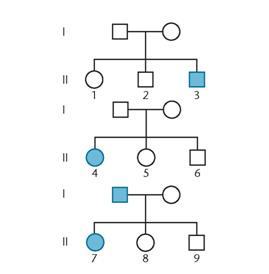
(c) Given your conclusions in part (a), indicate the genotype of the following individuals:
II-1, II-6, II-9
If more than one possibility applies, list all possibilities. Use the symbols A and a for the genotypes.
(a) Which combination of conditions, if any, can be excluded?
dominant and X-linked
dominant and autosomal
recessive and X-linked
recessive and autosomal
(b) For each combination that you excluded, indicate the single individual in generation II (e.g., II-1, II-2) that was most instrumental in your decision to exclude it. If none were excluded, answer "none apply."
(c) Given your conclusions in part (a), indicate the genotype of the following individuals:
II-1, II-6, II-9
If more than one possibility applies, list all possibilities. Use the symbols A and a for the genotypes.
Question
In goats, the development of the beard is due to a recessive gene. The following cross involving true-breeding goats was made and carried to the F 2 generation:
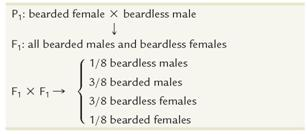
Offer an explanation for the inheritance and expression of this trait, diagramming the cross. Propose one or more crosses to test your hypothesis.
Offer an explanation for the inheritance and expression of this trait, diagramming the cross. Propose one or more crosses to test your hypothesis.
Question
Question
Question
Question
Question
Labrador retrievers may be black, brown (chocolate), or golden (yellow) in color (see chapter-opening photo). While each color may breed true, many different outcomes are seen when numerous litters are examined from a variety of matings where the parents are not necessarily true breeding. Following are just some of the many possibilities.
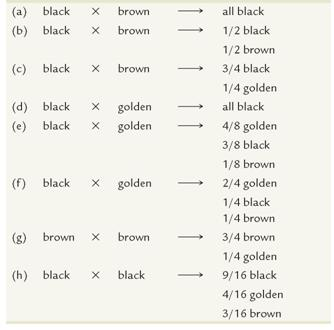
Propose a mode of inheritance that is consistent with these data, and indicate the corresponding genotypes of the parents in each mating. Indicate as well the genotypes of dogs that breed true for each color.
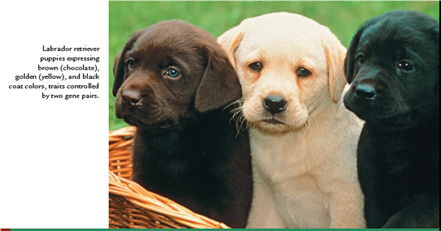
Propose a mode of inheritance that is consistent with these data, and indicate the corresponding genotypes of the parents in each mating. Indicate as well the genotypes of dogs that breed true for each color.
Question
Question
Question
A geneticist from an alien planet that prohibits genetic research brought with him to Earth two pure-breeding lines of frogs. One line croaks by uttering "rib-it rib-it" and has purple eyes. The other line croaks more softly by muttering "knee-deep knee-deep" and has green eyes. With a newfound freedom of inquiry, the geneticist mated the two types of frogs, producing F 1 frogs that were all utterers and had blue eyes. A large F 2 generation then yielded the following ratios:
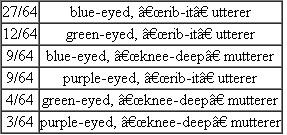 (a) How many total gene pairs are involved in the inheritance of both traits? Support your answer.
(b) Of these, how many are controlling eye color? How can you tell? How many are controlling croaking?
(c) Assign gene symbols for all phenotypes and indicate the genotypes of the P 1 and F 1 frogs.
(d) Indicate the genotypes of the six F 2 phenotypes.
(e) After years of experiments, the geneticist isolated pure-breeding strains of all six F 2 phenotypes. Indicate the F 1 and F 2 phenotypic ratios of the following cross using these pure-breeding strains:
blue-eyed, "knee-deep" mutterer × purple-eyed, "rib-it" utterer
(f) One set of crosses with his true-breeding lines initially caused the geneticist some confusion. When he crossed true-breeding purple-eyed, "knee-deep" mutterers with true-breeding green-eyed, "knee-deep" mutterers, he often got different results. In some matings, all offspring were blue-eyed, "knee-deep" mutterers, but in other matings all offspring were purple-eyed, "knee-deep" mutterers. In still a third mating, 1/2 blue-eyed, "knee-deep" mutterers and 1/2 purple-eyed, "knee-deep" mutterers were observed. Explain why the results differed.
(g) In another experiment, the geneticist crossed two purpleeyed, "rib-it" utterers together with the results shown here:
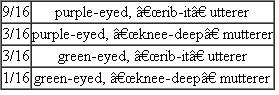 What were the genotypes of the two parents?
(a) How many total gene pairs are involved in the inheritance of both traits? Support your answer.(b) Of these, how many are controlling eye color? How can you tell? How many are controlling croaking?
(c) Assign gene symbols for all phenotypes and indicate the genotypes of the P 1 and F 1 frogs.
(d) Indicate the genotypes of the six F 2 phenotypes.
(e) After years of experiments, the geneticist isolated pure-breeding strains of all six F 2 phenotypes. Indicate the F 1 and F 2 phenotypic ratios of the following cross using these pure-breeding strains:
blue-eyed, "knee-deep" mutterer × purple-eyed, "rib-it" utterer
(f) One set of crosses with his true-breeding lines initially caused the geneticist some confusion. When he crossed true-breeding purple-eyed, "knee-deep" mutterers with true-breeding green-eyed, "knee-deep" mutterers, he often got different results. In some matings, all offspring were blue-eyed, "knee-deep" mutterers, but in other matings all offspring were purple-eyed, "knee-deep" mutterers. In still a third mating, 1/2 blue-eyed, "knee-deep" mutterers and 1/2 purple-eyed, "knee-deep" mutterers were observed. Explain why the results differed.
(g) In another experiment, the geneticist crossed two purpleeyed, "rib-it" utterers together with the results shown here:
What were the genotypes of the two parents? Question
The following pedigree is characteristic of an inherited condition known as male precocious puberty, where affected males show signs of puberty by age 4. Propose a genetic explanation of this phenotype.
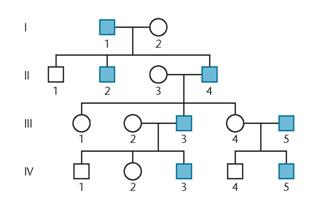
Question
Students taking a genetics exam were expected to answer the following question by converting data to a "meaningful ratio" and then solving the problem. The instructor assumed that the final ratio would reflect two gene pairs, and most correct answers did. Here is the exam question:
"Flowers may be white, orange, or brown. When plants with white flowers are crossed with plants with brown flowers, all the F 1 flowers are white. For F 2 flowers, the following data were obtained:
 Convert the F 2 data to a meaningful ratio that allows you to explain the inheritance of color. Determine the number of genes involved and the genotypes that yield each phenotype."
(a) Solve the problem for two gene pairs. What is the final F 2 ratio?
(b) A number of students failed to reduce the ratio for two gene pairs as described above and solved the problem using three gene pairs. When examined carefully, their solution was deemed a valid response by the instructor. Solve the problem using three gene pairs.
(c) We now have a dilemma. The data are consistent with two alternative mechanisms of inheritance. Propose an experiment that executes crosses involving the original parents that would distinguish between the two solutions proposed by the students. Explain how this experiment would resolve the dilemma.
"Flowers may be white, orange, or brown. When plants with white flowers are crossed with plants with brown flowers, all the F 1 flowers are white. For F 2 flowers, the following data were obtained:
Convert the F 2 data to a meaningful ratio that allows you to explain the inheritance of color. Determine the number of genes involved and the genotypes that yield each phenotype."(a) Solve the problem for two gene pairs. What is the final F 2 ratio?
(b) A number of students failed to reduce the ratio for two gene pairs as described above and solved the problem using three gene pairs. When examined carefully, their solution was deemed a valid response by the instructor. Solve the problem using three gene pairs.
(c) We now have a dilemma. The data are consistent with two alternative mechanisms of inheritance. Propose an experiment that executes crosses involving the original parents that would distinguish between the two solutions proposed by the students. Explain how this experiment would resolve the dilemma.
Question
In four o'clock plants, many flower colors are observed. In a cross involving two true-breeding strains, one crimson and the other white, all of the F 1 generation were rose color. In the F 2 , four new phenotypes appeared along with the P 1 and F 1 parental colors. The following ratio was obtained:
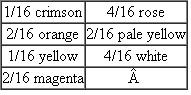 Propose an explanation for the inheritance of these flower colors.
Propose an explanation for the inheritance of these flower colors. Question
Question
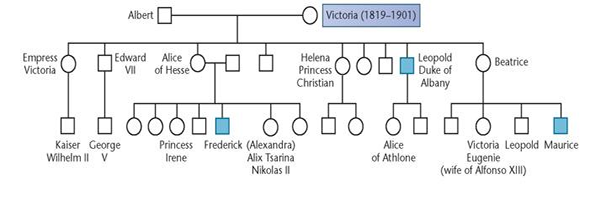
Below is a partial pedigree of hemophilia in the British Royal Family descended from Queen Victoria, who is believed to be the original "carrier" in this pedigree. Analyze the pedigree and indicate which females are also certain to be carriers. What is the probability that Princess Irene is a carrier?

Unlock Deck
Sign up to unlock the cards in this deck!
Unlock Deck
Unlock Deck
1/47

Play

Full screen (f)
Deck 4: Extensions of Mendelian Genetics
1
Researching their family histories, a deaf couple learns that each of them has relatives through several generations who are deaf. With a rudimentary understanding of genetics, they also learn that one of many forms of deafness can be inherited as an autosomal recessive trait. They plan to have children, and based on the above information, they are concerned that some or all of their children may be deaf. To their delight, their first child has normal hearing. The couple turns to you as a geneticist to help explain this situation.
Is it likely that these parents inherited their deafness as an autosomal recessive trait?
Is it likely that these parents inherited their deafness as an autosomal recessive trait?
Deafness can be inherited as an autosomal recessive trait:
Explanation
▪couple learns that deafness can be inherited as an autosomal recessive trait. They learn that two recessive alleles for hearing cause deafness. Moreover, their children could only have the recessive alleles. Since, they do not have the dominant allele for hearing to pass on to their children. All their children would be deaf. However, the couple's first child was found to have normal hearing.
Additionally, if each of them has two recessive alleles, the first child will have two recessive alleles. If the genes cause deafness in the couple, the genes cause deafness to the couple's first child.
Therefore, it is not likely the couple's deafness is the result of inheriting recessive alleles. Hence, their deafness is not the result of an autosomal recessive trait.
Explanation
▪couple learns that deafness can be inherited as an autosomal recessive trait. They learn that two recessive alleles for hearing cause deafness. Moreover, their children could only have the recessive alleles. Since, they do not have the dominant allele for hearing to pass on to their children. All their children would be deaf. However, the couple's first child was found to have normal hearing.
Additionally, if each of them has two recessive alleles, the first child will have two recessive alleles. If the genes cause deafness in the couple, the genes cause deafness to the couple's first child.
Therefore, it is not likely the couple's deafness is the result of inheriting recessive alleles. Hence, their deafness is not the result of an autosomal recessive trait.
2
In this chapter, we focused on extensions and modifications of Mendelian principles and ratios. In the process, we encountered many opportunities to consider how this information was acquired. On the basis of these discussions, what answers would you propose to the following fundamental questions?
(a) How were early geneticists able to ascertain inheritance patterns that did not fit typical Mendelian ratios?
(b) How did geneticists determine that inheritance of some phenotypic characteristics involves the interactions of two or more gene pairs? How were they able to determine how many gene pairs were involved?
(c) How do we know that specific genes are located on the sex-determining chromosomes rather than on autosomes?
(d) For genes whose expression seems to be tied to the sex of individuals, how do we know whether a gene is X-linked in contrast to exhibiting sex-limited or sex-influenced inheritance?
(a) How were early geneticists able to ascertain inheritance patterns that did not fit typical Mendelian ratios?
(b) How did geneticists determine that inheritance of some phenotypic characteristics involves the interactions of two or more gene pairs? How were they able to determine how many gene pairs were involved?
(c) How do we know that specific genes are located on the sex-determining chromosomes rather than on autosomes?
(d) For genes whose expression seems to be tied to the sex of individuals, how do we know whether a gene is X-linked in contrast to exhibiting sex-limited or sex-influenced inheritance?
(a)Geneticists are able to obtain inheritance patterns that do not fit Mendelian ratios. Geneticists do experiments and collect data. Their observations indicate that not all inheritance fit Mendelian ratios. In addition, codominance explains the existence of two phenotypic expressions, if an organism possesses different alleles that produce different expression simulataneously. For example, a species of plant might not have just red or white flowers. Incomplete or partial dominance of the red allele result in the presence of the white allele. Consequently, the plant has pink flower. Pink is blend of red and pink. Neither the allele for white nor the allele for red has total dominance.
(b)Geneticists also observe that one phenotypic expression may be controlled by multiple genes. For example, blood type is controlled by the interaction of more than one gene. The Bombay phenotype illustrates lack of one gene overrides the expression of the gene that controls blood type. In that phenomenon, an individual has the gene for one blood type that lacks another gene to prevent the expression of blood type. The interactions of multiple genes might result in deviation from the Mendelian ratios. One gene may be epistatic that overrides other genes. In addition, several genes may be linked on the same chromosomes and could not segregate independently. This is referred to as genetic linkage. Mendel's ratios do not take into account genetic linkage of different genes located on same chromosomes.
Similarly, many observations of other species reveal that all species mode of inheritance do not fit in Mendel's ratios. In addition, the mode of inheritance of other species is not supported by all Mendel's four postulates. Therefore, geneticists do experiments and collect data. Based on their data, calculations, and analysis geneticists determine the mode of inheritance of species.
(c)Several diseases or disorders are more prevalent in one gender when compared to another gender. Moreover, one sex is more vulnerable to inherit the genetic disease than the other sex. In human, color blindness is passed on from mother to son. Male is more vulnerable than female. Male has only one X chromosome. Female has two X chromosomes. Hence, the gene that control sight is located on the sex chromosome. Color blindness is an example of sex-linked inheritance. The genes responsible for the traits are on the X chromosome.
(d)In sex-limited inheritance, the genes responsible for the phenotypes are not located on the X chromosome. In sex-limited inheritance, the genes are on the autosomal chromosomes. However, the expressions of the genes are affected by sex of the individuals. For example, a male and a female have alleles for a trait, male have the gene expression, but female will not have the gene expression.
Additionally, in sex-influenced inheritance, the genes are not located on the X chromosome. The genes are located on autosomal chromosomes in sex-influenced inheritance. The phenotypic expressions of sex-influenced inheritance are influenced by the hormones of the individuals. The expressions of the traits may occur in both males and females. However, different hormones might influence different expressions of a trait.
(b)Geneticists also observe that one phenotypic expression may be controlled by multiple genes. For example, blood type is controlled by the interaction of more than one gene. The Bombay phenotype illustrates lack of one gene overrides the expression of the gene that controls blood type. In that phenomenon, an individual has the gene for one blood type that lacks another gene to prevent the expression of blood type. The interactions of multiple genes might result in deviation from the Mendelian ratios. One gene may be epistatic that overrides other genes. In addition, several genes may be linked on the same chromosomes and could not segregate independently. This is referred to as genetic linkage. Mendel's ratios do not take into account genetic linkage of different genes located on same chromosomes.
Similarly, many observations of other species reveal that all species mode of inheritance do not fit in Mendel's ratios. In addition, the mode of inheritance of other species is not supported by all Mendel's four postulates. Therefore, geneticists do experiments and collect data. Based on their data, calculations, and analysis geneticists determine the mode of inheritance of species.
(c)Several diseases or disorders are more prevalent in one gender when compared to another gender. Moreover, one sex is more vulnerable to inherit the genetic disease than the other sex. In human, color blindness is passed on from mother to son. Male is more vulnerable than female. Male has only one X chromosome. Female has two X chromosomes. Hence, the gene that control sight is located on the sex chromosome. Color blindness is an example of sex-linked inheritance. The genes responsible for the traits are on the X chromosome.
(d)In sex-limited inheritance, the genes responsible for the phenotypes are not located on the X chromosome. In sex-limited inheritance, the genes are on the autosomal chromosomes. However, the expressions of the genes are affected by sex of the individuals. For example, a male and a female have alleles for a trait, male have the gene expression, but female will not have the gene expression.
Additionally, in sex-influenced inheritance, the genes are not located on the X chromosome. The genes are located on autosomal chromosomes in sex-influenced inheritance. The phenotypic expressions of sex-influenced inheritance are influenced by the hormones of the individuals. The expressions of the traits may occur in both males and females. However, different hormones might influence different expressions of a trait.
3
Researching their family histories, a deaf couple learns that each of them has relatives through several generations who are deaf. With a rudimentary understanding of genetics, they also learn that one of many forms of deafness can be inherited as an autosomal recessive trait. They plan to have children, and based on the above information, they are concerned that some or all of their children may be deaf. To their delight, their first child has normal hearing. The couple turns to you as a geneticist to help explain this situation.
What is the likelihood that each future child will be deaf?
What is the likelihood that each future child will be deaf?
However, if the deafness gene were to follow an autosomal recessive pattern, both couples would have to be homozygous recessive for the trait in question because they express the trait. In that case, all following children would be homozygous recessive for the trait and there is a 100% chance that each future child is deaf.
4
Review the Chapter Concepts list. These all relate to exceptions to the inheritance patterns encountered by Mendel. Write a short essay that explains why multiple and lethal alleles often result in a modification of the classic Mendelian monohybrid and dihybrid ratios.
CHAPTER CONCEPTS
▪While alleles are transmitted from parent to offspring according to Mendelian principles, they often do not display the clear-cut dominant/recessive relationship observed by Mendel.
▪In many cases, in a departure from Mendelian genetics, two or more genes are known to influence the phenotype of a single characteristic.
▪Still another exception to Mendelian inheritance occurs when genes are located on the X chromosome, because one of the sexes receives only one copy of that chromosome, eliminating the possibility of heterozygosity.
▪The result of the various exceptions to Mendelian principles is the occurrence of phenotypic ratios that differ from those produced by standard monohybrid, dihybrid, and trihybrid crosses.
▪Phenotypes are often the combined result of genetics and the environment within which genes are expressed.
CHAPTER CONCEPTS
▪While alleles are transmitted from parent to offspring according to Mendelian principles, they often do not display the clear-cut dominant/recessive relationship observed by Mendel.
▪In many cases, in a departure from Mendelian genetics, two or more genes are known to influence the phenotype of a single characteristic.
▪Still another exception to Mendelian inheritance occurs when genes are located on the X chromosome, because one of the sexes receives only one copy of that chromosome, eliminating the possibility of heterozygosity.
▪The result of the various exceptions to Mendelian principles is the occurrence of phenotypic ratios that differ from those produced by standard monohybrid, dihybrid, and trihybrid crosses.
▪Phenotypes are often the combined result of genetics and the environment within which genes are expressed.
Unlock Deck
Unlock for access to all 47 flashcards in this deck.
Unlock Deck
k this deck
5
Researching their family histories, a deaf couple learns that each of them has relatives through several generations who are deaf. With a rudimentary understanding of genetics, they also learn that one of many forms of deafness can be inherited as an autosomal recessive trait. They plan to have children, and based on the above information, they are concerned that some or all of their children may be deaf. To their delight, their first child has normal hearing. The couple turns to you as a geneticist to help explain this situation.
What conclusions could be drawn if their first child had been deaf?
What conclusions could be drawn if their first child had been deaf?
Unlock Deck
Unlock for access to all 47 flashcards in this deck.
Unlock Deck
k this deck
6
In shorthorn cattle, coat color may be red, white, or roan. Roan is an intermediate phenotype expressed as a mixture of red and white hairs. The following data were obtained from various crosses:
How is coat color inherited? What are the genotypes of parents and offspring for each cross?
How is coat color inherited? What are the genotypes of parents and offspring for each cross?
Unlock Deck
Unlock for access to all 47 flashcards in this deck.
Unlock Deck
k this deck
7
In foxes, two alleles of a single gene, P and p , may result in lethality ( PP ), platinum coat ( Pp ), or silver coat ( pp ). What ratio is obtained when platinum foxes are interbred? Is the P allele behaving dominantly or recessively in causing (a) lethality; (b) platinum coat color?
Unlock Deck
Unlock for access to all 47 flashcards in this deck.
Unlock Deck
k this deck
8
In mice, a short-tailed mutant was discovered. When it was crossed to a normal long-tailed mouse, 4 offspring were shorttailed and 3 were long-tailed. Two short-tailed mice from the F 1 generation were selected and crossed. They produced 6 short-tailed and 3 long-tailed mice. These genetic experiments were repeated three times with approximately the same results. What genetic ratios are illustrated? Hypothesize the mode of inheritance and diagram the crosses.
Unlock Deck
Unlock for access to all 47 flashcards in this deck.
Unlock Deck
k this deck
9
List all possible genotypes for the A, B, AB, and O phenotypes. Is the mode of inheritance of the ABO blood types representative of dominance? of recessiveness? of codominance?
Unlock Deck
Unlock for access to all 47 flashcards in this deck.
Unlock Deck
k this deck
10
With regard to the ABO blood types in humans, determine the genotype of the male parent and female parent shown here:
Male parent: Blood type B; mother type O
Female parent: Blood type A; father type B
Predict the blood types of the offspring that this couple may have and the expected proportion of each.
Male parent: Blood type B; mother type O
Female parent: Blood type A; father type B
Predict the blood types of the offspring that this couple may have and the expected proportion of each.
Unlock Deck
Unlock for access to all 47 flashcards in this deck.
Unlock Deck
k this deck
11
In a disputed parentage case, the child is blood type O, while the mother is blood type A. What blood type would exclude a male from being the father? Would the other blood types prove that a particular male was the father?
Unlock Deck
Unlock for access to all 47 flashcards in this deck.
Unlock Deck
k this deck
12
The A and B antigens in humans may be found in water-soluble form in secretions, including saliva, of some individuals ( Se/Se and Se/se ) but not in others ( se/se ). The population thus contains "secretors" and "nonsecretors."
(a) Determine the proportion of various phenotypes (blood type and ability to secrete) in matings between individuals that are blood type AB and type O, both of whom are Se/se.
(b) How will the results of such matings change if both parents are heterozygous for the gene controlling the synthesis of the H substance ( Hh )?
(a) Determine the proportion of various phenotypes (blood type and ability to secrete) in matings between individuals that are blood type AB and type O, both of whom are Se/se.
(b) How will the results of such matings change if both parents are heterozygous for the gene controlling the synthesis of the H substance ( Hh )?
Unlock Deck
Unlock for access to all 47 flashcards in this deck.
Unlock Deck
k this deck
13
In chickens, a condition referred to as "creeper" exists whereby the bird has very short legs and wings, and appears to be creeping when it walks. If creepers are bred to normal chickens, one-half of the offspring are normal and one-half are creepers. Creepers never breed true. If bred together, they yield two-thirds creepers and one-third normal. Propose an explanation for the inheritance of this condition.
Unlock Deck
Unlock for access to all 47 flashcards in this deck.
Unlock Deck
k this deck
14
In rabbits, a series of multiple alleles controls coat color in the following way: C is dominant to all other alleles and causes full color. The chinchilla phenotype is due to the c ch allele, which is dominant to all alleles other than C. The c h allele, dominant only to c a (albino), results in the Himalayan coat color. Thus, the order of dominance is C c ch c h c a. For each of the following three cases, the phenotypes of the P 1 generations of two crosses are shown, as well as the phenotype of one member of the F 1 generation.
For each case, determine the genotypes of the P 1 generation and the F 1 offspring, and predict the results of making each indicated cross between F 1 individuals.
For each case, determine the genotypes of the P 1 generation and the F 1 offspring, and predict the results of making each indicated cross between F 1 individuals.
Unlock Deck
Unlock for access to all 47 flashcards in this deck.
Unlock Deck
k this deck
15
Three gene pairs located on separate autosomes determine flower color and shape as well as plant height. The first pair exhibits incomplete dominance, where the color can be red, pink (the heterozygote), or white. The second pair leads to personate (dominant) or peloric (recessive) flower shape, while the third gene pair produces either the dominant tall trait or the recessive dwarf trait. Homozygous plants that are red, personate, and tall are crossed to those that are white, peloric, and dwarf. Determine the F 1 genotype(s) and phenotype(s). If the F 1 plants are interbred, what proportion of the offspring will exhibit the same phenotype as the F 1 plants?
Unlock Deck
Unlock for access to all 47 flashcards in this deck.
Unlock Deck
k this deck
16
As in Problem, flower color may be red, white, or pink, and flower shape may be personate or peloric. For the following crosses, determine the P 1 and F 1 genotypes:
Three gene pairs located on separate autosomes determine flower color and shape as well as plant height. The first pair exhibits incomplete dominance, where the color can be red, pink (the heterozygote), or white. The second pair leads to personate (dominant) or peloric (recessive) flower shape, while the third gene pair produces either the dominant tall trait or the recessive dwarf trait. Homozygous plants that are red, personate, and tall are crossed to those that are white, peloric, and dwarf. Determine the F 1 genotype(s) and phenotype(s). If the F 1 plants are interbred, what proportion of the offspring will exhibit the same phenotype as the F 1 plants?
Three gene pairs located on separate autosomes determine flower color and shape as well as plant height. The first pair exhibits incomplete dominance, where the color can be red, pink (the heterozygote), or white. The second pair leads to personate (dominant) or peloric (recessive) flower shape, while the third gene pair produces either the dominant tall trait or the recessive dwarf trait. Homozygous plants that are red, personate, and tall are crossed to those that are white, peloric, and dwarf. Determine the F 1 genotype(s) and phenotype(s). If the F 1 plants are interbred, what proportion of the offspring will exhibit the same phenotype as the F 1 plants?
Unlock Deck
Unlock for access to all 47 flashcards in this deck.
Unlock Deck
k this deck
17
Horses can be cremello (a light cream color), chestnut (a brownish color), or palomino (a golden color with white in the horse's tail and mane). Of these phenotypes, only palominos never breed true.
(a) From the results given above, determine the mode of inheritance by assigning gene symbols and indicating which genotypes yield which phenotypes.
(b) Predict the F 1 and F 2 results of many initial matings between cremello and chestnut horses.
(a) From the results given above, determine the mode of inheritance by assigning gene symbols and indicating which genotypes yield which phenotypes.
(b) Predict the F 1 and F 2 results of many initial matings between cremello and chestnut horses.
Unlock Deck
Unlock for access to all 47 flashcards in this deck.
Unlock Deck
k this deck
18
With reference to the eye color phenotypes produced by the recessive, autosomal, unlinked brown and scarlet loci in Drosophila (see Figure), predict the F 1 and F 2 results of the following P 1 crosses. (Recall that when both the brown and scarlet alleles are homozygous, no pigment is produced, and the eyes are white.)(a) wild type × white
(b) wild type × scarlet
(c) brown × white
FIGURE
Figure 4-10 A theoretical explanation of the biochemical basis of the four eye color phenotypes produced in a cross between Drosophila with brown eyes and scarlet eyes. In the presence of at least one wild-type bw + allele, an enzyme is produced that converts substance b to c, and the pigment drosopterin is synthesized. In the presence of at least one wild-type st + allele, substance e is converted to f, and the pigment xanthommatin is synthesized. The homozygous presence of the recessive st or bw mutant allele blocks the synthesis of the respective pigment molecule. Either one, both, or neither of these pathways can be blocked, depending on the genotype.
(b) wild type × scarlet
(c) brown × white
FIGURE
Figure 4-10 A theoretical explanation of the biochemical basis of the four eye color phenotypes produced in a cross between Drosophila with brown eyes and scarlet eyes. In the presence of at least one wild-type bw + allele, an enzyme is produced that converts substance b to c, and the pigment drosopterin is synthesized. In the presence of at least one wild-type st + allele, substance e is converted to f, and the pigment xanthommatin is synthesized. The homozygous presence of the recessive st or bw mutant allele blocks the synthesis of the respective pigment molecule. Either one, both, or neither of these pathways can be blocked, depending on the genotype.
Unlock Deck
Unlock for access to all 47 flashcards in this deck.
Unlock Deck
k this deck
19
Pigment in mouse fur is only produced when the C allele is present. Individuals of the cc genotype are white. If color is present, it may be determined by the A , a alleles. AA or Aa results in agouti color, while aa results in black coats.
(a) What F 1 and F 2 genotypic and phenotypic ratios are obtained from a cross between AACC and aacc mice?
(b) In three crosses between agouti females whose genotypes were unknown and males of the aacc genotype, the following phenotypic ratios were obtained:
What are the genotypes of these female parents?
(a) What F 1 and F 2 genotypic and phenotypic ratios are obtained from a cross between AACC and aacc mice?
(b) In three crosses between agouti females whose genotypes were unknown and males of the aacc genotype, the following phenotypic ratios were obtained:
What are the genotypes of these female parents? Unlock Deck
Unlock for access to all 47 flashcards in this deck.
Unlock Deck
k this deck
20
In rats, the following genotypes of two independently assorting autosomal genes determine coat color:
▪third gene pair on a separate autosome determines whether or not any color will be produced. The CC and Cc genotypes allow color according to the expression of the A and B alleles. However, the cc genotype results in albino rats regardless of the A and B alleles present. Determine the F 1 phenotypic ratio of the following crosses:
(a) AAbbCC × aaBBcc
(b) AaBBCC × AABbcc
(c) AaBbCc × AaBbcc
(d) AaBBCc × AaBBCc
(e) AABbCc × AABbcc
▪third gene pair on a separate autosome determines whether or not any color will be produced. The CC and Cc genotypes allow color according to the expression of the A and B alleles. However, the cc genotype results in albino rats regardless of the A and B alleles present. Determine the F 1 phenotypic ratio of the following crosses:(a) AAbbCC × aaBBcc
(b) AaBBCC × AABbcc
(c) AaBbCc × AaBbcc
(d) AaBBCc × AaBBCc
(e) AABbCc × AABbcc
Unlock Deck
Unlock for access to all 47 flashcards in this deck.
Unlock Deck
k this deck
21
Given the inheritance pattern of coat color in rats described in Problem, predict the genotype and phenotype of the parents who produced the following offspring:
(a) 9/16 gray: 3/16 yellow: 3/16 black: 1/16 cream
(b) 9/16 gray: 3/16 yellow: 4/16 albino
(c) 27/64 gray: 16/64 albino: 9/64 yellow: 9/64 black: 3/64 cream
(d) 3/8 black: 3/8 cream: 2/8 albino
(e) 3/8 black: 4/8 albino: 1/8 cream
In rats, the following genotypes of two independently assorting autosomal genes determine coat color:
▪third gene pair on a separate autosome determines whether or not any color will be produced. The CC and Cc genotypes allow color according to the expression of the A and B alleles. However, the cc genotype results in albino rats regardless of the A and B alleles present. Determine the F 1 phenotypic ratio of the following crosses:
(a) AAbbCC × aaBBcc
(b) AaBBCC × AABbcc
(c) AaBbCc × AaBbcc
(d) AaBBCc × AaBBCc
(e) AABbCc × AABbcc
(a) 9/16 gray: 3/16 yellow: 3/16 black: 1/16 cream
(b) 9/16 gray: 3/16 yellow: 4/16 albino
(c) 27/64 gray: 16/64 albino: 9/64 yellow: 9/64 black: 3/64 cream
(d) 3/8 black: 3/8 cream: 2/8 albino
(e) 3/8 black: 4/8 albino: 1/8 cream
In rats, the following genotypes of two independently assorting autosomal genes determine coat color:
▪third gene pair on a separate autosome determines whether or not any color will be produced. The CC and Cc genotypes allow color according to the expression of the A and B alleles. However, the cc genotype results in albino rats regardless of the A and B alleles present. Determine the F 1 phenotypic ratio of the following crosses:(a) AAbbCC × aaBBcc
(b) AaBBCC × AABbcc
(c) AaBbCc × AaBbcc
(d) AaBBCc × AaBBCc
(e) AABbCc × AABbcc
Unlock Deck
Unlock for access to all 47 flashcards in this deck.
Unlock Deck
k this deck
22
In a species of the cat family, eye color can be gray, blue, green, or brown, and each trait is true breeding. In separate crosses involving homozygous parents, the following data were obtained:
(a) Analyze the data. How many genes are involved? Define gene symbols and indicate which genotypes yield each phenotype.
(b) In a cross between a gray-eyed cat and one of unknown genotype and phenotype, the F 1 generation was not observed. However, the F 2 resulted in the same F 2 ratio as in cross C. Determine the genotypes and phenotypes of the unknown P 1 and F 1 cats.
(a) Analyze the data. How many genes are involved? Define gene symbols and indicate which genotypes yield each phenotype.(b) In a cross between a gray-eyed cat and one of unknown genotype and phenotype, the F 1 generation was not observed. However, the F 2 resulted in the same F 2 ratio as in cross C. Determine the genotypes and phenotypes of the unknown P 1 and F 1 cats.
Unlock Deck
Unlock for access to all 47 flashcards in this deck.
Unlock Deck
k this deck
23
In a plant, a tall variety was crossed with a dwarf variety. All F 1 plants were tall. When F 1 × F 1 plants were interbred, 9/16 of the F 2 were tall and 7/16 were dwarf.
(a) Explain the inheritance of height by indicating the number of gene pairs involved and by designating which genotypes yield tall and which yield dwarf. (Use dashes where appropriate.)
(b) What proportion of the F 2 plants will be true breeding if self-fertilized? List these genotypes.
(a) Explain the inheritance of height by indicating the number of gene pairs involved and by designating which genotypes yield tall and which yield dwarf. (Use dashes where appropriate.)
(b) What proportion of the F 2 plants will be true breeding if self-fertilized? List these genotypes.
Unlock Deck
Unlock for access to all 47 flashcards in this deck.
Unlock Deck
k this deck
24
In a unique species of plants, flowers may be yellow, blue, red, or mauve. All colors may be true breeding. If plants with blue flowers are crossed to red-flowered plants, all F 1 plants have yellow flowers. When these produced an F 2 generation, the following ratio was observed:
9/16 yellow: 3/16 blue: 3/16 red: 1/16 mauve
In still another cross using true-breeding parents, yellow-flowered plants are crossed with mauve-flowered plants. Again, all F 1 plants had yellow flowers and the F 2 showed a 9:3:3:1 ratio, as just shown.
(a) Describe the inheritance of flower color by defining gene symbols and designating which genotypes give rise to each of the four phenotypes.
(b) Determine the F 1 and F 2 results of a cross between true-breeding red and true-breeding mauve-flowered plants.
9/16 yellow: 3/16 blue: 3/16 red: 1/16 mauve
In still another cross using true-breeding parents, yellow-flowered plants are crossed with mauve-flowered plants. Again, all F 1 plants had yellow flowers and the F 2 showed a 9:3:3:1 ratio, as just shown.
(a) Describe the inheritance of flower color by defining gene symbols and designating which genotypes give rise to each of the four phenotypes.
(b) Determine the F 1 and F 2 results of a cross between true-breeding red and true-breeding mauve-flowered plants.
Unlock Deck
Unlock for access to all 47 flashcards in this deck.
Unlock Deck
k this deck
25
Five human matings (1-5), identified by both maternal and paternal phenotypes for ABO and MN blood-group antigen status, are shown on the left side of the following table:
Each mating resulted in one of the five offspring shown in the right-hand column (a-e). Match each offspring with one correct set of parents, using each parental set only once. Is there more than one set of correct answers?
Each mating resulted in one of the five offspring shown in the right-hand column (a-e). Match each offspring with one correct set of parents, using each parental set only once. Is there more than one set of correct answers? Unlock Deck
Unlock for access to all 47 flashcards in this deck.
Unlock Deck
k this deck
26
A husband and wife have normal vision, although both of their fathers are red-green color-blind, an inherited X-linked recessive condition. What is the probability that their first child will be (a) a normal son? (b) a normal daughter? (c) a color-blind son? (d) a color-blind daughter?
Unlock Deck
Unlock for access to all 47 flashcards in this deck.
Unlock Deck
k this deck
27
In humans, the ABO blood type is under the control of autosomal multiple alleles. Color blindness is a recessive X-linked trait. If two parents who are both type A and have normal vision produce a son who is color-blind and is type O, what is the probability that their next child will be a female who has normal vision and is type O?
Unlock Deck
Unlock for access to all 47 flashcards in this deck.
Unlock Deck
k this deck
28
In Drosophila , an X-linked recessive mutation, scalloped ( sd ), causes irregular wing margins. Diagram the F 1 and F 2 results if (a) a scalloped female is crossed with a normal male; (b) a scalloped male is crossed with a normal female. Compare these results with those that would be obtained if the scalloped gene were autosomal.
Unlock Deck
Unlock for access to all 47 flashcards in this deck.
Unlock Deck
k this deck
29
Another recessive mutation in Drosophila , ebony (e), is on an autosome (chromosome 3) and causes darkening of the body compared with wild-type flies. What phenotypic F 1 and F 2 male and female ratios will result if a scalloped-winged female with normal body color is crossed with a normal-winged ebony male? Work out this problem by both the Punnett square method and the forked-line method.
Unlock Deck
Unlock for access to all 47 flashcards in this deck.
Unlock Deck
k this deck
30
In Drosophila , the X-linked recessive mutation vermilion ( v ) causes bright red eyes, in contrast to the brick-red eyes of wild type. A separate autosomal recessive mutation, suppressor of vermilion ( su-v ), causes flies homozygous or hemizygous for v to have wild-type eyes. In the absence of vermilion alleles, su-v has no effect on eye color. Determine the F 1 and F 2 phenotypic ratios from a cross between a female with wild-type alleles at the vermilion locus, but who is homozygous for su-v , with a vermilion male who has wild-type alleles at the su-v locus.
Unlock Deck
Unlock for access to all 47 flashcards in this deck.
Unlock Deck
k this deck
31
While vermilion is X-linked in Drosophila and causes the eye color to be bright red, brown is an autosomal recessive mutation that causes the eye to be brown. Flies carrying both mutations lose all pigmentation and are white-eyed. Predict the F 1 and F 2 results of the following crosses:
(a) vermilion females × brown males
(b) brown females × vermilion males
(c) white females × wild-type males
(a) vermilion females × brown males
(b) brown females × vermilion males
(c) white females × wild-type males
Unlock Deck
Unlock for access to all 47 flashcards in this deck.
Unlock Deck
k this deck
32
In a cross in Drosophila involving the X-linked recessive eye mutation white and the autosomally linked recessive eye mutation sepia (resulting in a dark eye), predict the F 1 and F 2 results of crossing true-breeding parents of the following phenotypes:
(a) white females × sepia males
(b) sepia females × white males
Note that white is epistatic to the expression of sepia.
(a) white females × sepia males
(b) sepia females × white males
Note that white is epistatic to the expression of sepia.
Unlock Deck
Unlock for access to all 47 flashcards in this deck.
Unlock Deck
k this deck
33
Consider the three pedigrees at the top of the right column, all involving a single human trait.
(a) Which combination of conditions, if any, can be excluded?
dominant and X-linked
dominant and autosomal
recessive and X-linked
recessive and autosomal
(b) For each combination that you excluded, indicate the single individual in generation II (e.g., II-1, II-2) that was most instrumental in your decision to exclude it. If none were excluded, answer "none apply."
(c) Given your conclusions in part (a), indicate the genotype of the following individuals:
II-1, II-6, II-9
If more than one possibility applies, list all possibilities. Use the symbols A and a for the genotypes.
(a) Which combination of conditions, if any, can be excluded?
dominant and X-linked
dominant and autosomal
recessive and X-linked
recessive and autosomal
(b) For each combination that you excluded, indicate the single individual in generation II (e.g., II-1, II-2) that was most instrumental in your decision to exclude it. If none were excluded, answer "none apply."
(c) Given your conclusions in part (a), indicate the genotype of the following individuals:
II-1, II-6, II-9
If more than one possibility applies, list all possibilities. Use the symbols A and a for the genotypes.
Unlock Deck
Unlock for access to all 47 flashcards in this deck.
Unlock Deck
k this deck
34
In goats, the development of the beard is due to a recessive gene. The following cross involving true-breeding goats was made and carried to the F 2 generation:
Offer an explanation for the inheritance and expression of this trait, diagramming the cross. Propose one or more crosses to test your hypothesis.
Offer an explanation for the inheritance and expression of this trait, diagramming the cross. Propose one or more crosses to test your hypothesis.
Unlock Deck
Unlock for access to all 47 flashcards in this deck.
Unlock Deck
k this deck
35
Predict the F 1 and F 2 results of crossing a male fowl that is cock-feathered with a true-breeding hen-feathered female fowl. Recall that these traits are sex limited.
Unlock Deck
Unlock for access to all 47 flashcards in this deck.
Unlock Deck
k this deck
36
Two mothers give birth to sons at the same time at a busy urban hospital. The son of mother 1 is afflicted with hemophilia, a disease caused by an X-linked recessive allele. Neither parent has the disease. Mother 2 has a normal son, despite the fact that the father has hemophilia. Several years later, couple 1 sues the hospital, claiming that these two newborns were swapped in the nursery following their birth. As a genetic counselor, you are called to testify. What information can you provide the jury concerning the allegation?
Unlock Deck
Unlock for access to all 47 flashcards in this deck.
Unlock Deck
k this deck
37
Discuss the topic of phenotypic expression and the many factors that impinge on it.
Unlock Deck
Unlock for access to all 47 flashcards in this deck.
Unlock Deck
k this deck
38
Contrast penetrance and expressivity as the terms relate to phenotypic expression.
Unlock Deck
Unlock for access to all 47 flashcards in this deck.
Unlock Deck
k this deck
39
Labrador retrievers may be black, brown (chocolate), or golden (yellow) in color (see chapter-opening photo). While each color may breed true, many different outcomes are seen when numerous litters are examined from a variety of matings where the parents are not necessarily true breeding. Following are just some of the many possibilities.
Propose a mode of inheritance that is consistent with these data, and indicate the corresponding genotypes of the parents in each mating. Indicate as well the genotypes of dogs that breed true for each color.
Propose a mode of inheritance that is consistent with these data, and indicate the corresponding genotypes of the parents in each mating. Indicate as well the genotypes of dogs that breed true for each color.
Unlock Deck
Unlock for access to all 47 flashcards in this deck.
Unlock Deck
k this deck
40
A true-breeding purple-leafed plant isolated from one side of El Yunque, the rain forest in Puerto Rico, was crossed to a true-breeding white variety found on the other side. The F 1 offspring were all purple. A large number of F 1 × F 1 crosses produced the following results:
purple: 4219 white: 5781 (Total = 10,000)Propose an explanation for the inheritance of leaf color. As a geneticist, how might you go about testing your hypothesis? Describe the genetic experiments that you would conduct.
purple: 4219 white: 5781 (Total = 10,000)Propose an explanation for the inheritance of leaf color. As a geneticist, how might you go about testing your hypothesis? Describe the genetic experiments that you would conduct.
Unlock Deck
Unlock for access to all 47 flashcards in this deck.
Unlock Deck
k this deck
41
In Dexter and Kerry cattle, animals may be polled (hornless) or horned. The Dexter animals have short legs, whereas the Kerry animals have long legs. When many offspring were obtained from matings between polled Kerrys and horned Dexters, half were found to be polled Dexters and half polled Kerrys. When these two types of F 1 cattle were mated to one another, the following F 2 data were obtained:
3/8 polled Dexters
3/8 polled Kerrys
1/8 horned Dexters
1/8 horned Kerrys
▪geneticist was puzzled by these data and interviewed farmers who had bred these cattle for decades. She learned that Kerrys were true breeding. Dexters, on the other hand, were not true breeding and never produced as many offspring as Kerrys. Provide a genetic explanation for these observations.
3/8 polled Dexters
3/8 polled Kerrys
1/8 horned Dexters
1/8 horned Kerrys
▪geneticist was puzzled by these data and interviewed farmers who had bred these cattle for decades. She learned that Kerrys were true breeding. Dexters, on the other hand, were not true breeding and never produced as many offspring as Kerrys. Provide a genetic explanation for these observations.
Unlock Deck
Unlock for access to all 47 flashcards in this deck.
Unlock Deck
k this deck
42
A geneticist from an alien planet that prohibits genetic research brought with him to Earth two pure-breeding lines of frogs. One line croaks by uttering "rib-it rib-it" and has purple eyes. The other line croaks more softly by muttering "knee-deep knee-deep" and has green eyes. With a newfound freedom of inquiry, the geneticist mated the two types of frogs, producing F 1 frogs that were all utterers and had blue eyes. A large F 2 generation then yielded the following ratios:
(a) How many total gene pairs are involved in the inheritance of both traits? Support your answer.
(b) Of these, how many are controlling eye color? How can you tell? How many are controlling croaking?
(c) Assign gene symbols for all phenotypes and indicate the genotypes of the P 1 and F 1 frogs.
(d) Indicate the genotypes of the six F 2 phenotypes.
(e) After years of experiments, the geneticist isolated pure-breeding strains of all six F 2 phenotypes. Indicate the F 1 and F 2 phenotypic ratios of the following cross using these pure-breeding strains:
blue-eyed, "knee-deep" mutterer × purple-eyed, "rib-it" utterer
(f) One set of crosses with his true-breeding lines initially caused the geneticist some confusion. When he crossed true-breeding purple-eyed, "knee-deep" mutterers with true-breeding green-eyed, "knee-deep" mutterers, he often got different results. In some matings, all offspring were blue-eyed, "knee-deep" mutterers, but in other matings all offspring were purple-eyed, "knee-deep" mutterers. In still a third mating, 1/2 blue-eyed, "knee-deep" mutterers and 1/2 purple-eyed, "knee-deep" mutterers were observed. Explain why the results differed.
(g) In another experiment, the geneticist crossed two purpleeyed, "rib-it" utterers together with the results shown here:
What were the genotypes of the two parents?
(a) How many total gene pairs are involved in the inheritance of both traits? Support your answer.(b) Of these, how many are controlling eye color? How can you tell? How many are controlling croaking?
(c) Assign gene symbols for all phenotypes and indicate the genotypes of the P 1 and F 1 frogs.
(d) Indicate the genotypes of the six F 2 phenotypes.
(e) After years of experiments, the geneticist isolated pure-breeding strains of all six F 2 phenotypes. Indicate the F 1 and F 2 phenotypic ratios of the following cross using these pure-breeding strains:
blue-eyed, "knee-deep" mutterer × purple-eyed, "rib-it" utterer
(f) One set of crosses with his true-breeding lines initially caused the geneticist some confusion. When he crossed true-breeding purple-eyed, "knee-deep" mutterers with true-breeding green-eyed, "knee-deep" mutterers, he often got different results. In some matings, all offspring were blue-eyed, "knee-deep" mutterers, but in other matings all offspring were purple-eyed, "knee-deep" mutterers. In still a third mating, 1/2 blue-eyed, "knee-deep" mutterers and 1/2 purple-eyed, "knee-deep" mutterers were observed. Explain why the results differed.
(g) In another experiment, the geneticist crossed two purpleeyed, "rib-it" utterers together with the results shown here:
What were the genotypes of the two parents? Unlock Deck
Unlock for access to all 47 flashcards in this deck.
Unlock Deck
k this deck
43
The following pedigree is characteristic of an inherited condition known as male precocious puberty, where affected males show signs of puberty by age 4. Propose a genetic explanation of this phenotype.
Unlock Deck
Unlock for access to all 47 flashcards in this deck.
Unlock Deck
k this deck
44
Students taking a genetics exam were expected to answer the following question by converting data to a "meaningful ratio" and then solving the problem. The instructor assumed that the final ratio would reflect two gene pairs, and most correct answers did. Here is the exam question:
"Flowers may be white, orange, or brown. When plants with white flowers are crossed with plants with brown flowers, all the F 1 flowers are white. For F 2 flowers, the following data were obtained:
Convert the F 2 data to a meaningful ratio that allows you to explain the inheritance of color. Determine the number of genes involved and the genotypes that yield each phenotype."
(a) Solve the problem for two gene pairs. What is the final F 2 ratio?
(b) A number of students failed to reduce the ratio for two gene pairs as described above and solved the problem using three gene pairs. When examined carefully, their solution was deemed a valid response by the instructor. Solve the problem using three gene pairs.
(c) We now have a dilemma. The data are consistent with two alternative mechanisms of inheritance. Propose an experiment that executes crosses involving the original parents that would distinguish between the two solutions proposed by the students. Explain how this experiment would resolve the dilemma.
"Flowers may be white, orange, or brown. When plants with white flowers are crossed with plants with brown flowers, all the F 1 flowers are white. For F 2 flowers, the following data were obtained:
Convert the F 2 data to a meaningful ratio that allows you to explain the inheritance of color. Determine the number of genes involved and the genotypes that yield each phenotype."(a) Solve the problem for two gene pairs. What is the final F 2 ratio?
(b) A number of students failed to reduce the ratio for two gene pairs as described above and solved the problem using three gene pairs. When examined carefully, their solution was deemed a valid response by the instructor. Solve the problem using three gene pairs.
(c) We now have a dilemma. The data are consistent with two alternative mechanisms of inheritance. Propose an experiment that executes crosses involving the original parents that would distinguish between the two solutions proposed by the students. Explain how this experiment would resolve the dilemma.
Unlock Deck
Unlock for access to all 47 flashcards in this deck.
Unlock Deck
k this deck
45
In four o'clock plants, many flower colors are observed. In a cross involving two true-breeding strains, one crimson and the other white, all of the F 1 generation were rose color. In the F 2 , four new phenotypes appeared along with the P 1 and F 1 parental colors. The following ratio was obtained:
Propose an explanation for the inheritance of these flower colors.
Propose an explanation for the inheritance of these flower colors. Unlock Deck
Unlock for access to all 47 flashcards in this deck.
Unlock Deck
k this deck
46
Proto-oncogenes stimulate cells to progress through the cell cycle and begin mitosis. In cells that stop dividing, transcription of proto-oncogenes is inhibited by regulatory molecules. As is typical of all genes, proto-oncogenes contain a regulatory DNA region followed by a coding DNA region that specifies the amino acid sequence of the gene product. Consider two types of mutation in a proto-oncogene, one in the regulatory region that eliminates transcriptional control and the other in the coding region that renders the gene product inactive. Characterize both of these mutant alleles as either gain-of-function or loss-of-function mutations and indicate whether each would be dominant or recessive.
Unlock Deck
Unlock for access to all 47 flashcards in this deck.
Unlock Deck
k this deck
47
Below is a partial pedigree of hemophilia in the British Royal Family descended from Queen Victoria, who is believed to be the original "carrier" in this pedigree. Analyze the pedigree and indicate which females are also certain to be carriers. What is the probability that Princess Irene is a carrier?
Unlock Deck
Unlock for access to all 47 flashcards in this deck.
Unlock Deck
k this deck
Unlock Deck
Unlock for access to all 47 flashcards in this deck.







