





 Chat with AI

Deck 6: Genetic Analysis and Mapping in Bacteria and
Full screen (f)

Question

Question
Question
Question
Question
Question
Question
Question
Question
Question
Question
Question
Question
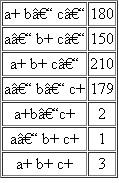
In a transformation experiment, donor DNA was obtained from a prototroph bacterial strain ( a + b + c + ) , and the recipient was a triple auxotroph ( a - b - c - ). What general conclusions can you draw about the linkage relationships among the three genes from the following transformant classes that were recovered?
Question
Question
Question
Question
Question
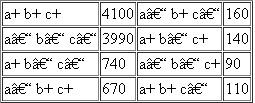
Two theoretical genetic strains of a virus (a - b - c - and a + b + c + ) were used to simultaneously infect a culture of host bacteria. Of 10,000 plaques scored, the following genotypes were observed. Determine the genetic map of these three genes on the viral chromosome. Decide whether interference was positive or negative.
Question
Question
Question
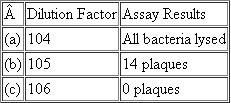
A phage-infected bacterial culture was subjected to a series of dilutions, and a plaque assay was performed in each case, with the results shown in the following table. What conclusion can be drawn in the case of each dilution, assuming that 0.1 mL was used in each plaque assay?
Question
Question
In an analysis of other rII mutants; complementation testing yielded the following results:
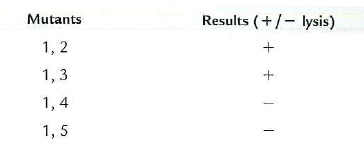
(a) Predict the results of testing 2 and 3, 2 and 4, and 3 and 4 together.
(b) if further testing yielded the following results, what would you conclude about mutant 5?
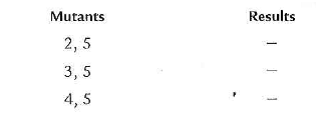
(a) Predict the results of testing 2 and 3, 2 and 4, and 3 and 4 together.
(b) if further testing yielded the following results, what would you conclude about mutant 5?
Question
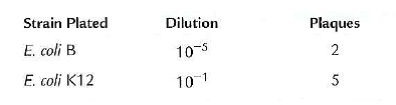
Using mutants 2 and 3 from the previous problem, following mixed infection on E. coli B, progeny viruses were plated in a series of dilutions on both E. coli B and K12 with the following results. What is the recombination frequency between the two mutants?
Reference: Problem : 19
In an analysis of other rII mutants; complementation testing yielded the following results:
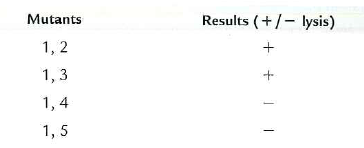
(a) Predict the results of testing 2 and 3, 2 and 4, and 3 and 4 together.
(b) if further testing yielded the following results, what would you conclude about mutant 5?
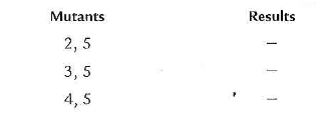
Reference: Problem : 19
In an analysis of other rII mutants; complementation testing yielded the following results:
(a) Predict the results of testing 2 and 3, 2 and 4, and 3 and 4 together.
(b) if further testing yielded the following results, what would you conclude about mutant 5?
Question
Question
Question
In studies of recombination between mutants 1 and 2 from the previous problem, the results shown in the following table were obtained.
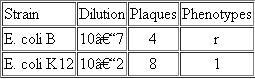 (a) Calculate the recombination frequency.
(b) When mutant 6 was tested for recombination with mutant 1, the data were the same as those shown above for strain B, but not for K12. The researcher lost the K12 data, but remembered that recombination was ten times more frequent than when mutants 1 and 2 were tested. What were the lost values (dilution and colony numbers)?
(c) Mutant 7 (Problem 22) failed to complement any of the other mutants (1-6). Define the nature of mutant 7.
During the analysis of seven rII mutations in phage T4, mutants 1, 2, and 6 were in cistron A, while mutants 3, 4, and 5 were in cistron B. Of these, mutant 4 was a deletion overlapping mutant 5. The remainder were point mutations. Nothing was known about mutant 7. Predict the results of complementation (+ or -) between 1 and 2; 1 and 3; 2 and 4; and 4 and 5.
(a) Calculate the recombination frequency.(b) When mutant 6 was tested for recombination with mutant 1, the data were the same as those shown above for strain B, but not for K12. The researcher lost the K12 data, but remembered that recombination was ten times more frequent than when mutants 1 and 2 were tested. What were the lost values (dilution and colony numbers)?
(c) Mutant 7 (Problem 22) failed to complement any of the other mutants (1-6). Define the nature of mutant 7.
During the analysis of seven rII mutations in phage T4, mutants 1, 2, and 6 were in cistron A, while mutants 3, 4, and 5 were in cistron B. Of these, mutant 4 was a deletion overlapping mutant 5. The remainder were point mutations. Nothing was known about mutant 7. Predict the results of complementation (+ or -) between 1 and 2; 1 and 3; 2 and 4; and 4 and 5.
Question
In Bacillus subtilis , linkage analysis of two mutant genes affecting the synthesis of two amino acids, tryptophan ( trp- ) and tyrosine ( tyr- ) , was performed using transformation. Examine the following data and draw all possible conclusions regarding linkage. What is the purpose of Part B of the experiment? [Reference: E. Nester, M. Schafer, and J. Lederberg (1963).]
![In Bacillus subtilis , linkage analysis of two mutant genes affecting the synthesis of two amino acids, tryptophan ( trp- ) and tyrosine ( tyr- ) , was performed using transformation. Examine the following data and draw all possible conclusions regarding linkage. What is the purpose of Part B of the experiment? [Reference: E. Nester, M. Schafer, and J. Lederberg (1963).] <div style=padding-top: 35px>](https://d2lvgg3v3hfg70.cloudfront.net/SM1220/11eb563d_4d84_4617_a8c8_47556ca70bb2_SM1220_00.jpg)
Question
An Hfr strain is used to map three genes in an interrupted mating experiment. The cross is Hfr/ a + b + c + rif × F - /a - b - c - rif r. (No map order is implied in the listing of the alleles; rif r is resistance to the antibiotic rifampicin.) The a + gene is required for the biosynthesis of nutrient A, the b + gene for nutrient B, and c + for nutrient C. The minus alleles are auxo-trophs for these nutrients. The cross is initiated at time = 0, and at various times, the mating mixture is plated on three types of medium. Each plate contains minimal medium (MM) plus rifampicin plus specific supplements that are indicated in the following table. (The results for each time interval are shown as the number of colonies growing on each plate.)
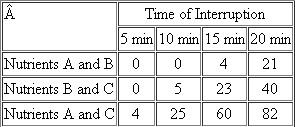 (a) What is the purpose of rifampicin in the experiment?
(b) Based on these data, determine the approximate location on the chromosome of the a, b , and c genes relative to one another and to the F factor.
(c) Can the location of the rif gene be determined in this experiment? If not, design an experiment to determine the location of rif relative to the F factor and to gene b.
(a) What is the purpose of rifampicin in the experiment?(b) Based on these data, determine the approximate location on the chromosome of the a, b , and c genes relative to one another and to the F factor.
(c) Can the location of the rif gene be determined in this experiment? If not, design an experiment to determine the location of rif relative to the F factor and to gene b.
Question
Question
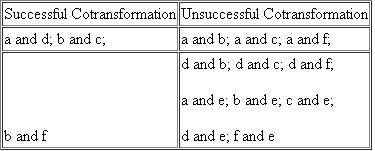
In a cotransformation experiment, using various combinations of genes two at a time, the following data were produced. Determine which genes are "linked" to which others.
Question
For the experiment in Problem, another gene, g , was studied. It demonstrated positive cotransformation when tested with gene f. Predict the results of testing gene g with genes a, b, c, d , and e.
In a cotransformation experiment, using various combinations of genes two at a time, the following data were produced. Determine which genes are "linked" to which others.
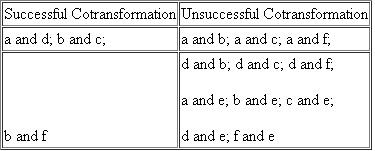
In a cotransformation experiment, using various combinations of genes two at a time, the following data were produced. Determine which genes are "linked" to which others.
Question
Bacterial conjugation, mediated mainly by conjugative plasmids such as F, represents a potential health threat through the sharing of genes for pathogenicity or antibiotic resistance. Given that more than 400 different species of bacteria coinhabit a healthy human gut and more than 200 coinhabit human skin, Francisco Dionisio [ Genetics (2002) 162:1525-1532] investigated the ability of plasmids to undergo between-species conjugal transfer. The following data are presented for various species of the enterobacterial genus Escherichia. The data are presented as "log base 10" values; for example, - 2.0 would be equivalent to 10 -2 as a rate of transfer. Assume that all differences between values presented are statistically significant.
(a) What general conclusion(s) can be drawn from these data?
(b) In what species is within-species transfer most likely? In what species pair is between-species transfer most likely?
(c) What is the significance of these findings in terms of human health?
![Bacterial conjugation, mediated mainly by conjugative plasmids such as F, represents a potential health threat through the sharing of genes for pathogenicity or antibiotic resistance. Given that more than 400 different species of bacteria coinhabit a healthy human gut and more than 200 coinhabit human skin, Francisco Dionisio [ Genetics (2002) 162:1525-1532] investigated the ability of plasmids to undergo between-species conjugal transfer. The following data are presented for various species of the enterobacterial genus Escherichia. The data are presented as log base 10 values; for example, - 2.0 would be equivalent to 10 -2 as a rate of transfer. Assume that all differences between values presented are statistically significant. (a) What general conclusion(s) can be drawn from these data? (b) In what species is within-species transfer most likely? In what species pair is between-species transfer most likely? (c) What is the significance of these findings in terms of human health? <div style=padding-top: 35px>](https://d2lvgg3v3hfg70.cloudfront.net/SM1220/11eb563d_4d87_0543_a8c8_55646084616c_SM1220_00.jpg)
(a) What general conclusion(s) can be drawn from these data?
(b) In what species is within-species transfer most likely? In what species pair is between-species transfer most likely?
(c) What is the significance of these findings in terms of human health?
Question
A study was conducted in an attempt to determine which functional regions of a particular conjugative transfer gene (tral) are involved in the transfer of plasmid R27 in Salmonella enterica. The R27 plasmid is of significant clinical interest because it is capable of encoding multiple-antibiotic resistance to typhoid fever. To identify functional regions responsible for conjugal transfer, an analysis by Lawley et al. (2002. J. Bacteriol. 184:2173-2180) was conducted in which particular regions of the tra1 gene were mutated and tested for their impact on conjugation. Shown here is a map of the regions tested and believed to be involved in conjugative transfer of the plasmid. Similar coloring indicates related function. Numbers correspond to each functional region subjected to mutation analysis.

Accompanying the map is a table showing the effects of these mutations on R27 conjugation.
Effects of Mutations in Functional Regions of Transfer Region 1 (tral) on R27 Conjugation
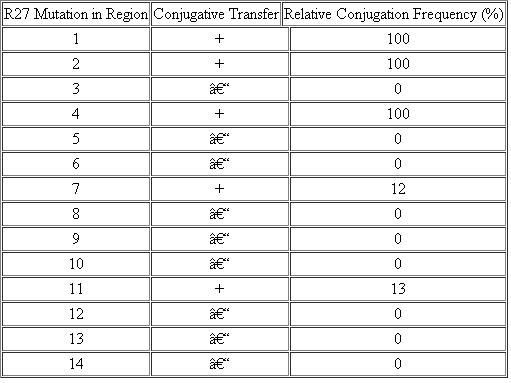 (a) Given the data, do all functional regions appear to influence conjugative transfer?
(b) Which regions appear to have the most impact on conjugation?
(c) Which regions appear to have a limited impact on conjugation?
(d) What general conclusions might one draw from these data?
Accompanying the map is a table showing the effects of these mutations on R27 conjugation.
Effects of Mutations in Functional Regions of Transfer Region 1 (tral) on R27 Conjugation
(a) Given the data, do all functional regions appear to influence conjugative transfer?(b) Which regions appear to have the most impact on conjugation?
(c) Which regions appear to have a limited impact on conjugation?
(d) What general conclusions might one draw from these data?
Question

Unlock Deck
Sign up to unlock the cards in this deck!
Unlock Deck
Unlock Deck
1/35

Play

Full screen (f)
Deck 6: Genetic Analysis and Mapping in Bacteria and
1
A 4-month-old infant had been running a moderate fever for 36 hours, and a nervous mother made a call to her pediatrician. Examination and testing revealed no outward signs of infection or cause of the fever. The anxious mother asked the pediatrician about antibiotics, but the pediatrician recommended watching the infant carefully for two days before making a decision. He explained that decades of rampant use of antibiotics in medicine and agriculture had caused a worldwide surge in bacteria that are now resistant to such drugs. He also said that the reproductive behavior of bacteria allows them to exchange antibiotic resistance traits with a wide range of other disease-causing bacteria, and that many strains are now resistant to multiple antibiotics. The physician's information raises several interesting questions.
Was the physician correct in saying that bacteria can share resistance?
Was the physician correct in saying that bacteria can share resistance?
The physician was incorrect to say that bacteria can share resistance. Bacteria can transfer portions of chromosomes to another. The bacteria are not sharing one copy of the chromosome, but instead a part of the donor chromosome (that may sometimes carry antibiotic resistance) is transferred and replaces a segment of the recipient bacteria's chromosome. Now each bacterium each has its own copy.
2
In this chapter, we have focused on genetic systems present in bacteria and on the viruses that use bacteria as hosts (bacteriophages). In particular, we discussed mechanisms by which bacteria and their phages undergo genetic recombination, which allows geneticists to map bacterial and bacteriophage chromosomes. In the process, we found many opportunities to consider how this information was acquired. From the explanations given in the chapter, what answers would you propose to the following questions?
(a) How do we know that genes exist in bacteria and bacteriophages?
(b) How do we know that bacteria undergo genetic recombination, allowing the transfer of genes from one organism to another?
(c) How do we know whether or not genetic recombination between bacteria involves cell-to-cell contact?
(d) How do we know that bacteriophages recombine genetic material through transduction and that cell-to-cell contact is not essential for transduction to occur?
(e) How do we know that intergenic exchange occurs in bacteriophages?
(f) How do we know that in bacteriophage T4 the rll locus is subdivided into two regions, or cistrons?
(a) How do we know that genes exist in bacteria and bacteriophages?
(b) How do we know that bacteria undergo genetic recombination, allowing the transfer of genes from one organism to another?
(c) How do we know whether or not genetic recombination between bacteria involves cell-to-cell contact?
(d) How do we know that bacteriophages recombine genetic material through transduction and that cell-to-cell contact is not essential for transduction to occur?
(e) How do we know that intergenic exchange occurs in bacteriophages?
(f) How do we know that in bacteriophage T4 the rll locus is subdivided into two regions, or cistrons?
(a)We can know that even bacteria and bacteriophages have genes from the characters they exhibit. In homogeneous mixtures of bacteria, some cells are resistant to bacteriophages, while the majority of cells are not. Furthermore, in different studies auxotrophic cells could be cultured if the necessary supplements were added to the media. These variants were isolated because there were mutations in the bacteria's genes.
Bacteriophages were known to contain genes as well because different bacteriophage strains had different plaque characteristics or the host specificity could change if there was a mutation.
(b)Lederberg and Tatum's experiment helps us to know that bacteria undergo genetic recombination. In this experiment, two auxotrophic strains were made to produce prototrophic colonies when the strains were mixed. But when the strains were separated by a media-permeable membrane and shared everything except physical contact, there were no prototrophs. This led to the conclusion that bacteria were genetically recombining by physical contact creating prototrophs. This mode of recombination was labeled conjugation.
Another genetic recombination technique was found as well, transformation. Competent cells take up exogenous deoxyribonucleic acids (DNA) from the environment. The DNA then undergoes homologous recombination. After one cell division, one transformant and one wild type cell are created. The exogenous DNA may either insert a new gene or a mutated gene causing genetic variation.
Finally, during transduction, it was found that a virus may package bacterial DNA in its protein capsule and then infect another cell releasing the bacterial DNA. The DNA then goes on to recombine with the host genome. This transfers genes from one bacterium to another.
(c)It is known that physical contact must be needed for genetic recombination from the Davis U-tube experiment. The tube is in the shape of a 'U' with a media-permeable membrane at the apex. One strain of bacteria is in one arm and the other strain in the other arm. Vacuum/pressure control is on one arm to mix the media during incubation to ensure the media is well mixed. Therefore, the cells never come in contact, but they share the same media.
If no transformants are seen then it is known that cell-to-cell contact is necessary.
(d)The Lederberg and Zinder experiment helps us to know that bacteriophages recombine genetic material through transduction and bacterial cell-to-cell contact is not essential for this process.
In the Lederberg and Zinder experiment, the scientists had two auxotrophic strains of bacteria separated in a Davis U-tube. Only one strain underwent genetic recombination and produced a prototrophic recombinant. Even when deoxyribonuclease (DNase) was added to the media, to remove exogenous DNA, there was still recombination. The addition of DNase ruled out transformation.
Also, the Davis U-tube's permeable membrane restricted all cell-to-cell contact, so the cells were not recombining through conjugation.
Later it was found that bacteriophages transferred the genetic material from one strain to the other.
(e)Intergenic exchange in bacteriophages was indicated through mixed infection experiments. In these experiments, two strains with at least two different loci with different phenotypes (plaque diameter versus plaque outline shape) simultaneously infect the bacterial lawn. From these experiments, recombined bacteriophages were isolated because they exhibited phenotypes different from the wild type.
(f)During Benzer's experiments he received two results. When mixing two strains of bacteriophage T4 that had different rII mutations there were either lysed cells or no lysed cells.
He determined that the pair of mutations must have been in the same functional domain if there was no lysis because when recombination occurred the function was not replaced. However, if there was lysis the mutation must have been in different cistrons. This led to the conclusion that there were only two cistrons.
Bacteriophages were known to contain genes as well because different bacteriophage strains had different plaque characteristics or the host specificity could change if there was a mutation.
(b)Lederberg and Tatum's experiment helps us to know that bacteria undergo genetic recombination. In this experiment, two auxotrophic strains were made to produce prototrophic colonies when the strains were mixed. But when the strains were separated by a media-permeable membrane and shared everything except physical contact, there were no prototrophs. This led to the conclusion that bacteria were genetically recombining by physical contact creating prototrophs. This mode of recombination was labeled conjugation.
Another genetic recombination technique was found as well, transformation. Competent cells take up exogenous deoxyribonucleic acids (DNA) from the environment. The DNA then undergoes homologous recombination. After one cell division, one transformant and one wild type cell are created. The exogenous DNA may either insert a new gene or a mutated gene causing genetic variation.
Finally, during transduction, it was found that a virus may package bacterial DNA in its protein capsule and then infect another cell releasing the bacterial DNA. The DNA then goes on to recombine with the host genome. This transfers genes from one bacterium to another.
(c)It is known that physical contact must be needed for genetic recombination from the Davis U-tube experiment. The tube is in the shape of a 'U' with a media-permeable membrane at the apex. One strain of bacteria is in one arm and the other strain in the other arm. Vacuum/pressure control is on one arm to mix the media during incubation to ensure the media is well mixed. Therefore, the cells never come in contact, but they share the same media.
If no transformants are seen then it is known that cell-to-cell contact is necessary.
(d)The Lederberg and Zinder experiment helps us to know that bacteriophages recombine genetic material through transduction and bacterial cell-to-cell contact is not essential for this process.
In the Lederberg and Zinder experiment, the scientists had two auxotrophic strains of bacteria separated in a Davis U-tube. Only one strain underwent genetic recombination and produced a prototrophic recombinant. Even when deoxyribonuclease (DNase) was added to the media, to remove exogenous DNA, there was still recombination. The addition of DNase ruled out transformation.
Also, the Davis U-tube's permeable membrane restricted all cell-to-cell contact, so the cells were not recombining through conjugation.
Later it was found that bacteriophages transferred the genetic material from one strain to the other.
(e)Intergenic exchange in bacteriophages was indicated through mixed infection experiments. In these experiments, two strains with at least two different loci with different phenotypes (plaque diameter versus plaque outline shape) simultaneously infect the bacterial lawn. From these experiments, recombined bacteriophages were isolated because they exhibited phenotypes different from the wild type.
(f)During Benzer's experiments he received two results. When mixing two strains of bacteriophage T4 that had different rII mutations there were either lysed cells or no lysed cells.
He determined that the pair of mutations must have been in the same functional domain if there was no lysis because when recombination occurred the function was not replaced. However, if there was lysis the mutation must have been in different cistrons. This led to the conclusion that there were only two cistrons.
3
A 4-month-old infant had been running a moderate fever for 36 hours, and a nervous mother made a call to her pediatrician. Examination and testing revealed no outward signs of infection or cause of the fever. The anxious mother asked the pediatrician about antibiotics, but the pediatrician recommended watching the infant carefully for two days before making a decision. He explained that decades of rampant use of antibiotics in medicine and agriculture had caused a worldwide surge in bacteria that are now resistant to such drugs. He also said that the reproductive behavior of bacteria allows them to exchange antibiotic resistance traits with a wide range of other disease-causing bacteria, and that many strains are now resistant to multiple antibiotics. The physician's information raises several interesting questions.
Where do bacteria carry antibiotic resistance genes, and how are they exchanged?
Where do bacteria carry antibiotic resistance genes, and how are they exchanged?
Bacteria can carry antibiotic resistant genes in either the chromosome or a plasmid.
If the antibiotic resistant genes are located within an F ' (fertility) plasmid, then when an F' cell meets an F - cell they undergo conjugation. One strand of the F' plasmid is transferred to the F - cell creating another F' cell. Both plasmids in each cell are then replicated to recreate the double-stranded helix. The F' plasmid may contain antibiotic resistant genes and when the F' plasmid is transferred the resistant genes are as well.
▪resistant gene located in the chromosome is transferred to another cell through high frequency recombination (Hfr). This occurs because the F factor is recombined into the chromosome. An Hfr cell and an F - cell undergo conjugation. An enzyme cuts the integrated F factor and begins transfer of a portion of the chromosome. The process is then interrupted and the chromosome fragment in the F - cell then homologously recombines with the F - cell's chromosome creating a recombinant.
If the antibiotic resistant genes are located within an F ' (fertility) plasmid, then when an F' cell meets an F - cell they undergo conjugation. One strand of the F' plasmid is transferred to the F - cell creating another F' cell. Both plasmids in each cell are then replicated to recreate the double-stranded helix. The F' plasmid may contain antibiotic resistant genes and when the F' plasmid is transferred the resistant genes are as well.
▪resistant gene located in the chromosome is transferred to another cell through high frequency recombination (Hfr). This occurs because the F factor is recombined into the chromosome. An Hfr cell and an F - cell undergo conjugation. An enzyme cuts the integrated F factor and begins transfer of a portion of the chromosome. The process is then interrupted and the chromosome fragment in the F - cell then homologously recombines with the F - cell's chromosome creating a recombinant.
4
Review the Chapter Concepts list. Many of these center around the findings that genetic recombination occurs in bacteria and in bacteriophages. Write a short summary that contrasts how recombination occurs in bacteria and bacteriophages.
CHAPTER CONCEPTS
▪Bacterial genomes are most often contained in a single circular chromosome.
▪Bacteria have developed numerous ways of exchanging and recombining genetic information between individual cells, including conjugation, transformation, and transduction.
▪The ability to undergo conjugation and to transfer the bacterial chromosome from one cell to another is governed by genetic information contained in the DNA of a "fertility," or F, factor.
▪The F factor can exist autonomously in the bacterial cytoplasm as a plasmid, or it can integrate into the bacterial chromosome, where it facilitates the transfer of the host chromosome to the recipient cell, leading to genetic recombination.
▪Genetic recombination during conjugation provides the basis for mapping bacterial genes.
▪Bacteriophages are viruses that have bacteria as their hosts. Viral DNA is injected into the host cell, where it replicates and directs the reproduction of the bacteriophage and the lysis of the bacterium.
▪Rarely, following infection, bacteriophage DNA integrates into the host chromosome, becoming a prophage, where it is replicated along with the bacterial DNA.
▪Bacteriophages undergo both intergenic and intragenic recombination.
CHAPTER CONCEPTS
▪Bacterial genomes are most often contained in a single circular chromosome.
▪Bacteria have developed numerous ways of exchanging and recombining genetic information between individual cells, including conjugation, transformation, and transduction.
▪The ability to undergo conjugation and to transfer the bacterial chromosome from one cell to another is governed by genetic information contained in the DNA of a "fertility," or F, factor.
▪The F factor can exist autonomously in the bacterial cytoplasm as a plasmid, or it can integrate into the bacterial chromosome, where it facilitates the transfer of the host chromosome to the recipient cell, leading to genetic recombination.
▪Genetic recombination during conjugation provides the basis for mapping bacterial genes.
▪Bacteriophages are viruses that have bacteria as their hosts. Viral DNA is injected into the host cell, where it replicates and directs the reproduction of the bacteriophage and the lysis of the bacterium.
▪Rarely, following infection, bacteriophage DNA integrates into the host chromosome, becoming a prophage, where it is replicated along with the bacterial DNA.
▪Bacteriophages undergo both intergenic and intragenic recombination.
Unlock Deck
Unlock for access to all 35 flashcards in this deck.
Unlock Deck
k this deck
5
A 4-month-old infant had been running a moderate fever for 36 hours, and a nervous mother made a call to her pediatrician. Examination and testing revealed no outward signs of infection or cause of the fever. The anxious mother asked the pediatrician about antibiotics, but the pediatrician recommended watching the infant carefully for two days before making a decision. He explained that decades of rampant use of antibiotics in medicine and agriculture had caused a worldwide surge in bacteria that are now resistant to such drugs. He also said that the reproductive behavior of bacteria allows them to exchange antibiotic resistance traits with a wide range of other disease-causing bacteria, and that many strains are now resistant to multiple antibiotics. The physician's information raises several interesting questions.
If the infant was given an antibiotic as a precaution, how might it contribute to the production of resistant bacteria?
If the infant was given an antibiotic as a precaution, how might it contribute to the production of resistant bacteria?
Unlock Deck
Unlock for access to all 35 flashcards in this deck.
Unlock Deck
k this deck
6
With respect to F + and F - bacterial matings, answer the following questions:
(a) How was it established that physical contact between cells was necessary?
(b) How was it established that chromosome transfer was unidirectional?
(c) What is the genetic basis for a bacterium's being F + ?
(a) How was it established that physical contact between cells was necessary?
(b) How was it established that chromosome transfer was unidirectional?
(c) What is the genetic basis for a bacterium's being F + ?
Unlock Deck
Unlock for access to all 35 flashcards in this deck.
Unlock Deck
k this deck
7
A 4-month-old infant had been running a moderate fever for 36 hours, and a nervous mother made a call to her pediatrician. Examination and testing revealed no outward signs of infection or cause of the fever. The anxious mother asked the pediatrician about antibiotics, but the pediatrician recommended watching the infant carefully for two days before making a decision. He explained that decades of rampant use of antibiotics in medicine and agriculture had caused a worldwide surge in bacteria that are now resistant to such drugs. He also said that the reproductive behavior of bacteria allows them to exchange antibiotic resistance traits with a wide range of other disease-causing bacteria, and that many strains are now resistant to multiple antibiotics. The physician's information raises several interesting questions.
Aside from hospitals, where else would infants and children come in contact with antibiotic-resistant strains of bacteria? Does the presence of such bacteria in the body always mean an infection?
Aside from hospitals, where else would infants and children come in contact with antibiotic-resistant strains of bacteria? Does the presence of such bacteria in the body always mean an infection?
Unlock Deck
Unlock for access to all 35 flashcards in this deck.
Unlock Deck
k this deck
8
List all major differences between (a) the F + X F - and the Hfr X F - bacterial crosses; and (b) the F + , F - Hfr, and F' bacteria.
Unlock Deck
Unlock for access to all 35 flashcards in this deck.
Unlock Deck
k this deck
9
Describe the basis for chromosome mapping in the Hfr X F - crosses.
Unlock Deck
Unlock for access to all 35 flashcards in this deck.
Unlock Deck
k this deck
10
In general, when recombination experiments are conducted with bacteria, participating bacteria are mixed in complete medium, then transferred to a minimal growth medium. Why isn't the protocol reversed: minimal medium first, complete medium second?
Unlock Deck
Unlock for access to all 35 flashcards in this deck.
Unlock Deck
k this deck
11
Why are the recombinants produced from an Hfr X F - cross rarely, if ever, F + ?
Unlock Deck
Unlock for access to all 35 flashcards in this deck.
Unlock Deck
k this deck
12
Describe the origin of F' bacteria and merozygotes.
Unlock Deck
Unlock for access to all 35 flashcards in this deck.
Unlock Deck
k this deck
13
In a transformation experiment, donor DNA was obtained from a prototroph bacterial strain ( a + b + c + ) , and the recipient was a triple auxotroph ( a - b - c - ). What general conclusions can you draw about the linkage relationships among the three genes from the following transformant classes that were recovered?
Unlock Deck
Unlock for access to all 35 flashcards in this deck.
Unlock Deck
k this deck
14
Describe the role of heteroduplex formation during transformation.
Unlock Deck
Unlock for access to all 35 flashcards in this deck.
Unlock Deck
k this deck
15
Explain the observations that led Zinder and Lederberg to conclude that the prototrophs recovered in their transduction experiments were not the result of F + mediated conjugation.
Unlock Deck
Unlock for access to all 35 flashcards in this deck.
Unlock Deck
k this deck
16
Define plaque, lysogeny, and prophage.
Unlock Deck
Unlock for access to all 35 flashcards in this deck.
Unlock Deck
k this deck
17
Differentiate between generalized and specialized transduction.
Unlock Deck
Unlock for access to all 35 flashcards in this deck.
Unlock Deck
k this deck
18
Two theoretical genetic strains of a virus (a - b - c - and a + b + c + ) were used to simultaneously infect a culture of host bacteria. Of 10,000 plaques scored, the following genotypes were observed. Determine the genetic map of these three genes on the viral chromosome. Decide whether interference was positive or negative.
Unlock Deck
Unlock for access to all 35 flashcards in this deck.
Unlock Deck
k this deck
19
The bacteriophage genome consists of many genes encoding proteins that make up the head, collar, tail, and tail fibers. When these genes are transcribed following phage infection, how are these proteins synthesized, since the phage genome lacks genes essential to ribosome structure?
Unlock Deck
Unlock for access to all 35 flashcards in this deck.
Unlock Deck
k this deck
20
If a single bacteriophage infects one E. coli cell present on a lawn of bacteria and, upon lysis, yields 200 viable viruses, how many phages will exist in a single plaque if three more lytic cycles occur?
Unlock Deck
Unlock for access to all 35 flashcards in this deck.
Unlock Deck
k this deck
21
A phage-infected bacterial culture was subjected to a series of dilutions, and a plaque assay was performed in each case, with the results shown in the following table. What conclusion can be drawn in the case of each dilution, assuming that 0.1 mL was used in each plaque assay?
Unlock Deck
Unlock for access to all 35 flashcards in this deck.
Unlock Deck
k this deck
22
In recombination studies of the rll locus in phage T4, what is the significance of the value determined by calculating phage growth in the K12 versus the B strains of E. coli following simultaneous infection in E. coli B? Which value is always greater?
Unlock Deck
Unlock for access to all 35 flashcards in this deck.
Unlock Deck
k this deck
23
In an analysis of other rII mutants; complementation testing yielded the following results:
(a) Predict the results of testing 2 and 3, 2 and 4, and 3 and 4 together.
(b) if further testing yielded the following results, what would you conclude about mutant 5?
(a) Predict the results of testing 2 and 3, 2 and 4, and 3 and 4 together.
(b) if further testing yielded the following results, what would you conclude about mutant 5?
Unlock Deck
Unlock for access to all 35 flashcards in this deck.
Unlock Deck
k this deck
24
Using mutants 2 and 3 from the previous problem, following mixed infection on E. coli B, progeny viruses were plated in a series of dilutions on both E. coli B and K12 with the following results. What is the recombination frequency between the two mutants?
Reference: Problem : 19
In an analysis of other rII mutants; complementation testing yielded the following results:
(a) Predict the results of testing 2 and 3, 2 and 4, and 3 and 4 together.
(b) if further testing yielded the following results, what would you conclude about mutant 5?
Reference: Problem : 19
In an analysis of other rII mutants; complementation testing yielded the following results:
(a) Predict the results of testing 2 and 3, 2 and 4, and 3 and 4 together.
(b) if further testing yielded the following results, what would you conclude about mutant 5?
Unlock Deck
Unlock for access to all 35 flashcards in this deck.
Unlock Deck
k this deck
25
Another mutation, 6, was tested in relation to mutations 1 through 5 from the previous problems. In initial testing, mutant 6 complemented mutants 2 and 3. In recombination testing with 1, 4, and 5, mutant 6 yielded recombinants with 1 and 5, but not with 4. What can you conclude about mutation 6?
Unlock Deck
Unlock for access to all 35 flashcards in this deck.
Unlock Deck
k this deck
26
During the analysis of seven rII mutations in phage T4, mutants 1, 2, and 6 were in cistron A, while mutants 3, 4, and 5 were in cistron B. Of these, mutant 4 was a deletion overlapping mutant 5. The remainder were point mutations. Nothing was known about mutant 7. Predict the results of complementation (+ or -) between 1 and 2; 1 and 3; 2 and 4; and 4 and 5.
Unlock Deck
Unlock for access to all 35 flashcards in this deck.
Unlock Deck
k this deck
27
In studies of recombination between mutants 1 and 2 from the previous problem, the results shown in the following table were obtained.
(a) Calculate the recombination frequency.
(b) When mutant 6 was tested for recombination with mutant 1, the data were the same as those shown above for strain B, but not for K12. The researcher lost the K12 data, but remembered that recombination was ten times more frequent than when mutants 1 and 2 were tested. What were the lost values (dilution and colony numbers)?
(c) Mutant 7 (Problem 22) failed to complement any of the other mutants (1-6). Define the nature of mutant 7.
During the analysis of seven rII mutations in phage T4, mutants 1, 2, and 6 were in cistron A, while mutants 3, 4, and 5 were in cistron B. Of these, mutant 4 was a deletion overlapping mutant 5. The remainder were point mutations. Nothing was known about mutant 7. Predict the results of complementation (+ or -) between 1 and 2; 1 and 3; 2 and 4; and 4 and 5.
(a) Calculate the recombination frequency.(b) When mutant 6 was tested for recombination with mutant 1, the data were the same as those shown above for strain B, but not for K12. The researcher lost the K12 data, but remembered that recombination was ten times more frequent than when mutants 1 and 2 were tested. What were the lost values (dilution and colony numbers)?
(c) Mutant 7 (Problem 22) failed to complement any of the other mutants (1-6). Define the nature of mutant 7.
During the analysis of seven rII mutations in phage T4, mutants 1, 2, and 6 were in cistron A, while mutants 3, 4, and 5 were in cistron B. Of these, mutant 4 was a deletion overlapping mutant 5. The remainder were point mutations. Nothing was known about mutant 7. Predict the results of complementation (+ or -) between 1 and 2; 1 and 3; 2 and 4; and 4 and 5.
Unlock Deck
Unlock for access to all 35 flashcards in this deck.
Unlock Deck
k this deck
28
In Bacillus subtilis , linkage analysis of two mutant genes affecting the synthesis of two amino acids, tryptophan ( trp- ) and tyrosine ( tyr- ) , was performed using transformation. Examine the following data and draw all possible conclusions regarding linkage. What is the purpose of Part B of the experiment? [Reference: E. Nester, M. Schafer, and J. Lederberg (1963).]
Unlock Deck
Unlock for access to all 35 flashcards in this deck.
Unlock Deck
k this deck
29
An Hfr strain is used to map three genes in an interrupted mating experiment. The cross is Hfr/ a + b + c + rif × F - /a - b - c - rif r. (No map order is implied in the listing of the alleles; rif r is resistance to the antibiotic rifampicin.) The a + gene is required for the biosynthesis of nutrient A, the b + gene for nutrient B, and c + for nutrient C. The minus alleles are auxo-trophs for these nutrients. The cross is initiated at time = 0, and at various times, the mating mixture is plated on three types of medium. Each plate contains minimal medium (MM) plus rifampicin plus specific supplements that are indicated in the following table. (The results for each time interval are shown as the number of colonies growing on each plate.)
(a) What is the purpose of rifampicin in the experiment?
(b) Based on these data, determine the approximate location on the chromosome of the a, b , and c genes relative to one another and to the F factor.
(c) Can the location of the rif gene be determined in this experiment? If not, design an experiment to determine the location of rif relative to the F factor and to gene b.
(a) What is the purpose of rifampicin in the experiment?(b) Based on these data, determine the approximate location on the chromosome of the a, b , and c genes relative to one another and to the F factor.
(c) Can the location of the rif gene be determined in this experiment? If not, design an experiment to determine the location of rif relative to the F factor and to gene b.
Unlock Deck
Unlock for access to all 35 flashcards in this deck.
Unlock Deck
k this deck
30
A plaque assay is performed beginning with 1 mL of a solution containing bacteriophages. This solution is serially diluted three times by combining 0.1 mL of each sequential dilution with 9.9 mL of liquid medium. Then 0.1 mL of the final dilution is plated in the plaque assay and yields 17 plaques. What is the initial density of bacteriophages in the original 1 mL?
Unlock Deck
Unlock for access to all 35 flashcards in this deck.
Unlock Deck
k this deck
31
In a cotransformation experiment, using various combinations of genes two at a time, the following data were produced. Determine which genes are "linked" to which others.
Unlock Deck
Unlock for access to all 35 flashcards in this deck.
Unlock Deck
k this deck
32
For the experiment in Problem, another gene, g , was studied. It demonstrated positive cotransformation when tested with gene f. Predict the results of testing gene g with genes a, b, c, d , and e.
In a cotransformation experiment, using various combinations of genes two at a time, the following data were produced. Determine which genes are "linked" to which others.
In a cotransformation experiment, using various combinations of genes two at a time, the following data were produced. Determine which genes are "linked" to which others.
Unlock Deck
Unlock for access to all 35 flashcards in this deck.
Unlock Deck
k this deck
33
Bacterial conjugation, mediated mainly by conjugative plasmids such as F, represents a potential health threat through the sharing of genes for pathogenicity or antibiotic resistance. Given that more than 400 different species of bacteria coinhabit a healthy human gut and more than 200 coinhabit human skin, Francisco Dionisio [ Genetics (2002) 162:1525-1532] investigated the ability of plasmids to undergo between-species conjugal transfer. The following data are presented for various species of the enterobacterial genus Escherichia. The data are presented as "log base 10" values; for example, - 2.0 would be equivalent to 10 -2 as a rate of transfer. Assume that all differences between values presented are statistically significant.
(a) What general conclusion(s) can be drawn from these data?
(b) In what species is within-species transfer most likely? In what species pair is between-species transfer most likely?
(c) What is the significance of these findings in terms of human health?
(a) What general conclusion(s) can be drawn from these data?
(b) In what species is within-species transfer most likely? In what species pair is between-species transfer most likely?
(c) What is the significance of these findings in terms of human health?
Unlock Deck
Unlock for access to all 35 flashcards in this deck.
Unlock Deck
k this deck
34
A study was conducted in an attempt to determine which functional regions of a particular conjugative transfer gene (tral) are involved in the transfer of plasmid R27 in Salmonella enterica. The R27 plasmid is of significant clinical interest because it is capable of encoding multiple-antibiotic resistance to typhoid fever. To identify functional regions responsible for conjugal transfer, an analysis by Lawley et al. (2002. J. Bacteriol. 184:2173-2180) was conducted in which particular regions of the tra1 gene were mutated and tested for their impact on conjugation. Shown here is a map of the regions tested and believed to be involved in conjugative transfer of the plasmid. Similar coloring indicates related function. Numbers correspond to each functional region subjected to mutation analysis.
Accompanying the map is a table showing the effects of these mutations on R27 conjugation.
Effects of Mutations in Functional Regions of Transfer Region 1 (tral) on R27 Conjugation
(a) Given the data, do all functional regions appear to influence conjugative transfer?
(b) Which regions appear to have the most impact on conjugation?
(c) Which regions appear to have a limited impact on conjugation?
(d) What general conclusions might one draw from these data?
Accompanying the map is a table showing the effects of these mutations on R27 conjugation.
Effects of Mutations in Functional Regions of Transfer Region 1 (tral) on R27 Conjugation
(a) Given the data, do all functional regions appear to influence conjugative transfer?(b) Which regions appear to have the most impact on conjugation?
(c) Which regions appear to have a limited impact on conjugation?
(d) What general conclusions might one draw from these data?
Unlock Deck
Unlock for access to all 35 flashcards in this deck.
Unlock Deck
k this deck
35
Influenza (the flu) is responsible for approximately 250,000 to 500,000 deaths annually, but periodically its toll has been much higher. For example, the 1918 flu pandemic killed approximately 30 million people worldwide and is considered the worst spread of a deadly illness in recorded history. With highly virulent flu strains emerging periodically, it is little wonder that the scientific community is actively studying influenza biology. In 2007, the National Institute of Allergy and Infectious Diseases completed sequencing of 2035 human and avian influenza virus strains. Influenza strains undergo recombination as described in this chapter, and they have a high mutation rate owing to the error-prone replication of their genome (which consists of RNA rather than DNA). In addition, they are capable of chromosome reassortment in which various combinations of their eight chromosomes (or portions thereof) can be packaged into progeny viruses when two or more strains infect the same cell. The end result is that we can make vaccines, but they must change annually, and even then, we can only guess at what specific viral strains will be prevalent in any given year. Based on the above information, consider the following questions:
(a) Of what evolutionary value to influenza viruses are high mutation and recombination rates coupled with chromosome reassortment?
(b) Why can't humans combat influenza just as they do mumps, measles, or chicken pox?
(c) Why are vaccines available for many viral diseases but not influenza?
(a) Of what evolutionary value to influenza viruses are high mutation and recombination rates coupled with chromosome reassortment?
(b) Why can't humans combat influenza just as they do mumps, measles, or chicken pox?
(c) Why are vaccines available for many viral diseases but not influenza?
Unlock Deck
Unlock for access to all 35 flashcards in this deck.
Unlock Deck
k this deck
Unlock Deck
Unlock for access to all 35 flashcards in this deck.







