





 Chat with AI

Deck 5: Chromosome Mapping in Eukaryotes
Full screen (f)

Question

Question
Question
Question
Question
Question
Question
Question
Question
Question
Question
Question
Question
The genes dumpy ( dp ) , clot ( cl ) , and apterous ( ap ) are linked on chromosome II of Drosophila. In a series of two-point mapping crosses, the following genetic distances were determined. What is the sequence of the three genes?

Question
Colored aleurone in the kernels of corn is due to the dominant allele R. The recessive allele r, when homozygous, produces colorless aleurone. The plant color (not the kernel color) is controlled by another gene with two alleles, Y and y. The dominant Y allele results in green color, whereas the homozygous presence of the recessive y allele causes the plant to appear yellow. In a testcross between a plant of unknown genotype and
phenotype and a plant that is homozygous recessive for both traits, the following progeny were obtained:
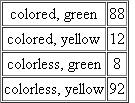 Explain how these results were obtained by determining the exact genotype and phenotype of the unknown plant, including the precise arrangement of the alleles on the homologs.
phenotype and a plant that is homozygous recessive for both traits, the following progeny were obtained:
Explain how these results were obtained by determining the exact genotype and phenotype of the unknown plant, including the precise arrangement of the alleles on the homologs. Question
In the cross shown here, involving two linked genes, ebony ( e ) and claret ( ca ), in Drosophila , where crossing over does not occur in males, offspring were produced in a 2 + : 1 ca : 1 e phenotypic ratio:

These genes are 30 units apart on chromosome III. What did crossing over in the female contribute to these phenotypes?
These genes are 30 units apart on chromosome III. What did crossing over in the female contribute to these phenotypes?
Question
In a series of two-point mapping crosses involving five genes located on chromosome II in Drosophila, the following recombinant (single-crossover) frequencies were observed:
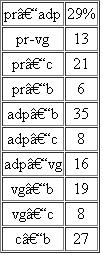 (a) Given that the adp gene is near the end of chromosome II (locus 83), construct a map of these genes.
(b) In another set of experiments, a sixth gene, d , was tested against b and pr :
 Predict the results of two-point mapping between d and c, d and vg , and d and adp.
(a) Given that the adp gene is near the end of chromosome II (locus 83), construct a map of these genes.(b) In another set of experiments, a sixth gene, d , was tested against b and pr :
Predict the results of two-point mapping between d and c, d and vg , and d and adp. Question
Two different female Drosophila were isolated, each heterozygous for the autosomally linked genes b ( black body ), d ( dachs tarsus ), and c ( curved wings ). These genes are in the order d - b - c , with b being closer to d than to c. Shown here is the genotypic arrangement for each female along with the various gametes formed by both:
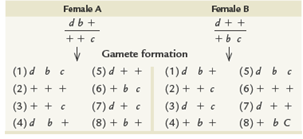
Identify which categories are noncrossovers (NCOs), single crossovers (SCOs), and double crossovers (DCOs) in each case. Then, indicate the relative frequency in which each will be produced.
Identify which categories are noncrossovers (NCOs), single crossovers (SCOs), and double crossovers (DCOs) in each case. Then, indicate the relative frequency in which each will be produced.
Question
In Drosophila, a cross was made between females-all expressing the three X-linked recessive traits scute bristles ( sc ), sable body ( s ) , and vermilion eyes ( v )-and wild-type males. In the F 1 , all females were wild type, while all males expressed all three mutant traits. The cross was carried to the F 2 generation, and 1000 offspring were counted, with the results shown in the following table.
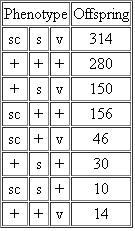 No determination of sex was made in the data.
(a) Using proper nomenclature, determine the genotypes of the P 1 and F 1 parents.
(b) Determine the sequence of the three genes and the map distances between them.
(c) Are there more or fewer double crossovers than expected?
(d) Calculate the coefficient of coincidence. Does it represent positive or negative interference?
No determination of sex was made in the data.(a) Using proper nomenclature, determine the genotypes of the P 1 and F 1 parents.
(b) Determine the sequence of the three genes and the map distances between them.
(c) Are there more or fewer double crossovers than expected?
(d) Calculate the coefficient of coincidence. Does it represent positive or negative interference?
Question
Another cross in Drosophila involved the recessive, X-linked genes yellow ( y ) , white ( w ) , and cut ( ct ). A yellow-bodied, white-eyed female with normal wings was crossed to a male whose eyes and body were normal but whose wings were cut. The F 1 females were wild type for all three traits, while the F 1 males expressed the yellow-body and white-eye traits. The cross was carried to an F 2 progeny, and only male offspring were tallied. On the basis of the data shown here, a genetic map was constructed.
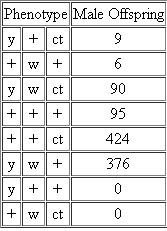 (a) Diagram the genotypes of the F 1 parents.
(b) Construct a map, assuming that white is at locus 1.5 on the X chromosome.
(c) Were any double-crossover offspring expected?
(d) Could the F 2 female offspring be used to construct the map? Why or why not?
(a) Diagram the genotypes of the F 1 parents.(b) Construct a map, assuming that white is at locus 1.5 on the X chromosome.
(c) Were any double-crossover offspring expected?
(d) Could the F 2 female offspring be used to construct the map? Why or why not?
Question
In Drosophila , Dichaete ( D ) is a mutation on chromosome III with a dominant effect on wing shape. It is lethal when homozygous. The genes ebony body ( e ) and pink eye ( p ) are recessive mutations on chromosome III. Flies from a Dichaete stock were crossed to homozygous ebony, pink flies, and the F 1 progeny, with a Dichaete phenotype, were backcrossed to the ebony, pink homozygotes. Using the results of this backcross shown in the table,
(a) Diagram this cross, showing the genotypes of the parents and offspring of both crosses.
(b) What is the sequence and interlocus distance between these three genes?
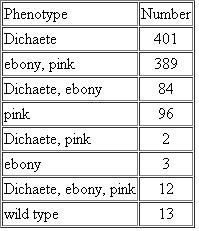
(a) Diagram this cross, showing the genotypes of the parents and offspring of both crosses.
(b) What is the sequence and interlocus distance between these three genes?
Question
Drosophila females homozygous for the third chromosomal genes pink and ebony (the same genes from Problem) were crossed with males homozygous for the second chromosomal gene dumpy. Because these genes are recessive, all offspring were wild type (normal). F 1 females were testcrossed to triply recessive males. If we assume that the two linked genes, pink and ebony , are 20 mu apart, predict the results of this cross. If the reciprocal cross were made (F 1 males-where no crossing over occurs-with triply recessive females), how would the results vary, if at all?
In Drosophila , Dichaete ( D ) is a mutation on chromosome III with a dominant effect on wing shape. It is lethal when homozygous. The genes ebony body ( e ) and pink eye ( p ) are recessive mutations on chromosome III. Flies from a Dichaete stock were crossed to homozygous ebony, pink flies, and the F 1 progeny, with a Dichaete phenotype, were backcrossed to the ebony, pink homozygotes. Using the results of this backcross shown in the table,
(a) Diagram this cross, showing the genotypes of the parents and offspring of both crosses.
(b) What is the sequence and interlocus distance between these three genes?
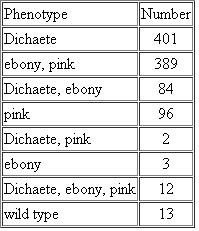
In Drosophila , Dichaete ( D ) is a mutation on chromosome III with a dominant effect on wing shape. It is lethal when homozygous. The genes ebony body ( e ) and pink eye ( p ) are recessive mutations on chromosome III. Flies from a Dichaete stock were crossed to homozygous ebony, pink flies, and the F 1 progeny, with a Dichaete phenotype, were backcrossed to the ebony, pink homozygotes. Using the results of this backcross shown in the table,
(a) Diagram this cross, showing the genotypes of the parents and offspring of both crosses.
(b) What is the sequence and interlocus distance between these three genes?
Question
In Drosophila , two mutations, Stubble ( Sb ) and curled ( cu ), are linked on chromosome III. Stubble is a dominant gene that is lethal in a homozygous state, and curled is a recessive gene. If a female of the genotype

is to be mated to detect recombinants among her offspring, what male genotype would you choose as a mate?
is to be mated to detect recombinants among her offspring, what male genotype would you choose as a mate?
Question
If the cross described in Problem were made, and if Sb and cu are 8.2 map units apart on chromosome III, and if 1000 offspring were recovered, what would be the outcome of the cross, assuming that equal numbers of males and females were observed?
In Drosophila , two mutations, Stubble ( Sb ) and curled ( cu ), are linked on chromosome III. Stubble is a dominant gene that is lethal in a homozygous state, and curled is a recessive gene. If a female of the genotype

is to be mated to detect recombinants among her offspring, what male genotype would you choose as a mate?
In Drosophila , two mutations, Stubble ( Sb ) and curled ( cu ), are linked on chromosome III. Stubble is a dominant gene that is lethal in a homozygous state, and curled is a recessive gene. If a female of the genotype
is to be mated to detect recombinants among her offspring, what male genotype would you choose as a mate?
Question
Question
Question
An organism of the genotype AaBbCc was testcrossed to a triply recessive organism ( aabbcc ). The genotypes of the progeny are presented in the following table.
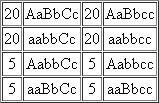 (a) If these three genes were all assorting independently, how many genotypic and phenotypic classes would result in the offspring, and in what proportion, assuming simple dominance and recessiveness in each gene pair?
(b) Answer part (a) again, assuming the three genes are so tightly linked on a single chromosome that no crossover gametes were recovered in the sample of offspring.
(c) What can you conclude from the actual data about the location of the three genes in relation to one another?
(a) If these three genes were all assorting independently, how many genotypic and phenotypic classes would result in the offspring, and in what proportion, assuming simple dominance and recessiveness in each gene pair?(b) Answer part (a) again, assuming the three genes are so tightly linked on a single chromosome that no crossover gametes were recovered in the sample of offspring.
(c) What can you conclude from the actual data about the location of the three genes in relation to one another?
Question
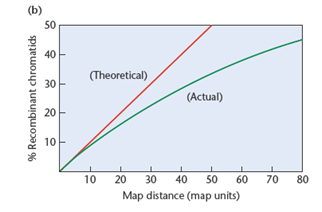
Based on our discussion of the potential inaccuracy of mapping (see Figure , would you revise your answer to Problem? If so, how?
FIGURE
(a) A double crossover is undetected because no rearrangement of alleles occurs. (b) The theoretical and actual percentage of recombinant chromatids versus map distance. The straight line shows the theoretical relationship if a direct correlation between recombination and map distance exists. The curved line is the actual relationship derived from studies of Drosophila , Neurospora , and Zea mays.

An organism of the genotype AaBbCc was testcrossed to a triply recessive organism ( aabbcc ). The genotypes of the progeny are presented in the following table.
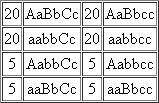 (a) If these three genes were all assorting independently, how many genotypic and phenotypic classes would result in the offspring, and in what proportion, assuming simple dominance and recessiveness in each gene pair?
(b) Answer part (a) again, assuming the three genes are so tightly linked on a single chromosome that no crossover gametes were recovered in the sample of offspring.
(c) What can you conclude from the actual data about the location of the three genes in relation to one another?
FIGURE
(a) A double crossover is undetected because no rearrangement of alleles occurs. (b) The theoretical and actual percentage of recombinant chromatids versus map distance. The straight line shows the theoretical relationship if a direct correlation between recombination and map distance exists. The curved line is the actual relationship derived from studies of Drosophila , Neurospora , and Zea mays.
An organism of the genotype AaBbCc was testcrossed to a triply recessive organism ( aabbcc ). The genotypes of the progeny are presented in the following table.
(a) If these three genes were all assorting independently, how many genotypic and phenotypic classes would result in the offspring, and in what proportion, assuming simple dominance and recessiveness in each gene pair?(b) Answer part (a) again, assuming the three genes are so tightly linked on a single chromosome that no crossover gametes were recovered in the sample of offspring.
(c) What can you conclude from the actual data about the location of the three genes in relation to one another?
Question
Question
Question
In a certain plant, fruit is either red or yellow, and fruit shape is either oval or long. Red and oval are the dominant traits. Two plants, both heterozygous for these traits, were testcrossed, with the following results.
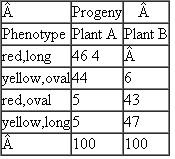 Determine the location of the genes relative to one another and the genotypes of the two parental plants.
Determine the location of the genes relative to one another and the genotypes of the two parental plants. Question
Question
A number of human-mouse somatic cell hybrid clones were examined for the expression of specific human genes and the presence of human chromosomes. The results are summarized in the following table. Assign each gene to the chromosome on which it is located.
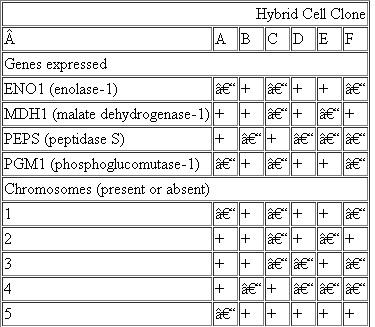
Question
A female of genotype

produces 100 meiotic tetrads. Of these, 68 show no crossover events. Of the remaining 32, 20 show a crossover between a and b , 10 show a crossover between b and c , and 2 show a double crossover between a and b and between b and c. Of the 400 gametes produced, how many of each of the 8 different genotypes will be produced? Assuming the order a - b - c and the allele arrangement previously shown, what is the map distance between these loci?
produces 100 meiotic tetrads. Of these, 68 show no crossover events. Of the remaining 32, 20 show a crossover between a and b , 10 show a crossover between b and c , and 2 show a double crossover between a and b and between b and c. Of the 400 gametes produced, how many of each of the 8 different genotypes will be produced? Assuming the order a - b - c and the allele arrangement previously shown, what is the map distance between these loci?
Question
In laboratory class, a genetics student was assigned to study an unknown mutation in Drosophila that had a whitish eye. He crossed females from his true-breeding mutant stock to wild-type (brick-red-eyed) males, recovering all wild-type F[ flies. In the F 2 generation, the following offspring were recovered in the following proportions:
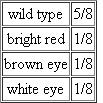 The student was stumped until the instructor suggested that perhaps the whitish eye in the original stock was the result of homozygosity for a mutation causing brown eyes and a mutation causing bright red eyes, illustrating gene interaction (see Chapter 4). After much thought, the student was able to analyze the data, explain the results, and learn several things about the location of the two genes relative to one another. One key to his understanding was that crossing over occurs in Drosophila females but not in males. Based on his analysis, what did the student learn about the two genes?
The student was stumped until the instructor suggested that perhaps the whitish eye in the original stock was the result of homozygosity for a mutation causing brown eyes and a mutation causing bright red eyes, illustrating gene interaction (see Chapter 4). After much thought, the student was able to analyze the data, explain the results, and learn several things about the location of the two genes relative to one another. One key to his understanding was that crossing over occurs in Drosophila females but not in males. Based on his analysis, what did the student learn about the two genes? Question
Drosophila melanogaster has one pair of sex chromosomes (XX or XY) and three pairs of autosomes, referred to as chromosomes II, III, and IV. A genetics student discovered a male fly with very short (sh) legs. Using this male, the student was able to establish a pure breeding stock of this mutant and found that it was recessive. She then incorporated the mutant into a stock containing the recessive gene black ( b , body color located on chromosome II) and the recessive gene pink ( p , eye color located on chromosome III). A female from the homozygous black, pink, short stock was then mated to a wild-type male. The F 1 males of this cross were all wild type and were then backcrossed to the homozygous b , p , sh females. The F 2 results appeared as shown in the following table. No other phenotypes were observed.
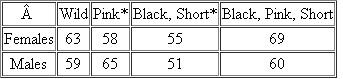 *Other trait or traits are wild type.
(a) Based on these results, the student was able to assign short to a linkage group (a chromosome). Which one was it? Include your step-by-step reasoning.
(b) The student repeated the experiment, making the reciprocal cross, F 1 females backcrossed to homozygous b , p , sh males. She observed that 85 percent of the offspring fell into the given classes, but that 15 percent of the offspring were equally divided among b + p , b + +, + sh p , and + sh + phenotypic males and females. How can these results be explained, and what information can be derived from the data?
*Other trait or traits are wild type.(a) Based on these results, the student was able to assign short to a linkage group (a chromosome). Which one was it? Include your step-by-step reasoning.
(b) The student repeated the experiment, making the reciprocal cross, F 1 females backcrossed to homozygous b , p , sh males. She observed that 85 percent of the offspring fell into the given classes, but that 15 percent of the offspring were equally divided among b + p , b + +, + sh p , and + sh + phenotypic males and females. How can these results be explained, and what information can be derived from the data?
Question
In Drosophila , a female fly is heterozygous for three mutations, Bar eyes ( B ), miniature wings ( m ), and ebony body ( e ). Note that Bar is a dominant mutation. The fly is crossed to a male with normal eyes, miniature wings, and ebony body. The results of the cross are as follows.
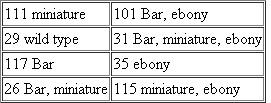 Interpret the results of this cross. If you conclude that linkage is involved between any of the genes, determine the map distance(s) between them.
Interpret the results of this cross. If you conclude that linkage is involved between any of the genes, determine the map distance(s) between them. Question
The gene controlling the Xg blood group alleles ( Xg+ and Xg~ ) and the gene controlling a newly described form of inherited recessive muscle weakness called episodic muscle weakness ( EMWX ) (Ryan et al., 1999) are closely linked on the X chromosome in humans at position Xp22.3 (the tip of the short arm). A male with EMWX who is Xg - marries a woman who is Xg+, and they have eight daughters and one son, all of whom are normal for muscle function, the male being Xg+ and all the daughters being heterozygous at both the EMWX and Xg loci. Following is a table that lists three of the daughters with the phenotypes of their husbands and children.
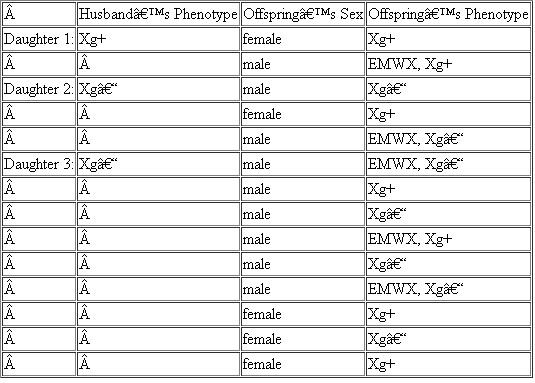 (a) Create a pedigree that represents all data stated above and in the following table.
(b) For each of the offspring, indicate whether or not a crossover was required to produce the phenotypes that are given.
(a) Create a pedigree that represents all data stated above and in the following table.(b) For each of the offspring, indicate whether or not a crossover was required to produce the phenotypes that are given.
Question
Because of the relatively high frequency of meiotic errors that lead to developmental abnormalities in humans, many research efforts have focused on identifying correlations between error frequency and chromosome morphology and behavior. Tease et al. (2002) studied human fetal oocytes of chromosomes 21, 18, and 13 using an immunocytological approach that allowed a direct estimate of the frequency and position of meiotic recombination. Below is a summary of information (modified from Tease et al., 2002) that compares recombination frequency with the frequency of trisomy for chromosomes 21, 18, and 13. (Note: You may want to read appropriate portions of Chapter 8 for descriptions of these trisomic conditions.)
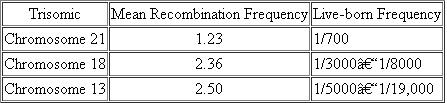 (a) What conclusions can be drawn from these data in terms of recombination and nondisjunction frequencies? How might recombination frequencies influence trisomic frequencies?
(b) Other studies indicate that the number of crossovers per oocyte is somewhat constant, and it has been suggested that positive chromosomal interference acts to spread out a limited number of crossovers among as many chromosomes as possible. Considering information in part (a), speculate on the selective advantage positive chromosomal interference might confer.
(a) What conclusions can be drawn from these data in terms of recombination and nondisjunction frequencies? How might recombination frequencies influence trisomic frequencies?(b) Other studies indicate that the number of crossovers per oocyte is somewhat constant, and it has been suggested that positive chromosomal interference acts to spread out a limited number of crossovers among as many chromosomes as possible. Considering information in part (a), speculate on the selective advantage positive chromosomal interference might confer.

Unlock Deck
Sign up to unlock the cards in this deck!
Unlock Deck
Unlock Deck
1/38

Play

Full screen (f)
Deck 5: Chromosome Mapping in Eukaryotes
1
As parents of an autistic child, a couple decided that entering a research study would not only educate them about their son's condition, but also help further research into this complex, behaviorally defined disorder. In an interview, researchers explained to the parents that autism results from the action of hundreds of genes and that no single gene accounts for more than a small percentage of cases. Recent studies have identified 18 genes that have a higher likelihood of involvement, referred to as candidate genes; three of these, on chromosomes 2, 7, and 14, are regarded as very strong candidate genes. Generally unaware of the principles of basic genetics, the couple asked a number of interesting questions. If you were the interviewer, how would you respond to them?
How might identification of a "candidate" gene be helpful in treating autism?
How might identification of a "candidate" gene be helpful in treating autism?
By selecting candidate genes, further research can be done to isolate exactly where the mutations occur, and then treatment regimens can be developed which are targeted to those specific mutations to treat autism or any other disorder.
2
In this chapter, we focused on linkage, chromosomal mapping, and many associated phenomena. In the process, we found many opportunities to consider the methods and reasoning by which much of this information was acquired. From the explanations given in the chapter, what answers would you propose to the following fundamental questions?
(a) How was it established experimentally that the frequency of recombination (crossing over) between two genes is related to the distance between them along the chromosome?
(b) How do we know that specific genes are linked on a single chromosome, in contrast to being located on separate chromosomes?
(c) How do we know that crossing over results from a physical exchange between chromatids?
(d) How do we know that sister chromatids undergo recombination during mitosis?
(e) When designed matings cannot be conducted in an organism (for example, in humans), how do we learn that genes are linked, and how do we map them?
(a) How was it established experimentally that the frequency of recombination (crossing over) between two genes is related to the distance between them along the chromosome?
(b) How do we know that specific genes are linked on a single chromosome, in contrast to being located on separate chromosomes?
(c) How do we know that crossing over results from a physical exchange between chromatids?
(d) How do we know that sister chromatids undergo recombination during mitosis?
(e) When designed matings cannot be conducted in an organism (for example, in humans), how do we learn that genes are linked, and how do we map them?
(a)The frequency of crossing over is directly proportional to the distance between two loci. One gene is located on one locus. The locus is on the chromosome. If the distance between two loci is small, crossing over is unlikely to occur. The genes on these loci may be linked. These linked genes are assorted together during gamete formation.
If the distance between two genes is far enough, crossing over may occur. Crossing over is the exchange of DNA (deoxyribonucleic acid) segments. Crossing over occurs between non-sister chromatids. However, sister chromatids could cross over and crossing over between sister-chromatids do not yield detectable differences in phenotypes.
During crossing over, alleles on the two non-sister chromatids switch with each other. The result is a different allele combination. Gametes with this combination do not have the same alleles as the parents' chromosomes.
Non-parental gametes have different allele combination from the parental chromosomes. These gametes are said to have nonparental chromosomes. Hence, they are nonparental offspring. Parental offspring have the same allele combination as the parents.
The further apart the two genes are with each other, the more often they cross over. Consequently, more offspring with the crossover phenotypes result. Therefore, the percentage of offspring indicates the distance between two genes.
The distance between two genes is designated as map unit or mu. One map unit is equal to 1%. For example, if offspring with phenotype A and B occur in 32% of the offspring, then gene A and B are 32 map units or 32 mu from each other.
Noncrossover offspring occur in the highest percentage. Double crossing over occurs least frequently. Hence, few offspring have double crossing over. Double crossing over is calculated by multiplying the products of the individual single crossing over.
(b)Genes that are located on different chromosomes follow Mendel's law of independent segregation. These genes segregate independently of one another. The offspring would have parental and nonparent chromosomes in equal proportion.
If the offspring with parental genes and nonparental genes are not in equal proportion, the two genes are linked. If there is equal proportion of parent offspring and nonparental offspring, then the two genes are not linked. These linked genes assorted independently of one another. These genes may be located on different chromosomes.
If two genes are linked on the same chromosomes, crossing over produces nonparent offspring. Nonparental offspring are offspring that do not have the same allele combination as their parents. These offspring tend to occur in fewer number than the parental offspring. No crossing over occurs in parental chromosomes.
(c)Creighton and McClintock did experiment to test that crossing over involve exchange of physical DNA segment. They tag the chromosomes with knob and translocated gene segments. They observed the offspring with recombinant DNA, for these tag gene segments. The presence of these tags on recombinant offspring indicates that exchange of physical DNA segment occurs during crossing over.
Creighton and McClintock found the tag gene segments on the recombinant offspring. Hence, crossing over involves the exchange of physical DNA segments.
(d)Crossing over between sister chromatids are detected. The method used is staining. Chromatids that are stained produce a glow under the fluorescence microscope. The degree or intensity of the flow is different from stained chromatids compared to unstained chromatids.
After crossing over, the sister chromatids have regions that glow differently than other regions of the same chromatids. The regions with different glow intensity produce patterns or patches. These patterns or patches are called harlequin chromosomes.
(e)It is difficult to determine whether human genes are linked. Two methods are used to determine if genes are linked on the same chromosomes. One method is called the lod score method. The other method is synteny testing.
In the lod score method, pedigrees are used to determine the probability of linkage and unlinked genes. First, the probability of linkage is determined. Then the probability of unlinked genes is determined. The ratio of linkage to unlinkage is calculated. This value is converted to a logarithm value. This value indicates the odds for or against linkage.
The value of 3.0 or higher indicates strong linkages among the genes. The value of -2.0 or less indicates no linkage among the genes. The value that is between -2.0 and 3.0 indicates no definite answer whether the genes are linked or not linked.
Synteny testing requires a technique developed in the 1960s. This technique is called somatic cell hybridization.
Somatic cell hybridization is the fusion of two different nuclei into a cytoplasm. The two nuclei come from different organisms of the same species. The two nuclei could come from different organisms of different species. The cell that has two nuclei is called heterokaryon.
Over time, the two nuclei in the heterokaryon fuse together into a single nucleus. This cell is now called synkaryon. Under culturing condition over many generations, the chromosomes of one organism gradually disappear. The remaining chromosomes produce gene products. The presences of these gene products and the remaining chromosomes are used to do the analysis. The analysis is to determine which chromosome produces which gene products.
Once a chromosome is identified, scientists use DNA markers to identify the locations of the genes. DNA markers are known DNA sequence. The locations of the DNA markers are also known. Scientists use these DNA markers to map the locations of genes.
If the distance between two genes is far enough, crossing over may occur. Crossing over is the exchange of DNA (deoxyribonucleic acid) segments. Crossing over occurs between non-sister chromatids. However, sister chromatids could cross over and crossing over between sister-chromatids do not yield detectable differences in phenotypes.
During crossing over, alleles on the two non-sister chromatids switch with each other. The result is a different allele combination. Gametes with this combination do not have the same alleles as the parents' chromosomes.
Non-parental gametes have different allele combination from the parental chromosomes. These gametes are said to have nonparental chromosomes. Hence, they are nonparental offspring. Parental offspring have the same allele combination as the parents.
The further apart the two genes are with each other, the more often they cross over. Consequently, more offspring with the crossover phenotypes result. Therefore, the percentage of offspring indicates the distance between two genes.
The distance between two genes is designated as map unit or mu. One map unit is equal to 1%. For example, if offspring with phenotype A and B occur in 32% of the offspring, then gene A and B are 32 map units or 32 mu from each other.
Noncrossover offspring occur in the highest percentage. Double crossing over occurs least frequently. Hence, few offspring have double crossing over. Double crossing over is calculated by multiplying the products of the individual single crossing over.
(b)Genes that are located on different chromosomes follow Mendel's law of independent segregation. These genes segregate independently of one another. The offspring would have parental and nonparent chromosomes in equal proportion.
If the offspring with parental genes and nonparental genes are not in equal proportion, the two genes are linked. If there is equal proportion of parent offspring and nonparental offspring, then the two genes are not linked. These linked genes assorted independently of one another. These genes may be located on different chromosomes.
If two genes are linked on the same chromosomes, crossing over produces nonparent offspring. Nonparental offspring are offspring that do not have the same allele combination as their parents. These offspring tend to occur in fewer number than the parental offspring. No crossing over occurs in parental chromosomes.
(c)Creighton and McClintock did experiment to test that crossing over involve exchange of physical DNA segment. They tag the chromosomes with knob and translocated gene segments. They observed the offspring with recombinant DNA, for these tag gene segments. The presence of these tags on recombinant offspring indicates that exchange of physical DNA segment occurs during crossing over.
Creighton and McClintock found the tag gene segments on the recombinant offspring. Hence, crossing over involves the exchange of physical DNA segments.
(d)Crossing over between sister chromatids are detected. The method used is staining. Chromatids that are stained produce a glow under the fluorescence microscope. The degree or intensity of the flow is different from stained chromatids compared to unstained chromatids.
After crossing over, the sister chromatids have regions that glow differently than other regions of the same chromatids. The regions with different glow intensity produce patterns or patches. These patterns or patches are called harlequin chromosomes.
(e)It is difficult to determine whether human genes are linked. Two methods are used to determine if genes are linked on the same chromosomes. One method is called the lod score method. The other method is synteny testing.
In the lod score method, pedigrees are used to determine the probability of linkage and unlinked genes. First, the probability of linkage is determined. Then the probability of unlinked genes is determined. The ratio of linkage to unlinkage is calculated. This value is converted to a logarithm value. This value indicates the odds for or against linkage.
The value of 3.0 or higher indicates strong linkages among the genes. The value of -2.0 or less indicates no linkage among the genes. The value that is between -2.0 and 3.0 indicates no definite answer whether the genes are linked or not linked.
Synteny testing requires a technique developed in the 1960s. This technique is called somatic cell hybridization.
Somatic cell hybridization is the fusion of two different nuclei into a cytoplasm. The two nuclei come from different organisms of the same species. The two nuclei could come from different organisms of different species. The cell that has two nuclei is called heterokaryon.
Over time, the two nuclei in the heterokaryon fuse together into a single nucleus. This cell is now called synkaryon. Under culturing condition over many generations, the chromosomes of one organism gradually disappear. The remaining chromosomes produce gene products. The presences of these gene products and the remaining chromosomes are used to do the analysis. The analysis is to determine which chromosome produces which gene products.
Once a chromosome is identified, scientists use DNA markers to identify the locations of the genes. DNA markers are known DNA sequence. The locations of the DNA markers are also known. Scientists use these DNA markers to map the locations of genes.
3
As parents of an autistic child, a couple decided that entering a research study would not only educate them about their son's condition, but also help further research into this complex, behaviorally defined disorder. In an interview, researchers explained to the parents that autism results from the action of hundreds of genes and that no single gene accounts for more than a small percentage of cases. Recent studies have identified 18 genes that have a higher likelihood of involvement, referred to as candidate genes; three of these, on chromosomes 2, 7, and 14, are regarded as very strong candidate genes. Generally unaware of the principles of basic genetics, the couple asked a number of interesting questions. If you were the interviewer, how would you respond to them?
Because there are hundreds of genes involved, is it possible that our children might inherit several or even many mutant versions of these genes?
Because there are hundreds of genes involved, is it possible that our children might inherit several or even many mutant versions of these genes?
While each child only has two copies of each individual gene (one from the mother and one from the father), if both parents are carriers of multiple mutant (distinct) genes, the child can receive multiple genes which have mutations which result in expressed disorders.
4
Review the Chapter Concepts list. Most of these center around the process of crossing over between linked genes. Write a short essay that discusses how crossing over can be detected and how the resultant data provide the basis of chromosome mapping.
CHAPTER CONCEPTS
▪Chromosomes in eukaryotes contain large numbers of genes, whose locations are fixed along the length of the chromosomes.
▪Unless separated by crossing over, alleles on the same chromosome segregate as a unit during gamete formation.
▪Crossing over between homologs during meiosis creates recombinant gametes with different combinations of alleles that enhance genetic variation.
▪Crossing over between homologs serves as the basis for the construction of chromosome maps. The greater the distance between two genes on a chromosome, the higher the frequency of crossing over is between them.
▪While exchanges also occur between sister chromatids during mitosis, no new recombinant chromatids are created.
CHAPTER CONCEPTS
▪Chromosomes in eukaryotes contain large numbers of genes, whose locations are fixed along the length of the chromosomes.
▪Unless separated by crossing over, alleles on the same chromosome segregate as a unit during gamete formation.
▪Crossing over between homologs during meiosis creates recombinant gametes with different combinations of alleles that enhance genetic variation.
▪Crossing over between homologs serves as the basis for the construction of chromosome maps. The greater the distance between two genes on a chromosome, the higher the frequency of crossing over is between them.
▪While exchanges also occur between sister chromatids during mitosis, no new recombinant chromatids are created.
Unlock Deck
Unlock for access to all 38 flashcards in this deck.
Unlock Deck
k this deck
5
As parents of an autistic child, a couple decided that entering a research study would not only educate them about their son's condition, but also help further research into this complex, behaviorally defined disorder. In an interview, researchers explained to the parents that autism results from the action of hundreds of genes and that no single gene accounts for more than a small percentage of cases. Recent studies have identified 18 genes that have a higher likelihood of involvement, referred to as candidate genes; three of these, on chromosomes 2, 7, and 14, are regarded as very strong candidate genes. Generally unaware of the principles of basic genetics, the couple asked a number of interesting questions. If you were the interviewer, how would you respond to them?
With such a complex genetic condition that may also depend on environmental factors, is there a way to calculate the risk that our next child will be autistic?
With such a complex genetic condition that may also depend on environmental factors, is there a way to calculate the risk that our next child will be autistic?
Unlock Deck
Unlock for access to all 38 flashcards in this deck.
Unlock Deck
k this deck
6
Describe the cytological observation that suggests that crossing over occurs during the first meiotic prophase.
Unlock Deck
Unlock for access to all 38 flashcards in this deck.
Unlock Deck
k this deck
7
As parents of an autistic child, a couple decided that entering a research study would not only educate them about their son's condition, but also help further research into this complex, behaviorally defined disorder. In an interview, researchers explained to the parents that autism results from the action of hundreds of genes and that no single gene accounts for more than a small percentage of cases. Recent studies have identified 18 genes that have a higher likelihood of involvement, referred to as candidate genes; three of these, on chromosomes 2, 7, and 14, are regarded as very strong candidate genes. Generally unaware of the principles of basic genetics, the couple asked a number of interesting questions. If you were the interviewer, how would you respond to them?
Is prenatal diagnosis for autism possible?
Is prenatal diagnosis for autism possible?
Unlock Deck
Unlock for access to all 38 flashcards in this deck.
Unlock Deck
k this deck
8
Why does more crossing over occur between two distantly linked genes than between two genes that are very close together on the same chromosome?
Unlock Deck
Unlock for access to all 38 flashcards in this deck.
Unlock Deck
k this deck
9
Explain why a 50 percent recovery of single-crossover products is the upper limit, even when crossing over always occurs between two linked genes?
Unlock Deck
Unlock for access to all 38 flashcards in this deck.
Unlock Deck
k this deck
10
Why are double-crossover events expected less frequently than single-crossover events?
Unlock Deck
Unlock for access to all 38 flashcards in this deck.
Unlock Deck
k this deck
11
What is the proposed basis for positive interference?
Unlock Deck
Unlock for access to all 38 flashcards in this deck.
Unlock Deck
k this deck
12
What two essential criteria must be met in order to execute a successful mapping cross?
Unlock Deck
Unlock for access to all 38 flashcards in this deck.
Unlock Deck
k this deck
13
The genes dumpy ( dp ) , clot ( cl ) , and apterous ( ap ) are linked on chromosome II of Drosophila. In a series of two-point mapping crosses, the following genetic distances were determined. What is the sequence of the three genes?
Unlock Deck
Unlock for access to all 38 flashcards in this deck.
Unlock Deck
k this deck
14
Colored aleurone in the kernels of corn is due to the dominant allele R. The recessive allele r, when homozygous, produces colorless aleurone. The plant color (not the kernel color) is controlled by another gene with two alleles, Y and y. The dominant Y allele results in green color, whereas the homozygous presence of the recessive y allele causes the plant to appear yellow. In a testcross between a plant of unknown genotype and
phenotype and a plant that is homozygous recessive for both traits, the following progeny were obtained:
Explain how these results were obtained by determining the exact genotype and phenotype of the unknown plant, including the precise arrangement of the alleles on the homologs.
phenotype and a plant that is homozygous recessive for both traits, the following progeny were obtained:
Explain how these results were obtained by determining the exact genotype and phenotype of the unknown plant, including the precise arrangement of the alleles on the homologs. Unlock Deck
Unlock for access to all 38 flashcards in this deck.
Unlock Deck
k this deck
15
In the cross shown here, involving two linked genes, ebony ( e ) and claret ( ca ), in Drosophila , where crossing over does not occur in males, offspring were produced in a 2 + : 1 ca : 1 e phenotypic ratio:
These genes are 30 units apart on chromosome III. What did crossing over in the female contribute to these phenotypes?
These genes are 30 units apart on chromosome III. What did crossing over in the female contribute to these phenotypes?
Unlock Deck
Unlock for access to all 38 flashcards in this deck.
Unlock Deck
k this deck
16
In a series of two-point mapping crosses involving five genes located on chromosome II in Drosophila, the following recombinant (single-crossover) frequencies were observed:
(a) Given that the adp gene is near the end of chromosome II (locus 83), construct a map of these genes.
(b) In another set of experiments, a sixth gene, d , was tested against b and pr :
Predict the results of two-point mapping between d and c, d and vg , and d and adp.
(a) Given that the adp gene is near the end of chromosome II (locus 83), construct a map of these genes.(b) In another set of experiments, a sixth gene, d , was tested against b and pr :
Predict the results of two-point mapping between d and c, d and vg , and d and adp. Unlock Deck
Unlock for access to all 38 flashcards in this deck.
Unlock Deck
k this deck
17
Two different female Drosophila were isolated, each heterozygous for the autosomally linked genes b ( black body ), d ( dachs tarsus ), and c ( curved wings ). These genes are in the order d - b - c , with b being closer to d than to c. Shown here is the genotypic arrangement for each female along with the various gametes formed by both:
Identify which categories are noncrossovers (NCOs), single crossovers (SCOs), and double crossovers (DCOs) in each case. Then, indicate the relative frequency in which each will be produced.
Identify which categories are noncrossovers (NCOs), single crossovers (SCOs), and double crossovers (DCOs) in each case. Then, indicate the relative frequency in which each will be produced.
Unlock Deck
Unlock for access to all 38 flashcards in this deck.
Unlock Deck
k this deck
18
In Drosophila, a cross was made between females-all expressing the three X-linked recessive traits scute bristles ( sc ), sable body ( s ) , and vermilion eyes ( v )-and wild-type males. In the F 1 , all females were wild type, while all males expressed all three mutant traits. The cross was carried to the F 2 generation, and 1000 offspring were counted, with the results shown in the following table.
No determination of sex was made in the data.
(a) Using proper nomenclature, determine the genotypes of the P 1 and F 1 parents.
(b) Determine the sequence of the three genes and the map distances between them.
(c) Are there more or fewer double crossovers than expected?
(d) Calculate the coefficient of coincidence. Does it represent positive or negative interference?
No determination of sex was made in the data.(a) Using proper nomenclature, determine the genotypes of the P 1 and F 1 parents.
(b) Determine the sequence of the three genes and the map distances between them.
(c) Are there more or fewer double crossovers than expected?
(d) Calculate the coefficient of coincidence. Does it represent positive or negative interference?
Unlock Deck
Unlock for access to all 38 flashcards in this deck.
Unlock Deck
k this deck
19
Another cross in Drosophila involved the recessive, X-linked genes yellow ( y ) , white ( w ) , and cut ( ct ). A yellow-bodied, white-eyed female with normal wings was crossed to a male whose eyes and body were normal but whose wings were cut. The F 1 females were wild type for all three traits, while the F 1 males expressed the yellow-body and white-eye traits. The cross was carried to an F 2 progeny, and only male offspring were tallied. On the basis of the data shown here, a genetic map was constructed.
(a) Diagram the genotypes of the F 1 parents.
(b) Construct a map, assuming that white is at locus 1.5 on the X chromosome.
(c) Were any double-crossover offspring expected?
(d) Could the F 2 female offspring be used to construct the map? Why or why not?
(a) Diagram the genotypes of the F 1 parents.(b) Construct a map, assuming that white is at locus 1.5 on the X chromosome.
(c) Were any double-crossover offspring expected?
(d) Could the F 2 female offspring be used to construct the map? Why or why not?
Unlock Deck
Unlock for access to all 38 flashcards in this deck.
Unlock Deck
k this deck
20
In Drosophila , Dichaete ( D ) is a mutation on chromosome III with a dominant effect on wing shape. It is lethal when homozygous. The genes ebony body ( e ) and pink eye ( p ) are recessive mutations on chromosome III. Flies from a Dichaete stock were crossed to homozygous ebony, pink flies, and the F 1 progeny, with a Dichaete phenotype, were backcrossed to the ebony, pink homozygotes. Using the results of this backcross shown in the table,
(a) Diagram this cross, showing the genotypes of the parents and offspring of both crosses.
(b) What is the sequence and interlocus distance between these three genes?
(a) Diagram this cross, showing the genotypes of the parents and offspring of both crosses.
(b) What is the sequence and interlocus distance between these three genes?
Unlock Deck
Unlock for access to all 38 flashcards in this deck.
Unlock Deck
k this deck
21
Drosophila females homozygous for the third chromosomal genes pink and ebony (the same genes from Problem) were crossed with males homozygous for the second chromosomal gene dumpy. Because these genes are recessive, all offspring were wild type (normal). F 1 females were testcrossed to triply recessive males. If we assume that the two linked genes, pink and ebony , are 20 mu apart, predict the results of this cross. If the reciprocal cross were made (F 1 males-where no crossing over occurs-with triply recessive females), how would the results vary, if at all?
In Drosophila , Dichaete ( D ) is a mutation on chromosome III with a dominant effect on wing shape. It is lethal when homozygous. The genes ebony body ( e ) and pink eye ( p ) are recessive mutations on chromosome III. Flies from a Dichaete stock were crossed to homozygous ebony, pink flies, and the F 1 progeny, with a Dichaete phenotype, were backcrossed to the ebony, pink homozygotes. Using the results of this backcross shown in the table,
(a) Diagram this cross, showing the genotypes of the parents and offspring of both crosses.
(b) What is the sequence and interlocus distance between these three genes?
In Drosophila , Dichaete ( D ) is a mutation on chromosome III with a dominant effect on wing shape. It is lethal when homozygous. The genes ebony body ( e ) and pink eye ( p ) are recessive mutations on chromosome III. Flies from a Dichaete stock were crossed to homozygous ebony, pink flies, and the F 1 progeny, with a Dichaete phenotype, were backcrossed to the ebony, pink homozygotes. Using the results of this backcross shown in the table,
(a) Diagram this cross, showing the genotypes of the parents and offspring of both crosses.
(b) What is the sequence and interlocus distance between these three genes?
Unlock Deck
Unlock for access to all 38 flashcards in this deck.
Unlock Deck
k this deck
22
In Drosophila , two mutations, Stubble ( Sb ) and curled ( cu ), are linked on chromosome III. Stubble is a dominant gene that is lethal in a homozygous state, and curled is a recessive gene. If a female of the genotype
is to be mated to detect recombinants among her offspring, what male genotype would you choose as a mate?
is to be mated to detect recombinants among her offspring, what male genotype would you choose as a mate?
Unlock Deck
Unlock for access to all 38 flashcards in this deck.
Unlock Deck
k this deck
23
If the cross described in Problem were made, and if Sb and cu are 8.2 map units apart on chromosome III, and if 1000 offspring were recovered, what would be the outcome of the cross, assuming that equal numbers of males and females were observed?
In Drosophila , two mutations, Stubble ( Sb ) and curled ( cu ), are linked on chromosome III. Stubble is a dominant gene that is lethal in a homozygous state, and curled is a recessive gene. If a female of the genotype
is to be mated to detect recombinants among her offspring, what male genotype would you choose as a mate?
In Drosophila , two mutations, Stubble ( Sb ) and curled ( cu ), are linked on chromosome III. Stubble is a dominant gene that is lethal in a homozygous state, and curled is a recessive gene. If a female of the genotype
is to be mated to detect recombinants among her offspring, what male genotype would you choose as a mate?
Unlock Deck
Unlock for access to all 38 flashcards in this deck.
Unlock Deck
k this deck
24
Are mitotic recombinations and sister chromatid exchanges effective in producing genetic variability in an individual? in the offspring of individuals?
Unlock Deck
Unlock for access to all 38 flashcards in this deck.
Unlock Deck
k this deck
25
What possible conclusions can be drawn from the observations that in male Drosophila , no crossing over occurs, and that during meiosis, synaptonemal complexes are not seen in males but are observed in females where crossing over occurs?
Unlock Deck
Unlock for access to all 38 flashcards in this deck.
Unlock Deck
k this deck
26
An organism of the genotype AaBbCc was testcrossed to a triply recessive organism ( aabbcc ). The genotypes of the progeny are presented in the following table.
(a) If these three genes were all assorting independently, how many genotypic and phenotypic classes would result in the offspring, and in what proportion, assuming simple dominance and recessiveness in each gene pair?
(b) Answer part (a) again, assuming the three genes are so tightly linked on a single chromosome that no crossover gametes were recovered in the sample of offspring.
(c) What can you conclude from the actual data about the location of the three genes in relation to one another?
(a) If these three genes were all assorting independently, how many genotypic and phenotypic classes would result in the offspring, and in what proportion, assuming simple dominance and recessiveness in each gene pair?(b) Answer part (a) again, assuming the three genes are so tightly linked on a single chromosome that no crossover gametes were recovered in the sample of offspring.
(c) What can you conclude from the actual data about the location of the three genes in relation to one another?
Unlock Deck
Unlock for access to all 38 flashcards in this deck.
Unlock Deck
k this deck
27
Based on our discussion of the potential inaccuracy of mapping (see Figure , would you revise your answer to Problem? If so, how?
FIGURE
(a) A double crossover is undetected because no rearrangement of alleles occurs. (b) The theoretical and actual percentage of recombinant chromatids versus map distance. The straight line shows the theoretical relationship if a direct correlation between recombination and map distance exists. The curved line is the actual relationship derived from studies of Drosophila , Neurospora , and Zea mays.
An organism of the genotype AaBbCc was testcrossed to a triply recessive organism ( aabbcc ). The genotypes of the progeny are presented in the following table.
(a) If these three genes were all assorting independently, how many genotypic and phenotypic classes would result in the offspring, and in what proportion, assuming simple dominance and recessiveness in each gene pair?
(b) Answer part (a) again, assuming the three genes are so tightly linked on a single chromosome that no crossover gametes were recovered in the sample of offspring.
(c) What can you conclude from the actual data about the location of the three genes in relation to one another?
FIGURE
(a) A double crossover is undetected because no rearrangement of alleles occurs. (b) The theoretical and actual percentage of recombinant chromatids versus map distance. The straight line shows the theoretical relationship if a direct correlation between recombination and map distance exists. The curved line is the actual relationship derived from studies of Drosophila , Neurospora , and Zea mays.
An organism of the genotype AaBbCc was testcrossed to a triply recessive organism ( aabbcc ). The genotypes of the progeny are presented in the following table.
(a) If these three genes were all assorting independently, how many genotypic and phenotypic classes would result in the offspring, and in what proportion, assuming simple dominance and recessiveness in each gene pair?(b) Answer part (a) again, assuming the three genes are so tightly linked on a single chromosome that no crossover gametes were recovered in the sample of offspring.
(c) What can you conclude from the actual data about the location of the three genes in relation to one another?
Unlock Deck
Unlock for access to all 38 flashcards in this deck.
Unlock Deck
k this deck
28
Traditional gene mapping has been applied successfully to a variety of organisms including yeast, fungi, maize, and Drosophila. However, human gene mapping has only recently shared a similar spotlight. What factors have delayed the application of traditional gene-mapping techniques in humans?
Unlock Deck
Unlock for access to all 38 flashcards in this deck.
Unlock Deck
k this deck
29
DNA markers have greatly enhanced the mapping of genes in humans. What are DNA markers, and what advantage do they confer?
Unlock Deck
Unlock for access to all 38 flashcards in this deck.
Unlock Deck
k this deck
30
In a certain plant, fruit is either red or yellow, and fruit shape is either oval or long. Red and oval are the dominant traits. Two plants, both heterozygous for these traits, were testcrossed, with the following results.
Determine the location of the genes relative to one another and the genotypes of the two parental plants.
Determine the location of the genes relative to one another and the genotypes of the two parental plants. Unlock Deck
Unlock for access to all 38 flashcards in this deck.
Unlock Deck
k this deck
31
Two plants in a cross were each heterozygous for two gene pairs ( Ab/aB ) whose loci are linked and 25 mu apart. Assuming that crossing over occurs during the formation of both male and female gametes and that the A and B alleles are dominant, determine the phenotypic ratio of their offspring.
Unlock Deck
Unlock for access to all 38 flashcards in this deck.
Unlock Deck
k this deck
32
A number of human-mouse somatic cell hybrid clones were examined for the expression of specific human genes and the presence of human chromosomes. The results are summarized in the following table. Assign each gene to the chromosome on which it is located.
Unlock Deck
Unlock for access to all 38 flashcards in this deck.
Unlock Deck
k this deck
33
A female of genotype
produces 100 meiotic tetrads. Of these, 68 show no crossover events. Of the remaining 32, 20 show a crossover between a and b , 10 show a crossover between b and c , and 2 show a double crossover between a and b and between b and c. Of the 400 gametes produced, how many of each of the 8 different genotypes will be produced? Assuming the order a - b - c and the allele arrangement previously shown, what is the map distance between these loci?
produces 100 meiotic tetrads. Of these, 68 show no crossover events. Of the remaining 32, 20 show a crossover between a and b , 10 show a crossover between b and c , and 2 show a double crossover between a and b and between b and c. Of the 400 gametes produced, how many of each of the 8 different genotypes will be produced? Assuming the order a - b - c and the allele arrangement previously shown, what is the map distance between these loci?
Unlock Deck
Unlock for access to all 38 flashcards in this deck.
Unlock Deck
k this deck
34
In laboratory class, a genetics student was assigned to study an unknown mutation in Drosophila that had a whitish eye. He crossed females from his true-breeding mutant stock to wild-type (brick-red-eyed) males, recovering all wild-type F[ flies. In the F 2 generation, the following offspring were recovered in the following proportions:
The student was stumped until the instructor suggested that perhaps the whitish eye in the original stock was the result of homozygosity for a mutation causing brown eyes and a mutation causing bright red eyes, illustrating gene interaction (see Chapter 4). After much thought, the student was able to analyze the data, explain the results, and learn several things about the location of the two genes relative to one another. One key to his understanding was that crossing over occurs in Drosophila females but not in males. Based on his analysis, what did the student learn about the two genes?
The student was stumped until the instructor suggested that perhaps the whitish eye in the original stock was the result of homozygosity for a mutation causing brown eyes and a mutation causing bright red eyes, illustrating gene interaction (see Chapter 4). After much thought, the student was able to analyze the data, explain the results, and learn several things about the location of the two genes relative to one another. One key to his understanding was that crossing over occurs in Drosophila females but not in males. Based on his analysis, what did the student learn about the two genes? Unlock Deck
Unlock for access to all 38 flashcards in this deck.
Unlock Deck
k this deck
35
Drosophila melanogaster has one pair of sex chromosomes (XX or XY) and three pairs of autosomes, referred to as chromosomes II, III, and IV. A genetics student discovered a male fly with very short (sh) legs. Using this male, the student was able to establish a pure breeding stock of this mutant and found that it was recessive. She then incorporated the mutant into a stock containing the recessive gene black ( b , body color located on chromosome II) and the recessive gene pink ( p , eye color located on chromosome III). A female from the homozygous black, pink, short stock was then mated to a wild-type male. The F 1 males of this cross were all wild type and were then backcrossed to the homozygous b , p , sh females. The F 2 results appeared as shown in the following table. No other phenotypes were observed.
*Other trait or traits are wild type.
(a) Based on these results, the student was able to assign short to a linkage group (a chromosome). Which one was it? Include your step-by-step reasoning.
(b) The student repeated the experiment, making the reciprocal cross, F 1 females backcrossed to homozygous b , p , sh males. She observed that 85 percent of the offspring fell into the given classes, but that 15 percent of the offspring were equally divided among b + p , b + +, + sh p , and + sh + phenotypic males and females. How can these results be explained, and what information can be derived from the data?
*Other trait or traits are wild type.(a) Based on these results, the student was able to assign short to a linkage group (a chromosome). Which one was it? Include your step-by-step reasoning.
(b) The student repeated the experiment, making the reciprocal cross, F 1 females backcrossed to homozygous b , p , sh males. She observed that 85 percent of the offspring fell into the given classes, but that 15 percent of the offspring were equally divided among b + p , b + +, + sh p , and + sh + phenotypic males and females. How can these results be explained, and what information can be derived from the data?
Unlock Deck
Unlock for access to all 38 flashcards in this deck.
Unlock Deck
k this deck
36
In Drosophila , a female fly is heterozygous for three mutations, Bar eyes ( B ), miniature wings ( m ), and ebony body ( e ). Note that Bar is a dominant mutation. The fly is crossed to a male with normal eyes, miniature wings, and ebony body. The results of the cross are as follows.
Interpret the results of this cross. If you conclude that linkage is involved between any of the genes, determine the map distance(s) between them.
Interpret the results of this cross. If you conclude that linkage is involved between any of the genes, determine the map distance(s) between them. Unlock Deck
Unlock for access to all 38 flashcards in this deck.
Unlock Deck
k this deck
37
The gene controlling the Xg blood group alleles ( Xg+ and Xg~ ) and the gene controlling a newly described form of inherited recessive muscle weakness called episodic muscle weakness ( EMWX ) (Ryan et al., 1999) are closely linked on the X chromosome in humans at position Xp22.3 (the tip of the short arm). A male with EMWX who is Xg - marries a woman who is Xg+, and they have eight daughters and one son, all of whom are normal for muscle function, the male being Xg+ and all the daughters being heterozygous at both the EMWX and Xg loci. Following is a table that lists three of the daughters with the phenotypes of their husbands and children.
(a) Create a pedigree that represents all data stated above and in the following table.
(b) For each of the offspring, indicate whether or not a crossover was required to produce the phenotypes that are given.
(a) Create a pedigree that represents all data stated above and in the following table.(b) For each of the offspring, indicate whether or not a crossover was required to produce the phenotypes that are given.
Unlock Deck
Unlock for access to all 38 flashcards in this deck.
Unlock Deck
k this deck
38
Because of the relatively high frequency of meiotic errors that lead to developmental abnormalities in humans, many research efforts have focused on identifying correlations between error frequency and chromosome morphology and behavior. Tease et al. (2002) studied human fetal oocytes of chromosomes 21, 18, and 13 using an immunocytological approach that allowed a direct estimate of the frequency and position of meiotic recombination. Below is a summary of information (modified from Tease et al., 2002) that compares recombination frequency with the frequency of trisomy for chromosomes 21, 18, and 13. (Note: You may want to read appropriate portions of Chapter 8 for descriptions of these trisomic conditions.)
(a) What conclusions can be drawn from these data in terms of recombination and nondisjunction frequencies? How might recombination frequencies influence trisomic frequencies?
(b) Other studies indicate that the number of crossovers per oocyte is somewhat constant, and it has been suggested that positive chromosomal interference acts to spread out a limited number of crossovers among as many chromosomes as possible. Considering information in part (a), speculate on the selective advantage positive chromosomal interference might confer.
(a) What conclusions can be drawn from these data in terms of recombination and nondisjunction frequencies? How might recombination frequencies influence trisomic frequencies?(b) Other studies indicate that the number of crossovers per oocyte is somewhat constant, and it has been suggested that positive chromosomal interference acts to spread out a limited number of crossovers among as many chromosomes as possible. Considering information in part (a), speculate on the selective advantage positive chromosomal interference might confer.
Unlock Deck
Unlock for access to all 38 flashcards in this deck.
Unlock Deck
k this deck
Unlock Deck
Unlock for access to all 38 flashcards in this deck.







