





 Chat with AI

Deck 5: Production Technology and Cost
Full screen (f)

Question

Question
Question
Question
Question
Question
Question
Question
Question
Question
Question
Question
Question
Question
Question
Question
Question
Question
Question
Question
Question
Question
Question
Question
Question
Question
Question
Question
Question
Question
Question
Question
Question
Question
Question
Question
Question
Question
Question
Question
Question
Question
Question
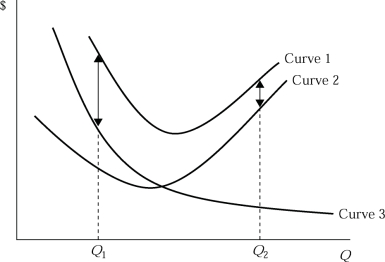 Figure 5.1
Refer to Figure 5.1, which shows a family of average cost curves. The average variable cost at a given level of output is represented by:
A)the vertical distance between Curve 1 and Curve 3 at a given level of output.
B)the vertical distance between Curve 1 and Curve 2 at a given level of output.
C)the vertical sum of Curve 1 and Curve 3 at a given level of output.
D)the vertical sum of Curve 1 and Curve 2 at a given level of output.
Question
Figure 5.1Refer to Figure 5.1, which shows a family of average cost curves. The average total cost at a given level of output is represented by:
A)the vertical distance between curve 1 and Curve 2 at a given level of output.
B)the vertical sum of Curve 1 and Curve 2 at a given level of output.
C)the vertical sum of Curve 2 and Curve 3 at a given level of output.
D)the vertical distance between Curve 2 and Curve 3 at a given level of output.
Question
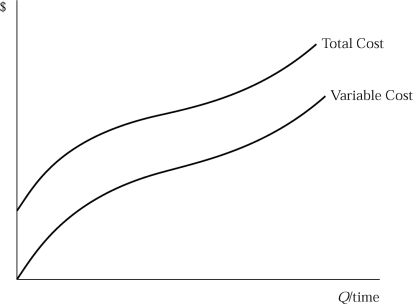 Figure 5.4
One can tell that Figure 5.4 shows short run costs because:
A)the slope of total costs and variable costs are the same.
B)costs are rising.
C)total costs are positive when output is zero implying fixed costs.
D)all of the above
Question
Question
Figure 5.4In Figure 5.4, the difference between total costs and variable cost is:
A)average total cost.
B)fixed cost.
C)total costs are positive when output is zero implying fixed costs.
D)all of the above
Question
Figure 5.1Refer to Figure 5.1, which shows a family of average cost curves. The average total cost curve is represented by:
A)Curve 1.
B)Curve 2.
C)Curve 3.
D)The vertical sum of curve 1 and curve 2.
Question
Figure 5.1Refer to Figure 5.1, which shows a family of average cost curves. The average fixed cost curve is represented by:
A)Curve 1.
B)Curve 2.
C)Curve 3.
D)The vertical sum of curve 1 and curve 2.
Question
Question
Question
Question
Question
Question
Question
Question
Question
Question
Figure 5.1Refer to Figure 5.1, which shows a family of average cost curves. The average variable cost curve is represented by:
A)Curve 1.
B)Curve 2.
C)Curve 3.
D)The vertical sum of curve 2 and curve 3.
Question
Question
Question
Question
Figure 5.1Refer to Figure 5.1, which shows a family of average cost curves. The average fixed cost at a given level of output is represented by:
A)the vertical distance between Curve 1 and Curve 2 at a given level of output.
B)the vertical distance between Curve 1 and Curve 3 at a given level of output.
C)the vertical sum of Curve 1 and Curve 2 at a given level of output.
D)the vertical sum of Curve 1 and Curve 3 at a given level of output.
Question
Question
Question
Figure 5.1Refer to Figure 5.1, which shows a family of average cost curves. Why does the vertical distance between Curve 1 and Curve 2 decrease as output increases from Q1 to Q2?
A)Because average variable cost first decreases, then increases as output increases from Q1 to Q2.
B)Because average fixed cost decreases as output increases from Q1 to Q2.
C)Because average total cost first decreases, then increases as output increases from Q1 to Q2.
D)Because average variable cost increases faster than average fixed cost as output level approaches Q2.
Question
Question
Question
Question
Question
Question
Question
Question
Question
Question
Question
Question
Question
Question

Unlock Deck
Sign up to unlock the cards in this deck!
Unlock Deck
Unlock Deck
1/209

Play

Full screen (f)
Deck 5: Production Technology and Cost
1
_______ are costs that do not require a monetary payment.
A)Implicit costs
B)Explicit costs
C)Accounting costs
D)All opportunity costs
A)Implicit costs
B)Explicit costs
C)Accounting costs
D)All opportunity costs
Implicit costs
2
You are a student at a university. You pay $8,000 per year in tuition, $5,000 per year in living expenses, and $1,000 per year for books. Were you not in school, you could earn $15,000 per year and you would not live with your parents. What is your economic cost of a year in college?
A)$9,000
B)$15,000
C)$24,000
D)$29,000
A)$9,000
B)$15,000
C)$24,000
D)$29,000
$24,000
3
In the short run, _______ factors of production are fixed, while in the long run, _______ of them are.
A)some; none
B)all; none
C)no; at least some
D)all; at least some
A)some; none
B)all; none
C)no; at least some
D)all; at least some
some; none
4
Since all costs positive, then economic profits would always be smaller than accounting profits.
Unlock Deck
Unlock for access to all 209 flashcards in this deck.
Unlock Deck
k this deck
5
Economic profit is total revenue less economic costs.
Unlock Deck
Unlock for access to all 209 flashcards in this deck.
Unlock Deck
k this deck
6
Joe runs a restaurant. He pays his employees $200,000 per year. His ingredients cost him $50,000 per year. Prior to running his restaurant, Joe was a lawyer earning $150,000 per year. What would economists say is Joeʹs cost of running the restaurant?
A)$150,000
B)$200,000
C)$250,000
D)$400,000
A)$150,000
B)$200,000
C)$250,000
D)$400,000
Unlock Deck
Unlock for access to all 209 flashcards in this deck.
Unlock Deck
k this deck
7
Economic cost is always less than accounting cost.
Unlock Deck
Unlock for access to all 209 flashcards in this deck.
Unlock Deck
k this deck
8
Which of the following are included in calculating economic costs?
A)implicit costs
B)explicit costs
C)accounting costs
D)All of the above are correct.
A)implicit costs
B)explicit costs
C)accounting costs
D)All of the above are correct.
Unlock Deck
Unlock for access to all 209 flashcards in this deck.
Unlock Deck
k this deck
9
An example of an implicit cost is:
A)the wages paid to workers.
B)the interest on business loans.
C)the imputed rent on a store owned by the firm.
D)the materials used to produce the product.
A)the wages paid to workers.
B)the interest on business loans.
C)the imputed rent on a store owned by the firm.
D)the materials used to produce the product.
Unlock Deck
Unlock for access to all 209 flashcards in this deck.
Unlock Deck
k this deck
10
Which of the following statements is incorrect?
A)A firmʹs total economic cost is at least as large as the firmʹs total accounting cost.
B)A firmʹs total economic cost includes both explicit cost and implicit cost of the firm.
C)A firmʹs implicit cost is the opportunity cost of non-purchased inputs.
D)A firmʹs total accounting cost is at least as large as the firmʹs implicit cost.
A)A firmʹs total economic cost is at least as large as the firmʹs total accounting cost.
B)A firmʹs total economic cost includes both explicit cost and implicit cost of the firm.
C)A firmʹs implicit cost is the opportunity cost of non-purchased inputs.
D)A firmʹs total accounting cost is at least as large as the firmʹs implicit cost.
Unlock Deck
Unlock for access to all 209 flashcards in this deck.
Unlock Deck
k this deck
11
Which of the following is a short-run adjustment?
A)Three new firms enter the computer chip industry.
B)A firm hires six new workers.
C)The number of farms in Kansas increases by 10%.
D)A firm opens two new plants.
A)Three new firms enter the computer chip industry.
B)A firm hires six new workers.
C)The number of farms in Kansas increases by 10%.
D)A firm opens two new plants.
Unlock Deck
Unlock for access to all 209 flashcards in this deck.
Unlock Deck
k this deck
12
Which of the following is a long-run adjustment?
A)A firm lays off two workers.
B)Two firms exit the asbestos removal industry.
C)A manufacturer increases its purchase of raw materials.
D)A farmer buys twice her usual amount of herbicide.
A)A firm lays off two workers.
B)Two firms exit the asbestos removal industry.
C)A manufacturer increases its purchase of raw materials.
D)A farmer buys twice her usual amount of herbicide.
Unlock Deck
Unlock for access to all 209 flashcards in this deck.
Unlock Deck
k this deck
13
Which of the following is a long-run adjustment?
A)A firm hires two new workers.
B)The number of professional baseball teams increases by two.
C)GM buys more steel for its auto plants in Michigan.
D)A farmer buys twice her usual amount of fertilizer.
A)A firm hires two new workers.
B)The number of professional baseball teams increases by two.
C)GM buys more steel for its auto plants in Michigan.
D)A farmer buys twice her usual amount of fertilizer.
Unlock Deck
Unlock for access to all 209 flashcards in this deck.
Unlock Deck
k this deck
14
Accountants include _______ costs as part of a firmʹs costs, while economists include _______ costs.
A)explicit; no explicit
B)implicit; no implicit
C)explicit and implicit; implicit
D)explicit; explicit and implicit
A)explicit; no explicit
B)implicit; no implicit
C)explicit and implicit; implicit
D)explicit; explicit and implicit
Unlock Deck
Unlock for access to all 209 flashcards in this deck.
Unlock Deck
k this deck
15
Jane is a student at a university. She pays $10,000 per year in tuition, $4,000 per year in living expenses, and $800 per year for books. Were she not in school, she could earn $20,000 per year working as a bookkeeper and she would not live with her parents. What is her economic cost of a year in college?
A)$10,000
B)$13,000
C)$30,800
D)$34,800
A)$10,000
B)$13,000
C)$30,800
D)$34,800
Unlock Deck
Unlock for access to all 209 flashcards in this deck.
Unlock Deck
k this deck
16
Economic cost differs from accounting cost because accountants do not consider implicit costs.
Unlock Deck
Unlock for access to all 209 flashcards in this deck.
Unlock Deck
k this deck
17
Which of the following is an example of something that economists would consider a cost but accountants would not?
A)the cost of materials and supplies purchased by a firm
B)the salary that the firm actually pays to the firmʹs owner
C)the interest income foregone by the firmʹs owner because the owner invested funds into the firm
D)the cost of advertising
A)the cost of materials and supplies purchased by a firm
B)the salary that the firm actually pays to the firmʹs owner
C)the interest income foregone by the firmʹs owner because the owner invested funds into the firm
D)the cost of advertising
Unlock Deck
Unlock for access to all 209 flashcards in this deck.
Unlock Deck
k this deck
18
Which of the following is an example of something that economists would consider a cost but accountants would not?
A)the wages paid to employees of a firm
B)the wages that the owner of a firm could have earned in some alternative job
C)rent paid to a businessʹ landlord
D)the cost of leather used in the production of footballs
A)the wages paid to employees of a firm
B)the wages that the owner of a firm could have earned in some alternative job
C)rent paid to a businessʹ landlord
D)the cost of leather used in the production of footballs
Unlock Deck
Unlock for access to all 209 flashcards in this deck.
Unlock Deck
k this deck
19
Implicit cost is the opportunity cost of the inputs that do not require monetary payment.
Unlock Deck
Unlock for access to all 209 flashcards in this deck.
Unlock Deck
k this deck
20
_______ are costs that require a monetary payment.
A)Implicit costs
B)Explicit costs
C)Accounting costs
D)B and C are correct.
A)Implicit costs
B)Explicit costs
C)Accounting costs
D)B and C are correct.
Unlock Deck
Unlock for access to all 209 flashcards in this deck.
Unlock Deck
k this deck
21
Diminishing marginal returns implies that firms:
A)require fewer and fewer workers to produce each additional unit of output.
B)require more and more workers to produce each additional unit of output.
C)get decreasing amounts of revenue for each unit of output they produce.
D)get increasing amounts of revenue for each unit of output they produce.
A)require fewer and fewer workers to produce each additional unit of output.
B)require more and more workers to produce each additional unit of output.
C)get decreasing amounts of revenue for each unit of output they produce.
D)get increasing amounts of revenue for each unit of output they produce.
Unlock Deck
Unlock for access to all 209 flashcards in this deck.
Unlock Deck
k this deck
22
Table 5.1
-Refer to Table 5.1, which gives a firmʹs production function. Assume that all non -labor inputs are fixed. The marginal product of the fourth worker is:
A)12 units.
B)11 units.
C)5 units.
D)0 units.
-Refer to Table 5.1, which gives a firmʹs production function. Assume that all non -labor inputs are fixed. The marginal product of the fourth worker is:
A)12 units.
B)11 units.
C)5 units.
D)0 units.
Unlock Deck
Unlock for access to all 209 flashcards in this deck.
Unlock Deck
k this deck
23
Diminishing marginal returns implies that:
A)marginal product is decreasing.
B)marginal product is increasing.
C)marginal product is constant.
D)marginal product may be increasing or decreasing.
A)marginal product is decreasing.
B)marginal product is increasing.
C)marginal product is constant.
D)marginal product may be increasing or decreasing.
Unlock Deck
Unlock for access to all 209 flashcards in this deck.
Unlock Deck
k this deck
24
In the short run, at least one factor of production is fixed. This implies that beyond some level of output a firm will:
A)ʺlearn by doing.ʺ
B)experience diminishing marginal returns.
C)experience increasing marginal returns.
D)have a U-shaped long-run average cost curve.
A)ʺlearn by doing.ʺ
B)experience diminishing marginal returns.
C)experience increasing marginal returns.
D)have a U-shaped long-run average cost curve.
Unlock Deck
Unlock for access to all 209 flashcards in this deck.
Unlock Deck
k this deck
25
Explain the relationship between average fixed cost and marginal cost.
Unlock Deck
Unlock for access to all 209 flashcards in this deck.
Unlock Deck
k this deck
26
A firm experiences diminishing marginal returns because:
A)all factors of production are variable.
B)people ʺlearn by doing.ʺ
C)all factors of production are fixed.
D)at least one factor of production is fixed.
A)all factors of production are variable.
B)people ʺlearn by doing.ʺ
C)all factors of production are fixed.
D)at least one factor of production is fixed.
Unlock Deck
Unlock for access to all 209 flashcards in this deck.
Unlock Deck
k this deck
27
Which of the following is NOT true when the firm experiences diminishing marginal product?
A)The total product is decreasing.
B)The marginal product of the previous worker is higher than the current worker.
C)The firm is operating in the short run.
D)The firmʹs total cost is increasing.
A)The total product is decreasing.
B)The marginal product of the previous worker is higher than the current worker.
C)The firm is operating in the short run.
D)The firmʹs total cost is increasing.
Unlock Deck
Unlock for access to all 209 flashcards in this deck.
Unlock Deck
k this deck
28
Explain the difference between fixed costs in the short run and in the long run.
Unlock Deck
Unlock for access to all 209 flashcards in this deck.
Unlock Deck
k this deck
29
What are the differences between economic cost and accounting costs?
Unlock Deck
Unlock for access to all 209 flashcards in this deck.
Unlock Deck
k this deck
30
Diminishing marginal returns implies that:
A)marginal costs are decreasing.
B)marginal costs are increasing.
C)marginal costs are constant.
D)marginal costs may be increasing or decreasing.
A)marginal costs are decreasing.
B)marginal costs are increasing.
C)marginal costs are constant.
D)marginal costs may be increasing or decreasing.
Unlock Deck
Unlock for access to all 209 flashcards in this deck.
Unlock Deck
k this deck
31
Table 5.1
-Refer to Table 5.1, which gives a firmʹs production function. Assume that all non -labor inputs are fixed. Marginal product is maximized when the firm hires:
A)2 workers.
B)3 workers.
C)4 workers.
D)5 workers.
-Refer to Table 5.1, which gives a firmʹs production function. Assume that all non -labor inputs are fixed. Marginal product is maximized when the firm hires:
A)2 workers.
B)3 workers.
C)4 workers.
D)5 workers.
Unlock Deck
Unlock for access to all 209 flashcards in this deck.
Unlock Deck
k this deck
32
Explain the difference between the short run and the long run.
Unlock Deck
Unlock for access to all 209 flashcards in this deck.
Unlock Deck
k this deck
33
What are the explicit and implicit cost?
Unlock Deck
Unlock for access to all 209 flashcards in this deck.
Unlock Deck
k this deck
34
Can a firmʹs accounting profit be smaller than the economic profit? Assume that all costs are positive.
Unlock Deck
Unlock for access to all 209 flashcards in this deck.
Unlock Deck
k this deck
35
What is economic profit?
Unlock Deck
Unlock for access to all 209 flashcards in this deck.
Unlock Deck
k this deck
36
When at least one factor of production is fixed, firms require more and more workers to produce each additional unit of output. This describes:
A)increasing marginal returns.
B)diminishing marginal returns.
C)learning by doing.
D)short-run adjustments.
A)increasing marginal returns.
B)diminishing marginal returns.
C)learning by doing.
D)short-run adjustments.
Unlock Deck
Unlock for access to all 209 flashcards in this deck.
Unlock Deck
k this deck
37
Table 5.2
-Refer to Table 5.2, which gives a firmʹs production function. Assume that all non -labor inputs are fixed. The marginal product is maximized when the firm hires:
A)2 workers.
B)3 workers.
C)4 workers.
D)5 workers.
Unlock Deck
Unlock for access to all 209 flashcards in this deck.
Unlock Deck
k this deck
38
Table 5.1
-Refer to Table 5.1, which gives a firmʹs production function. Assume that all non -labor inputs are fixed. Diminishing marginal returns set in with the addition of the:
A)third worker.
B)fourth worker.
C)fifth worker.
D)sixth worker.
-Refer to Table 5.1, which gives a firmʹs production function. Assume that all non -labor inputs are fixed. Diminishing marginal returns set in with the addition of the:
A)third worker.
B)fourth worker.
C)fifth worker.
D)sixth worker.
Unlock Deck
Unlock for access to all 209 flashcards in this deck.
Unlock Deck
k this deck
39
Table 5.2
-Refer to Table 5.2, which gives a firmʹs production function. Assume that all non -labor inputs are fixed. Diminishing returns set in with the addition of the:
A)third worker.
B)fourth worker.
C)fifth worker.
D)sixth worker.
Unlock Deck
Unlock for access to all 209 flashcards in this deck.
Unlock Deck
k this deck
40
The interest on a business loan is an implicit cost.
Unlock Deck
Unlock for access to all 209 flashcards in this deck.
Unlock Deck
k this deck
41
Marginal product is defined as the change in _______ resulting from a one-unit increase in _______.
A)total product; input
B)total product; output
C)output; total product
D)total cost; output
A)total product; input
B)total product; output
C)output; total product
D)total cost; output
Unlock Deck
Unlock for access to all 209 flashcards in this deck.
Unlock Deck
k this deck
42
Average total cost equals:
A)total fixed cost plus total variable cost.
B)average fixed cost minus average variable cost.
C)average fixed cost plus average variable cost.
D)total cost minus average cost.
A)total fixed cost plus total variable cost.
B)average fixed cost minus average variable cost.
C)average fixed cost plus average variable cost.
D)total cost minus average cost.
Unlock Deck
Unlock for access to all 209 flashcards in this deck.
Unlock Deck
k this deck
43
Figure 5.1Refer to Figure 5.1, which shows a family of average cost curves. The average variable cost at a given level of output is represented by:
A)the vertical distance between Curve 1 and Curve 3 at a given level of output.
B)the vertical distance between Curve 1 and Curve 2 at a given level of output.
C)the vertical sum of Curve 1 and Curve 3 at a given level of output.
D)the vertical sum of Curve 1 and Curve 2 at a given level of output.
Unlock Deck
Unlock for access to all 209 flashcards in this deck.
Unlock Deck
k this deck
44
Figure 5.1Refer to Figure 5.1, which shows a family of average cost curves. The average total cost at a given level of output is represented by:
A)the vertical distance between curve 1 and Curve 2 at a given level of output.
B)the vertical sum of Curve 1 and Curve 2 at a given level of output.
C)the vertical sum of Curve 2 and Curve 3 at a given level of output.
D)the vertical distance between Curve 2 and Curve 3 at a given level of output.
Unlock Deck
Unlock for access to all 209 flashcards in this deck.
Unlock Deck
k this deck
45
Figure 5.4One can tell that Figure 5.4 shows short run costs because:
A)the slope of total costs and variable costs are the same.
B)costs are rising.
C)total costs are positive when output is zero implying fixed costs.
D)all of the above
Unlock Deck
Unlock for access to all 209 flashcards in this deck.
Unlock Deck
k this deck
46
Average variable cost equals:
A)total fixed cost plus total variable cost.
B)average total cost minus average fixed cost.
C)average total cost plus average fixed cost.
D)total cost minus average cost.
A)total fixed cost plus total variable cost.
B)average total cost minus average fixed cost.
C)average total cost plus average fixed cost.
D)total cost minus average cost.
Unlock Deck
Unlock for access to all 209 flashcards in this deck.
Unlock Deck
k this deck
47
Figure 5.4In Figure 5.4, the difference between total costs and variable cost is:
A)average total cost.
B)fixed cost.
C)total costs are positive when output is zero implying fixed costs.
D)all of the above
Unlock Deck
Unlock for access to all 209 flashcards in this deck.
Unlock Deck
k this deck
48
Figure 5.1Refer to Figure 5.1, which shows a family of average cost curves. The average total cost curve is represented by:
A)Curve 1.
B)Curve 2.
C)Curve 3.
D)The vertical sum of curve 1 and curve 2.
Unlock Deck
Unlock for access to all 209 flashcards in this deck.
Unlock Deck
k this deck
49
Figure 5.1Refer to Figure 5.1, which shows a family of average cost curves. The average fixed cost curve is represented by:
A)Curve 1.
B)Curve 2.
C)Curve 3.
D)The vertical sum of curve 1 and curve 2.
Unlock Deck
Unlock for access to all 209 flashcards in this deck.
Unlock Deck
k this deck
50
_______ is a cost that independent of the quantity produced by the firm and is incurred by the firm in the short run.
A)Fixed cost
B)Economic cost
C)Variable cost
D)Average total cost
A)Fixed cost
B)Economic cost
C)Variable cost
D)Average total cost
Unlock Deck
Unlock for access to all 209 flashcards in this deck.
Unlock Deck
k this deck
51
Markʹs Baseballs produces baseballs. Markʹs Baseballs has total fixed costs of $500. Markʹs average variable cost is $20, and his average total cost is $25. Mark is currently producing:
A)5 baseballs.
B)25 baseballs.
C)100 baseballs.
D)a number of baseballs that cannot be determined from the information provided.
A)5 baseballs.
B)25 baseballs.
C)100 baseballs.
D)a number of baseballs that cannot be determined from the information provided.
Unlock Deck
Unlock for access to all 209 flashcards in this deck.
Unlock Deck
k this deck
52
Marginal product in the short run:
A)increases at all levels of production.
B)diminishes at all levels of production.
C)may initially increase, then eventually decrease.
D)may initially decrease, then eventually increase.
A)increases at all levels of production.
B)diminishes at all levels of production.
C)may initially increase, then eventually decrease.
D)may initially decrease, then eventually increase.
Unlock Deck
Unlock for access to all 209 flashcards in this deck.
Unlock Deck
k this deck
53
Table 5.2
-Refer to Table 5.2, which gives a firmʹs production function. Assume that all non -labor inputs are fixed. The marginal product of the fourth worker is:
A)0 units.
B)10 units.
C)25 units.
D)30 units.
Unlock Deck
Unlock for access to all 209 flashcards in this deck.
Unlock Deck
k this deck
54
Average fixed cost is defined as:
A)total variable cost divided by quantity.
B)quantity divided by total variable cost.
C)the change in total variable cost divided by the change in quantity.
D)total fixed cost divided by quantity.
A)total variable cost divided by quantity.
B)quantity divided by total variable cost.
C)the change in total variable cost divided by the change in quantity.
D)total fixed cost divided by quantity.
Unlock Deck
Unlock for access to all 209 flashcards in this deck.
Unlock Deck
k this deck
55
Average variable cost is defined as:
A)total variable cost divided by quantity.
B)quantity divided by total variable cost.
C)the change in total variable cost divided by the change in quantity.
D)the change in quantity divided by the change in total variable cost.
A)total variable cost divided by quantity.
B)quantity divided by total variable cost.
C)the change in total variable cost divided by the change in quantity.
D)the change in quantity divided by the change in total variable cost.
Unlock Deck
Unlock for access to all 209 flashcards in this deck.
Unlock Deck
k this deck
56
Table 5.2
-Refer to Table 5.2, which gives a firmʹs production function. Assume that all non -labor inputs are fixed. The marginal product of the fifth worker is:
A)0 units.
B)10 units.
C)25 units.
D)30 units.
Unlock Deck
Unlock for access to all 209 flashcards in this deck.
Unlock Deck
k this deck
57
Average total cost is defined as:
A)total variable cost divided by quantity.
B)quantity divided by total variable cost.
C)the change in total variable cost divided by the change in quantity.
D)total cost divided by quantity.
A)total variable cost divided by quantity.
B)quantity divided by total variable cost.
C)the change in total variable cost divided by the change in quantity.
D)total cost divided by quantity.
Unlock Deck
Unlock for access to all 209 flashcards in this deck.
Unlock Deck
k this deck
58
_______ is a cost that changes with the quantity produced by the firm and is incurred by the firm in the short run.
A)Fixed cost
B)Economic cost
C)Variable cost
D)Average total cost
A)Fixed cost
B)Economic cost
C)Variable cost
D)Average total cost
Unlock Deck
Unlock for access to all 209 flashcards in this deck.
Unlock Deck
k this deck
59
Figure 5.1Refer to Figure 5.1, which shows a family of average cost curves. The average variable cost curve is represented by:
A)Curve 1.
B)Curve 2.
C)Curve 3.
D)The vertical sum of curve 2 and curve 3.
Unlock Deck
Unlock for access to all 209 flashcards in this deck.
Unlock Deck
k this deck
60
In the short run, the firmʹs total cost equals:
A)the total fixed costs + the total variable costs.
B)the average fixed costs +average variable costs.
C)the average fixed cost + the marginal cost.
D)the total variable costs only.
A)the total fixed costs + the total variable costs.
B)the average fixed costs +average variable costs.
C)the average fixed cost + the marginal cost.
D)the total variable costs only.
Unlock Deck
Unlock for access to all 209 flashcards in this deck.
Unlock Deck
k this deck
61
When a firm is experiencing diminishing returns:
A)average cost is always increasing.
B)average cost is always decreasing.
C)marginal costs are always less than average costs.
D)none of the above
A)average cost is always increasing.
B)average cost is always decreasing.
C)marginal costs are always less than average costs.
D)none of the above
Unlock Deck
Unlock for access to all 209 flashcards in this deck.
Unlock Deck
k this deck
62
Table 5.3
-Table 5.3 presents the cost schedule for Candyʹs Cakes. If Candy produces two cakes, Candyʹs marginal cost is:
A)$0.
B)$20.
C)$25.
D)$50.
-Table 5.3 presents the cost schedule for Candyʹs Cakes. If Candy produces two cakes, Candyʹs marginal cost is:
A)$0.
B)$20.
C)$25.
D)$50.
Unlock Deck
Unlock for access to all 209 flashcards in this deck.
Unlock Deck
k this deck
63
Figure 5.1Refer to Figure 5.1, which shows a family of average cost curves. The average fixed cost at a given level of output is represented by:
A)the vertical distance between Curve 1 and Curve 2 at a given level of output.
B)the vertical distance between Curve 1 and Curve 3 at a given level of output.
C)the vertical sum of Curve 1 and Curve 2 at a given level of output.
D)the vertical sum of Curve 1 and Curve 3 at a given level of output.
Unlock Deck
Unlock for access to all 209 flashcards in this deck.
Unlock Deck
k this deck
64
Table 5.4
-Table 5.4 presents the cost schedule for Davidʹs Figs. If David produces two figs, Davidʹs average variable costs are:
A)$80.
B)$85.
C)$90.
D)$170.
Unlock Deck
Unlock for access to all 209 flashcards in this deck.
Unlock Deck
k this deck
65
When marginal costs are increasing:
A)a firm is experiencing diminishing returns.
B)average cost is always increasing.
C)average cost is always decreasing.
D)marginal costs are always greater than average costs.
A)a firm is experiencing diminishing returns.
B)average cost is always increasing.
C)average cost is always decreasing.
D)marginal costs are always greater than average costs.
Unlock Deck
Unlock for access to all 209 flashcards in this deck.
Unlock Deck
k this deck
66
Figure 5.1Refer to Figure 5.1, which shows a family of average cost curves. Why does the vertical distance between Curve 1 and Curve 2 decrease as output increases from Q1 to Q2?
A)Because average variable cost first decreases, then increases as output increases from Q1 to Q2.
B)Because average fixed cost decreases as output increases from Q1 to Q2.
C)Because average total cost first decreases, then increases as output increases from Q1 to Q2.
D)Because average variable cost increases faster than average fixed cost as output level approaches Q2.
Unlock Deck
Unlock for access to all 209 flashcards in this deck.
Unlock Deck
k this deck
67
Which of the following is true?
A)ATC = AVC - AFC.
B)TVC/Q = TC/Q + TFC/Q
C)ΔTC/ΔQ = ΔAVC/ΔQ
D)ΔTVC/ΔQ = MC
A)ATC = AVC - AFC.
B)TVC/Q = TC/Q + TFC/Q
C)ΔTC/ΔQ = ΔAVC/ΔQ
D)ΔTVC/ΔQ = MC
Unlock Deck
Unlock for access to all 209 flashcards in this deck.
Unlock Deck
k this deck
68
Table 5.3
-Table 5.3 presents the cost schedule for Candyʹs Cakes. If Candy produces three cakes, Candyʹs marginal costs are:
A)$0.
B)$25.
C)$41.67.
D)$75.
-Table 5.3 presents the cost schedule for Candyʹs Cakes. If Candy produces three cakes, Candyʹs marginal costs are:
A)$0.
B)$25.
C)$41.67.
D)$75.
Unlock Deck
Unlock for access to all 209 flashcards in this deck.
Unlock Deck
k this deck
69
Table 5.4
-Table 5.4 presents the cost schedule for Davidʹs Figs. If David produces zero fig, Davidʹs total costs are:
A)$0.
B)$90.
C)$100.
D)$130.
Unlock Deck
Unlock for access to all 209 flashcards in this deck.
Unlock Deck
k this deck
70
In the short run, the marginal cost of the first unit of output is $20, the marginal cost of producing the second unit of output is $16, and the marginal cost of producing the third unit of output is $12. The firmʹs total variable cost of producing three units of output is:
A)$12.
B)$16.
C)$20.
D)$48.
A)$12.
B)$16.
C)$20.
D)$48.
Unlock Deck
Unlock for access to all 209 flashcards in this deck.
Unlock Deck
k this deck
71
In the short run, the marginal cost of the first unit of output is $40, the average variable cost of producing three units of output is $32, and the marginal cost of producing the second unit of output is $32. What is the marginal cost of producing the third unit of output?
A)$24
B)$32
C)$40
D)$96
A)$24
B)$32
C)$40
D)$96
Unlock Deck
Unlock for access to all 209 flashcards in this deck.
Unlock Deck
k this deck
72
Table 5.3
-Table 5.3 presents the cost schedule for Candyʹs Cakes. If Candy produces one cake, Candyʹs total variable costs are:
A)$0.
B)$30.
C)$50.
D)$80.
-Table 5.3 presents the cost schedule for Candyʹs Cakes. If Candy produces one cake, Candyʹs total variable costs are:
A)$0.
B)$30.
C)$50.
D)$80.
Unlock Deck
Unlock for access to all 209 flashcards in this deck.
Unlock Deck
k this deck
73
Table 5.4
-Table 5.4 presents the cost schedule for Davidʹs Figs. If David produces three figs, Davidʹs total variable costs are:
A)$0.
B)$41.67.
C)$80.
D)$240.
Unlock Deck
Unlock for access to all 209 flashcards in this deck.
Unlock Deck
k this deck
74
Table 5.4
-Table 5.4 presents the cost schedule for Davidʹs Figs. If David produces four figs, Davidʹs average total costs are:
A)$60.
B)$75.
C)$100.
D)$400.
Unlock Deck
Unlock for access to all 209 flashcards in this deck.
Unlock Deck
k this deck
75
When a firm is experiencing diminishing marginal returns:
A)average cost is increasing.
B)average cost is decreasing.
C)marginal costs are increasing.
D)marginal costs are decreasing.
A)average cost is increasing.
B)average cost is decreasing.
C)marginal costs are increasing.
D)marginal costs are decreasing.
Unlock Deck
Unlock for access to all 209 flashcards in this deck.
Unlock Deck
k this deck
76
In the short run, the marginal cost of producing the first unit of output is $50, the marginal cost of the second unit of output is $20, and the marginal cost of producing the third unit of output is $16. The firmʹs total cost of producing three units of output is:
A)$16.
B)$48.
C)$86.
D)cannot be determined from the information provided
A)$16.
B)$48.
C)$86.
D)cannot be determined from the information provided
Unlock Deck
Unlock for access to all 209 flashcards in this deck.
Unlock Deck
k this deck
77
If a firmʹs total fixed costs are $30, the firmʹs marginal cost of producing the first unit of output is $30, and the average total cost of producing two units of output is $42, the marginal cost of the second unit of output is:
A)$84.
B)$54.
C)$42.
D)$24.
A)$84.
B)$54.
C)$42.
D)$24.
Unlock Deck
Unlock for access to all 209 flashcards in this deck.
Unlock Deck
k this deck
78
Table 5.4
-Table 5.4 presents the cost schedule for Davidʹs Figs. If David produces two figs, Davidʹs marginal costs are:
A)$80.
B)$90.
C)$100.
D)$170.
Unlock Deck
Unlock for access to all 209 flashcards in this deck.
Unlock Deck
k this deck
79
In the short run, the marginal cost of the first unit of output is $20, the average variable cost of producing three units of output is $16, and the marginal cost of producing the second unit of output is $16. What is the marginal cost of producing the third unit of output?
A)$12
B)$16
C)$20
D)$48
A)$12
B)$16
C)$20
D)$48
Unlock Deck
Unlock for access to all 209 flashcards in this deck.
Unlock Deck
k this deck
80
Table 5.3
-Table 5.3 presents the cost schedule for Candyʹs Cakes. If Candy produces zero cake, Candyʹs total costs are:
A)$0.
B)$50.
C)$100.
D)$150
-Table 5.3 presents the cost schedule for Candyʹs Cakes. If Candy produces zero cake, Candyʹs total costs are:
A)$0.
B)$50.
C)$100.
D)$150
Unlock Deck
Unlock for access to all 209 flashcards in this deck.
Unlock Deck
k this deck
Unlock Deck
Unlock for access to all 209 flashcards in this deck.







