





 Chat with AI

Deck 6: Accounting for Merchandise Inventory
Full screen (f)

Question

Question
Question
Question
Question
Question
Question
Question
Question
Question
Question
Question
Question
Question
Question
Question
Question
Question
Question
Question
Question
Table 6-5
Assume the following data for Kruger Sales for November 2019: On November 30, a physical count reveals 6 units on hand.
Refer to Table 6-5. Calculate gross margin for Kruger Sales assuming the perpetual FIFO cost method is being used.
Assume the following data for Kruger Sales for November 2019:
On November 30, a physical count reveals 6 units on hand.Refer to Table 6-5. Calculate gross margin for Kruger Sales assuming the perpetual FIFO cost method is being used.
Question
Table 6-5
Assume the following data for Kruger Sales for November 2019: On November 30, a physical count reveals 6 units on hand.
Refer to Table 6-5. Calculate gross margin for Kruger Sales assuming the perpetual moving-weighted-average-cost method is being used.
Assume the following data for Kruger Sales for November 2019:
On November 30, a physical count reveals 6 units on hand.Refer to Table 6-5. Calculate gross margin for Kruger Sales assuming the perpetual moving-weighted-average-cost method is being used.
Question
Question
Question
Table 6-5
Assume the following data for Kruger Sales for November 2019: On November 30, a physical count reveals 6 units on hand.
Refer to Table 6-5. Calculate ending inventory for Kruger Sales assuming the perpetual FIFO cost method is being used.
Assume the following data for Kruger Sales for November 2019:
On November 30, a physical count reveals 6 units on hand.Refer to Table 6-5. Calculate ending inventory for Kruger Sales assuming the perpetual FIFO cost method is being used.
Question
Question
The following data pertain to Cross Company (assume a perpetual inventory system)for the month ended January 31, 2019: 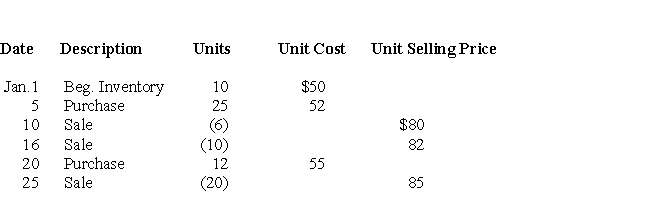 Required:
1. Compute the cost of goods sold and ending inventory under FIFO.
2. Compute Gross Margin under FIFO
Required:1. Compute the cost of goods sold and ending inventory under FIFO.
2. Compute Gross Margin under FIFO
Question
Question
Table 6-5
Assume the following data for Kruger Sales for November 2019: On November 30, a physical count reveals 6 units on hand.
Refer to Table 6-5. Calculate ending inventory for Kruger Sales assuming the perpetual moving-weighted-average-cost method is being used.
Assume the following data for Kruger Sales for November 2019:
On November 30, a physical count reveals 6 units on hand.Refer to Table 6-5. Calculate ending inventory for Kruger Sales assuming the perpetual moving-weighted-average-cost method is being used.
Question
Question
Question
Question
Question
Question
Question
Question
Question
Question
Question
Question
Question
Question
Question
Question
Question
Question
Question
Question
Question
Question
Question
Sam's Corner Store has the following purchase and sales information for one of their inventory items: 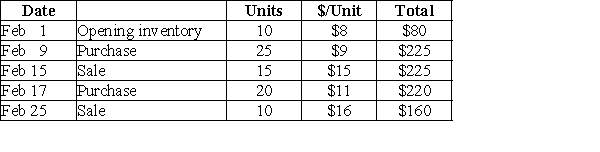 Required:
For (a)and (b)assume the company uses the periodic inventory system.
(a)Calculate the gross profit if the company uses first-in, first-out (FIFO)
(b)Calculate the value of the ending inventory if the company uses weighted average.
For (c)and (d)assume the company uses the perpetual inventory system.
(c)What is the cost of goods sold for the Feb 25 sale if the company uses weighted average to cost the inventory?
(d)What is the value of the ending inventory if the company uses FIFO?
Required:For (a)and (b)assume the company uses the periodic inventory system.
(a)Calculate the gross profit if the company uses first-in, first-out (FIFO)
(b)Calculate the value of the ending inventory if the company uses weighted average.
For (c)and (d)assume the company uses the perpetual inventory system.
(c)What is the cost of goods sold for the Feb 25 sale if the company uses weighted average to cost the inventory?
(d)What is the value of the ending inventory if the company uses FIFO?
Question
Question
Question
Jan-Con Company provides the following information for the month of August. 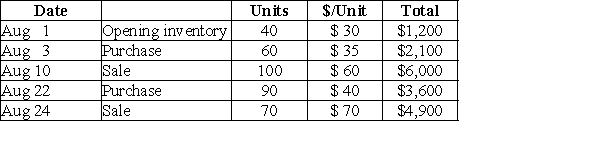 Required:
(a)What is the value of the ending inventory assuming the company uses a periodic inventory system and the weighted-average method?
(b)What is the cost of goods sold if the company uses a perpetual inventory system and the FIFO method of valuing inventory?
(c)What is the cost of goods sold if the company uses a perpetual inventory system and the weighted average method of valuing inventory?
Required:(a)What is the value of the ending inventory assuming the company uses a periodic inventory system and the weighted-average method?
(b)What is the cost of goods sold if the company uses a perpetual inventory system and the FIFO method of valuing inventory?
(c)What is the cost of goods sold if the company uses a perpetual inventory system and the weighted average method of valuing inventory?
Question
Question
Sam Levine Merchandising had the following transactions during May: 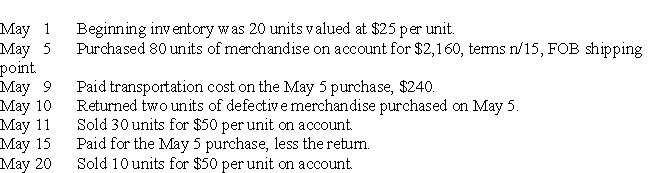 Required:
1. Assuming FIFO and that the perpetual inventory system is used, prepare the journal entries to record the above transactions.
2. Assuming weighted-average and that the periodic inventory system is used, prepare the journal entries to record the above transactions.
Required:1. Assuming FIFO and that the perpetual inventory system is used, prepare the journal entries to record the above transactions.
2. Assuming weighted-average and that the periodic inventory system is used, prepare the journal entries to record the above transactions.
Question
Question
Question
Question
Question
Question
Question
Question
Question
Question
Question
Question
Question
Question
Question
Question
Question
Question
Question
Question
Question
Question
Question

Unlock Deck
Sign up to unlock the cards in this deck!
Unlock Deck
Unlock Deck
1/136

Play

Full screen (f)
Deck 6: Accounting for Merchandise Inventory
1
The two main types of inventory systems are the perpetual system and the periodic system.
True
2
Which of the following methods represents the most accurate cost?
A)FIFO
B)specific-unit-cost
C)average cost
D)weighted-average cost
A)FIFO
B)specific-unit-cost
C)average cost
D)weighted-average cost
B
3
Gross margin is the excess of net sales revenue over cost of goods sold.
True
4
FIFO costing is consistent with the physical movement of inventory for many companies.
Unlock Deck
Unlock for access to all 136 flashcards in this deck.
Unlock Deck
k this deck
5
Under the perpetual system, ending inventory and cost of goods sold will be the same when FIFO inventory costing method is used.
Unlock Deck
Unlock for access to all 136 flashcards in this deck.
Unlock Deck
k this deck
6
Inventory is classified:
A)as a property, plant, and equipment asset on the balance sheet.
B)as a current asset on the balance sheet.
C)as a current liability on the balance sheet.
D)as either an investment or a current asset on the balance sheet.
A)as a property, plant, and equipment asset on the balance sheet.
B)as a current asset on the balance sheet.
C)as a current liability on the balance sheet.
D)as either an investment or a current asset on the balance sheet.
Unlock Deck
Unlock for access to all 136 flashcards in this deck.
Unlock Deck
k this deck
7
A jeweller selling unique, high-priced items of jewellery would most likely use which method of inventory costing?
A)FIFO
B)average cost
C)specific-unit-cost
D)weighted-average cost
A)FIFO
B)average cost
C)specific-unit-cost
D)weighted-average cost
Unlock Deck
Unlock for access to all 136 flashcards in this deck.
Unlock Deck
k this deck
8
Under moving-weighted-average cost method, the cost of goods sold is based on the oldest purchases.
Unlock Deck
Unlock for access to all 136 flashcards in this deck.
Unlock Deck
k this deck
9
All balance sheets have inventory listed as an asset.
Unlock Deck
Unlock for access to all 136 flashcards in this deck.
Unlock Deck
k this deck
10
Measuring the cost of inventory is difficult when prices are constant.
Unlock Deck
Unlock for access to all 136 flashcards in this deck.
Unlock Deck
k this deck
11
The specific-unit-cost method is useful for inventory items that have a distinctive identity.
Unlock Deck
Unlock for access to all 136 flashcards in this deck.
Unlock Deck
k this deck
12
In a perpetual inventory system, recording a sale also includes a corresponding journal entry to record the inventory reduction.
Unlock Deck
Unlock for access to all 136 flashcards in this deck.
Unlock Deck
k this deck
13
Which of the following is not an acceptable inventory cost method?
A)first-in, first-out
B)last-out, first-in
C)specific-unit-cost
D)weighted-average cost
A)first-in, first-out
B)last-out, first-in
C)specific-unit-cost
D)weighted-average cost
Unlock Deck
Unlock for access to all 136 flashcards in this deck.
Unlock Deck
k this deck
14
It is necessary to do a physical count of inventory when using a perpetual inventory system.
Unlock Deck
Unlock for access to all 136 flashcards in this deck.
Unlock Deck
k this deck
15
The specific-unit-cost method is useful for inventory items that have common characteristics, such as tonnes of ore or litres of paint.
Unlock Deck
Unlock for access to all 136 flashcards in this deck.
Unlock Deck
k this deck
16
A FIFO perpetual inventory system:
A)assigns the most recent costs to ending inventory.
B)assigns the most recent costs to cost of goods sold when goods are sold.
C)reports the oldest costs for ending inventory values.
D)does not match the typical physical flow of goods.
A)assigns the most recent costs to ending inventory.
B)assigns the most recent costs to cost of goods sold when goods are sold.
C)reports the oldest costs for ending inventory values.
D)does not match the typical physical flow of goods.
Unlock Deck
Unlock for access to all 136 flashcards in this deck.
Unlock Deck
k this deck
17
The inventory costing method used must match the physical flow of goods in and out of inventory.
Unlock Deck
Unlock for access to all 136 flashcards in this deck.
Unlock Deck
k this deck
18
A perpetual inventory system:
A)keeps a running record of all goods.
B)can be maintained only with computer software.
C)is used only for inexpensive goods.
D)does not require a physical count at the end of the fiscal year.
A)keeps a running record of all goods.
B)can be maintained only with computer software.
C)is used only for inexpensive goods.
D)does not require a physical count at the end of the fiscal year.
Unlock Deck
Unlock for access to all 136 flashcards in this deck.
Unlock Deck
k this deck
19
Under the FIFO method, ending inventory is valued based on the most recent purchases.
Unlock Deck
Unlock for access to all 136 flashcards in this deck.
Unlock Deck
k this deck
20
If inventory items may be identified individually, the business could easily use this method of inventory costing:
A)average cost.
B)specific-unit-cost.
C)FIFO.
D)weighted-average cost.
A)average cost.
B)specific-unit-cost.
C)FIFO.
D)weighted-average cost.
Unlock Deck
Unlock for access to all 136 flashcards in this deck.
Unlock Deck
k this deck
21
Table 6-5
Assume the following data for Kruger Sales for November 2019: On November 30, a physical count reveals 6 units on hand.
Refer to Table 6-5. Calculate gross margin for Kruger Sales assuming the perpetual FIFO cost method is being used.
Assume the following data for Kruger Sales for November 2019:
On November 30, a physical count reveals 6 units on hand.Refer to Table 6-5. Calculate gross margin for Kruger Sales assuming the perpetual FIFO cost method is being used.
Unlock Deck
Unlock for access to all 136 flashcards in this deck.
Unlock Deck
k this deck
22
Table 6-5
Assume the following data for Kruger Sales for November 2019: On November 30, a physical count reveals 6 units on hand.
Refer to Table 6-5. Calculate gross margin for Kruger Sales assuming the perpetual moving-weighted-average-cost method is being used.
Assume the following data for Kruger Sales for November 2019:
On November 30, a physical count reveals 6 units on hand.Refer to Table 6-5. Calculate gross margin for Kruger Sales assuming the perpetual moving-weighted-average-cost method is being used.
Unlock Deck
Unlock for access to all 136 flashcards in this deck.
Unlock Deck
k this deck
23
Table 6-6 Sam's Wholesale Bikes
-Refer to Table 6-6. What is the gross margin for the two months assuming that Sam's uses the perpetual inventory weighted-average-cost method?
A)$13,504
B)$21,728
C)$10,800
D)$17,977
-Refer to Table 6-6. What is the gross margin for the two months assuming that Sam's uses the perpetual inventory weighted-average-cost method?
A)$13,504
B)$21,728
C)$10,800
D)$17,977
Unlock Deck
Unlock for access to all 136 flashcards in this deck.
Unlock Deck
k this deck
24
Table 6-4
Assume the following data for Burnette Sales for 2019: On December 31, a physical count reveals 15 units on hand.
-Refer to Table 6-4. Under the FIFO method (assuming a perpetual inventory system), ending inventory would be valued at:
A)$162.
B)$105.
C)$115.
D)$135.
Assume the following data for Burnette Sales for 2019: On December 31, a physical count reveals 15 units on hand.
-Refer to Table 6-4. Under the FIFO method (assuming a perpetual inventory system), ending inventory would be valued at:
A)$162.
B)$105.
C)$115.
D)$135.
Unlock Deck
Unlock for access to all 136 flashcards in this deck.
Unlock Deck
k this deck
25
Table 6-5
Assume the following data for Kruger Sales for November 2019: On November 30, a physical count reveals 6 units on hand.
Refer to Table 6-5. Calculate ending inventory for Kruger Sales assuming the perpetual FIFO cost method is being used.
Assume the following data for Kruger Sales for November 2019:
On November 30, a physical count reveals 6 units on hand.Refer to Table 6-5. Calculate ending inventory for Kruger Sales assuming the perpetual FIFO cost method is being used.
Unlock Deck
Unlock for access to all 136 flashcards in this deck.
Unlock Deck
k this deck
26
Table 6-6 Sam's Wholesale Bikes
-Refer to Table 6-6. What is the gross margin for the two months assuming that Sam's uses the perpetual inventory FIFO inventory method?
A)$18,275
B)$4,100
C)$11,600
D)$21,600
-Refer to Table 6-6. What is the gross margin for the two months assuming that Sam's uses the perpetual inventory FIFO inventory method?
A)$18,275
B)$4,100
C)$11,600
D)$21,600
Unlock Deck
Unlock for access to all 136 flashcards in this deck.
Unlock Deck
k this deck
27
The following data pertain to Cross Company (assume a perpetual inventory system)for the month ended January 31, 2019: Required:
1. Compute the cost of goods sold and ending inventory under FIFO.
2. Compute Gross Margin under FIFO
Required:1. Compute the cost of goods sold and ending inventory under FIFO.
2. Compute Gross Margin under FIFO
Unlock Deck
Unlock for access to all 136 flashcards in this deck.
Unlock Deck
k this deck
28
When the FIFO method of inventory valuation is used, cost of goods sold is assumed to consist of the:
A)most recently purchased units.
B)most expensive units.
C)least expensive units.
D)oldest units.
A)most recently purchased units.
B)most expensive units.
C)least expensive units.
D)oldest units.
Unlock Deck
Unlock for access to all 136 flashcards in this deck.
Unlock Deck
k this deck
29
Table 6-5
Assume the following data for Kruger Sales for November 2019: On November 30, a physical count reveals 6 units on hand.
Refer to Table 6-5. Calculate ending inventory for Kruger Sales assuming the perpetual moving-weighted-average-cost method is being used.
Assume the following data for Kruger Sales for November 2019:
On November 30, a physical count reveals 6 units on hand.Refer to Table 6-5. Calculate ending inventory for Kruger Sales assuming the perpetual moving-weighted-average-cost method is being used.
Unlock Deck
Unlock for access to all 136 flashcards in this deck.
Unlock Deck
k this deck
30
The adjusting entry at year end under a perpetual inventory system to record cost of goods sold includes a:
A)debit to cost of goods sold and a credit to inventory for the ending balance of inventory.
B)debit to purchases and a credit to cost of goods sold for the beginning balance of purchases.
C)debit to cost of goods sold and a credit to inventory for the beginning balance of inventory.
D)No adjusting entry is required under a perpetual inventory system to adjust the beginning and ending balances.
A)debit to cost of goods sold and a credit to inventory for the ending balance of inventory.
B)debit to purchases and a credit to cost of goods sold for the beginning balance of purchases.
C)debit to cost of goods sold and a credit to inventory for the beginning balance of inventory.
D)No adjusting entry is required under a perpetual inventory system to adjust the beginning and ending balances.
Unlock Deck
Unlock for access to all 136 flashcards in this deck.
Unlock Deck
k this deck
31
Table 6-4
Assume the following data for Burnette Sales for 2019: On December 31, a physical count reveals 15 units on hand.
-Refer to Table 6-4. Assume a perpetual system. Under the moving-weighted-average-cost method, the cost of goods sold for the first sale (20 units)would be valued at:
A)$164.
B)$105.
C)$115.
D)$135.
Assume the following data for Burnette Sales for 2019: On December 31, a physical count reveals 15 units on hand.
-Refer to Table 6-4. Assume a perpetual system. Under the moving-weighted-average-cost method, the cost of goods sold for the first sale (20 units)would be valued at:
A)$164.
B)$105.
C)$115.
D)$135.
Unlock Deck
Unlock for access to all 136 flashcards in this deck.
Unlock Deck
k this deck
32
Table 6-6 Sam's Wholesale Bikes
-Refer to Table 6-6. What is the value of the February ending inventory assuming that Sam's uses the perpetual weighted-average inventory method?
A)$13,877
B)$17,628
C)$6,700
D)$9,404
-Refer to Table 6-6. What is the value of the February ending inventory assuming that Sam's uses the perpetual weighted-average inventory method?
A)$13,877
B)$17,628
C)$6,700
D)$9,404
Unlock Deck
Unlock for access to all 136 flashcards in this deck.
Unlock Deck
k this deck
33
Which of the following inventory costing methods requires a company to keep track of the actual physical movement of individual inventory items?
A)specific-unit-cost
B)weighted-average cost
C)FIFO
D)average cost
A)specific-unit-cost
B)weighted-average cost
C)FIFO
D)average cost
Unlock Deck
Unlock for access to all 136 flashcards in this deck.
Unlock Deck
k this deck
34
Table 6-6 Sam's Wholesale Bikes
-Refer to Table 6-6. What is the cost of goods sold for the two months assuming that Sam's uses the perpetual weighted-average inventory method?
A)$38,772
B)$42,523
C)$49,700
D)$46,996
-Refer to Table 6-6. What is the cost of goods sold for the two months assuming that Sam's uses the perpetual weighted-average inventory method?
A)$38,772
B)$42,523
C)$49,700
D)$46,996
Unlock Deck
Unlock for access to all 136 flashcards in this deck.
Unlock Deck
k this deck
35
Table 6-6 Sam's Wholesale Bikes
-Refer to Table 6-6. What is the cost of goods sold for the two months assuming that Sam's uses the perpetual FIFO inventory method?
A)$42,225
B)$56,400
C)$48,900
D)$38,900
-Refer to Table 6-6. What is the cost of goods sold for the two months assuming that Sam's uses the perpetual FIFO inventory method?
A)$42,225
B)$56,400
C)$48,900
D)$38,900
Unlock Deck
Unlock for access to all 136 flashcards in this deck.
Unlock Deck
k this deck
36
When the FIFO method is used, ending inventory is assumed to consist of the:
A)oldest units.
B)most recently purchased units.
C)units with the highest per unit cost.
D)units with the lowest per unit cost.
A)oldest units.
B)most recently purchased units.
C)units with the highest per unit cost.
D)units with the lowest per unit cost.
Unlock Deck
Unlock for access to all 136 flashcards in this deck.
Unlock Deck
k this deck
37
Table 6-6 Sam's Wholesale Bikes
-Refer to Table 6-6. What is the value of the February ending inventory assuming that Sam's uses the perpetual FIFO inventory method?
A)$7,500
B)$17,500
C)$14,175
D)$15,875
-Refer to Table 6-6. What is the value of the February ending inventory assuming that Sam's uses the perpetual FIFO inventory method?
A)$7,500
B)$17,500
C)$14,175
D)$15,875
Unlock Deck
Unlock for access to all 136 flashcards in this deck.
Unlock Deck
k this deck
38
Table 6-4
Assume the following data for Burnette Sales for 2019: On December 31, a physical count reveals 15 units on hand.
-Refer to Table 6-4. Assume a perpetual inventory system. Under FIFO method, the cost of goods sold for the second sale (12 units)would be calculated as:
A)$165.
B)$105.
C)$115.
D)$135.
Assume the following data for Burnette Sales for 2019: On December 31, a physical count reveals 15 units on hand.
-Refer to Table 6-4. Assume a perpetual inventory system. Under FIFO method, the cost of goods sold for the second sale (12 units)would be calculated as:
A)$165.
B)$105.
C)$115.
D)$135.
Unlock Deck
Unlock for access to all 136 flashcards in this deck.
Unlock Deck
k this deck
39
If a company uses a perpetual inventory system, it will maintain all the following accounts except:
A)cost of goods sold.
B)inventory.
C)sales.
D)purchases.
A)cost of goods sold.
B)inventory.
C)sales.
D)purchases.
Unlock Deck
Unlock for access to all 136 flashcards in this deck.
Unlock Deck
k this deck
40
Using the perpetual inventory method, what is the weighted-average cost of ending inventory rounded to the nearest whole dollar?
A)$400
B)$360
C)$346
D)$864
A)$400
B)$360
C)$346
D)$864
Unlock Deck
Unlock for access to all 136 flashcards in this deck.
Unlock Deck
k this deck
41
Moving-weighted-average matches cost of goods sold to sales on the income statement better than FIFO.
Unlock Deck
Unlock for access to all 136 flashcards in this deck.
Unlock Deck
k this deck
42
FIFO results in a more accurate portrayal of ending inventory on the balance sheet than does moving-weighted-average.
Unlock Deck
Unlock for access to all 136 flashcards in this deck.
Unlock Deck
k this deck
43
The moving-weighted-average-cost method generates a gross margin that will be lower than the gross margin generated under FIFO costing when prices are rising.
Unlock Deck
Unlock for access to all 136 flashcards in this deck.
Unlock Deck
k this deck
44
Once an inventory method is selected by a business, the consistency characteristic of accounting would require that this method be used from year to year.
Unlock Deck
Unlock for access to all 136 flashcards in this deck.
Unlock Deck
k this deck
45
When prices are falling, the cost of goods sold reported on the income statement on a weighted-average basis is generally:
A)lower than on a FIFO basis.
B)greater than on a FIFO basis.
C)equal to ending inventory reported on a FIFO basis.
D)equally likely to be higher or lower on a weighted-average basis as opposed to a FIFO basis.
A)lower than on a FIFO basis.
B)greater than on a FIFO basis.
C)equal to ending inventory reported on a FIFO basis.
D)equally likely to be higher or lower on a weighted-average basis as opposed to a FIFO basis.
Unlock Deck
Unlock for access to all 136 flashcards in this deck.
Unlock Deck
k this deck
46
When inventory prices are rising, the FIFO method will generally yield a gross margin that is:
A)less than the weighted average method.
B)equal to the gross margin of the weighted-average method.
C)higher than the weighted-average method.
D)FIFO does not generally cause a gross margin that is different from that of any other costing method.
A)less than the weighted average method.
B)equal to the gross margin of the weighted-average method.
C)higher than the weighted-average method.
D)FIFO does not generally cause a gross margin that is different from that of any other costing method.
Unlock Deck
Unlock for access to all 136 flashcards in this deck.
Unlock Deck
k this deck
47
The disclosure principle of accounting requires that a business reveal to the user of the financial statement the method used to value inventory.
Unlock Deck
Unlock for access to all 136 flashcards in this deck.
Unlock Deck
k this deck
48
The materiality concept of accounting allows a business to expense the cost of freight-in rather than add it to the cost of the inventory on the basis that the difference in the accounting treatment would not sway a decision by a financial statement user.
Unlock Deck
Unlock for access to all 136 flashcards in this deck.
Unlock Deck
k this deck
49
When prices are rising, the cost of goods sold on the income statement reported on a weighted-average basis is generally:
A)lower than on a FIFO basis.
B)equal to ending inventory reported on a FIFO basis.
C)greater than on a FIFO basis.
D)equally likely to be higher or lower on a weighted-average basis as opposed to a FIFO basis.
A)lower than on a FIFO basis.
B)equal to ending inventory reported on a FIFO basis.
C)greater than on a FIFO basis.
D)equally likely to be higher or lower on a weighted-average basis as opposed to a FIFO basis.
Unlock Deck
Unlock for access to all 136 flashcards in this deck.
Unlock Deck
k this deck
50
FIFO will report the lowest cost of goods sold on the income statement when prices are falling.
Unlock Deck
Unlock for access to all 136 flashcards in this deck.
Unlock Deck
k this deck
51
Under either the periodic or the perpetual system, ending inventory will be the same when FIFO inventory costing method is used.
Unlock Deck
Unlock for access to all 136 flashcards in this deck.
Unlock Deck
k this deck
52
Sam's Corner Store has the following purchase and sales information for one of their inventory items: Required:
For (a)and (b)assume the company uses the periodic inventory system.
(a)Calculate the gross profit if the company uses first-in, first-out (FIFO)
(b)Calculate the value of the ending inventory if the company uses weighted average.
For (c)and (d)assume the company uses the perpetual inventory system.
(c)What is the cost of goods sold for the Feb 25 sale if the company uses weighted average to cost the inventory?
(d)What is the value of the ending inventory if the company uses FIFO?
Required:For (a)and (b)assume the company uses the periodic inventory system.
(a)Calculate the gross profit if the company uses first-in, first-out (FIFO)
(b)Calculate the value of the ending inventory if the company uses weighted average.
For (c)and (d)assume the company uses the perpetual inventory system.
(c)What is the cost of goods sold for the Feb 25 sale if the company uses weighted average to cost the inventory?
(d)What is the value of the ending inventory if the company uses FIFO?
Unlock Deck
Unlock for access to all 136 flashcards in this deck.
Unlock Deck
k this deck
53
When prices are rising, the ending inventory balance reported on a weighted-average basis is generally:
A)lower than on a FIFO basis.
B)greater than on a FIFO basis.
C)equal to ending inventory reported on a FIFO basis.
D)equally likely to be higher or lower on a weighted-average basis as opposed to a FIFO basis.
A)lower than on a FIFO basis.
B)greater than on a FIFO basis.
C)equal to ending inventory reported on a FIFO basis.
D)equally likely to be higher or lower on a weighted-average basis as opposed to a FIFO basis.
Unlock Deck
Unlock for access to all 136 flashcards in this deck.
Unlock Deck
k this deck
54
When inventory costs are rising, FIFO results in the highest cost of goods sold and the lowest gross margin.
Unlock Deck
Unlock for access to all 136 flashcards in this deck.
Unlock Deck
k this deck
55
Jan-Con Company provides the following information for the month of August. Required:
(a)What is the value of the ending inventory assuming the company uses a periodic inventory system and the weighted-average method?
(b)What is the cost of goods sold if the company uses a perpetual inventory system and the FIFO method of valuing inventory?
(c)What is the cost of goods sold if the company uses a perpetual inventory system and the weighted average method of valuing inventory?
Required:(a)What is the value of the ending inventory assuming the company uses a periodic inventory system and the weighted-average method?
(b)What is the cost of goods sold if the company uses a perpetual inventory system and the FIFO method of valuing inventory?
(c)What is the cost of goods sold if the company uses a perpetual inventory system and the weighted average method of valuing inventory?
Unlock Deck
Unlock for access to all 136 flashcards in this deck.
Unlock Deck
k this deck
56
When inventory prices are declining, the FIFO method will generally yield a gross margin that is:
A)less than the weighted-average method.
B)equal to the gross margin of the weighted-average method.
C)higher than the weighted-average method.
D)FIFO does not generally cause a gross margin that is different from that of any other costing method.
A)less than the weighted-average method.
B)equal to the gross margin of the weighted-average method.
C)higher than the weighted-average method.
D)FIFO does not generally cause a gross margin that is different from that of any other costing method.
Unlock Deck
Unlock for access to all 136 flashcards in this deck.
Unlock Deck
k this deck
57
Sam Levine Merchandising had the following transactions during May: Required:
1. Assuming FIFO and that the perpetual inventory system is used, prepare the journal entries to record the above transactions.
2. Assuming weighted-average and that the periodic inventory system is used, prepare the journal entries to record the above transactions.
Required:1. Assuming FIFO and that the perpetual inventory system is used, prepare the journal entries to record the above transactions.
2. Assuming weighted-average and that the periodic inventory system is used, prepare the journal entries to record the above transactions.
Unlock Deck
Unlock for access to all 136 flashcards in this deck.
Unlock Deck
k this deck
58
When inventory prices are rising, the weighted-average method will generally result in a:
A)higher gross margin than FIFO.
B)lower ending inventory value than FIFO.
C)higher owner's equity balance than FIFO.
D)lower cost of goods sold than FIFO.
A)higher gross margin than FIFO.
B)lower ending inventory value than FIFO.
C)higher owner's equity balance than FIFO.
D)lower cost of goods sold than FIFO.
Unlock Deck
Unlock for access to all 136 flashcards in this deck.
Unlock Deck
k this deck
59
The FIFO method can result in misleading inventory costs on the balance sheet because the oldest prices are left in ending inventory.
Unlock Deck
Unlock for access to all 136 flashcards in this deck.
Unlock Deck
k this deck
60
When prices are falling, the ending inventory balance reported on a FIFO basis is generally:
A)lower than on a weighted-average basis.
B)greater than on a weighted-average basis.
C)equal to ending inventory reported on a weighted-average basis.
D)equally likely to be higher or lower on a weighted-average basis as opposed to a FIFO basis.
A)lower than on a weighted-average basis.
B)greater than on a weighted-average basis.
C)equal to ending inventory reported on a weighted-average basis.
D)equally likely to be higher or lower on a weighted-average basis as opposed to a FIFO basis.
Unlock Deck
Unlock for access to all 136 flashcards in this deck.
Unlock Deck
k this deck
61
Table 6-2 On December 31, a physical count reveals 80 units in ending inventory.
-Referring to Table 6-2, assuming all goods are sold throughout the year for $17 per unit, gross margin calculated under the periodic FIFO method would be:
A)$1,210.
B)$1,260.
C)$1,150.
D)$900.
-Referring to Table 6-2, assuming all goods are sold throughout the year for $17 per unit, gross margin calculated under the periodic FIFO method would be:
A)$1,210.
B)$1,260.
C)$1,150.
D)$900.
Unlock Deck
Unlock for access to all 136 flashcards in this deck.
Unlock Deck
k this deck
62
If a company uses periodic inventory and FIFO when prices are falling, the effect will:
A)reduce cost of goods sold.
B)increase the inventory ending balance on the balance sheet.
C)reduce the gross margin.
D)increase the gross margin.
A)reduce cost of goods sold.
B)increase the inventory ending balance on the balance sheet.
C)reduce the gross margin.
D)increase the gross margin.
Unlock Deck
Unlock for access to all 136 flashcards in this deck.
Unlock Deck
k this deck
63
Table 6-1
Assume the following data for Burnette Merchandising for 2019: On December 31, a physical count reveals 15 units in ending inventory.
-Refer to Table 6-1. Assume a periodic inventory system. Under the FIFO method, ending inventory would be valued at:
A)$165.
B)$105.
C)$162.
D)$135.
Assume the following data for Burnette Merchandising for 2019: On December 31, a physical count reveals 15 units in ending inventory.
-Refer to Table 6-1. Assume a periodic inventory system. Under the FIFO method, ending inventory would be valued at:
A)$165.
B)$105.
C)$162.
D)$135.
Unlock Deck
Unlock for access to all 136 flashcards in this deck.
Unlock Deck
k this deck
64
The perpetual and periodic inventory systems will produce identical cost of goods sold and ending inventory balances using which of the following cost flow assumptions?
A)FIFO
B)average
C)weighted-average
D)just in time
A)FIFO
B)average
C)weighted-average
D)just in time
Unlock Deck
Unlock for access to all 136 flashcards in this deck.
Unlock Deck
k this deck
65
Which of the following statements is true about a company making an accounting change in its financial statements?
A)It must disclose the effect of the change on net income.
B)It is generally entitled to make one accounting change per year.
C)Companies can never make accounting changes because of the consistency characteristic.
D)Management must ask permission from the federal government.
A)It must disclose the effect of the change on net income.
B)It is generally entitled to make one accounting change per year.
C)Companies can never make accounting changes because of the consistency characteristic.
D)Management must ask permission from the federal government.
Unlock Deck
Unlock for access to all 136 flashcards in this deck.
Unlock Deck
k this deck
66
Given the following data, what is the value of ending inventory if the FIFO periodic method is used?
A)$1,400
B)$840
C)$910
D)$1,600
A)$1,400
B)$840
C)$910
D)$1,600
Unlock Deck
Unlock for access to all 136 flashcards in this deck.
Unlock Deck
k this deck
67
Table 6-2 On December 31, a physical count reveals 80 units in ending inventory.
-Referring to Table 6-2, the cost of ending inventory using the periodic weighted-average-cost method rounded to the nearest whole number would be:
A)$1,910.
B)$860.
C)$834.
D)$850.
-Referring to Table 6-2, the cost of ending inventory using the periodic weighted-average-cost method rounded to the nearest whole number would be:
A)$1,910.
B)$860.
C)$834.
D)$850.
Unlock Deck
Unlock for access to all 136 flashcards in this deck.
Unlock Deck
k this deck
68
Given the following data, what is the cost of ending inventory rounded to the nearest whole dollar using periodic FIFO?
A)$400
B)$360
C)$890
D)$850
A)$400
B)$360
C)$890
D)$850
Unlock Deck
Unlock for access to all 136 flashcards in this deck.
Unlock Deck
k this deck
69
An item is considered material if:
A)it facilitates comparison with the financial statements of another company in the same industry.
B)its inclusion in the financial statements would cause a statement user to change a decision.
C)its dollar value is greater than 10% of net income.
D)it is accounted for using a treatment that is not normally allowed by generally accepted accounting principles.
A)it facilitates comparison with the financial statements of another company in the same industry.
B)its inclusion in the financial statements would cause a statement user to change a decision.
C)its dollar value is greater than 10% of net income.
D)it is accounted for using a treatment that is not normally allowed by generally accepted accounting principles.
Unlock Deck
Unlock for access to all 136 flashcards in this deck.
Unlock Deck
k this deck
70
The lower-of-cost-and-net-realizable-value rule is an application of the consistency principle.
Unlock Deck
Unlock for access to all 136 flashcards in this deck.
Unlock Deck
k this deck
71
Table 6-1
Assume the following data for Burnette Merchandising for 2019: On December 31, a physical count reveals 15 units in ending inventory.
-Refer to Table 6-1. Assume a periodic inventory system. Under the weighted-average method, cost of goods sold on the income statement would be:
A)$396.
B)$294.
C)$389.
D)$420.
Assume the following data for Burnette Merchandising for 2019: On December 31, a physical count reveals 15 units in ending inventory.
-Refer to Table 6-1. Assume a periodic inventory system. Under the weighted-average method, cost of goods sold on the income statement would be:
A)$396.
B)$294.
C)$389.
D)$420.
Unlock Deck
Unlock for access to all 136 flashcards in this deck.
Unlock Deck
k this deck
72
Table 6-2 On December 31, a physical count reveals 80 units in ending inventory.
-Referring to Table 6-2, the cost of ending inventory using the periodic FIFO method would be:
A)$1,910.
B)$860.
C)$800.
D)$850.
-Referring to Table 6-2, the cost of ending inventory using the periodic FIFO method would be:
A)$1,910.
B)$860.
C)$800.
D)$850.
Unlock Deck
Unlock for access to all 136 flashcards in this deck.
Unlock Deck
k this deck
73
Table 6-1
Assume the following data for Burnette Merchandising for 2019: On December 31, a physical count reveals 15 units in ending inventory.
-Refer to Table 6-1. Assume a periodic inventory system. Under the FIFO method, cost of goods sold on the income statement would be:
A)$294.
B)$375.
C)$462.
D)$420.
Assume the following data for Burnette Merchandising for 2019: On December 31, a physical count reveals 15 units in ending inventory.
-Refer to Table 6-1. Assume a periodic inventory system. Under the FIFO method, cost of goods sold on the income statement would be:
A)$294.
B)$375.
C)$462.
D)$420.
Unlock Deck
Unlock for access to all 136 flashcards in this deck.
Unlock Deck
k this deck
74
Given the following data, what is the cost of goods sold rounded to the nearest whole dollar using periodic FIFO?
A)$400
B)$360
C)$890
D)$850
A)$400
B)$360
C)$890
D)$850
Unlock Deck
Unlock for access to all 136 flashcards in this deck.
Unlock Deck
k this deck
75
Table 6-2 On December 31, a physical count reveals 80 units in ending inventory.
-Referring to Table 6-2, assuming all goods are sold throughout the year for $19 per unit, gross margin calculated under the periodic FIFO method would be:
A)$1,620.
B)$1,510.
C)$1,260.
D)$1,570.
-Referring to Table 6-2, assuming all goods are sold throughout the year for $19 per unit, gross margin calculated under the periodic FIFO method would be:
A)$1,620.
B)$1,510.
C)$1,260.
D)$1,570.
Unlock Deck
Unlock for access to all 136 flashcards in this deck.
Unlock Deck
k this deck
76
Given the following data, what is the gross margin if cost of goods sold is determined using the weighted-average method?
A)$2,556
B)$1,444
C)$2,500
D)$1,500
A)$2,556
B)$1,444
C)$2,500
D)$1,500
Unlock Deck
Unlock for access to all 136 flashcards in this deck.
Unlock Deck
k this deck
77
Table 6-2 On December 31, a physical count reveals 80 units in ending inventory.
-Referring to Table 6-2, cost of goods sold calculated under the periodic FIFO method would be:
A)$1,800.
B)$2,160.
C)$1,910.
D)$1,850.
-Referring to Table 6-2, cost of goods sold calculated under the periodic FIFO method would be:
A)$1,800.
B)$2,160.
C)$1,910.
D)$1,850.
Unlock Deck
Unlock for access to all 136 flashcards in this deck.
Unlock Deck
k this deck
78
Given the following data, what is the gross margin if cost of goods sold is determined using the FIFO periodic method?
A)$2,540
B)$1,460
C)$1,400
D)$1,390
A)$2,540
B)$1,460
C)$1,400
D)$1,390
Unlock Deck
Unlock for access to all 136 flashcards in this deck.
Unlock Deck
k this deck
79
Using the FIFO method, the earliest purchases of inventory are assumed to be contained:
A)on the balance sheet as part of ending inventory.
B)on the income statement as part of cost of goods sold.
C)equally split between the income statement and the balance sheet.
D)majority on the income statement and minority on the balance sheet.
A)on the balance sheet as part of ending inventory.
B)on the income statement as part of cost of goods sold.
C)equally split between the income statement and the balance sheet.
D)majority on the income statement and minority on the balance sheet.
Unlock Deck
Unlock for access to all 136 flashcards in this deck.
Unlock Deck
k this deck
80
Which statement addresses the consistency characteristic of accounting information?
A)Companies in the same industry must use the same inventory costing method to facilitate comparison of results.
B)Financial reporting practices in one country should be consistent with those in other countries.
C)Businesses should generally use the same accounting methods and procedures from one period to the next.
D)Once a company selects an inventory costing method, it must always use that method.
A)Companies in the same industry must use the same inventory costing method to facilitate comparison of results.
B)Financial reporting practices in one country should be consistent with those in other countries.
C)Businesses should generally use the same accounting methods and procedures from one period to the next.
D)Once a company selects an inventory costing method, it must always use that method.
Unlock Deck
Unlock for access to all 136 flashcards in this deck.
Unlock Deck
k this deck
Unlock Deck
Unlock for access to all 136 flashcards in this deck.







