





 Chat with AI

Deck 4: Civil Liberties
Full screen (f)

Question

Question
Question
Question
Question
Question
Question
Question
Question
Question
Question
Question
Question
Question
Question
Question
Question
Question
Question
Question
Question
Question
Question
Question
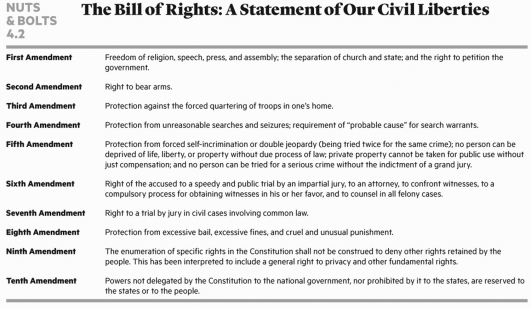 Which one of the following civil liberties is NOT protected in the First Amendment?
A) speech
B) assembly
C) religion
D) privacy
Question
Question
Question
Question
Question
Question
Question
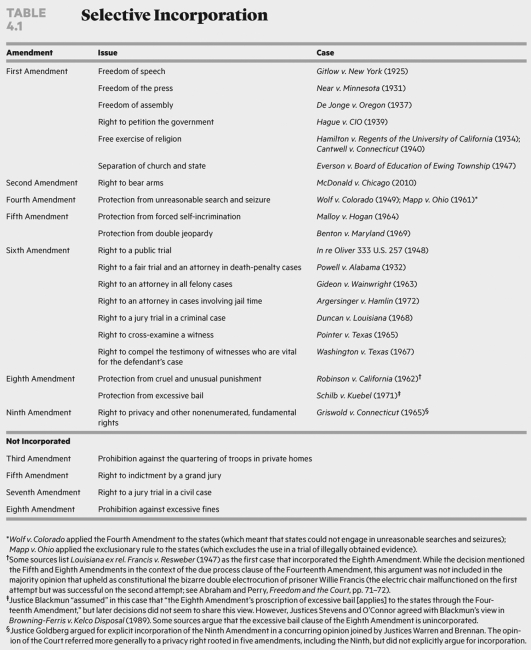 Which one of the following cases specifically applied one of the Bill of Rights amendments to state action?
A) Barron v. Baltimore
B) Gitlow v. New York
C) Marbury v. Madison
D) McCulloch v. Maryland
Question
Question
Question
Question
Question
Question
Question
Question
Question
Question
Question
Question
Question
Question
Question
Question
Question
Question
Question
Question
Question
Question
Question
Question
Question
Question
Question
Question
Question
Question
Question
Question
Question
Question
Question
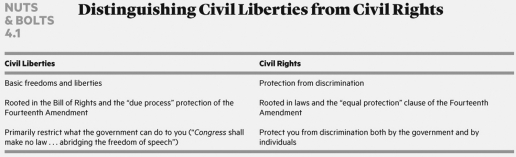 What is the difference between civil liberties and civil rights?
 Question
Question
Question
Question
Question
Question
Question
Question
Question
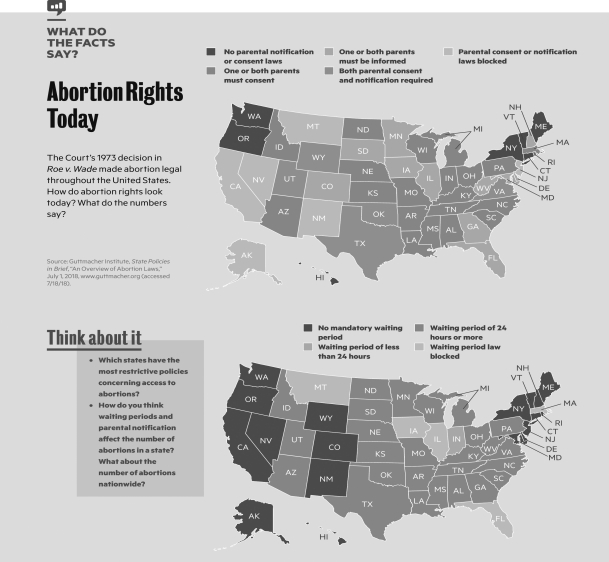 Which one of the following statements is accurate concerning abortion rights in the United States?
A) Most states have no parental notification or consent laws for minors.
B) Significant restrictions on abortion rights still exist in the United States.
C) Mandatory waiting period laws for abortions are no longer constitutional in the United States.
D) There are no restrictions on abortion rights in the United States today.
Question
Question
Question
Question
Question

Unlock Deck
Sign up to unlock the cards in this deck!
Unlock Deck
Unlock Deck
1/88

Play

Full screen (f)
Deck 4: Civil Liberties
1
The exclusionary rule is still in effect in the United States today, though it has been judicially weakened over time.
True
2
Obscenity is difficult to define since community standards can vary in different parts of
the country.
the country.
True
3
Civil rights are about freedom and civil liberties are about equality.
False
4
What is the classic example of a Constitutionally permissible restriction on free speech?
A) shouting "fire" in a crowded movie theater
B) people can say whatever they want under the First Amendment
C) the pledge of allegiance
D) contributing money to political campaigns
A) shouting "fire" in a crowded movie theater
B) people can say whatever they want under the First Amendment
C) the pledge of allegiance
D) contributing money to political campaigns
Unlock Deck
Unlock for access to all 88 flashcards in this deck.
Unlock Deck
k this deck
5
Passage of the Fourteenth Amendment after the Civil War meant that states were immediately held to the same restrictions that applied to the federal government.
Unlock Deck
Unlock for access to all 88 flashcards in this deck.
Unlock Deck
k this deck
6
Governments cannot regulate fighting words.
Unlock Deck
Unlock for access to all 88 flashcards in this deck.
Unlock Deck
k this deck
7
Basic freedoms in the United States
A) are absolute; no restrictions are allowed.
B) can never be diminished under the Constitution.
C) must be balanced against competing interests, such as national security.
D) have vanished in the modern era.
A) are absolute; no restrictions are allowed.
B) can never be diminished under the Constitution.
C) must be balanced against competing interests, such as national security.
D) have vanished in the modern era.
Unlock Deck
Unlock for access to all 88 flashcards in this deck.
Unlock Deck
k this deck
8
Americans' religious freedoms are based on two different clauses in the First Amendment:
the free exercise clause and the establishment clause.
the free exercise clause and the establishment clause.
Unlock Deck
Unlock for access to all 88 flashcards in this deck.
Unlock Deck
k this deck
9
Voluntary school prayer in the public schools has been constitutional since 2002.
Unlock Deck
Unlock for access to all 88 flashcards in this deck.
Unlock Deck
k this deck
10
The process of selective incorporation was used widely by the Supreme Court justices in both the 1930s and 1960s.
Unlock Deck
Unlock for access to all 88 flashcards in this deck.
Unlock Deck
k this deck
11
The word "privacy" appears in the First Amendment.
Unlock Deck
Unlock for access to all 88 flashcards in this deck.
Unlock Deck
k this deck
12
Prior restraint has been clearly defined by the Supreme Court justices.
Unlock Deck
Unlock for access to all 88 flashcards in this deck.
Unlock Deck
k this deck
13
Civil liberties are
A) absolute guarantees of political freedom.
B) restrictions on government action that are intended to protect political freedoms.
C) required government actions intended to promote equality.
D) responsibilities for citizens outlined in the Constitution.
A) absolute guarantees of political freedom.
B) restrictions on government action that are intended to protect political freedoms.
C) required government actions intended to promote equality.
D) responsibilities for citizens outlined in the Constitution.
Unlock Deck
Unlock for access to all 88 flashcards in this deck.
Unlock Deck
k this deck
14
The Bill of Rights was created at the Constitutional Convention because the Federalists feared excessive government power.
Unlock Deck
Unlock for access to all 88 flashcards in this deck.
Unlock Deck
k this deck
15
The clear and present danger test meant that the government was not allowed to suppress
speech it deemed dangerous.
speech it deemed dangerous.
Unlock Deck
Unlock for access to all 88 flashcards in this deck.
Unlock Deck
k this deck
16
The series of school shootings in the last few years has led to more stringent gun control legislation
at the federal level.
at the federal level.
Unlock Deck
Unlock for access to all 88 flashcards in this deck.
Unlock Deck
k this deck
17
The due process clause of the Fourteenth Amendment is an important extension of civil liberties because it guarantees provisions of the Bill of Rights at the state level.
Unlock Deck
Unlock for access to all 88 flashcards in this deck.
Unlock Deck
k this deck
18
Gay rights are typically perceived as more of a civil liberty rather than a civil right issue.
Unlock Deck
Unlock for access to all 88 flashcards in this deck.
Unlock Deck
k this deck
19
The public outcry against the Alien and Sedition Acts helped Thomas Jefferson become president.
Unlock Deck
Unlock for access to all 88 flashcards in this deck.
Unlock Deck
k this deck
20
The Bill of Rights has always been interpreted by the Supreme Court justices to apply to the federal government and the states.
Unlock Deck
Unlock for access to all 88 flashcards in this deck.
Unlock Deck
k this deck
21
What is the constitutional basis of selective incorporation?
A) Article I
B) Article II
C) First Amendment
D) Fourteenth Amendment
A) Article I
B) Article II
C) First Amendment
D) Fourteenth Amendment
Unlock Deck
Unlock for access to all 88 flashcards in this deck.
Unlock Deck
k this deck
22
Mainstream defenders of free speech
A) believe that there should be no limits on what people say.
B) believe that it is essential to engage in a free exchange of ideas.
C) typically oppose allowing the Ku Klux Klan to rally in a public space.
D) typically oppose the ability of members of the Westboro Baptist Church to protest at military funerals.
A) believe that there should be no limits on what people say.
B) believe that it is essential to engage in a free exchange of ideas.
C) typically oppose allowing the Ku Klux Klan to rally in a public space.
D) typically oppose the ability of members of the Westboro Baptist Church to protest at military funerals.
Unlock Deck
Unlock for access to all 88 flashcards in this deck.
Unlock Deck
k this deck
23
Civil liberties are guaranteed by ________.
A) the Eleventh Amendment
B) Article I
C) the Bill of Rights
D) the Tenth Amendment
A) the Eleventh Amendment
B) Article I
C) the Bill of Rights
D) the Tenth Amendment
Unlock Deck
Unlock for access to all 88 flashcards in this deck.
Unlock Deck
k this deck
24
Which one of the following civil liberties is NOT protected in the First Amendment?A) speech
B) assembly
C) religion
D) privacy
Unlock Deck
Unlock for access to all 88 flashcards in this deck.
Unlock Deck
k this deck
25
Which one of these events occurred first?
A) passage of the Bill of Rights
B) enactment of the Alien and Sedition Acts
C) establishment of the clear and present danger test
D) establishment of the strict scrutiny test
A) passage of the Bill of Rights
B) enactment of the Alien and Sedition Acts
C) establishment of the clear and present danger test
D) establishment of the strict scrutiny test
Unlock Deck
Unlock for access to all 88 flashcards in this deck.
Unlock Deck
k this deck
26
How was the Bill of Rights developed?
A) Civil liberties were central to the debate at the Constitutional Convention.
B) A committee was formed during the Constitutional Convention, but its
Recommendations were ignored.
C) It was drafted after the ratification process had begun.
D) It was drafted in the 1850s.
A) Civil liberties were central to the debate at the Constitutional Convention.
B) A committee was formed during the Constitutional Convention, but its
Recommendations were ignored.
C) It was drafted after the ratification process had begun.
D) It was drafted in the 1850s.
Unlock Deck
Unlock for access to all 88 flashcards in this deck.
Unlock Deck
k this deck
27
How have the Supreme Court justices typically protected free speech in recent years?
A) The justices typically uphold virtually all types of activities associated with free speech.
B) The justices are typically influenced by the content-neutrality or lack thereof in speech restrictions
C) The justices generally do not support claims of free speech.
D) The justices typically do not grant standing in free speech cases.
A) The justices typically uphold virtually all types of activities associated with free speech.
B) The justices are typically influenced by the content-neutrality or lack thereof in speech restrictions
C) The justices generally do not support claims of free speech.
D) The justices typically do not grant standing in free speech cases.
Unlock Deck
Unlock for access to all 88 flashcards in this deck.
Unlock Deck
k this deck
28
The Alien and Sedition Acts
A) were passed in the eighteenth century.
B) were endorsed by the leaders of the Democratic-Republican Party.
C) limited campaign contributions for federal candidates.
D) were immensely popular with the people.
A) were passed in the eighteenth century.
B) were endorsed by the leaders of the Democratic-Republican Party.
C) limited campaign contributions for federal candidates.
D) were immensely popular with the people.
Unlock Deck
Unlock for access to all 88 flashcards in this deck.
Unlock Deck
k this deck
29
Which is the highest standard imposed on free speech cases by the Supreme Court justices?
A) rational basis review
B) intermediate scrutiny
C) strict scrutiny
D) stringent judicial review
A) rational basis review
B) intermediate scrutiny
C) strict scrutiny
D) stringent judicial review
Unlock Deck
Unlock for access to all 88 flashcards in this deck.
Unlock Deck
k this deck
30
________ determined that there was a "wall of eternal separation between church and state."
A) Thomas Jefferson
B) James Madison
C) Abraham Lincoln
D) Woodrow Wilson
A) Thomas Jefferson
B) James Madison
C) Abraham Lincoln
D) Woodrow Wilson
Unlock Deck
Unlock for access to all 88 flashcards in this deck.
Unlock Deck
k this deck
31
Which one of the following cases specifically applied one of the Bill of Rights amendments to state action?A) Barron v. Baltimore
B) Gitlow v. New York
C) Marbury v. Madison
D) McCulloch v. Maryland
Unlock Deck
Unlock for access to all 88 flashcards in this deck.
Unlock Deck
k this deck
32
Selective incorporation was created by ________.
A) Supreme Court justices
B) Congress
C) Article I
D) executive bureaucrats
A) Supreme Court justices
B) Congress
C) Article I
D) executive bureaucrats
Unlock Deck
Unlock for access to all 88 flashcards in this deck.
Unlock Deck
k this deck
33
________ forbids states from denying "life, liberty, or property" without following rules based on the Bill of Rights.
A) The establishment clause
B) The necessary and proper clause
C) The due process clause
D) The privileges and immunities clause
A) The establishment clause
B) The necessary and proper clause
C) The due process clause
D) The privileges and immunities clause
Unlock Deck
Unlock for access to all 88 flashcards in this deck.
Unlock Deck
k this deck
34
Which event prompted the harshest crackdowns on free speech since the Sedition Act of 1798?
A) World War II
B) World War I
C) Civil War
D) War of 1812
A) World War II
B) World War I
C) Civil War
D) War of 1812
Unlock Deck
Unlock for access to all 88 flashcards in this deck.
Unlock Deck
k this deck
35
________ opposed ratification of the Constitution until a bill of rights was included.
A) The Federalists
B) The Democratic-Republicans
C) The Antifederalists
D) James Madison
A) The Federalists
B) The Democratic-Republicans
C) The Antifederalists
D) James Madison
Unlock Deck
Unlock for access to all 88 flashcards in this deck.
Unlock Deck
k this deck
36
The clear and present danger test allows government to
A) regulate political speech when it is inconvenient.
B) prevent people from protesting some government actions, such as wars.
C) limit some political speech but only when it may cause significant harm to others.
D) jail dissidents and malcontents in some extreme circumstances.
A) regulate political speech when it is inconvenient.
B) prevent people from protesting some government actions, such as wars.
C) limit some political speech but only when it may cause significant harm to others.
D) jail dissidents and malcontents in some extreme circumstances.
Unlock Deck
Unlock for access to all 88 flashcards in this deck.
Unlock Deck
k this deck
37
Under the establishment clause of the First Amendment, members of Congress
A) can establish an official religion in the United States.
B) cannot help or hurt religion with legislation.
C) can never provide aid for any religious organizations.
D) cannot pray during a legislative session.
A) can establish an official religion in the United States.
B) cannot help or hurt religion with legislation.
C) can never provide aid for any religious organizations.
D) cannot pray during a legislative session.
Unlock Deck
Unlock for access to all 88 flashcards in this deck.
Unlock Deck
k this deck
38
Based on past court decisions, the Supreme Court is MOST likely to rule that which of the following is Constitutionally protected behavior?
A) a student group protesting school policies by walking out of class
B) an anti-immigrant group holding a protest rally in a neighborhood with a large population of immigrants
C) a cigarette manufacturer advertising on Saturday-morning television
D) taxpayers who oppose a government policy withholding a portion of their taxes
A) a student group protesting school policies by walking out of class
B) an anti-immigrant group holding a protest rally in a neighborhood with a large population of immigrants
C) a cigarette manufacturer advertising on Saturday-morning television
D) taxpayers who oppose a government policy withholding a portion of their taxes
Unlock Deck
Unlock for access to all 88 flashcards in this deck.
Unlock Deck
k this deck
39
Which one of the following statements is accurate with regard to money in federal campaigns?
A) Candidates in federal elections are not subject to limits on contributions they receive directly from citizens.
B) Candidates for the presidency are limited in how much of their own money they can lend to their campaign.
C) Candidates in federal elections only have to report contributions of $5,000 or more to the Federal Election Commission.
D) The justices of the Supreme Court have attempted to balance First Amendment rights of candidates and their supporters with the public interest in honest and ethical elections.
A) Candidates in federal elections are not subject to limits on contributions they receive directly from citizens.
B) Candidates for the presidency are limited in how much of their own money they can lend to their campaign.
C) Candidates in federal elections only have to report contributions of $5,000 or more to the Federal Election Commission.
D) The justices of the Supreme Court have attempted to balance First Amendment rights of candidates and their supporters with the public interest in honest and ethical elections.
Unlock Deck
Unlock for access to all 88 flashcards in this deck.
Unlock Deck
k this deck
40
After the Civil War, why did former slaves not enjoy the same protection from state governments as they did from the national government?
A) The Supreme Court justices still embraced the standard of dual citizenship, despite the Fourteenth Amendment.
B) The Supreme Court justices felt the Civil War had effectively ended slavery.
C) The Dred Scott decision had ruled that slaves were property.
D) The Fifth Amendment also applied to the states.
A) The Supreme Court justices still embraced the standard of dual citizenship, despite the Fourteenth Amendment.
B) The Supreme Court justices felt the Civil War had effectively ended slavery.
C) The Dred Scott decision had ruled that slaves were property.
D) The Fifth Amendment also applied to the states.
Unlock Deck
Unlock for access to all 88 flashcards in this deck.
Unlock Deck
k this deck
41
The Fourth, Fifth, Sixth, and Eighth Amendments contain ________ rights.
A) civil
B) equal protection
C) freedom of expression
D) due process
A) civil
B) equal protection
C) freedom of expression
D) due process
Unlock Deck
Unlock for access to all 88 flashcards in this deck.
Unlock Deck
k this deck
42
Warrantless searches
A) are always illegal.
B) are not always illegal.
C) have not been conducted since the communist scare of the 1950s.
D) are generally only conducted by unsavory police forces.
A) are always illegal.
B) are not always illegal.
C) have not been conducted since the communist scare of the 1950s.
D) are generally only conducted by unsavory police forces.
Unlock Deck
Unlock for access to all 88 flashcards in this deck.
Unlock Deck
k this deck
43
A township council passes an ordinance that prevents a Nazi group from marching through town. The Supreme Court justices would likely overturn the ordinance as a violation of the
Group's freedom of ________.
A) religion
B) petition
C) assembly
D) speech
Group's freedom of ________.
A) religion
B) petition
C) assembly
D) speech
Unlock Deck
Unlock for access to all 88 flashcards in this deck.
Unlock Deck
k this deck
44
In 2008, the Supreme Court justices
A) made it easier for state officials to ban handguns.
B) recognized an individual's right to bear arms for self-defense and hunting for
The first time.
C) determined that the right to bear arms is a collective right.
D) upheld the constitutionality of strict gun control legislation.
A) made it easier for state officials to ban handguns.
B) recognized an individual's right to bear arms for self-defense and hunting for
The first time.
C) determined that the right to bear arms is a collective right.
D) upheld the constitutionality of strict gun control legislation.
Unlock Deck
Unlock for access to all 88 flashcards in this deck.
Unlock Deck
k this deck
45
The Fourth Amendment
A) provides the right to legal counsel and a jury trial in front of peers.
B) prohibits cruel and unusual punishment.
C) protects against unreasonable searches by the police.
D) protects people from having to testify against themselves in a court of law.
A) provides the right to legal counsel and a jury trial in front of peers.
B) prohibits cruel and unusual punishment.
C) protects against unreasonable searches by the police.
D) protects people from having to testify against themselves in a court of law.
Unlock Deck
Unlock for access to all 88 flashcards in this deck.
Unlock Deck
k this deck
46
The justices of the Supreme Court
A) have recently extended First Amendment rights to corporations and labor unions in federal elections.
B) have recently overturned the ban on "soft money."
C) have determined that money has no place in federal campaigns.
D) have determined that public universities can no longer charge a higher rate of tuition
For out-of-state residents.
A) have recently extended First Amendment rights to corporations and labor unions in federal elections.
B) have recently overturned the ban on "soft money."
C) have determined that money has no place in federal campaigns.
D) have determined that public universities can no longer charge a higher rate of tuition
For out-of-state residents.
Unlock Deck
Unlock for access to all 88 flashcards in this deck.
Unlock Deck
k this deck
47
The U.S. Supreme Court justices have replaced the clear and present danger test with ________.
A) the libel test
B) the direct incitement test
C) the symbolic test
D) the national security test
A) the libel test
B) the direct incitement test
C) the symbolic test
D) the national security test
Unlock Deck
Unlock for access to all 88 flashcards in this deck.
Unlock Deck
k this deck
48
What aspects of assembly can be regulated by the government without violating the freedom of assembly?
A) only the time and place of the event
B) time, place, and manner of the event without considering the content of the message
C) time, place, and manner of the event as long as the regulation is content neutral
D) only during times of war
A) only the time and place of the event
B) time, place, and manner of the event without considering the content of the message
C) time, place, and manner of the event as long as the regulation is content neutral
D) only during times of war
Unlock Deck
Unlock for access to all 88 flashcards in this deck.
Unlock Deck
k this deck
49
When it comes to the question of prior restraint on the press, the Supreme Court justices
A) have set a high bar for the government to meet if it wants to restrict the press.
B) favor the national government over the press, particularly in times of war and conflict.
C) follow Congress's lead in regulating the press.
D) defer to the Federal Communications Commission.
A) have set a high bar for the government to meet if it wants to restrict the press.
B) favor the national government over the press, particularly in times of war and conflict.
C) follow Congress's lead in regulating the press.
D) defer to the Federal Communications Commission.
Unlock Deck
Unlock for access to all 88 flashcards in this deck.
Unlock Deck
k this deck
50
The Pentagon Papers case balanced what two considerations?
A) freedom of the press and national security
B) content-neutrality standards and national security
C) the public's right to know and content-neutrality standards
D) freedom of the press and the public's right to know
A) freedom of the press and national security
B) content-neutrality standards and national security
C) the public's right to know and content-neutrality standards
D) freedom of the press and the public's right to know
Unlock Deck
Unlock for access to all 88 flashcards in this deck.
Unlock Deck
k this deck
51
Which part of the Bill of Rights was the latest to be applied at the state level?
A) Second Amendment
B) Fourth Amendment
C) Fifth Amendment
D) Fourteenth Amendment
A) Second Amendment
B) Fourth Amendment
C) Fifth Amendment
D) Fourteenth Amendment
Unlock Deck
Unlock for access to all 88 flashcards in this deck.
Unlock Deck
k this deck
52
Fighting words, obscenity, and libel receive
A) the same level of protection as political speech.
B) less protection than political speech.
C) more protection than political speech.
D) no attention from the federal government.
A) the same level of protection as political speech.
B) less protection than political speech.
C) more protection than political speech.
D) no attention from the federal government.
Unlock Deck
Unlock for access to all 88 flashcards in this deck.
Unlock Deck
k this deck
53
Which one of the following statements is true about libel?
A) It is more difficult for public officials to prove libel than private citizens.
B) The justices of the Supreme Court ruled in favor of Jerry Falwell in a famous libel case in the 1980s.
C) It is almost impossible for a private citizen to prove libel in the federal courts.
D) All people are perceived by the justices of the Supreme Court as peer equals when it comes to the issue of libel.
A) It is more difficult for public officials to prove libel than private citizens.
B) The justices of the Supreme Court ruled in favor of Jerry Falwell in a famous libel case in the 1980s.
C) It is almost impossible for a private citizen to prove libel in the federal courts.
D) All people are perceived by the justices of the Supreme Court as peer equals when it comes to the issue of libel.
Unlock Deck
Unlock for access to all 88 flashcards in this deck.
Unlock Deck
k this deck
54
Which one of the following is accurate regarding the right to peacefully assemble?
A) The right to peacefully assemble has been consistently upheld by the Supreme Court justices.
B) Members of the Ku Klux Klan and the Nazi Party have generally not been allowed to hold public rallies.
C) Local government officials generally do not have to let unpopular groups assemble in their communities if they do not wish to do so.
D) The right to assemble can be constitutionally restricted by a "heckler's veto."
A) The right to peacefully assemble has been consistently upheld by the Supreme Court justices.
B) Members of the Ku Klux Klan and the Nazi Party have generally not been allowed to hold public rallies.
C) Local government officials generally do not have to let unpopular groups assemble in their communities if they do not wish to do so.
D) The right to assemble can be constitutionally restricted by a "heckler's veto."
Unlock Deck
Unlock for access to all 88 flashcards in this deck.
Unlock Deck
k this deck
55
The right against self-incrimination, based in ________, is an example of ________.
A) the Fifth Amendment; due process rights
B) the Fourth Amendment; settled law
C) Miranda v. Arizona; due process rights
D) the Bill of Rights; a free speech protection
A) the Fifth Amendment; due process rights
B) the Fourth Amendment; settled law
C) Miranda v. Arizona; due process rights
D) the Bill of Rights; a free speech protection
Unlock Deck
Unlock for access to all 88 flashcards in this deck.
Unlock Deck
k this deck
56
The Supreme Court justices have ruled that the government can make laws about commercial speech when
A) someone brings the speech to their attention.
B) the Federal Communications Commission is unanimous in opposition.
C) that speech is misleading.
D) the speech airs on television.
A) someone brings the speech to their attention.
B) the Federal Communications Commission is unanimous in opposition.
C) that speech is misleading.
D) the speech airs on television.
Unlock Deck
Unlock for access to all 88 flashcards in this deck.
Unlock Deck
k this deck
57
The Miller test
A) is no longer utilized.
B) is still applied today.
C) is now used in slander cases.
D) is now used in hate speech cases.
A) is no longer utilized.
B) is still applied today.
C) is now used in slander cases.
D) is now used in hate speech cases.
Unlock Deck
Unlock for access to all 88 flashcards in this deck.
Unlock Deck
k this deck
58
Burning the flag is an example of ________.
A) slander
B) hate speech
C) symbolic speech
D) a clear and present danger
A) slander
B) hate speech
C) symbolic speech
D) a clear and present danger
Unlock Deck
Unlock for access to all 88 flashcards in this deck.
Unlock Deck
k this deck
59
Speech that is offensive or abusive, particularly in terms of race, gender, or sexual orientation, is called ________.
A) symbolic speech
B) hate speech
C) slanderous speech
D) expressive speech
A) symbolic speech
B) hate speech
C) slanderous speech
D) expressive speech
Unlock Deck
Unlock for access to all 88 flashcards in this deck.
Unlock Deck
k this deck
60
The Miller test is a set of rules for determining whether
A) something is obscene.
B) the government can prevent the press from publishing something.
C) Congress can regulate speech about the U.S. government.
D) a public figure has been slandered.
A) something is obscene.
B) the government can prevent the press from publishing something.
C) Congress can regulate speech about the U.S. government.
D) a public figure has been slandered.
Unlock Deck
Unlock for access to all 88 flashcards in this deck.
Unlock Deck
k this deck
61
Privacy rights
A) are enumerated explicitly in the Constitution.
B) go back to the early nineteenth century.
C) were first developed in Roe v. Wade.
D) were first developed in 1965 in Griswold v. Connecticut.
A) are enumerated explicitly in the Constitution.
B) go back to the early nineteenth century.
C) were first developed in Roe v. Wade.
D) were first developed in 1965 in Griswold v. Connecticut.
Unlock Deck
Unlock for access to all 88 flashcards in this deck.
Unlock Deck
k this deck
62
When it comes to gay rights, the Supreme Court justices have
A) established very broad privacy rights for sexual behavior.
B) established very limited privacy rights for sexual behavior.
C) determined that sodomy could be legal for heterosexuals but not homosexuals.
D) determined that civil rights for gay Americans is a states' rights matter.
A) established very broad privacy rights for sexual behavior.
B) established very limited privacy rights for sexual behavior.
C) determined that sodomy could be legal for heterosexuals but not homosexuals.
D) determined that civil rights for gay Americans is a states' rights matter.
Unlock Deck
Unlock for access to all 88 flashcards in this deck.
Unlock Deck
k this deck
63
Why was Gitlow v. New York (1925) such an important case?
Unlock Deck
Unlock for access to all 88 flashcards in this deck.
Unlock Deck
k this deck
64
The Supreme Court's decision in Griswold v. Connecticut (1965)
A) established the right to privacy as existing in the Bill of Rights.
B) guaranteed a woman's right to an abortion.
C) meant the police had to read a person a list of her or his rights in advance of an arrest.
D) created a standard for determining when political speech could be regulated.
A) established the right to privacy as existing in the Bill of Rights.
B) guaranteed a woman's right to an abortion.
C) meant the police had to read a person a list of her or his rights in advance of an arrest.
D) created a standard for determining when political speech could be regulated.
Unlock Deck
Unlock for access to all 88 flashcards in this deck.
Unlock Deck
k this deck
65
Explain why flag burning is an example of symbolic speech.
Unlock Deck
Unlock for access to all 88 flashcards in this deck.
Unlock Deck
k this deck
66
What is the difference between civil liberties and civil rights? Unlock Deck
Unlock for access to all 88 flashcards in this deck.
Unlock Deck
k this deck
67
Discuss two divergent views on the meaning of the Second Amendment.
Unlock Deck
Unlock for access to all 88 flashcards in this deck.
Unlock Deck
k this deck
68
Which one of the following statements most accurately describes the use of the death penalty?
A) There has been a clear trend among the states away from the use of the death penalty.
B) There has been very little change in the frequency with which states use the death penalty.
C) More states choose to use the death penalty every year.
D) No states use the death penalty anymore.
A) There has been a clear trend among the states away from the use of the death penalty.
B) There has been very little change in the frequency with which states use the death penalty.
C) More states choose to use the death penalty every year.
D) No states use the death penalty anymore.
Unlock Deck
Unlock for access to all 88 flashcards in this deck.
Unlock Deck
k this deck
69
What is the clear and present danger test?
Unlock Deck
Unlock for access to all 88 flashcards in this deck.
Unlock Deck
k this deck
70
Under the ________, government officials have increased access to individual library, banking, and medical records.
A) Freedom of Information Act
B) USA PATRIOT Act
C) FBI Control Act
D) Tenth Amendment
A) Freedom of Information Act
B) USA PATRIOT Act
C) FBI Control Act
D) Tenth Amendment
Unlock Deck
Unlock for access to all 88 flashcards in this deck.
Unlock Deck
k this deck
71
Roe v. Wade (1973)
A) is no longer in effect.
B) is still in effect, but has been altered to allow for state restrictions on abortion.
C) is no longer controversial.
D) was not fundamentally about the right to privacy.
A) is no longer in effect.
B) is still in effect, but has been altered to allow for state restrictions on abortion.
C) is no longer controversial.
D) was not fundamentally about the right to privacy.
Unlock Deck
Unlock for access to all 88 flashcards in this deck.
Unlock Deck
k this deck
72
What is the wall of separation between church and state? Identify some inherent contradictions in the contemporary world.
Unlock Deck
Unlock for access to all 88 flashcards in this deck.
Unlock Deck
k this deck
73
A year after Gideon v. Wainwright, Congress passed a law making ________ even stronger.
A) the right to an attorney
B) the exclusionary rule
C) self-incrimination
D) double jeopardy
A) the right to an attorney
B) the exclusionary rule
C) self-incrimination
D) double jeopardy
Unlock Deck
Unlock for access to all 88 flashcards in this deck.
Unlock Deck
k this deck
74
The right to counsel is provided in the ________ Amendment. After the decision in ________, this was extended to require that counsel be provided for people who cannot afford an attorney.
A) Sixth; Gitlow v. New York
B) Sixth; Gideon v. Wainwright
C) Fourth; Gideon v. Wainwright
D) Fifth; Gideon v. Wainwright
A) Sixth; Gitlow v. New York
B) Sixth; Gideon v. Wainwright
C) Fourth; Gideon v. Wainwright
D) Fifth; Gideon v. Wainwright
Unlock Deck
Unlock for access to all 88 flashcards in this deck.
Unlock Deck
k this deck
75
Which one of the following statements is accurate concerning abortion rights in the United States?A) Most states have no parental notification or consent laws for minors.
B) Significant restrictions on abortion rights still exist in the United States.
C) Mandatory waiting period laws for abortions are no longer constitutional in the United States.
D) There are no restrictions on abortion rights in the United States today.
Unlock Deck
Unlock for access to all 88 flashcards in this deck.
Unlock Deck
k this deck
76
Privacy rights are controversial because
A) they emanate from Congress rather than the Supreme Court.
B) they are not explicitly stated in the Bill of Rights.
C) presidents can change them whenever they want to do so by executive order.
D) the Supreme Court has not recognized that they exist.
A) they emanate from Congress rather than the Supreme Court.
B) they are not explicitly stated in the Bill of Rights.
C) presidents can change them whenever they want to do so by executive order.
D) the Supreme Court has not recognized that they exist.
Unlock Deck
Unlock for access to all 88 flashcards in this deck.
Unlock Deck
k this deck
77
The broad right to pursue abortion services, subject to specific state limitations, was guaranteed in ________.
A) Miranda v. Arizona
B) Gideon v. Wainwright
C) Roe v. Wade
D) Griswold v. Connecticut
A) Miranda v. Arizona
B) Gideon v. Wainwright
C) Roe v. Wade
D) Griswold v. Connecticut
Unlock Deck
Unlock for access to all 88 flashcards in this deck.
Unlock Deck
k this deck
78
What is the difference between strict and intermediate scrutiny?
Unlock Deck
Unlock for access to all 88 flashcards in this deck.
Unlock Deck
k this deck
79
In 1972, the justices of the Supreme Court
A) determined that the death penalty was unconstitutional because the process of applying it was too inconsistent.
B) determined that all death penalty cases should be consolidated so that one trial existed to determine guilt or innocence as well as sentencing.
C) determined that the death penalty is cruel and unusual punishment under the Constitution.
D) determined that the death penalty was strictly a states' rights issue.
A) determined that the death penalty was unconstitutional because the process of applying it was too inconsistent.
B) determined that all death penalty cases should be consolidated so that one trial existed to determine guilt or innocence as well as sentencing.
C) determined that the death penalty is cruel and unusual punishment under the Constitution.
D) determined that the death penalty was strictly a states' rights issue.
Unlock Deck
Unlock for access to all 88 flashcards in this deck.
Unlock Deck
k this deck
80
Which one of the following statements is accurate under the existing interpretation of the Fourth Amendment by the U.S. Supreme Court justices?
A) Drug testing of all federal employees is permissible.
B) All candidates for state office must pass a drug test within 30 days of announcing their candidacy.
C) Some, but not all, federal employees are subject to drug testing.
D) No drug testing of any public or private employees is permissible.
A) Drug testing of all federal employees is permissible.
B) All candidates for state office must pass a drug test within 30 days of announcing their candidacy.
C) Some, but not all, federal employees are subject to drug testing.
D) No drug testing of any public or private employees is permissible.
Unlock Deck
Unlock for access to all 88 flashcards in this deck.
Unlock Deck
k this deck
Unlock Deck
Unlock for access to all 88 flashcards in this deck.







