





 Chat with AI

Deck 8: Supply, Demand and Government Policies
Full screen (f)

Question

Question
Question
Question
Question
Question
Question
Question
Question
Question
Question
Question
Question
Question
Question
Question
Question
Question
Question
Question
Question
Question
Question
Question
Question
Question
Refer to the graph below. Which of the following statements is correct? 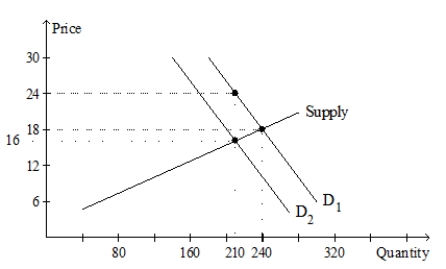
A) The amount of the tax per unit is €6.
B) The tax leaves the size of the market unchanged.
C) The tax is levied on buyers of the good, rather than on sellers.
D) All of the above are correct.
A) The amount of the tax per unit is €6.
B) The tax leaves the size of the market unchanged.
C) The tax is levied on buyers of the good, rather than on sellers.
D) All of the above are correct.
Question
Refer to the graph above. What is the amount of the tax per unit? 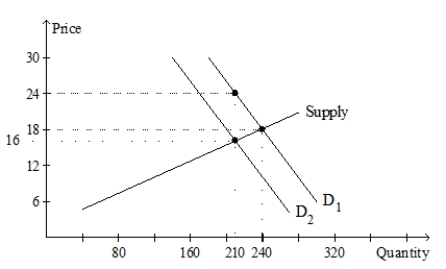
A) €8
B) €6
C) €4
D) €2
A) €8
B) €6
C) €4
D) €2
Question
Question
Question
Question
Question
Question
Question
Question
Question
Question
Question
Question
Question
Question
Question
Question
Question
Using the graph below, analyse the effect a €700 price floor would have on this market for ten-speed bicycles. Would this be a binding price floor? 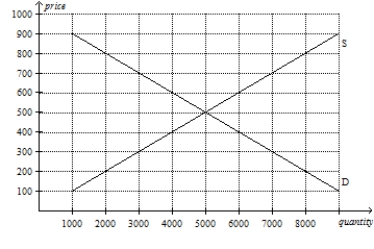
Question
Question
Question
Question
Using the graph below, analyze the effect a €300 price ceiling would have on the market for ten-speed bicycles. Would this be a binding price ceiling? 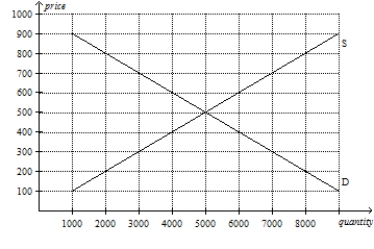
Question
Question
Question

Unlock Deck
Sign up to unlock the cards in this deck!
Unlock Deck
Unlock Deck
1/51

Play

Full screen (f)
Deck 8: Supply, Demand and Government Policies
1
A price floor set above the equilibrium price is a binding constraint.
True
2
For a price ceiling to be a binding constraint on the market, the government must set it
A) above the equilibrium price.
B) below the equilibrium price.
C) precisely at the equilibrium price.
D) at any price because all price ceilings are binding constraints.
A) above the equilibrium price.
B) below the equilibrium price.
C) precisely at the equilibrium price.
D) at any price because all price ceilings are binding constraints.
B
3
Rent controls typically end up
A) increasing rents received by landlords.
B) raising property values.
C) encouraging landlords to overspend for maintenance.
D) discouraging new housing construction.
A) increasing rents received by landlords.
B) raising property values.
C) encouraging landlords to overspend for maintenance.
D) discouraging new housing construction.
D
4
If the government imposes a binding price floor on sugar, it may also have to
A) establish programs to expand supply in the private sector.
B) establish programs to reduce demand in the private sector.
C) produce some sugar itself.
D) purchase the surplus sugar.
A) establish programs to expand supply in the private sector.
B) establish programs to reduce demand in the private sector.
C) produce some sugar itself.
D) purchase the surplus sugar.
Unlock Deck
Unlock for access to all 51 flashcards in this deck.
Unlock Deck
k this deck
5
Government-created price floors are typically imposed to
A) help consumers.
B) help producers.
C) raise tax revenue.
D) shift the supply curve to the right.
A) help consumers.
B) help producers.
C) raise tax revenue.
D) shift the supply curve to the right.
Unlock Deck
Unlock for access to all 51 flashcards in this deck.
Unlock Deck
k this deck
6
Suppose the equilibrium price for apartments is €500 per month and the government imposes rent controls of €250. Which of the following is unlikely to occur as a result of the rent controls?
A) There may be long lines of buyers waiting for apartments.
B) Landlords may discriminate among apartment renters.
C) Landlords may be offered bribes to rent apartments.
D) There will be a shortage of housing.
E) The quality of apartments will improve.
A) There may be long lines of buyers waiting for apartments.
B) Landlords may discriminate among apartment renters.
C) Landlords may be offered bribes to rent apartments.
D) There will be a shortage of housing.
E) The quality of apartments will improve.
Unlock Deck
Unlock for access to all 51 flashcards in this deck.
Unlock Deck
k this deck
7
Which of the following statements about a binding price ceiling is true?
A) The shortage created by the price ceiling is greater in the short run than in the long run.
B) The surplus created by the price ceiling is greater in the short run than in the long run.
C) The surplus created by the price ceiling is greater in the long run than in the short run.
D) The shortage created by the price ceiling is greater in the long run than in the short run.
A) The shortage created by the price ceiling is greater in the short run than in the long run.
B) The surplus created by the price ceiling is greater in the short run than in the long run.
C) The surplus created by the price ceiling is greater in the long run than in the short run.
D) The shortage created by the price ceiling is greater in the long run than in the short run.
Unlock Deck
Unlock for access to all 51 flashcards in this deck.
Unlock Deck
k this deck
8
A €10 tax on football boots will always raise the price that the buyers pay for football boots by €10.
Unlock Deck
Unlock for access to all 51 flashcards in this deck.
Unlock Deck
k this deck
9
A price ceiling that is not a binding constraint today could cause a shortage in the future if demand were to increase and raise the equilibrium price above the fixed price ceiling.
Unlock Deck
Unlock for access to all 51 flashcards in this deck.
Unlock Deck
k this deck
10
The ultimate burden of a tax falls most heavily on the side of the market that is less elastic.
Unlock Deck
Unlock for access to all 51 flashcards in this deck.
Unlock Deck
k this deck
11
Which side of the market is more likely to lobby government for a price floor?
A) the buyers
B) neither buyers nor sellers desire a price floor.
C) the sellers
D) both buyers and sellers desire a price floor.
A) the buyers
B) neither buyers nor sellers desire a price floor.
C) the sellers
D) both buyers and sellers desire a price floor.
Unlock Deck
Unlock for access to all 51 flashcards in this deck.
Unlock Deck
k this deck
12
If the equilibrium price of petrol is €1.00 per litre and the government places a price ceiling on petrol of €1.50 per litre, the result will be a shortage of petrol.
Unlock Deck
Unlock for access to all 51 flashcards in this deck.
Unlock Deck
k this deck
13
A tax creates a tax wedge between a buyer and a seller. This causes the price paid by the buyer to rise, the price received by the seller to fall, and the quantity sold to fall.
Unlock Deck
Unlock for access to all 51 flashcards in this deck.
Unlock Deck
k this deck
14
A tax collected from buyers has an equivalent impact to a same size tax collected from sellers.
Unlock Deck
Unlock for access to all 51 flashcards in this deck.
Unlock Deck
k this deck
15
A 10 per cent increase in the minimum wage is more likely to raise unemployment among teenage workers than among mid-career professional workers
Unlock Deck
Unlock for access to all 51 flashcards in this deck.
Unlock Deck
k this deck
16
A price floor
A) always determines the price at which a good must be sold.
B) sets a legal maximum on the price at which a good can be sold.
C) is not a binding constraint if it is set above the equilibrium price.
D) sets a legal minimum on the price at which a good can be sold.
A) always determines the price at which a good must be sold.
B) sets a legal maximum on the price at which a good can be sold.
C) is not a binding constraint if it is set above the equilibrium price.
D) sets a legal minimum on the price at which a good can be sold.
Unlock Deck
Unlock for access to all 51 flashcards in this deck.
Unlock Deck
k this deck
17
A binding price ceiling creates
A) a shortage or a surplus depending on whether the price ceiling is set above or below the equilibrium price.
B) a surplus.
C) a shortage.
D) an equilibrium.
A) a shortage or a surplus depending on whether the price ceiling is set above or below the equilibrium price.
B) a surplus.
C) a shortage.
D) an equilibrium.
Unlock Deck
Unlock for access to all 51 flashcards in this deck.
Unlock Deck
k this deck
18
A price ceiling set below the equilibrium price causes a surplus.
Unlock Deck
Unlock for access to all 51 flashcards in this deck.
Unlock Deck
k this deck
19
A subsidy given to suppliers has the effect of shifting the demand curve outwards.
Unlock Deck
Unlock for access to all 51 flashcards in this deck.
Unlock Deck
k this deck
20
If the equilibrium price of bread is €2 and the government imposes a €1.50 price ceiling on the price of bread,
A) more bread will be produced to meet the increased demand.
B) there will be a shortage of bread.
C) the demand for bread will decrease because suppliers will reduce their supply.
D) a surplus of bread will emerge.
A) more bread will be produced to meet the increased demand.
B) there will be a shortage of bread.
C) the demand for bread will decrease because suppliers will reduce their supply.
D) a surplus of bread will emerge.
Unlock Deck
Unlock for access to all 51 flashcards in this deck.
Unlock Deck
k this deck
21
The tax per unit on a good is the
A) difference between the list price and the actual price paid by the buyer.
B) licensing fees and other business taxes paid by sellers, averaged over the total quantity of goods sold.
C) difference between the total price paid by the buyer and the price received by the seller.
D) difference between wholesale and retail prices.
A) difference between the list price and the actual price paid by the buyer.
B) licensing fees and other business taxes paid by sellers, averaged over the total quantity of goods sold.
C) difference between the total price paid by the buyer and the price received by the seller.
D) difference between wholesale and retail prices.
Unlock Deck
Unlock for access to all 51 flashcards in this deck.
Unlock Deck
k this deck
22
The government is thinking about increasing the tax on petrol to promote conservation. The tax will discourage the consumption of petrol most when the price elasticity of demand equals
A) 0.1
B) 0.7
C) 1.3
D) 2.0
A) 0.1
B) 0.7
C) 1.3
D) 2.0
Unlock Deck
Unlock for access to all 51 flashcards in this deck.
Unlock Deck
k this deck
23
The tax burden will fall most heavily on sellers of the good when the demand curve
A) is relatively steep, and the supply curve is relatively flat.
B) is relatively flat, and the supply curve is relatively steep.
C) and the supply curve are both relatively flat.
D) and the supply curve are both relatively steep.
A) is relatively steep, and the supply curve is relatively flat.
B) is relatively flat, and the supply curve is relatively steep.
C) and the supply curve are both relatively flat.
D) and the supply curve are both relatively steep.
Unlock Deck
Unlock for access to all 51 flashcards in this deck.
Unlock Deck
k this deck
24
When a tax is collected from the buyers in a market,
A) the tax burden falls most heavily on the buyers.
B) the buyers bear the burden of the tax.
C) the sellers bear the burden of the tax.
D) the tax burden on the buyers and sellers is the same as an equivalent tax collected from the sellers.
A) the tax burden falls most heavily on the buyers.
B) the buyers bear the burden of the tax.
C) the sellers bear the burden of the tax.
D) the tax burden on the buyers and sellers is the same as an equivalent tax collected from the sellers.
Unlock Deck
Unlock for access to all 51 flashcards in this deck.
Unlock Deck
k this deck
25
Within the supply and demand model, a tax collected from the sellers of a good shifts the
A) demand curve downward by the size of the tax per unit.
B) supply curve downward by the size of the tax per unit.
C) demand curve upward by the size of the tax per unit.
D) supply curve upward by the size of the tax per unit.
A) demand curve downward by the size of the tax per unit.
B) supply curve downward by the size of the tax per unit.
C) demand curve upward by the size of the tax per unit.
D) supply curve upward by the size of the tax per unit.
Unlock Deck
Unlock for access to all 51 flashcards in this deck.
Unlock Deck
k this deck
26
Refer to the graph below. Which of the following statements is correct?
A) The amount of the tax per unit is €6.
B) The tax leaves the size of the market unchanged.
C) The tax is levied on buyers of the good, rather than on sellers.
D) All of the above are correct.
A) The amount of the tax per unit is €6.
B) The tax leaves the size of the market unchanged.
C) The tax is levied on buyers of the good, rather than on sellers.
D) All of the above are correct.
Unlock Deck
Unlock for access to all 51 flashcards in this deck.
Unlock Deck
k this deck
27
Refer to the graph above. What is the amount of the tax per unit?
A) €8
B) €6
C) €4
D) €2
A) €8
B) €6
C) €4
D) €2
Unlock Deck
Unlock for access to all 51 flashcards in this deck.
Unlock Deck
k this deck
28
The surplus caused by a binding price floor will be greatest if
A) demand is inelastic and supply is elastic.
B) supply is inelastic and demand is elastic.
C) both supply and demand are elastic.
D) both supply and demand are inelastic.
A) demand is inelastic and supply is elastic.
B) supply is inelastic and demand is elastic.
C) both supply and demand are elastic.
D) both supply and demand are inelastic.
Unlock Deck
Unlock for access to all 51 flashcards in this deck.
Unlock Deck
k this deck
29
The quantity sold in a market will decrease if the government
A) decreases a binding price floor in that market.
B) increases a binding price ceiling in that market.
C) increases a tax on the good sold in that market.
D) All of the above are correct.
A) decreases a binding price floor in that market.
B) increases a binding price ceiling in that market.
C) increases a tax on the good sold in that market.
D) All of the above are correct.
Unlock Deck
Unlock for access to all 51 flashcards in this deck.
Unlock Deck
k this deck
30
The burden of a tax falls more heavily on the sellers in a market when
A) both supply and demand are elastic.
B) both supply and demand are inelastic.
C) demand is inelastic and supply is elastic.
D) demand is elastic and supply is inelastic.
A) both supply and demand are elastic.
B) both supply and demand are inelastic.
C) demand is inelastic and supply is elastic.
D) demand is elastic and supply is inelastic.
Unlock Deck
Unlock for access to all 51 flashcards in this deck.
Unlock Deck
k this deck
31
Taxes levied directly on consumers
A) always hurt consumers rather than producers.
B) always hurt producers rather than consumers.
C) generate more revenue than taxes levied on producers.
D) have the same effect as taxes directly levied on producers.
A) always hurt consumers rather than producers.
B) always hurt producers rather than consumers.
C) generate more revenue than taxes levied on producers.
D) have the same effect as taxes directly levied on producers.
Unlock Deck
Unlock for access to all 51 flashcards in this deck.
Unlock Deck
k this deck
32
A tax of €1.00 per litre on petrol
A) places a tax wedge of €1.00 between the price the buyers pay and the price the sellers receive.
B) decreases the price the sellers receive by €1.00 per litre.
C) increases the price the buyers pay by €1.00 per litre.
D) increases the price the buyers pay by precisely €0.50 and reduces the price received by sellers by precisely €0.50.
A) places a tax wedge of €1.00 between the price the buyers pay and the price the sellers receive.
B) decreases the price the sellers receive by €1.00 per litre.
C) increases the price the buyers pay by €1.00 per litre.
D) increases the price the buyers pay by precisely €0.50 and reduces the price received by sellers by precisely €0.50.
Unlock Deck
Unlock for access to all 51 flashcards in this deck.
Unlock Deck
k this deck
33
Which of the following takes place when a tax is placed on a good?
A) a decrease in the price buyers pay, an increase in the price sellers receive, and a decrease in the quantity sold
B) an increase in the price buyers pay, a decrease in the price sellers receive, and an increase in the quantity sold
C) a decrease in the price buyers pay, an increase in the price sellers receive, and an increase in the quantity sold
D) an increase in the price buyers pay, a decrease in the price sellers receive, and a decrease in the quantity sold
A) a decrease in the price buyers pay, an increase in the price sellers receive, and a decrease in the quantity sold
B) an increase in the price buyers pay, a decrease in the price sellers receive, and an increase in the quantity sold
C) a decrease in the price buyers pay, an increase in the price sellers receive, and an increase in the quantity sold
D) an increase in the price buyers pay, a decrease in the price sellers receive, and a decrease in the quantity sold
Unlock Deck
Unlock for access to all 51 flashcards in this deck.
Unlock Deck
k this deck
34
Which of the following causes a surplus of a good?
A) a binding price floor
B) a binding price ceiling
C) a tax on the good
D) More than one of the above is correct.
A) a binding price floor
B) a binding price ceiling
C) a tax on the good
D) More than one of the above is correct.
Unlock Deck
Unlock for access to all 51 flashcards in this deck.
Unlock Deck
k this deck
35
Which of the following is an example of a price floor?
A) the minimum wage
B) rent controls
C) restricting petrol prices to €1.00 per litre when the equilibrium price is €1.50 per litre
D) All of these answers are price floors.
A) the minimum wage
B) rent controls
C) restricting petrol prices to €1.00 per litre when the equilibrium price is €1.50 per litre
D) All of these answers are price floors.
Unlock Deck
Unlock for access to all 51 flashcards in this deck.
Unlock Deck
k this deck
36
A tax placed on a good that is a necessity for consumers will likely generate a tax burden that
A) falls more heavily on sellers.
B) falls entirely on sellers.
C) falls more heavily on buyers.
D) is evenly distributed between buyers and sellers.
A) falls more heavily on sellers.
B) falls entirely on sellers.
C) falls more heavily on buyers.
D) is evenly distributed between buyers and sellers.
Unlock Deck
Unlock for access to all 51 flashcards in this deck.
Unlock Deck
k this deck
37
The government is thinking about increasing the tax on petrol to raise additional revenue rather than to promote conservation. The tax will result in the greatest amount of tax revenue if the price elasticity of demand for petrol equals
A) 1.8
B) 1.4
C) 1.0
D) 0.5
A) 1.8
B) 1.4
C) 1.0
D) 0.5
Unlock Deck
Unlock for access to all 51 flashcards in this deck.
Unlock Deck
k this deck
38
Which of the following statements is true if the government places a price ceiling on petrol at €1.50 per litre and the equilibrium price is €1.00 per litre?
A) A significant increase in the demand for petrol could cause the price ceiling to become a binding constraint.
B) A significant increase in the supply of petrol could cause the price ceiling to become a binding constraint.
C) There will be a shortage of petrol.
D) There will be a surplus of petrol.
A) A significant increase in the demand for petrol could cause the price ceiling to become a binding constraint.
B) A significant increase in the supply of petrol could cause the price ceiling to become a binding constraint.
C) There will be a shortage of petrol.
D) There will be a surplus of petrol.
Unlock Deck
Unlock for access to all 51 flashcards in this deck.
Unlock Deck
k this deck
39
Which of the following is correct? A tax burden
A) falls more heavily on the side of the market that is more elastic.
B) falls more heavily on the side of the market that is less elastic.
C) falls more heavily on the side of the market that is closest to unit elastic.
D) is distributed independently of the relative elasticities of supply and demand.
A) falls more heavily on the side of the market that is more elastic.
B) falls more heavily on the side of the market that is less elastic.
C) falls more heavily on the side of the market that is closest to unit elastic.
D) is distributed independently of the relative elasticities of supply and demand.
Unlock Deck
Unlock for access to all 51 flashcards in this deck.
Unlock Deck
k this deck
40
Within the supply and demand model, a tax collected from the buyers of a good shifts the
A) supply curve downward by the size of the tax per unit.
B) supply curve upward by the size of the tax per unit.
C) demand curve upward by the size of the tax per unit.
D) demand curve downward by the size of the tax per unit.
A) supply curve downward by the size of the tax per unit.
B) supply curve upward by the size of the tax per unit.
C) demand curve upward by the size of the tax per unit.
D) demand curve downward by the size of the tax per unit.
Unlock Deck
Unlock for access to all 51 flashcards in this deck.
Unlock Deck
k this deck
41
What is the difference between a price ceiling and a price floor?
Unlock Deck
Unlock for access to all 51 flashcards in this deck.
Unlock Deck
k this deck
42
A subsidy is the opposite of a tax. The government pays buyers a €0.50 subsidy for each bus ticket purchased.
a) What happens to the effective price paid by consumers buying bus tickets, the effective price received by bus companies and the quantity traded? Create a graph to justify your answer.
b) Who gains and who loses from this policy?
a) What happens to the effective price paid by consumers buying bus tickets, the effective price received by bus companies and the quantity traded? Create a graph to justify your answer.
b) Who gains and who loses from this policy?
Unlock Deck
Unlock for access to all 51 flashcards in this deck.
Unlock Deck
k this deck
43
How does elasticity affect the burden of a tax? Justify your answer using supply and demand diagrams.
Unlock Deck
Unlock for access to all 51 flashcards in this deck.
Unlock Deck
k this deck
44
Using the graph below, analyse the effect a €700 price floor would have on this market for ten-speed bicycles. Would this be a binding price floor?
Unlock Deck
Unlock for access to all 51 flashcards in this deck.
Unlock Deck
k this deck
45
Subsidies are levied when a government wants to:
A) increase its tax revenues.
B) encourage the consumption of a good it thinks is currently under-produced.
C) decrease the demand for a product.
D) provide consumers with a disincentive to buy.
A) increase its tax revenues.
B) encourage the consumption of a good it thinks is currently under-produced.
C) decrease the demand for a product.
D) provide consumers with a disincentive to buy.
Unlock Deck
Unlock for access to all 51 flashcards in this deck.
Unlock Deck
k this deck
46
The government decides to reduce air pollution by reducing the use of petrol. It imposes a tax of €0.50 on each litre of petrol sold.
a. Should it impose this tax on petrol companies or motorists? Create a graph to justify your answer.
b. If demand for petrol were more elastic, would this tax be more or less effective in reducing the quantity of petrol consumed?
c. To what extent are consumers of petrol and oil industry workers affected by this tax?
a. Should it impose this tax on petrol companies or motorists? Create a graph to justify your answer.
b. If demand for petrol were more elastic, would this tax be more or less effective in reducing the quantity of petrol consumed?
c. To what extent are consumers of petrol and oil industry workers affected by this tax?
Unlock Deck
Unlock for access to all 51 flashcards in this deck.
Unlock Deck
k this deck
47
Why would policymakers choose to impose a price ceiling or price floor?
Unlock Deck
Unlock for access to all 51 flashcards in this deck.
Unlock Deck
k this deck
48
Using the graph below, analyze the effect a €300 price ceiling would have on the market for ten-speed bicycles. Would this be a binding price ceiling?
Unlock Deck
Unlock for access to all 51 flashcards in this deck.
Unlock Deck
k this deck
49
For which of the following products would the burden of a tax likely fall more heavily on the sellers?
A) clothing
B) food
C) housing
D) entertainment
A) clothing
B) food
C) housing
D) entertainment
Unlock Deck
Unlock for access to all 51 flashcards in this deck.
Unlock Deck
k this deck
50
The burden of a tax falls more heavily on the buyers in a market when
A) both supply and demand are inelastic.
B) demand is elastic and supply is inelastic.
C) both supply and demand are elastic.
D) demand is inelastic and supply is elastic.
A) both supply and demand are inelastic.
B) demand is elastic and supply is inelastic.
C) both supply and demand are elastic.
D) demand is inelastic and supply is elastic.
Unlock Deck
Unlock for access to all 51 flashcards in this deck.
Unlock Deck
k this deck
51
Which of the following statements about the burden of a tax is correct?
A) The tax burden generated from a tax placed on a good that consumers perceive to be a necessity will fall most heavily on the sellers of the good.
B) The burden of a tax falls on the side of the market (buyers or sellers) from which it is collected.
C) The distribution of the burden of a tax is determined by the relative elasticities of supply and demand and is not determined by legislation.
D) The tax burden falls most heavily on the side of the market (buyers or sellers) that is most willing to leave the market when price movements are unfavourable to them.
A) The tax burden generated from a tax placed on a good that consumers perceive to be a necessity will fall most heavily on the sellers of the good.
B) The burden of a tax falls on the side of the market (buyers or sellers) from which it is collected.
C) The distribution of the burden of a tax is determined by the relative elasticities of supply and demand and is not determined by legislation.
D) The tax burden falls most heavily on the side of the market (buyers or sellers) that is most willing to leave the market when price movements are unfavourable to them.
Unlock Deck
Unlock for access to all 51 flashcards in this deck.
Unlock Deck
k this deck
Unlock Deck
Unlock for access to all 51 flashcards in this deck.







