





 Chat with AI

Deck 6: Proteins
Full screen (f)

Question

Question
Question
Question
Question
Question
Question
Question
Question
Question
Question
Question
Question
Question
Question
Question
Question
Question
Question
Question
Question
Question
Question
Question
Question
Question
Question
Question
Question
Question
Question
Question
Question
Question
Question
Question
Question
Question
Question
Question
Question
Question
Question
Question
Question
Question
Question
Question
Question
Question
Question
Question
Question
Question
Question
Question
Question
Question
Question
Question
Question
Question
Question
Question
Question
Question
Question
Question
Question
Question
Question
Question
Question
Question
Question
Question
Question
Question
Match the following with the descriptions below
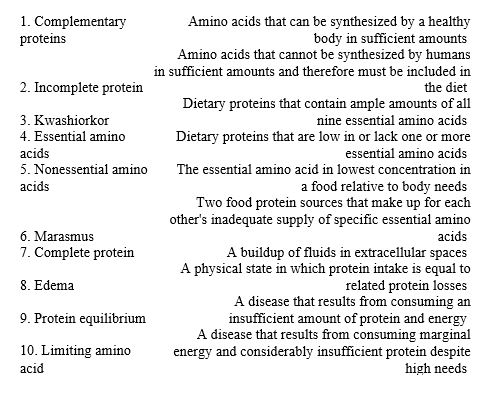
Question
Question

Unlock Deck
Sign up to unlock the cards in this deck!
Unlock Deck
Unlock Deck
1/80

Play

Full screen (f)
Deck 6: Proteins
1
Which of the following is true about protein?
A) It is unique in that it is the only dietary component that contains selenium.
B) It is important primarily for increasing bone density.
C) It is made up of combinations of approximately 20 amino acids.
D) It is made up of combinations of amino acids and fatty acids.
A) It is unique in that it is the only dietary component that contains selenium.
B) It is important primarily for increasing bone density.
C) It is made up of combinations of approximately 20 amino acids.
D) It is made up of combinations of amino acids and fatty acids.
C
2
The nitrogen from amino acid breakdown is
A) stored in the liver.
B) oxidized to carbohydrate.
C) converted to urea.
D) converted to fat.
A) stored in the liver.
B) oxidized to carbohydrate.
C) converted to urea.
D) converted to fat.
C
3
How many grams of protein are needed per day by a male non-athlete, weighing 87 kilograms?
A) 70
B) 87
C) 174
D) 191
A) 70
B) 87
C) 174
D) 191
A
4
Insulin is one example of a protein that acts as ________________.
A) an antioxidant
B) an enzyme
C) a hormone
D) an antibody
A) an antioxidant
B) an enzyme
C) a hormone
D) an antibody
Unlock Deck
Unlock for access to all 80 flashcards in this deck.
Unlock Deck
k this deck
5
_______________ does not eat any animal foods and consumes only plant products.
A) A fruitarian
B) An omnivore
C) A lacto-ovo vegetarian
D) A vegan
A) A fruitarian
B) An omnivore
C) A lacto-ovo vegetarian
D) A vegan
Unlock Deck
Unlock for access to all 80 flashcards in this deck.
Unlock Deck
k this deck
6
Three dietary advantages of plant protein sources over animal sources are: 1) they are a good source of dietary fiber, 2) they are low in saturated fat, and 3) they contain no _______________.
A) cellulose
B) collagen
C) cholesterol
D) caffeine
A) cellulose
B) collagen
C) cholesterol
D) caffeine
Unlock Deck
Unlock for access to all 80 flashcards in this deck.
Unlock Deck
k this deck
7
Which of the following is a food that provides all of the essential amino acids?
A) Wheat
B) Peanut butter
C) Navy beans
D) Milk
A) Wheat
B) Peanut butter
C) Navy beans
D) Milk
Unlock Deck
Unlock for access to all 80 flashcards in this deck.
Unlock Deck
k this deck
8
The best estimate for the amount of protein required for nearly all adults is _______________ g/kg/day.
A) 0.5
B) 0.8
C) 1.6
D) 2.0
A) 0.5
B) 0.8
C) 1.6
D) 2.0
Unlock Deck
Unlock for access to all 80 flashcards in this deck.
Unlock Deck
k this deck
9
In proteins, amino acids are joined by _______________ bonds.
A) amino
B) peptide
C) proteolytic
D) nitrogen
A) amino
B) peptide
C) proteolytic
D) nitrogen
Unlock Deck
Unlock for access to all 80 flashcards in this deck.
Unlock Deck
k this deck
10
Amino acids are transported via the _______________ vein to the liver.
A) hepatic
B) renal
C) intestinal
D) portal
A) hepatic
B) renal
C) intestinal
D) portal
Unlock Deck
Unlock for access to all 80 flashcards in this deck.
Unlock Deck
k this deck
11
An illness that results from a malfunction of the red blood cell because of an incorrect structure in parts of the hemoglobin protein chain is called _______________.
A) marasmus
B) kwashiorkor
C) sickle cell anemia
D) megaloblastic anemia
A) marasmus
B) kwashiorkor
C) sickle cell anemia
D) megaloblastic anemia
Unlock Deck
Unlock for access to all 80 flashcards in this deck.
Unlock Deck
k this deck
12
The basic building block of a protein is called a(n)
A) fatty acid.
B) monosaccharide.
C) amino acid.
D) keto acid.
A) fatty acid.
B) monosaccharide.
C) amino acid.
D) keto acid.
Unlock Deck
Unlock for access to all 80 flashcards in this deck.
Unlock Deck
k this deck
13
All of the following are true of high-quality protein except
A) it contains all essential amino acids.
B) it provides 7 kcal/g of energy.
C) it can support body maintenance.
D) it can support body growth.
A) it contains all essential amino acids.
B) it provides 7 kcal/g of energy.
C) it can support body maintenance.
D) it can support body growth.
Unlock Deck
Unlock for access to all 80 flashcards in this deck.
Unlock Deck
k this deck
14
The chemical element found in all amino acids but not found in either carbohydrates or fats is
A) carbon.
B) nitrogen.
C) oxygen.
D) hydrogen.
A) carbon.
B) nitrogen.
C) oxygen.
D) hydrogen.
Unlock Deck
Unlock for access to all 80 flashcards in this deck.
Unlock Deck
k this deck
15
Which of the following is not true about an incomplete protein source?
A) It lacks one or more essential amino acids.
B) It cannot support body growth and maintenance by itself.
C) To adequately meet protein needs from incomplete protein sources, a person would have to eat two complementary proteins.
D) Lower quantities of this source could be eaten to get adequate quantities of essential amino acids.
A) It lacks one or more essential amino acids.
B) It cannot support body growth and maintenance by itself.
C) To adequately meet protein needs from incomplete protein sources, a person would have to eat two complementary proteins.
D) Lower quantities of this source could be eaten to get adequate quantities of essential amino acids.
Unlock Deck
Unlock for access to all 80 flashcards in this deck.
Unlock Deck
k this deck
16
An essential amino acid
A) can be synthesized in the body if there is a nitrogen source.
B) can be synthesized in the body if caloric intake is adequate.
C) cannot be synthesized in the body in sufficient quantity to meet body needs.
D) can be formed in the body from semiessential amino acids.
A) can be synthesized in the body if there is a nitrogen source.
B) can be synthesized in the body if caloric intake is adequate.
C) cannot be synthesized in the body in sufficient quantity to meet body needs.
D) can be formed in the body from semiessential amino acids.
Unlock Deck
Unlock for access to all 80 flashcards in this deck.
Unlock Deck
k this deck
17
Short chain proteins and _______________ are the end products of protein digestion that can be taken up by the absorptive cells of the small intestine.
A) amino acids
B) nitrogen
C) polypeptides
D) amino groups
A) amino acids
B) nitrogen
C) polypeptides
D) amino groups
Unlock Deck
Unlock for access to all 80 flashcards in this deck.
Unlock Deck
k this deck
18
_______________ is a type of malnutrition that results primarily from not consuming enough calories.
A) Kwashiorkor
B) Marasmus
C) Anorexia
D) Starvation
A) Kwashiorkor
B) Marasmus
C) Anorexia
D) Starvation
Unlock Deck
Unlock for access to all 80 flashcards in this deck.
Unlock Deck
k this deck
19
Treating a protein with acid, heat, or agitation will cause _______________, meaning that the three-dimensional structure of the protein has been altered.
A) alteration
B) breakdown
C) destruction
D) denaturation
A) alteration
B) breakdown
C) destruction
D) denaturation
Unlock Deck
Unlock for access to all 80 flashcards in this deck.
Unlock Deck
k this deck
20
Plant proteins do not match our needs for essential amino acids and therefore are called _______________ proteins.
A) nonessential
B) uncomplemetary
C) incomplete
D) branched-chain
A) nonessential
B) uncomplemetary
C) incomplete
D) branched-chain
Unlock Deck
Unlock for access to all 80 flashcards in this deck.
Unlock Deck
k this deck
21
Food proteins are used most efficiently when we
A) are eating a very low kilocalorie diet.
B) eat large quantities of protein even though our kilocalorie intake may be low.
C) are consuming enough carbohydrates and fats to meet our kilocalorie needs.
D) are eating enough fat even though carbohydrate intake may be low.
A) are eating a very low kilocalorie diet.
B) eat large quantities of protein even though our kilocalorie intake may be low.
C) are consuming enough carbohydrates and fats to meet our kilocalorie needs.
D) are eating enough fat even though carbohydrate intake may be low.
Unlock Deck
Unlock for access to all 80 flashcards in this deck.
Unlock Deck
k this deck
22
Approximately how many different amino acids are used in the synthesis of body proteins?
A) 5
B) 9
C) 20
D) 29
A) 5
B) 9
C) 20
D) 29
Unlock Deck
Unlock for access to all 80 flashcards in this deck.
Unlock Deck
k this deck
23
What is meant by the amino acid sequence of a protein?
A) Number of side chains in the protein
B) Folding arrangement of the peptide chain
C) Order of appearance of amino acids in the peptide chain
D) Order of appearance of only the essential amino acids in the protein
A) Number of side chains in the protein
B) Folding arrangement of the peptide chain
C) Order of appearance of amino acids in the peptide chain
D) Order of appearance of only the essential amino acids in the protein
Unlock Deck
Unlock for access to all 80 flashcards in this deck.
Unlock Deck
k this deck
24
Wilma is an alcoholic. Her liver has been damaged to such a degree that it cannot produce the appropriate blood proteins for fluid balance. She develops a condition called edema, which is
A) extreme thirst.
B) the build up of fluids in extracellular spaces.
C) loss of muscle mass.
D) cardiovascular disease.
A) extreme thirst.
B) the build up of fluids in extracellular spaces.
C) loss of muscle mass.
D) cardiovascular disease.
Unlock Deck
Unlock for access to all 80 flashcards in this deck.
Unlock Deck
k this deck
25
If a food does not contain the necessary amounts of a certain amino acid to meet a body need, that amino acid is referred to as a(n)
A) complementary amino acid.
B) essential amino acid.
C) limiting amino acid.
D) dispensable amino acid.
A) complementary amino acid.
B) essential amino acid.
C) limiting amino acid.
D) dispensable amino acid.
Unlock Deck
Unlock for access to all 80 flashcards in this deck.
Unlock Deck
k this deck
26
Which of the following is not true about body proteins?
A) They are in a state of breakdown, rebuilding, and repair.
B) They are static and change little after achievement of adult status.
C) Those in the bone marrow and intestine undergo the most change, in terms of breakdown and synthesis.
D) Their breakdown products, especially amino acids, can be recycled.
A) They are in a state of breakdown, rebuilding, and repair.
B) They are static and change little after achievement of adult status.
C) Those in the bone marrow and intestine undergo the most change, in terms of breakdown and synthesis.
D) Their breakdown products, especially amino acids, can be recycled.
Unlock Deck
Unlock for access to all 80 flashcards in this deck.
Unlock Deck
k this deck
27
Which of the following is not true about the events during and after absorption of the products of protein digestion?
A) Most protein eaten ends up as individual amino acids in the blood.
B) Small peptides are digested further to amino acids inside the absorptive cells of the small intestine.
C) Many whole proteins are absorbed and enter the blood.
D) Amino acids travel to the liver via the portal vein.
A) Most protein eaten ends up as individual amino acids in the blood.
B) Small peptides are digested further to amino acids inside the absorptive cells of the small intestine.
C) Many whole proteins are absorbed and enter the blood.
D) Amino acids travel to the liver via the portal vein.
Unlock Deck
Unlock for access to all 80 flashcards in this deck.
Unlock Deck
k this deck
28
When protein consumption is in excess of body needs and energy needs are met, the excess amino acids are metabolized and the energy in the molecule is
A) stored as fat.
B) excreted in the urine.
C) stored as amino acids in muscle.
D) stored as amino acids in the liver.
A) stored as fat.
B) excreted in the urine.
C) stored as amino acids in muscle.
D) stored as amino acids in the liver.
Unlock Deck
Unlock for access to all 80 flashcards in this deck.
Unlock Deck
k this deck
29
Johnny is 10 years old. He has had minimal protein intake for the last two years. He has just recently had surgery. What are the likely results of his deficient protein intake?
A) His surgical wound will heal quickly and effectively, but he won't grow effectively.
B) His surgical wound will not heal quickly and effectively, but he will grow effectively.
C) The size of his vital organs, including his heart, liver, and muscles, will decrease.
D) His surgical wound will heal effectively and he will grow normally because he can live off fat stores.
A) His surgical wound will heal quickly and effectively, but he won't grow effectively.
B) His surgical wound will not heal quickly and effectively, but he will grow effectively.
C) The size of his vital organs, including his heart, liver, and muscles, will decrease.
D) His surgical wound will heal effectively and he will grow normally because he can live off fat stores.
Unlock Deck
Unlock for access to all 80 flashcards in this deck.
Unlock Deck
k this deck
30
All of the following are true of the alteration of the three-dimensional structure of a protein except
A) it tends to be rigid and retains its structure.
B) it can be caused by heat, acid, or base.
C) it is called denaturation.
D) it usually destroys its physiological function.
A) it tends to be rigid and retains its structure.
B) it can be caused by heat, acid, or base.
C) it is called denaturation.
D) it usually destroys its physiological function.
Unlock Deck
Unlock for access to all 80 flashcards in this deck.
Unlock Deck
k this deck
31
If the diet is lacking an essential amino acid, what will be the course of action?
A) Body cells will synthesize it.
B) Protein synthesis will be limited.
C) Health will not be affected as long as other nutrients are adequate.
D) Proteins will be made but they will lack that particular amino acid.
A) Body cells will synthesize it.
B) Protein synthesis will be limited.
C) Health will not be affected as long as other nutrients are adequate.
D) Proteins will be made but they will lack that particular amino acid.
Unlock Deck
Unlock for access to all 80 flashcards in this deck.
Unlock Deck
k this deck
32
If the carbohydrate content of the diet is insufficient to meet the body's needs for glucose, which of the following can be converted to glucose?
A) Urea
B) Fatty acids
C) Amino acids
D) Ketones
A) Urea
B) Fatty acids
C) Amino acids
D) Ketones
Unlock Deck
Unlock for access to all 80 flashcards in this deck.
Unlock Deck
k this deck
33
Proteins are digested in which areas of the body?
A) Mouth and stomach
B) Mouth and small intestine
C) Stomach and small intestine
D) Small and large intestines
A) Mouth and stomach
B) Mouth and small intestine
C) Stomach and small intestine
D) Small and large intestines
Unlock Deck
Unlock for access to all 80 flashcards in this deck.
Unlock Deck
k this deck
34
A hereditary condition caused by an incorrect amino acid in the amino acid sequence of a protein chain is
A) kwashiorkor.
B) sickle cell anemia.
C) marasmus.
D) edema.
A) kwashiorkor.
B) sickle cell anemia.
C) marasmus.
D) edema.
Unlock Deck
Unlock for access to all 80 flashcards in this deck.
Unlock Deck
k this deck
35
In the case of sickle cell anemia, the slight alterations in the DNA of red blood cells lead to
A) defects in the membranes of these cells.
B) changes in the structure of the protein hemoglobin.
C) poor use of glucose for energy.
D) inability of the cells to make protein.
A) defects in the membranes of these cells.
B) changes in the structure of the protein hemoglobin.
C) poor use of glucose for energy.
D) inability of the cells to make protein.
Unlock Deck
Unlock for access to all 80 flashcards in this deck.
Unlock Deck
k this deck
36
All of the following are functions of protein except to
A) repair tissues.
B) support growth of new tissue.
C) supply more than 40 percent of the kilocalories in the diet.
D) synthesize hormones and enzymes.
A) repair tissues.
B) support growth of new tissue.
C) supply more than 40 percent of the kilocalories in the diet.
D) synthesize hormones and enzymes.
Unlock Deck
Unlock for access to all 80 flashcards in this deck.
Unlock Deck
k this deck
37
Cooking an egg alters its appearance due to
A) denaturation.
B) emulsification.
C) esterification.
D) detoxification.
A) denaturation.
B) emulsification.
C) esterification.
D) detoxification.
Unlock Deck
Unlock for access to all 80 flashcards in this deck.
Unlock Deck
k this deck
38
The chemical bond joining adjacent amino acids is called a(n) _____________ bond.
A) glycosidic
B) ionic
C) amino
D) peptide
A) glycosidic
B) ionic
C) amino
D) peptide
Unlock Deck
Unlock for access to all 80 flashcards in this deck.
Unlock Deck
k this deck
39
What enzyme is released by the stomach to digest protein?
A) Pepsin
B) Lipase
C) Amylase
D) Trypsin
A) Pepsin
B) Lipase
C) Amylase
D) Trypsin
Unlock Deck
Unlock for access to all 80 flashcards in this deck.
Unlock Deck
k this deck
40
Which of the following is not true about pepsin?
A) Amino acid chains are the digestive products of its action.
B) Pepsin works best in an alkaline environment.
C) Acid activates pepsin.
D) Pepsin acts on food in the stomach.
A) Amino acid chains are the digestive products of its action.
B) Pepsin works best in an alkaline environment.
C) Acid activates pepsin.
D) Pepsin acts on food in the stomach.
Unlock Deck
Unlock for access to all 80 flashcards in this deck.
Unlock Deck
k this deck
41
All of the following describe the fate of excess protein except
A) used for energy.
B) made into glucose.
C) made into fat.
D) stored as muscle protein.
A) used for energy.
B) made into glucose.
C) made into fat.
D) stored as muscle protein.
Unlock Deck
Unlock for access to all 80 flashcards in this deck.
Unlock Deck
k this deck
42
When there is a need for increased dietary protein during pregnancy or lactation, which foodstuff would be least desirable?
A) Eggs
B) Dried beans
C) Gelatin
D) Beef
A) Eggs
B) Dried beans
C) Gelatin
D) Beef
Unlock Deck
Unlock for access to all 80 flashcards in this deck.
Unlock Deck
k this deck
43
Proteins regulate the acid-base balance of the blood by
A) acting as buffers.
B) releasing nitrogen.
C) synthesizing hydrochloric acid.
D) binding sodium ions.
A) acting as buffers.
B) releasing nitrogen.
C) synthesizing hydrochloric acid.
D) binding sodium ions.
Unlock Deck
Unlock for access to all 80 flashcards in this deck.
Unlock Deck
k this deck
44
Jack weighs 176 pounds (80 kilograms). What would be his RDA for protein?
A) 10 grams
B) 64 grams
C) 80 grams
D) 27 grams
A) 10 grams
B) 64 grams
C) 80 grams
D) 27 grams
Unlock Deck
Unlock for access to all 80 flashcards in this deck.
Unlock Deck
k this deck
45
Which of the following is true about protein intake in the United States?
A) Plant sources of protein predominate in the United States.
B) We eat less animal sources of protein than people in Asia and Africa.
C) About 70 percent of the protein we eat in the United States comes from animal products.
D) Chicken is our main animal source of protein.
A) Plant sources of protein predominate in the United States.
B) We eat less animal sources of protein than people in Asia and Africa.
C) About 70 percent of the protein we eat in the United States comes from animal products.
D) Chicken is our main animal source of protein.
Unlock Deck
Unlock for access to all 80 flashcards in this deck.
Unlock Deck
k this deck
46
A protein that acts as a hormone is
A) insulin.
B) trypsin.
C) pepsin.
D) hemoglobin.
A) insulin.
B) trypsin.
C) pepsin.
D) hemoglobin.
Unlock Deck
Unlock for access to all 80 flashcards in this deck.
Unlock Deck
k this deck
47
Edema appears when there is a severe lack of dietary protein because
A) sodium is retained in the body.
B) blood protein levels fall and fluid shifts to the tissues.
C) blood protein levels increase and force fluid into the tissues.
D) increased protein synthesis occurs in tissues causing fluid to flow into them from the blood.
A) sodium is retained in the body.
B) blood protein levels fall and fluid shifts to the tissues.
C) blood protein levels increase and force fluid into the tissues.
D) increased protein synthesis occurs in tissues causing fluid to flow into them from the blood.
Unlock Deck
Unlock for access to all 80 flashcards in this deck.
Unlock Deck
k this deck
48
Antibodies are
A) hormones.
B) enzymes.
C) lipoproteins.
D) proteins.
A) hormones.
B) enzymes.
C) lipoproteins.
D) proteins.
Unlock Deck
Unlock for access to all 80 flashcards in this deck.
Unlock Deck
k this deck
49
If a person does not eat enough carbohydrate to supply the glucose the body needs, which of the following will happen?
A) Fatty acids will be converted to glucose.
B) The pancreas will convert insulin to glucose.
C) The liver will convert amino acids to glucose.
D) The pancreas will convert protein to glucose.
A) Fatty acids will be converted to glucose.
B) The pancreas will convert insulin to glucose.
C) The liver will convert amino acids to glucose.
D) The pancreas will convert protein to glucose.
Unlock Deck
Unlock for access to all 80 flashcards in this deck.
Unlock Deck
k this deck
50
Donovan has been consuming large quantities of food and in violation of safe rules of athletic training is injecting testosterone. He has been seeing large temporary gains in muscle mass. He is in a state of
A) negative protein balance.
B) positive protein balance.
C) energy equilibrium.
D) excess protein balance.
A) negative protein balance.
B) positive protein balance.
C) energy equilibrium.
D) excess protein balance.
Unlock Deck
Unlock for access to all 80 flashcards in this deck.
Unlock Deck
k this deck
51
The typical American diet supplies approximately what percentage of protein as essential amino acids?
A) 10%
B) 25%
C) 40%
D) 50%
A) 10%
B) 25%
C) 40%
D) 50%
Unlock Deck
Unlock for access to all 80 flashcards in this deck.
Unlock Deck
k this deck
52
Which of the following is true about protein intake of people in the United States?
A) Most do not consume enough protein.
B) Most consume approximately the amount needed to balance losses.
C) Athletes generally do not get enough protein without supplements.
D) Most consume more than is needed.
A) Most do not consume enough protein.
B) Most consume approximately the amount needed to balance losses.
C) Athletes generally do not get enough protein without supplements.
D) Most consume more than is needed.
Unlock Deck
Unlock for access to all 80 flashcards in this deck.
Unlock Deck
k this deck
53
Maggie has anorexia nervosa and regularly starves herself. She is likely to be in a state of
A) protein equilibrium.
B) positive protein balance.
C) negative protein balance.
D) positive energy balance.
A) protein equilibrium.
B) positive protein balance.
C) negative protein balance.
D) positive energy balance.
Unlock Deck
Unlock for access to all 80 flashcards in this deck.
Unlock Deck
k this deck
54
The RDA for protein translates into approximately what percentage of total daily kilocalorie needs?
A) 5%
B) 10%
C) 15%
D) 20%
A) 5%
B) 10%
C) 15%
D) 20%
Unlock Deck
Unlock for access to all 80 flashcards in this deck.
Unlock Deck
k this deck
55
High protein diets may be harmful for
A) those with kidney disease.
B) athletes.
C) the elderly.
D) body builders.
A) those with kidney disease.
B) athletes.
C) the elderly.
D) body builders.
Unlock Deck
Unlock for access to all 80 flashcards in this deck.
Unlock Deck
k this deck
56
One would be likely to see positive protein balance in all of the following conditions except
A) growth.
B) pregnancy.
C) starvation.
D) recovery from surgery.
A) growth.
B) pregnancy.
C) starvation.
D) recovery from surgery.
Unlock Deck
Unlock for access to all 80 flashcards in this deck.
Unlock Deck
k this deck
57
When comparing plant sources of protein to animal sources, we could say
A) plant sources tend to be higher in saturated fat.
B) plant sources tend to be higher in cholesterol.
C) animal sources tend to be higher in phytochemicals.
D) plant sources tend to be higher in dietary fiber.
A) plant sources tend to be higher in saturated fat.
B) plant sources tend to be higher in cholesterol.
C) animal sources tend to be higher in phytochemicals.
D) plant sources tend to be higher in dietary fiber.
Unlock Deck
Unlock for access to all 80 flashcards in this deck.
Unlock Deck
k this deck
58
Currently, the best estimate for the amount of protein required for nearly all adults is _____ grams per kilogram of body weight per day.
A) 2
B) 0.6
C) 0.8
D) 1.5
A) 2
B) 0.6
C) 0.8
D) 1.5
Unlock Deck
Unlock for access to all 80 flashcards in this deck.
Unlock Deck
k this deck
59
All of the following are essential amino acids except
A) alanine.
B) lysine.
C) methionine.
D) threonine.
A) alanine.
B) lysine.
C) methionine.
D) threonine.
Unlock Deck
Unlock for access to all 80 flashcards in this deck.
Unlock Deck
k this deck
60
Proteins that bind to foreign proteins in the body are
A) enzymes.
B) antibodies.
C) hormones.
D) collagen.
A) enzymes.
B) antibodies.
C) hormones.
D) collagen.
Unlock Deck
Unlock for access to all 80 flashcards in this deck.
Unlock Deck
k this deck
61
The edema in children with kwashiorkor is the result of fluid leaking into
A) body tissues from the bloodstream because of decreased blood protein levels.
B) body tissues from the bloodstream because of decreased energy levels.
C) the bloodstream from body tissues because of decreased cellular proteins.
D) the bloodstream from body tissues because of decreased energy.
A) body tissues from the bloodstream because of decreased blood protein levels.
B) body tissues from the bloodstream because of decreased energy levels.
C) the bloodstream from body tissues because of decreased cellular proteins.
D) the bloodstream from body tissues because of decreased energy.
Unlock Deck
Unlock for access to all 80 flashcards in this deck.
Unlock Deck
k this deck
62
The combination of plant foods that most often is used to provide complete protein is
A) legumes and nuts.
B) legumes and grains.
C) vegetables and nuts.
D) vegetables and seeds.
A) legumes and nuts.
B) legumes and grains.
C) vegetables and nuts.
D) vegetables and seeds.
Unlock Deck
Unlock for access to all 80 flashcards in this deck.
Unlock Deck
k this deck
63
All of the following describe kwashiorkor and marasmus except
A) forms of protein-energy malnutrition.
B) common in developing nations.
C) created by political, economic, geographic, social, and dietary factors.
D) diseases that are troublesome but not life threatening.
A) forms of protein-energy malnutrition.
B) common in developing nations.
C) created by political, economic, geographic, social, and dietary factors.
D) diseases that are troublesome but not life threatening.
Unlock Deck
Unlock for access to all 80 flashcards in this deck.
Unlock Deck
k this deck
64
Many legumes are deficient in the essential amino-acid ________________ , while grains are limited in _________________.
Rev: 01_20_2015_QC_CS-3591
A) methionine; lysine
B) alanine; tyrosine
C) lysine; alanine
D) arginine; phenylalanine
Rev: 01_20_2015_QC_CS-3591
A) methionine; lysine
B) alanine; tyrosine
C) lysine; alanine
D) arginine; phenylalanine
Unlock Deck
Unlock for access to all 80 flashcards in this deck.
Unlock Deck
k this deck
65
The child with marasmus has all of the following conditions except
A) skin-and-bones appearance.
B) often less than age 2.
C) can suffer impaired brain growth and development.
D) edema in the abdomen and legs.
A) skin-and-bones appearance.
B) often less than age 2.
C) can suffer impaired brain growth and development.
D) edema in the abdomen and legs.
Unlock Deck
Unlock for access to all 80 flashcards in this deck.
Unlock Deck
k this deck
66
Most proteins are ________________________ (joining of 10 or more amino acids), ranging from about 50 to 2000 amino acids.
A) dipeptides
B) tripeptides
C) proteases
D) polypeptides
A) dipeptides
B) tripeptides
C) proteases
D) polypeptides
Unlock Deck
Unlock for access to all 80 flashcards in this deck.
Unlock Deck
k this deck
67
It takes approximately _____ kg kilograms of grain to produce ____ kg kilogram of animal protein in cereal-fed animals.
A) 2; 1
B) 3; 1
C) 5; 1
D) 10; 1
A) 2; 1
B) 3; 1
C) 5; 1
D) 10; 1
Unlock Deck
Unlock for access to all 80 flashcards in this deck.
Unlock Deck
k this deck
68
An association between ____________ consumption and total mortality, as well as premature mortality caused by cardiovascular disease and cancer, has been found in men and women.
A) turkey
B) tuna
C) chicken
D) red meat
A) turkey
B) tuna
C) chicken
D) red meat
Unlock Deck
Unlock for access to all 80 flashcards in this deck.
Unlock Deck
k this deck
69
Kwashiorkor usually is associated with a deficiency of
A) carbohydrates.
B) fat.
C) protein.
D) kilocalories.
A) carbohydrates.
B) fat.
C) protein.
D) kilocalories.
Unlock Deck
Unlock for access to all 80 flashcards in this deck.
Unlock Deck
k this deck
70
Marasmus usually is associated with a deficiency of
A) kilocalories.
B) protein.
C) carbohydrate.
D) fat.
A) kilocalories.
B) protein.
C) carbohydrate.
D) fat.
Unlock Deck
Unlock for access to all 80 flashcards in this deck.
Unlock Deck
k this deck
71
The American Institute for Cancer Research promotes "The New American Plate," which includes plant-based foods covering __________________ of the plate and meat, fish, poultry, or low-fat dairy covering __________________ of the plate.
A) one-half; one-half
B) three-quarters (or more); one-quarter (or less)
C) two-thirds (or more); one-third (or less)
D) one-third (or less); two-thirds (or more)
A) one-half; one-half
B) three-quarters (or more); one-quarter (or less)
C) two-thirds (or more); one-third (or less)
D) one-third (or less); two-thirds (or more)
Unlock Deck
Unlock for access to all 80 flashcards in this deck.
Unlock Deck
k this deck
72
A vegetarian who excludes animal flesh but consumes such products as milk and eggs is referred to as a(n)
A) lactovegetarian.
B) lactoovovegetarian.
C) vegan.
D) ovovegetarian.
A) lactovegetarian.
B) lactoovovegetarian.
C) vegan.
D) ovovegetarian.
Unlock Deck
Unlock for access to all 80 flashcards in this deck.
Unlock Deck
k this deck
73
A vegetarian who eats only plant foods is a(n)
A) lactoovovegetarian.
B) lactovegetarian.
C) vegan.
D) ovovegetarian.
A) lactoovovegetarian.
B) lactovegetarian.
C) vegan.
D) ovovegetarian.
Unlock Deck
Unlock for access to all 80 flashcards in this deck.
Unlock Deck
k this deck
74
Kwashiorkor appears in children between the ages of 2 and 5 years. The reason is that
A) growth needs are low.
B) children have been weaned from breast milk to starchy gruels.
C) by this time, adequate exposure to other children allows them to catch it.
D) protein intake has been high for a long enough time to cause kidney damage.
A) growth needs are low.
B) children have been weaned from breast milk to starchy gruels.
C) by this time, adequate exposure to other children allows them to catch it.
D) protein intake has been high for a long enough time to cause kidney damage.
Unlock Deck
Unlock for access to all 80 flashcards in this deck.
Unlock Deck
k this deck
75
Because the ____________________________ diet is recognized as being low in meat, rich in fresh fruit and vegetables, low in added sugar and saturated fatty acids, it has been recommended as a sustainable alternative to the MyPlate dietary pattern.
A) Canadian
B) Mediterranean
C) Asian
D) European
A) Canadian
B) Mediterranean
C) Asian
D) European
Unlock Deck
Unlock for access to all 80 flashcards in this deck.
Unlock Deck
k this deck
76
The child with kwashiorkor has all the following conditions except
A) moderate weight deficit.
B) some visible fat stores.
C) edema in the abdomen and legs.
D) a skin-and-bones appearance.
A) moderate weight deficit.
B) some visible fat stores.
C) edema in the abdomen and legs.
D) a skin-and-bones appearance.
Unlock Deck
Unlock for access to all 80 flashcards in this deck.
Unlock Deck
k this deck
77
Because the DNA cannot leave the nucleus to get to the ribosomes, the genes for proteins must be transcribed into ______________ that can leave the nucleus.
A) amino acids
B) chromosomes
C) mRNA
D) tRNA
A) amino acids
B) chromosomes
C) mRNA
D) tRNA
Unlock Deck
Unlock for access to all 80 flashcards in this deck.
Unlock Deck
k this deck
78
Match the following with the descriptions below
Unlock Deck
Unlock for access to all 80 flashcards in this deck.
Unlock Deck
k this deck
79
The most reliable source of vitamin B12 for the vegan would be
A) fortified soybean milk.
B) milk.
C) cheese.
D) eggs.
A) fortified soybean milk.
B) milk.
C) cheese.
D) eggs.
Unlock Deck
Unlock for access to all 80 flashcards in this deck.
Unlock Deck
k this deck
80
If Betty wants to eat the most nutrient-dense source of protein, she would eat
A) whole milk
B) beef.
C) tuna.
D) egg yolks.
A) whole milk
B) beef.
C) tuna.
D) egg yolks.
Unlock Deck
Unlock for access to all 80 flashcards in this deck.
Unlock Deck
k this deck
Unlock Deck
Unlock for access to all 80 flashcards in this deck.







