





 Chat with AI


Contemporary Engineering Economics 6th Edition by Chan Park
Edition 6ISBN: 978-0134105598Contemporary Engineering Economics 6th Edition by Chan Park
Edition 6ISBN: 978-0134105598 Exercise 20
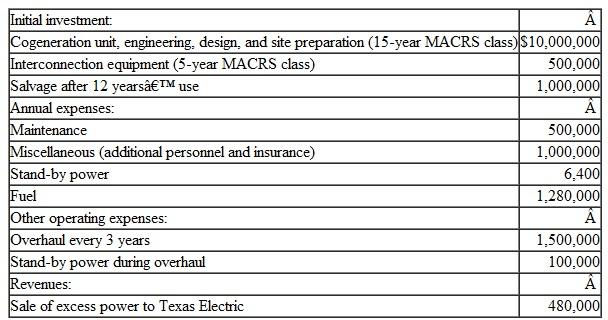
After ACC management decided to raise the $10.5 million by selling bonds (Problem), the company's engineers estimated the operating costs of the cogeneration project. The annual cash flow is composed of many factors: maintenance, standby power, overhaul costs, and miscellaneous expenses. Maintenance costs are projected to be approximately $500,000 per year. The unit must be overhauled every three years at a cost of $1.5 million. Miscellaneous expenses, such as the cost of additional personnel and insurance, are expected to total $1 million. Another annual expense is that for stand-by power, which is a service provided by the utility in the event of a cogeneration unit trip or scheduled maintenance outage. Unscheduled outages are expected to occur four times annually with each averaging two hours in duration at an annual expense of $6,400. Overhauling the unit takes approximately 100 hours and occurs every three years, requiring another power cost of $ 100,000. Fuel (spot gas) will be consumed at a rate of $8,000 BTU per kWh, including the heat recovery cycle. At $2.00 per million BTU, the annual fuel cost will reach $1,280,000. Due to obsolescence, the expected life of the cogeneration project will be 12 years, after which Allison will pay ACC $1 million for the salvage of all equipment.
Revenue will be incurred from the sale of excess electricity to the utility company at a negotiated rate. Since the chemical plant will consume (on average) 85% of the unit's 10-MW output, 15% of the output will be sold at $0.04 per kWh, bringing in an annual revenue of $480,000. ACC's marginal tax rate (combined federal and state) is 36%, and the company's minimum required rate of return for any cogeneration project is 27%. The anticipated costs and revenues are summarized in Table.
(a) If the cogeneration unit and other connecting equipment could be financed by issuing corporate bonds at an interest rate of 9% compounded annually, with the flotation expenses as indicated in Problem, determine the net cash flow from the cogeneration project.
(b) If the cogeneration unit can be leased, what would be the maximum annual lease amount that ACC is willing to pay
TABLE ST 15.5
 Problem
The American Chemical Corporation (ACC) is a multinational manufacturer of industrial chemical products. ACC has made great progress in reducing energy costs and has implemented several cogeneration projects in the United States and Puerto Rico, including the completion of a 35-megawatt (MW) unit in Chicago and a 29-MW unit in Baton Rouge. The division of ACC being considered for one of its more recent cogeneration projects is a chemical plant located in Texas. The plant has a power usage of 80 million kilowatt hours (kWh) annually. However, on the average, it uses 85% of its 10-MW capacity, which would bring the average power usage to 68 million kWh annually. Texas Electric currently charges $0.09 per kWh of electric consumption for the ACC plant, a rate that is considered high throughout the industry.
Because ACC's power consumption is so large, the purchase of a cogeneration unit would be desirable. Installation of the unit would allow ACC to generate its own power and to avoid the annual $6,120,000 expense to Texas Electric. The total initial investment cost would be $10,500,000, including $10,000,000 for the purchase of the power unit itself (which is a gas-fired 10-MW Allison 571), engineering, design, and site preparation, and $500,000 for the purchase of interconnection equipment (such as poles and distribution lines) that will be used to interface the co-generator with the existing utility facilities.
ACC is considering two financing options:
• ACC could finance $2,000,000 through the manufacturer at 10% for 10 years and the remaining $8,500,000 through issuing common stock. The flotation cost for a common-stock offering is 8.1%, and the stock will be priced at $45 per share.
• Investment bankers have indicated that 10-year 9% bonds could be sold at a price of $900 for each $1,000 bond. The flotation costs would be 1.9% to raise $10.5 million.
(a) Determine the debt-repayment schedule for the term loan from the equipment manufacturer.
(b) Determine the flotation costs and the number of common stocks to sell to raise the $8,500,000.
(c) Determine the flotation costs and the number of $1,000 par value bonds to be sold to raise $10.5 million.
Revenue will be incurred from the sale of excess electricity to the utility company at a negotiated rate. Since the chemical plant will consume (on average) 85% of the unit's 10-MW output, 15% of the output will be sold at $0.04 per kWh, bringing in an annual revenue of $480,000. ACC's marginal tax rate (combined federal and state) is 36%, and the company's minimum required rate of return for any cogeneration project is 27%. The anticipated costs and revenues are summarized in Table.
(a) If the cogeneration unit and other connecting equipment could be financed by issuing corporate bonds at an interest rate of 9% compounded annually, with the flotation expenses as indicated in Problem, determine the net cash flow from the cogeneration project.
(b) If the cogeneration unit can be leased, what would be the maximum annual lease amount that ACC is willing to pay
TABLE ST 15.5
ProblemThe American Chemical Corporation (ACC) is a multinational manufacturer of industrial chemical products. ACC has made great progress in reducing energy costs and has implemented several cogeneration projects in the United States and Puerto Rico, including the completion of a 35-megawatt (MW) unit in Chicago and a 29-MW unit in Baton Rouge. The division of ACC being considered for one of its more recent cogeneration projects is a chemical plant located in Texas. The plant has a power usage of 80 million kilowatt hours (kWh) annually. However, on the average, it uses 85% of its 10-MW capacity, which would bring the average power usage to 68 million kWh annually. Texas Electric currently charges $0.09 per kWh of electric consumption for the ACC plant, a rate that is considered high throughout the industry.
Because ACC's power consumption is so large, the purchase of a cogeneration unit would be desirable. Installation of the unit would allow ACC to generate its own power and to avoid the annual $6,120,000 expense to Texas Electric. The total initial investment cost would be $10,500,000, including $10,000,000 for the purchase of the power unit itself (which is a gas-fired 10-MW Allison 571), engineering, design, and site preparation, and $500,000 for the purchase of interconnection equipment (such as poles and distribution lines) that will be used to interface the co-generator with the existing utility facilities.
ACC is considering two financing options:
• ACC could finance $2,000,000 through the manufacturer at 10% for 10 years and the remaining $8,500,000 through issuing common stock. The flotation cost for a common-stock offering is 8.1%, and the stock will be priced at $45 per share.
• Investment bankers have indicated that 10-year 9% bonds could be sold at a price of $900 for each $1,000 bond. The flotation costs would be 1.9% to raise $10.5 million.
(a) Determine the debt-repayment schedule for the term loan from the equipment manufacturer.
(b) Determine the flotation costs and the number of common stocks to sell to raise the $8,500,000.
(c) Determine the flotation costs and the number of $1,000 par value bonds to be sold to raise $10.5 million.
Explanation Verified
Verified
The fifteenth chapter that is in the tex...

Contemporary Engineering Economics 6th Edition by Chan Park

Why don’t you like this exercise?
Other Minimum 8 character and maximum 255 character
Character 255







