





 Chat with AI


The Living World 8th Edition by George Johnson
Edition 8ISBN: 978-0078024214The Living World 8th Edition by George Johnson
Edition 8ISBN: 978-0078024214 Exercise 18
Are Chytrids Killing the Frogs ?
As you learned in section 18.6 of this chapter, chytrid fungi are thought to be playing a major role in a worldwide wave of amphibian extinctions, discussed in much more detail in chapter 38 (page 809). Our awareness of the possible role of chytrids began in Queensland (the northeastern portion of australia) in 1993, when a mass die-off of frogs was reported. All different kinds of frogs seemed to be affected, and entire populations were wiped out. In the rainforests of northern Queensland, populations of the sharp-nosed torrent frog ( Taudactylus acutirostris ) were found to be so seriously affected as to be in danger of extinction. Captive colonies were set up at James Cook University and at the Melbourne and taronga zoos in an attempt to preserve the species. Unfortunately, the preservation of the species failed. Every frog in the colonies died.
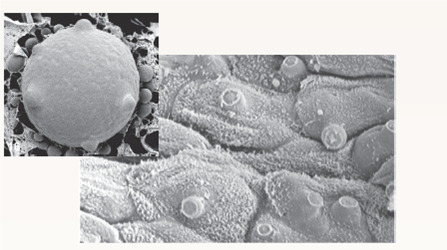
What was killing the frogs? The answer to this question came in 1998, when researchers examined the epithelium (skin) of sick frogs under the scanning electron microscope and saw what you can see in the photomicrographs to the right. Normally a relatively smooth surface, the epithelium of the dying frogs was roughened, with spherical bodies protruding from the surface.
These protrusions are zoosporangia, asexual reproductive structures of a chytrid fungus. One is shown up close ( inset ). Each zoosporangium is roughly spherical, with one or more small projecting tubes. Millions of tiny zoospores develop in each zoosporangium. When the plug blocking the tip of a tube disappears, the spores are discharged onto the surface of adjacent skin cells or into the water, where their flagella allow them to swim until they encounter another host. When one of the zoospores contacts the skin of another frog, it attaches and forms a new zoosporangium in the subsurface layer of the skin, renewing the infection cycle.
Study of the infecting chytrids revealed them to be members of the species Batrachochytrium dendrobatidis. This was unexpected. Chytrids are typically found in water and moist soil, and although there are several types known to infect plants and insects, no chytrid had ever been known to infect a vertebrate.
These initial scanning electron micrograph results seemed to make a pretty convincing case that chytrids had caused the mass die-off of frogs in Queensland. However, in order to provide more direct evidence, a series of experiments was carried out in which the ability of the chytrid fungus to kill frogs was directly assessed.
In one such experiment, typical of many, some frogs of the genus Dendrobates were exposed to chytrids and others were not. After three weeks, all frogs were examined for shed skin, a clinical sign of the frog-killing disease. The results are seen in the pie charts above.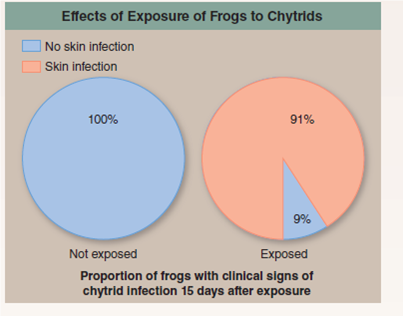
Further Analysis
a. Many kinds of frogs and salamanders are dying all over the world. Does this experiment suggest a way to determine how general is the susceptibility of amphibians to chytrid infection?
b. While a few frog die-offs have occurred in the past, none has been nearly this serious. Do you think B. dendrobatidis is a new species, or do you think environmental changes like global warming or increased UV radiation resulting from ozone depletion might be the cause? Discuss.
As you learned in section 18.6 of this chapter, chytrid fungi are thought to be playing a major role in a worldwide wave of amphibian extinctions, discussed in much more detail in chapter 38 (page 809). Our awareness of the possible role of chytrids began in Queensland (the northeastern portion of australia) in 1993, when a mass die-off of frogs was reported. All different kinds of frogs seemed to be affected, and entire populations were wiped out. In the rainforests of northern Queensland, populations of the sharp-nosed torrent frog ( Taudactylus acutirostris ) were found to be so seriously affected as to be in danger of extinction. Captive colonies were set up at James Cook University and at the Melbourne and taronga zoos in an attempt to preserve the species. Unfortunately, the preservation of the species failed. Every frog in the colonies died.
What was killing the frogs? The answer to this question came in 1998, when researchers examined the epithelium (skin) of sick frogs under the scanning electron microscope and saw what you can see in the photomicrographs to the right. Normally a relatively smooth surface, the epithelium of the dying frogs was roughened, with spherical bodies protruding from the surface.
These protrusions are zoosporangia, asexual reproductive structures of a chytrid fungus. One is shown up close ( inset ). Each zoosporangium is roughly spherical, with one or more small projecting tubes. Millions of tiny zoospores develop in each zoosporangium. When the plug blocking the tip of a tube disappears, the spores are discharged onto the surface of adjacent skin cells or into the water, where their flagella allow them to swim until they encounter another host. When one of the zoospores contacts the skin of another frog, it attaches and forms a new zoosporangium in the subsurface layer of the skin, renewing the infection cycle.
Study of the infecting chytrids revealed them to be members of the species Batrachochytrium dendrobatidis. This was unexpected. Chytrids are typically found in water and moist soil, and although there are several types known to infect plants and insects, no chytrid had ever been known to infect a vertebrate.
These initial scanning electron micrograph results seemed to make a pretty convincing case that chytrids had caused the mass die-off of frogs in Queensland. However, in order to provide more direct evidence, a series of experiments was carried out in which the ability of the chytrid fungus to kill frogs was directly assessed.
In one such experiment, typical of many, some frogs of the genus Dendrobates were exposed to chytrids and others were not. After three weeks, all frogs were examined for shed skin, a clinical sign of the frog-killing disease. The results are seen in the pie charts above.
Further Analysis
a. Many kinds of frogs and salamanders are dying all over the world. Does this experiment suggest a way to determine how general is the susceptibility of amphibians to chytrid infection?
b. While a few frog die-offs have occurred in the past, none has been nearly this serious. Do you think B. dendrobatidis is a new species, or do you think environmental changes like global warming or increased UV radiation resulting from ozone depletion might be the cause? Discuss.
Explanation Verified
Verified
In this question, we discuss the exposur...

The Living World 8th Edition by George Johnson

Why don’t you like this exercise?
Other Minimum 8 character and maximum 255 character
Character 255







