





 Chat with AI


The Living World 8th Edition by George Johnson
Edition 8ISBN: 978-0078024214The Living World 8th Edition by George Johnson
Edition 8ISBN: 978-0078024214 Exercise 12
In his experiments, Frederick Griffith found that
A) hereditary information within a cell cannot be changed.
B) hereditary information can be added to cells from other cells.
C) mice infected with live R strains die.
D) mice infected with heat-killed S strains die.
The work by Griffith provided the first evidence of transformation. Review the four experiments outlined in figure 11.1. Predict the likely outcome for the following variations on this classic research. Mice are infected with
A) heat-killed pathogenic and heat-killed nonpathogenic bacteria.
B) heat-killed pathogenic and live nonpathogenic bacteria in the presence of an enzyme that digests proteins (proteases).
C) heat-killed pathogenic and live nonpathogenic bacteria in the presence of an enzyme that digests DNA (endonuclease).
Figure 11.1 How Griffith discovered transformation.
Transformation, the movement of a gene from one organism to another, provided some of the key evidence that DNA is the genetic material. Griffith found that extracts of dead pathogenic strains of the bacterium Streptococcus pneumoniae can "transform" live harmless strains into live pathogenic strains.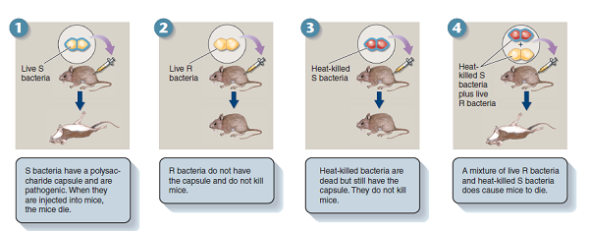
A) hereditary information within a cell cannot be changed.
B) hereditary information can be added to cells from other cells.
C) mice infected with live R strains die.
D) mice infected with heat-killed S strains die.
The work by Griffith provided the first evidence of transformation. Review the four experiments outlined in figure 11.1. Predict the likely outcome for the following variations on this classic research. Mice are infected with
A) heat-killed pathogenic and heat-killed nonpathogenic bacteria.
B) heat-killed pathogenic and live nonpathogenic bacteria in the presence of an enzyme that digests proteins (proteases).
C) heat-killed pathogenic and live nonpathogenic bacteria in the presence of an enzyme that digests DNA (endonuclease).
Figure 11.1 How Griffith discovered transformation.
Transformation, the movement of a gene from one organism to another, provided some of the key evidence that DNA is the genetic material. Griffith found that extracts of dead pathogenic strains of the bacterium Streptococcus pneumoniae can "transform" live harmless strains into live pathogenic strains.
Explanation Verified
Verified
Using Streptococcus pneumoniae bacteria,...

The Living World 8th Edition by George Johnson

Why don’t you like this exercise?
Other Minimum 8 character and maximum 255 character
Character 255







