





 Chat with AI


Inquiry into Life 15th Edition by Sylvia Mader ,Michael Windelspecht
Edition 15ISBN: 978-1259426162Inquiry into Life 15th Edition by Sylvia Mader ,Michael Windelspecht
Edition 15ISBN: 978-1259426162 Exercise 2
Japan's Nuclear Crisis
On March 11, 2011, a magnitude 8.9 earthquake struck the coast of Japan, causing the shutdown of 11 of Japan's nuclear power reactors, including reactors 1, 2, and 3 at the Fukushima Daiichi power plant. Shortly after the shutdown, the pressure within reactor 1 built up to twice that of normal levels. In an attempt to relieve pressure, steam-containing radiation was vented from the reactors. Over the next several days, the plant continued to have problems and the levels of radiation in the surrounding areas continued to rise. Shortly thereafter, Japanese officials formed a 10-kilometer (km) evacuation zone, which, over the next few days, was increased to 20 km, resulting in the relocation of close to 390,000 people.
The Fukushima disaster released a number of radioactive isotopes into the atmosphere and the surrounding ocean. These included isotopes of iodine, cesium, and xenon. Each of these isotopes are a by-product of the nuclear fission reactions that occur within a nuclear power plant. As the uranium in these plants breaks down, the uranium atoms release energy (such as gamma radiation) and particles (alpha and beta particles). This is called radioactive decay, and the loss of particles effectively transforms the original uranium atom into isotopes of another element. In many cases, the resulting isotopes are also radioactive, and then undergo additional radioactive decay.
Three of the more common isotopes released by the Fukushima disaster are listed below. These isotopes differ considerably in the types of radiation that they release, their half-lives, and their potential adverse effects on living organisms, such as humans.
Cesium-134 and Cesium-137
Perhaps the biggest concern following the Fukushima disaster was the release of radioactive cesium. Naturally, cesium (Cs) is a metal with an atomic number of 55 and an atomic mass of approximately 132.9. However, within a nuclear reactor, two isotopes of cesium ( 134 Cs and 137 Cs) are formed. Cesium 134 and Cesium 137 have half-lives of 2 years and 30 years, respectively. Both of these isotopes release both beta particles and gamma radiation as they decay. Both beta particles and gamma radiation have the ability to penetrate tissues and damage cells and their DNA. Exposure to beta particles and gamma radiation, either internally or externally, can cause burns and greatly increases the chance of cancer.
Following the Fukushima disaster, there were significant concerns of 137 Cs entering the atmosphere and the Pacific Ocean. Because of the winds at the time, most of the 137 Cs was carried back over Japan, forcing evacuations up to 35 kilometers (22 miles) inland. Large regions of this evacuation zone still remain uninhabitable due to soil contamination by 137 Cs. Small amounts of atmospheric 137 Cs were detected on the west coast of the United States, and some 137 Cs has been detected in the waters off the coast of California, but in neither case at levels that are considered hazardous to humans.
Iodine -131
Radioactive iodine, 131 I, was also released by the reactors. Iodine is a water-soluble element that has an atomic number of 53 and an atomic mass of approximately 126.9. There are several forms of iodine isotopes, with 131 I being formed mainly by nuclear fission reactions. Like 137 Cs, 131 I emits beta particles which may damage tissues. It also releases small amounts of gamma radiation.
Radioactive iodine only has a half-life of about 8 days, so its long-term effect on the environment is minimal. In our bodies, iodine is mainly used by the thyroid gland to manufacture the thyroid hormones associated with metabolic functions, including overall metabolic rate. Intense exposure to 131 I may cause thyroid problems, including thyroid cancer. Interestingly, isotopes of iodine at low doses are used by the medical profession to diagnose problems with the thyroid gland and treat some forms of thyroid cancer.
Xenon-133
Xenon (Xe) is a noble gas with an atomic number of 54 and an atomic weight of 131.2. One isotope of xenon, 133 Xe, has a half-life of only 5 days. Like 131 I and 137 Cs, 133 Xe emits beta particles which may damage tissue, but the short half-life of the isotope limits the chances of severe problems. Further reducing the risk is the fact that, as a noble gas, xenon does not react with other elements, and thus is not easily introduced into the chemical compounds within cells.
Like radioactive iodine, 133 Xe is used by the medical profession to diagnose disease. Since it is a gas, it is frequently used in the diagnosis of lung disorders. Studies are now underway to use 133 Xe as a form of treatment for certain types of lung cancer, since it easily enters the lungs and the emission of beta particles can help destroy lung cancer cells.
Figure 2A The Fukushima Power Plant. The explosion of the plant following the tsunamis released radioactive isotopes into the atmosphere and surrounding water.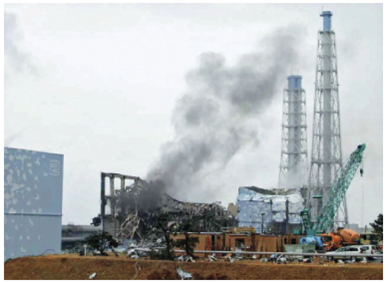
Explain why 137 Cs is more dangerous than 131 I or 133 Xe.
On March 11, 2011, a magnitude 8.9 earthquake struck the coast of Japan, causing the shutdown of 11 of Japan's nuclear power reactors, including reactors 1, 2, and 3 at the Fukushima Daiichi power plant. Shortly after the shutdown, the pressure within reactor 1 built up to twice that of normal levels. In an attempt to relieve pressure, steam-containing radiation was vented from the reactors. Over the next several days, the plant continued to have problems and the levels of radiation in the surrounding areas continued to rise. Shortly thereafter, Japanese officials formed a 10-kilometer (km) evacuation zone, which, over the next few days, was increased to 20 km, resulting in the relocation of close to 390,000 people.
The Fukushima disaster released a number of radioactive isotopes into the atmosphere and the surrounding ocean. These included isotopes of iodine, cesium, and xenon. Each of these isotopes are a by-product of the nuclear fission reactions that occur within a nuclear power plant. As the uranium in these plants breaks down, the uranium atoms release energy (such as gamma radiation) and particles (alpha and beta particles). This is called radioactive decay, and the loss of particles effectively transforms the original uranium atom into isotopes of another element. In many cases, the resulting isotopes are also radioactive, and then undergo additional radioactive decay.
Three of the more common isotopes released by the Fukushima disaster are listed below. These isotopes differ considerably in the types of radiation that they release, their half-lives, and their potential adverse effects on living organisms, such as humans.
Cesium-134 and Cesium-137
Perhaps the biggest concern following the Fukushima disaster was the release of radioactive cesium. Naturally, cesium (Cs) is a metal with an atomic number of 55 and an atomic mass of approximately 132.9. However, within a nuclear reactor, two isotopes of cesium ( 134 Cs and 137 Cs) are formed. Cesium 134 and Cesium 137 have half-lives of 2 years and 30 years, respectively. Both of these isotopes release both beta particles and gamma radiation as they decay. Both beta particles and gamma radiation have the ability to penetrate tissues and damage cells and their DNA. Exposure to beta particles and gamma radiation, either internally or externally, can cause burns and greatly increases the chance of cancer.
Following the Fukushima disaster, there were significant concerns of 137 Cs entering the atmosphere and the Pacific Ocean. Because of the winds at the time, most of the 137 Cs was carried back over Japan, forcing evacuations up to 35 kilometers (22 miles) inland. Large regions of this evacuation zone still remain uninhabitable due to soil contamination by 137 Cs. Small amounts of atmospheric 137 Cs were detected on the west coast of the United States, and some 137 Cs has been detected in the waters off the coast of California, but in neither case at levels that are considered hazardous to humans.
Iodine -131
Radioactive iodine, 131 I, was also released by the reactors. Iodine is a water-soluble element that has an atomic number of 53 and an atomic mass of approximately 126.9. There are several forms of iodine isotopes, with 131 I being formed mainly by nuclear fission reactions. Like 137 Cs, 131 I emits beta particles which may damage tissues. It also releases small amounts of gamma radiation.
Radioactive iodine only has a half-life of about 8 days, so its long-term effect on the environment is minimal. In our bodies, iodine is mainly used by the thyroid gland to manufacture the thyroid hormones associated with metabolic functions, including overall metabolic rate. Intense exposure to 131 I may cause thyroid problems, including thyroid cancer. Interestingly, isotopes of iodine at low doses are used by the medical profession to diagnose problems with the thyroid gland and treat some forms of thyroid cancer.
Xenon-133
Xenon (Xe) is a noble gas with an atomic number of 54 and an atomic weight of 131.2. One isotope of xenon, 133 Xe, has a half-life of only 5 days. Like 131 I and 137 Cs, 133 Xe emits beta particles which may damage tissue, but the short half-life of the isotope limits the chances of severe problems. Further reducing the risk is the fact that, as a noble gas, xenon does not react with other elements, and thus is not easily introduced into the chemical compounds within cells.
Like radioactive iodine, 133 Xe is used by the medical profession to diagnose disease. Since it is a gas, it is frequently used in the diagnosis of lung disorders. Studies are now underway to use 133 Xe as a form of treatment for certain types of lung cancer, since it easily enters the lungs and the emission of beta particles can help destroy lung cancer cells.
Figure 2A The Fukushima Power Plant. The explosion of the plant following the tsunamis released radioactive isotopes into the atmosphere and surrounding water.
Explain why 137 Cs is more dangerous than 131 I or 133 Xe.
Explanation Verified
Verified
137 Cs is a radioactive isotope of Cesiu...

Inquiry into Life 15th Edition by Sylvia Mader ,Michael Windelspecht

Why don’t you like this exercise?
Other Minimum 8 character and maximum 255 character
Character 255







