





 Chat with AI


Cost Management: A Strategic Emphasis 5th Edition by David Stout, Edward Blocher, Gary Cokins
Edition 5ISBN: 0073526940Cost Management: A Strategic Emphasis 5th Edition by David Stout, Edward Blocher, Gary Cokins
Edition 5ISBN: 0073526940Master Budget, Flexible Budget, and Profit-Variance Analysis Going into the period just ended, Ortiz&Co., manufacturer of a moderately priced espresso maker for retail sale, had planned to produce and sell 3,900 units at $100 per unit. Budgeted variable manufacturing costs per unit are $50. Ortiz pays its salespeople a 10 percent sales commission, which is the only variable nonmanufacturing cost for the company. Fixed costs are budgeted as follows: manufacturing, $50,000; marketing, $36,000.
Actual financial results for the period were disappointing. While sales volume was up (4,000 units sold), actual operating profit was only $20,000 for the period. Fixed manufacturing costs were as budgeted, but fixed marketing expenses exceeded budget by $4,000. Actual sales revenue for the period was $390,000, and actual variable costs were $70 per unit (the actual sales commission was 10 percent of sales revenue generated).
Required
1. Develop an Excel spreadsheet that is able to produce a profit-variance report similar to the one presented in text Exhibit 14.4.
2. Use the spreadsheet you developed in (1) and the data presented above to complete the profit-variance report for the period. Below the table you create, show separately the following variances:
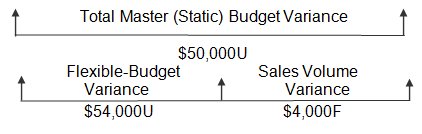
?a. Total master (static) budget variance (i.e., the total operating-income variance for the period).
?b. Total flexible-budget variance.
?c. Flexible-budget variance for total variable costs, plus the flexible-budget variance for:
??(1) variable manufacturing costs.
??(2) variable nonmanufacturing costs.
?d. Flexible-budget variance for total fixed costs, plus the flexible-budget variance for:
??(1) fixed manufacturing costs.
??(2) fixed nonmanufacturing costs.
3. Provide a concise interpretation for each of the variances calculated above in (2).
4. Using the variances you calculated above in (2), prepare in as much detail as the data allow, a separate summary report similar to text Exhibit 14.2.
 Verified
Step 1 of 3
1.
| Actual Results | Flexible-Budget Variances | Flexible Budget | Sales Volume Variance | Master (Static) Budget |
Unit sales | 4,000 | 0 | 4,000 | 100F | 3,900 |
Sales | $390,000 | $10,000U | $400,000 | $10,000F | $390,000 |
Variable Costs: |
|
|
|
|
|
Manufacturing | $241,000 | $41,000U | $200,000 | $5,000U | $195,000 |
Marketing | $39,000 | $1,000F | $40,000 | $1,000U | $39,000 |
Total Variable Costs | $280,000 | $40,000U | $240,000 | $6,000U | $234,000 |
CM | $110,000 | $50,000U | $160,000 | $4,000F | $156,000 |
Fixed Costs: |
|
|
|
|
|
Manufacturing | $50,000 | $0 | $50,000 | $0 | $50,000 |
Marketing | $40,000 | $4,000U | $36,000 | $0 | $36,000 |
Total Fixed Costs | $90,000 | $4,000U | $86,000 | $0 | $86,000 |
Operating Income | $20,000 | $54,000U | $74,000 | $4,000F | $70,000 |
Step 2 of 3
Step 3 of 3


Why don’t you like this exercise?
Other






