


expand icon
book Cost Management: A Strategic Emphasis 5th Edition by David Stout, Edward Blocher, Gary Cokins cover

Cost Management: A Strategic Emphasis 5th Edition by David Stout, Edward Blocher, Gary Cokins

Edition 5ISBN: 0073526940
book Cost Management: A Strategic Emphasis 5th Edition by David Stout, Edward Blocher, Gary Cokins cover

Cost Management: A Strategic Emphasis 5th Edition by David Stout, Edward Blocher, Gary Cokins

Edition 5ISBN: 0073526940
Exercise 14

Theory of Constraints Chemical Products Company (CPC) produces a variety of chemicals, primarily adhesives, lubricants, and polymers for industrial use by manufacturers to produce plastics and other compounds. Don Leo, the production vice president, has been informed of a disturbing trend of increasing customer complaints regarding late deliveries from the Canton, Kentucky, plant. The Canton plant is one of the firm’s newest and most modern plants and is dedicated to the manufacture of two products, Polymer 1 and Polymer 2. Don has downloaded some incomplete recent information about the Canton plant onto his laptop; he plans to analyze the information in the hour or so he has before his next meeting of the CPC executive committee. He is concerned that some comments will be made about the problems at Canton, and he wants to have an idea of how to respond. Because CPC views Polymer 1 and Polymer 2 as very promising in terms of both sales and profit potential, the news of these problems is likely to spark some comment. The data downloaded by Don is as follows:


Number of Hours Required for Each Product


Activity

Polymer 1

Polymer 2

Number of Hours Available per Week

Filtering

2

4

320

Stripping

2

3

320

Reacting

3

5

320

Final filtering

2

1

160

Mixing

3

3

320

Other information


Current sales demand (per week)

60

40


Price

$1 45

$185


Don has sketched the following flow diagram for the Canton plant. He believes it is relatively accurate because of his frequent contact with the plant.
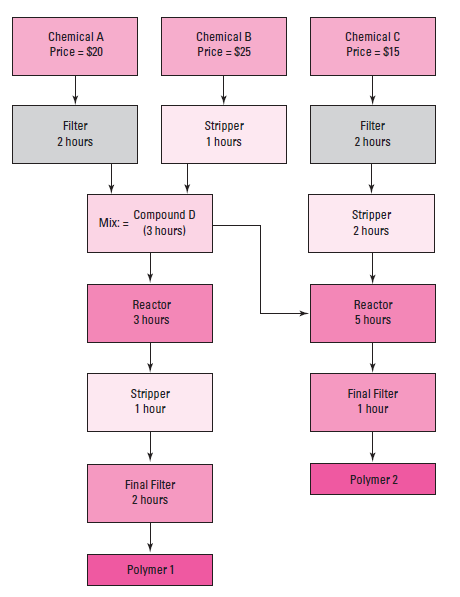
 <span class=bold><span class=bold>Theory of Constraints</span></span> Chemical Products Company (CPC) produces a variety of chemicals, primarily adhesives, lubricants, and polymers for industrial use by manufacturers to produce plastics and other compounds. Don Leo, the production vice president, has been informed of a disturbing trend of increasing customer complaints regarding late deliveries from the Canton, Kentucky, plant. The Canton plant is one of the firm’s newest and most modern plants and is dedicated to the manufacture of two products, Polymer 1 and Polymer 2. Don has downloaded some incomplete recent information about the Canton plant onto his laptop; he plans to analyze the information in the hour or so he has before his next meeting of the CPC executive committee. He is concerned that some comments will be made about the problems at Canton, and he wants to have an idea of how to respond. Because CPC views Polymer 1 and Polymer 2 as very promising in terms of both sales and profit potential, the news of these problems is likely to spark some comment. The data downloaded by Don is as follows: <table cellspacing=0 cellpadding=0 border=0>    <tbody>     <tr>      <td valign=top>   </td>      <td colspan=2 valign=top align=center><p align=center><span class=bold><span class=bold>Number of Hours Required for Each Product</span></span> </td>      <td valign=top align=center><p align=center>  </td>     </tr>     <tr>      <td valign=top align=left> <span class=bold><span class=bold>Activity</span></span> </td>      <td valign=top align=center><p align=center><span class=bold><span class=bold>Polymer 1</span></span> </td>      <td valign=top align=center><p align=center><span class=bold><span class=bold>Polymer 2</span></span> </td>      <td valign=top align=center><p align=center><span class=bold><span class=bold>Number of Hours Available per Week</span></span> </td>     </tr>     <tr>      <td valign=top align=left> Filtering </td>      <td valign=top align=right><p align=right>2 </td>      <td valign=top align=right><p align=right>4 </td>      <td valign=top align=center><p align=center>320 </td>     </tr>     <tr>      <td valign=top align=left> Stripping </td>      <td valign=top align=right><p align=right>2 </td>      <td valign=top align=right><p align=right>3 </td>      <td valign=top align=center><p align=center>320 </td>     </tr>     <tr>      <td valign=top align=left> Reacting </td>      <td valign=top align=right><p align=right>3 </td>      <td valign=top align=right><p align=right>5 </td>      <td valign=top align=center><p align=center>320 </td>     </tr>     <tr>      <td valign=top align=left> Final filtering </td>      <td valign=top align=right><p align=right>2 </td>      <td valign=top align=right><p align=right>1 </td>      <td valign=top align=center><p align=center>160 </td>     </tr>     <tr>      <td valign=top align=left> Mixing </td>      <td valign=top align=right><p align=right>3 </td>      <td valign=top align=right><p align=right>3 </td>      <td valign=top align=center><p align=center>320 </td>     </tr>     <tr>      <td valign=top align=left> Other information </td>      <td valign=top align=right><p align=right>  </td>      <td valign=top align=right><p align=right>  </td>      <td valign=top align=center><p align=center>  </td>     </tr>     <tr>      <td valign=top align=left> Current sales demand (per week) </td>      <td valign=top align=right><p align=right>60 </td>      <td valign=top align=right><p align=right>40 </td>      <td valign=top align=center><p align=center>  </td>     </tr>     <tr>      <td valign=top align=left> Price </td>      <td valign=top align=right><p align=right>$1 45 </td>      <td valign=top align=right><p align=right>$185 </td>      <td valign=top align=center><p align=center>  </td>     </tr>    </tbody>   </table> Don has sketched the following flow diagram for the Canton plant. He believes it is relatively accurate because of his frequent contact with the plant.   <span class=bold><span class=bold>Required</span></span> Prepare a set of notes that Don can use in the executive meeting if questions come up about the problems at the Canton plant.

Required Prepare a set of notes that Don can use in the executive meeting if questions come up about the problems at the Canton plant.

Step-by-step solution
Verified
like image
like image

Step 1 of 3

With the information available Don can complete the first two steps of TOC as shown below. The analysis shows that the reactor process is the constraint, and that in the short run, Polymer 1 is the most profitable product. The most profitable product mix is 60 units of Polymer 1 and 35 units Polymer 2. Until the production delays can be dealt with (TOC steps 3-5), Don should advise CPC to meet all the sales demand of Polymer 1 and to advise customers of Polymer 2 there would be some delays in the short–term. Then, CPC should work quickly to relieve the constraint, reactor time, by applying the third, fourth and fifth TOC steps. Without specialized technical knowledge of the manufacturing processes in this industry, one can only speculate about what these steps might be. 

 First: Identify the Constraint


Total Time Required for Each activity for Given Demand


Time Required for

Total

Time

Slack


Polymer 1

Polymer 2

Time

Available

Time

Filtering

60x2=

120

40x(2+2)=  160

280

320

40

Stripper

60x(1+1)=

120

40x(2+1)=  120

240

320

80

Reactor

60x3=

180

40x5 =  200

380

320

-60

Final Filter   60x2=

120

40x 1 =   40

160

160

0

Mixing

60x3=

180

40x3 = 120

300

320

20

?

The  reactor is the constraint , since there is a demand of 380 hours but only 320 hours available.


Step 2 of 3


Step 3 of 3

close menu
Cost Management: A Strategic Emphasis 5th Edition by David Stout, Edward Blocher, Gary Cokins
cross icon



