





 Chat with AI


Cost Management: A Strategic Emphasis 5th Edition by David Stout, Edward Blocher, Gary Cokins
Edition 5ISBN: 0073526940Cost Management: A Strategic Emphasis 5th Edition by David Stout, Edward Blocher, Gary Cokins
Edition 5ISBN: 0073526940Regression; Applicants for MBA Programs Business schools have commonly observed that when job opportunities are down, those interested in business seek to enter MBA programs. To test this hypothesis, we decided to look at the number of applicants for the Graduate Management Admissions Test (GMAT) which is required for application to most MBA programs and to compare that to the unemployment rate. The GMAT data is only available on an annual basis, so we also use annual unemployment data. The GMAT data is from the Graduate Management Admissions Council (www.gmac. com/gmac) while the unemployment data is taken from the Web site of the U.S. Bureau of Labor Statistics (www.bls.gov/data/home.htm). We have data for both the total unemployment rate and the rate for college graduates 25 years of age or older. The data for 2000 through September 2008 is shown below. The unemployment rate is the median value for the 12 months in the year (or the 9 months in 2008). The percentage change (from prior year) in GMAT exam takers is from the GMAC’s publication “2008 Application Trends Survey.”
| Unemployment Rate | Unemployment Rate for College Grads | Percentage Change in GMAT Takers |
2000 | 4.0% | 1.6% | 4% |
2001 | 4.6 | 2.2 | 3 |
2002 | 5.8 | 2.9 | 12 |
2003 | 6.0 | 3.1 | (7) |
2004 | 5.5 | 2.7 | (9) |
2005 | 5.1 | 2.3 | (4) |
2006 | 4.6 | 2 | 6 |
2007 | 4.7 | 2.1 | 5 |
2008 | 5.5 | 2.3 | 10 |
Required
1. Use regression on the above data to determine whether there is a relationship between the unemployment rate and the number of GMAT exam takers. Use both measures of unemployment and see if there is a difference in your results. State whether you expect the relationship to be positive or negative (inverse).
2. Assume that the relationship between the unemployment rate and the number of GMAT takers is a lagged relationship and a change in the unemployment rate in one year leads to a change in GMAT takers in the following year. Use regression again and compare your results to those in part 1.
 Verified
Step 1 of 2
Regression; Applicants for M.B.A. Programs (50 min)
1.?The regression results are shown below. We expect a positive relationship which would confirm that an increase in the unemployment rate is associated with an increase in the number of GMAT takers. The results show little relationship between the unemployment rate and the percentage change in the number of GMAT takers in the same year. Limitations of these results are that the unemployment rate is measured as the total unemployment rate in the U.S., and a more precise measure of unemployment would be more appropriate.
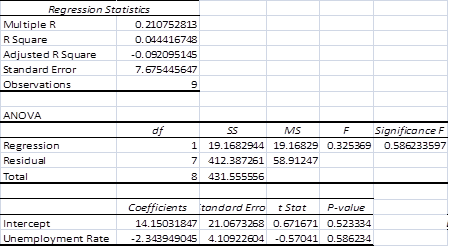
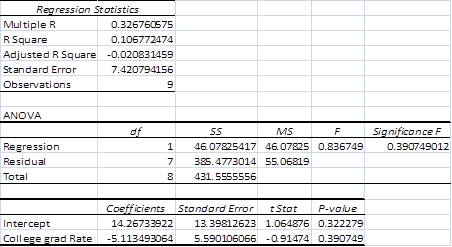
The following uses the unemployment rate for college graduates 25 years or older (also from the Bureau of Labor Statistics site). The results are marginally better, but not statistically significant.
Step 2 of 2


Why don’t you like this exercise?
Other






