





 Chat with AI


Cost Management: A Strategic Emphasis 5th Edition by David Stout, Edward Blocher, Gary Cokins
Edition 5ISBN: 0073526940Cost Management: A Strategic Emphasis 5th Edition by David Stout, Edward Blocher, Gary Cokins
Edition 5ISBN: 0073526940Cost Estimation, Machine Replacement, Ethics SpectroGlass Company manufactures glass for office buildings in Arizona and Southern California. As a result of age and wear, a critical machine in the production process has begun to produce quality defects. SpectroGlass is considering replacing the old machine with a new machine, either brand A or brand B. The manufacturer of each machine has provided SpectroGlass these data on the cost of operation of its machine at various levels of output:
Output (square yards) | Machine A Estimated Total Costs | Machine B Estimated Total Costs |
4,000 | $ 54,600 | $ 70,000 |
7,000 | 78,800 | 100,000 |
9,000 | 90,300 | 115,000 |
14,000 | 114,900 | 137,000 |
16,000 | 132,400 | 146,000 |
24,000 | 210,000 | 192,000 |
Required
1. Use the High-Low method to determine the cost equations for each machine, and then to determine if SpectroGlass’s output is expected to be 22,000 square yards, which machine should it purchase? At 15,000 square yards? Is the High-Low method useful here? Why or why not?
2. As a cost analyst at SpectroGlass, you have been assigned to complete requirement 1. A production supervisor comes to you to say that the nature of the defect is really very difficult to detect and that most customers will not notice it, so he questions replacing it. He suggests that you modify your calculations to justify keeping the present machine to keep things the way they are and save the company some money. What do you say?
3. Assume that machine A is manufactured in Germany and machine B is manufactured in Canada. As a U.S.-based firm, what considerations are important to SpectroGlass, in addition to those already mentioned in your answer to requirement 1?
 Verified
Step 1 of 3
Cost Estimation; Machine Replacement; Ethics (25 min)
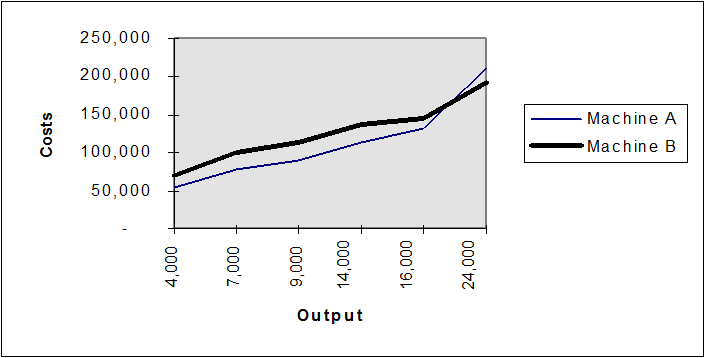
1.?A graph of the data shows no significant outliers nor nonlinear relationships. See below
Using the High-Low method:
Machine A:

? constant = $210,000 - ($7.77 x 24,000)
? = $23,520
? or
? = $54,600 - ($7.77 x 4,000)
? = $23,520
The estimate for total costs at 22,000 square yards is:
$23,520 + ($7.77 x 22,000) = $194,460
At 15,000 yards:
$23,520 + ($7.77 x 15,000) = $140,070
Machine B:

constant = $192,000 - ($6.10 x 24,000) = $45,600
? or
= $70,000 - ($6.10 x 4,000) = $45,600
The estimate for total costs at 22,000 square yards is:
$45,600 + ($6.10 x 22,000) = $179,800
At 15,000 yards:
$45,600 + ($6.10 x 15,000) = $137,100
The calculations show that the costs are lower at both the 22,000 level and the 15,000 level for Machine B, which suggests that Machine B is preferred for production levels above at least 15,000. The answer is wrong. Note by inspection of the chart in the text and inspection of the graph above, that Machine A is preferred to Machine B up to 16,000 units or more. The error in the analysis is the error in using the High-Low method for cost estimation in this particular case. The High-Low method derives a linear relationship from the least to the largest level of output, while in fact the relationship between output and cost in this case is not linear, as illustrated in the graph above. The exercise serves as a good reminder that the application of a cost estimation method should be used with caution, and that the review of the related graph can be a key step in identifying potential mistakes.
Step 2 of 3
Step 3 of 3


Why don’t you like this exercise?
Other






