





 Chat with AI


Cost Management: A Strategic Emphasis 5th Edition by David Stout, Edward Blocher, Gary Cokins
Edition 5ISBN: 0073526940Cost Management: A Strategic Emphasis 5th Edition by David Stout, Edward Blocher, Gary Cokins
Edition 5ISBN: 0073526940Joint Products Yonica Petroleum is a global manufacturer of specialty chemicals that are made from the waste products of the petroleum industry. Yonica in effect recycles a good portion of the waste from the refineries used by the large oil companies. The specialty chemicals are used as cleaning solvents and lubricants in industrial applications. Yonica has three products—Y64, G22, and X17—and total joint production cost of $356,000. Yonica plans to process all three products beyond the split-off point in order to be able to sell the product at the higher price after additional processing.
| Y64 | G22 | X17 |
Gallons produced and sold | 22,000 | 45,500 | 18,000 |
Sales price at split off point | $2.24 | $2.88 | $0.44 |
Separable processing cost | $65,500 | $34,250 | $55,400 |
Sales price after additional processing | $ 10.50 | $ 6.75 | $ 4.22 |
Number of customers | 22 | 3 | 46 |
1. Calculate the product cost of each of the three product lines using the following methods:
(a) physical unit method, (b) sales value at split-off method, and (c) the net realizable value method.
2. Which of the three methods do you think would be preferred in this case? Why?
3. While Yonica chose to process all three products beyond the split-off point, do you think this is the correct decision? Which products, if any, do you think should have been processed beyond the split-off point, and why?
 Verified
Step 1 of 3
Note: the information on number of customers is irrelevant
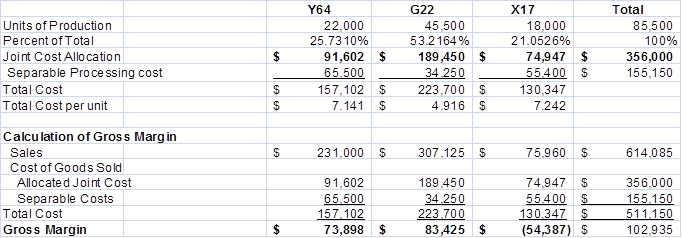
1.?a. The Physical Unit Method
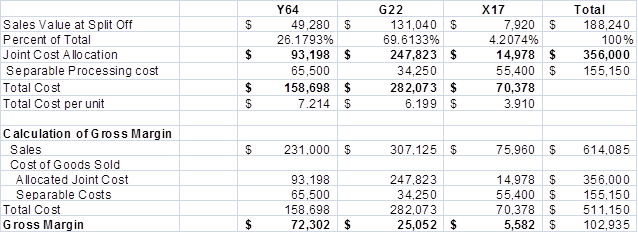
?b The Sales Value at Split Off Method
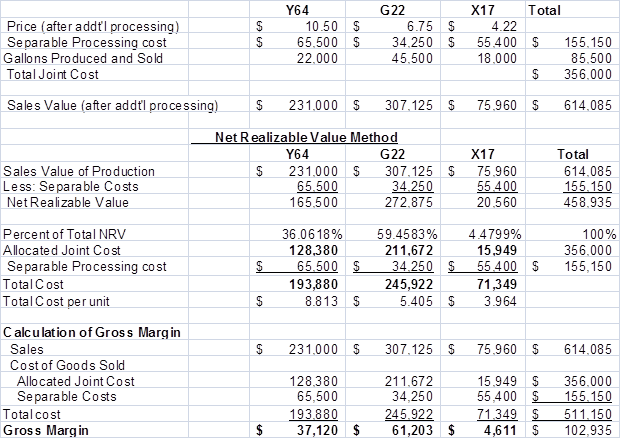
?c. The Net Realizable Value Method
Step 2 of 3
Step 3 of 3


Why don’t you like this exercise?
Other






