expand icon
book Introductory Econometrics: A Modern Approach 6th Edition by Jeffrey M Wooldridge cover

Introductory Econometrics: A Modern Approach 6th Edition by Jeffrey M Wooldridge

Edition 6ISBN: 130527010X
book Introductory Econometrics: A Modern Approach 6th Edition by Jeffrey M Wooldridge cover

Introductory Econometrics: A Modern Approach 6th Edition by Jeffrey M Wooldridge

Edition 6ISBN: 130527010X
Exercise 1

Use the data in WAGE2.RAW for this exercise.

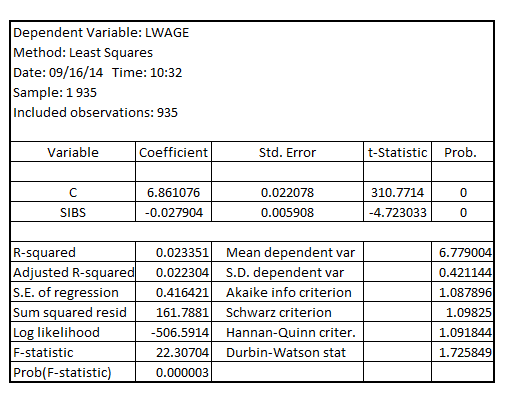
(i) In Example 15.2, using sibs as an instrument for educ, the IV estimate of the return to education is .122. To convince yourself that using sibs as an IV for educ is not the same as just plugging sibs in for educ and running an OLS regression, run the regression of log(wage) on sibs and explain your findings.

(ii) The variable brthord is birth order (brthord is one for a first-born child, two for a second-born child, and so on). Explain why educ and brthord might be negatively correlated. Regress educ on brthord to determine whether there is a statistically significant negative correlation.

(iii) Use brthord as an IV for educ in  Use the data in WAGE2.RAW for this exercise. <blockquote> (i) In Example 15.2, using sibs as an instrument for educ, the IV estimate of the return to education is .122. To convince yourself that using sibs as an IV for educ is not the same as just plugging sibs in for educ and running an OLS regression, run the regression of log(wage) on sibs and explain your findings. (ii) The variable brthord is birth order (brthord is one for a first-born child, two for a second-born child, and so on). Explain why educ and brthord might be negatively correlated. Regress educ on brthord to determine whether there is a statistically significant negative correlation. (iii) Use brthord as an IV for educ in   . Report and interpret the results. (iv) Now, suppose that we include number of siblings as an explanatory variable in the wage equation; this controls for family background, to some extent: log(wage) = ?0 + ?<span class=sub>1</span>educ + ?<span class=sub>2</span>sibs + u. Suppose that we want to use brthord as an IV for educ, assuming that sibs is exogenous. The reduced form for educ is educ = ?<span class=sub>0</span> + ?<span class=sub>1</span>sibs + ?<span class=sub>2</span>brthord + v. State and test the identification assumption. (v) Estimate the equation from part (iv) using brthord as an IV for educ (and sibs as its own IV). Comment on the standard errors for   and   . (vi) Using the fitted values from part (iv), educ, compute the correlation between educ and sibs. Use this result to explain your findings from part (v). </blockquote>   . Report and interpret the results.

(iv) Now, suppose that we include number of siblings as an explanatory variable in the wage equation; this controls for family background, to some extent:

log(wage) = ?0 + ?1educ + ?2sibs + u.

Suppose that we want to use brthord as an IV for educ, assuming that sibs is exogenous. The reduced form for educ is

educ = ?0 + ?1sibs + ?2brthord + v.

State and test the identification assumption.

(v) Estimate the equation from part (iv) using brthord as an IV for educ (and sibs as its own IV). Comment on the standard errors for  Use the data in WAGE2.RAW for this exercise. <blockquote> (i) In Example 15.2, using sibs as an instrument for educ, the IV estimate of the return to education is .122. To convince yourself that using sibs as an IV for educ is not the same as just plugging sibs in for educ and running an OLS regression, run the regression of log(wage) on sibs and explain your findings. (ii) The variable brthord is birth order (brthord is one for a first-born child, two for a second-born child, and so on). Explain why educ and brthord might be negatively correlated. Regress educ on brthord to determine whether there is a statistically significant negative correlation. (iii) Use brthord as an IV for educ in   . Report and interpret the results. (iv) Now, suppose that we include number of siblings as an explanatory variable in the wage equation; this controls for family background, to some extent: log(wage) = ?0 + ?<span class=sub>1</span>educ + ?<span class=sub>2</span>sibs + u. Suppose that we want to use brthord as an IV for educ, assuming that sibs is exogenous. The reduced form for educ is educ = ?<span class=sub>0</span> + ?<span class=sub>1</span>sibs + ?<span class=sub>2</span>brthord + v. State and test the identification assumption. (v) Estimate the equation from part (iv) using brthord as an IV for educ (and sibs as its own IV). Comment on the standard errors for   and   . (vi) Using the fitted values from part (iv), educ, compute the correlation between educ and sibs. Use this result to explain your findings from part (v). </blockquote>   and  Use the data in WAGE2.RAW for this exercise. <blockquote> (i) In Example 15.2, using sibs as an instrument for educ, the IV estimate of the return to education is .122. To convince yourself that using sibs as an IV for educ is not the same as just plugging sibs in for educ and running an OLS regression, run the regression of log(wage) on sibs and explain your findings. (ii) The variable brthord is birth order (brthord is one for a first-born child, two for a second-born child, and so on). Explain why educ and brthord might be negatively correlated. Regress educ on brthord to determine whether there is a statistically significant negative correlation. (iii) Use brthord as an IV for educ in   . Report and interpret the results. (iv) Now, suppose that we include number of siblings as an explanatory variable in the wage equation; this controls for family background, to some extent: log(wage) = ?0 + ?<span class=sub>1</span>educ + ?<span class=sub>2</span>sibs + u. Suppose that we want to use brthord as an IV for educ, assuming that sibs is exogenous. The reduced form for educ is educ = ?<span class=sub>0</span> + ?<span class=sub>1</span>sibs + ?<span class=sub>2</span>brthord + v. State and test the identification assumption. (v) Estimate the equation from part (iv) using brthord as an IV for educ (and sibs as its own IV). Comment on the standard errors for   and   . (vi) Using the fitted values from part (iv), educ, compute the correlation between educ and sibs. Use this result to explain your findings from part (v). </blockquote>   .

(vi) Using the fitted values from part (iv), educ, compute the correlation between educ and sibs. Use this result to explain your findings from part (v).

Step-by-step solution
Verified
like image
like image

Step 1 of 7

(i)

On estimating the regression of    <div class=answer> (i) On estimating the regression of   on   , the result is:   The coefficient of   is -0.027904 It is interpreted as an increase of an additional sibling reduces the monthly wage by 2.7904% The variable   could be correlated with the error term of this model as the error may account for omitted variable such as   with which   is stated to have certain degree of correlation. on    <div class=answer> (i) On estimating the regression of   on   , the result is:   The coefficient of   is -0.027904 It is interpreted as an increase of an additional sibling reduces the monthly wage by 2.7904% The variable   could be correlated with the error term of this model as the error may account for omitted variable such as   with which   is stated to have certain degree of correlation. , the result is:

    <div class=answer> (i) On estimating the regression of   on   , the result is:   The coefficient of   is -0.027904 It is interpreted as an increase of an additional sibling reduces the monthly wage by 2.7904% The variable   could be correlated with the error term of this model as the error may account for omitted variable such as   with which   is stated to have certain degree of correlation.

The coefficient of     <div class=answer> (i) On estimating the regression of   on   , the result is:   The coefficient of   is -0.027904 It is interpreted as an increase of an additional sibling reduces the monthly wage by 2.7904% The variable   could be correlated with the error term of this model as the error may account for omitted variable such as   with which   is stated to have certain degree of correlation. is -0.027904 It is interpreted as an increase of an additional sibling reduces the monthly wage by 2.7904%

The variable     <div class=answer> (i) On estimating the regression of   on   , the result is:   The coefficient of   is -0.027904 It is interpreted as an increase of an additional sibling reduces the monthly wage by 2.7904% The variable   could be correlated with the error term of this model as the error may account for omitted variable such as   with which   is stated to have certain degree of correlation. could be correlated with the error term of this model as the error may account for omitted variable such as     <div class=answer> (i) On estimating the regression of   on   , the result is:   The coefficient of   is -0.027904 It is interpreted as an increase of an additional sibling reduces the monthly wage by 2.7904% The variable   could be correlated with the error term of this model as the error may account for omitted variable such as   with which   is stated to have certain degree of correlation. with which     <div class=answer> (i) On estimating the regression of   on   , the result is:   The coefficient of   is -0.027904 It is interpreted as an increase of an additional sibling reduces the monthly wage by 2.7904% The variable   could be correlated with the error term of this model as the error may account for omitted variable such as   with which   is stated to have certain degree of correlation. is stated to have certain degree of correlation.


Step 2 of 7


Step 3 of 7


Step 4 of 7


Step 5 of 7


Step 6 of 7


Step 7 of 7

close menu
Introductory Econometrics: A Modern Approach 6th Edition by Jeffrey M Wooldridge
cross icon