


expand icon
book Introductory Econometrics: A Modern Approach 6th Edition by Jeffrey M Wooldridge cover

Introductory Econometrics: A Modern Approach 6th Edition by Jeffrey M Wooldridge

Edition 6ISBN: 130527010X
book Introductory Econometrics: A Modern Approach 6th Edition by Jeffrey M Wooldridge cover

Introductory Econometrics: A Modern Approach 6th Edition by Jeffrey M Wooldridge

Edition 6ISBN: 130527010X
Exercise 16

The file PENSION.RAW contains information on participant-directed pension plans for U.S. workers. Some of the observations are for couples within the same family, so this data set constitutes a small cluster sample (with cluster sizes of two).

(i) Ignoring the clustering by family, use OLS to estimate the model

 The file PENSION.RAW contains information on participant-directed pension plans for U.S. workers. Some of the observations are for couples within the same family, so this data set constitutes a small cluster sample (with cluster sizes of two). <blockquote> (i) Ignoring the clustering by family, use OLS to estimate the model   where the variables are defined in the data set. The variable of most interest is choice, which is a dummy variable equal to one if the worker has a choice in how to allocate pension funds among different investments. What is the estimated effect of choice? Is it statistically significant? (ii) Are the income, wealth, stock holding, and IRA holding control variables important? Explain. (iii) Determine how many different families there are in the data set. (iv) Now, obtain the standard errors for OLS that are robust to cluster correlation within a family. Do they differ much from the usual OLS standard errors? Are you surprised? (v) Estimate the equation by differencing across only the spouses within a family. Why do the explanatory variables asked about in part (ii) drop out in the first-differenced estimation? (vi) Are any of the remaining explanatory variables in part (v) significant? Are you surprised? </blockquote>
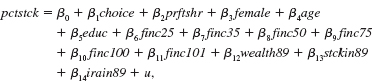
where the variables are defined in the data set. The variable of most interest is choice, which is a dummy variable equal to one if the worker has a choice in how to allocate pension funds among different investments. What is the estimated effect of choice? Is it statistically significant?

(ii) Are the income, wealth, stock holding, and IRA holding control variables important? Explain.

(iii) Determine how many different families there are in the data set.

(iv) Now, obtain the standard errors for OLS that are robust to cluster correlation within a family. Do they differ much from the usual OLS standard errors? Are you surprised?

(v) Estimate the equation by differencing across only the spouses within a family. Why do the explanatory variables asked about in part (ii) drop out in the first-differenced estimation?

(vi) Are any of the remaining explanatory variables in part (v) significant? Are you surprised?

Step-by-step solution
Verified
like image
like image

Step 1 of 8

(i)

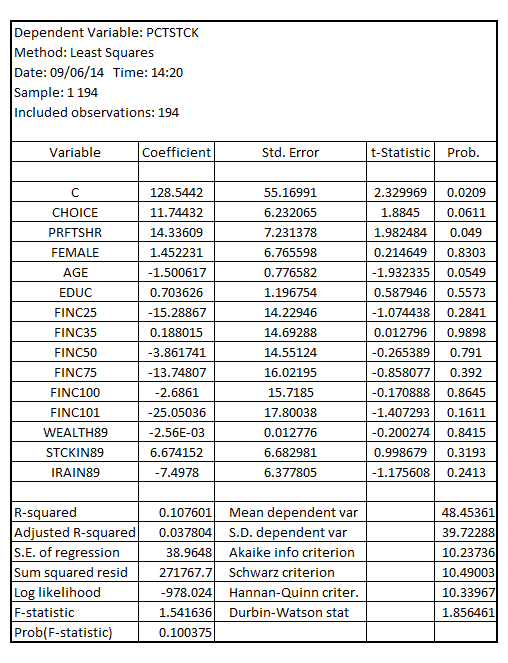
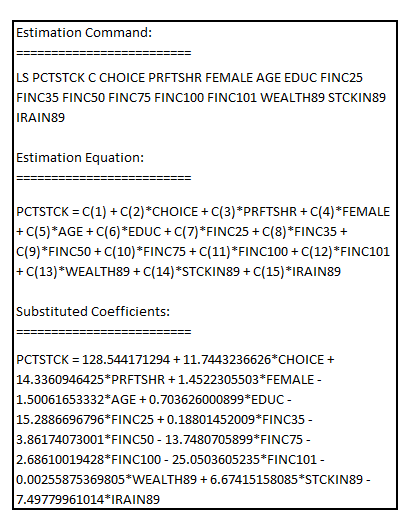
Ignoring the clustering by family and using OLS to estimate the model, the result is:

    <div class=answer> (i) Ignoring the clustering by family and using OLS to estimate the model, the result is:       The coefficient of   is 11.74432 with the p-value 0.0611 which is greater than critical p-value of 0.05 at 5% level of significance, indicating that the variable   is not statistically significant at 5% level of significance
    <div class=answer> (i) Ignoring the clustering by family and using OLS to estimate the model, the result is:       The coefficient of   is 11.74432 with the p-value 0.0611 which is greater than critical p-value of 0.05 at 5% level of significance, indicating that the variable   is not statistically significant at 5% level of significance
    <div class=answer> (i) Ignoring the clustering by family and using OLS to estimate the model, the result is:       The coefficient of   is 11.74432 with the p-value 0.0611 which is greater than critical p-value of 0.05 at 5% level of significance, indicating that the variable   is not statistically significant at 5% level of significance

The coefficient of     <div class=answer> (i) Ignoring the clustering by family and using OLS to estimate the model, the result is:       The coefficient of   is 11.74432 with the p-value 0.0611 which is greater than critical p-value of 0.05 at 5% level of significance, indicating that the variable   is not statistically significant at 5% level of significance is 11.74432 with the p-value 0.0611 which is greater than critical p-value of 0.05 at 5% level of significance, indicating that the variable     <div class=answer> (i) Ignoring the clustering by family and using OLS to estimate the model, the result is:       The coefficient of   is 11.74432 with the p-value 0.0611 which is greater than critical p-value of 0.05 at 5% level of significance, indicating that the variable   is not statistically significant at 5% level of significance is not statistically significant at 5% level of significance


Step 2 of 8


Step 3 of 8


Step 4 of 8


Step 5 of 8


Step 6 of 8


Step 7 of 8


Step 8 of 8

close menu
Introductory Econometrics: A Modern Approach 6th Edition by Jeffrey M Wooldridge
cross icon



