


expand icon
book Introductory Econometrics: A Modern Approach 6th Edition by Jeffrey M Wooldridge cover

Introductory Econometrics: A Modern Approach 6th Edition by Jeffrey M Wooldridge

Edition 6ISBN: 130527010X
book Introductory Econometrics: A Modern Approach 6th Edition by Jeffrey M Wooldridge cover

Introductory Econometrics: A Modern Approach 6th Edition by Jeffrey M Wooldridge

Edition 6ISBN: 130527010X
Exercise 18

Use the data in NYSE.RAW to answer these questions.

(i) Estimate the model in equation and obtain the squared OLS residuals. Find the average, minimum, and maximum values of û2t over the sample.

(ii) Use the squared OLS residuals to estimate the following model of heteroske-dasticity:

 Use the data in NYSE.RAW to answer these questions. <blockquote> (i) Estimate the model in equation and obtain the squared OLS residuals. Find the average, minimum, and maximum values of û<span class=sup>2</span><span class=sub>t</span> over the sample. (ii) Use the squared OLS residuals to estimate the following model of heteroske-dasticity:   Report the estimated coefficients, the reported standard errors, the R-squared, and the adjusted R-squared. (iii) Sketch the conditional variance as a function of the lagged return v For what value of return<span class=sub>-1</span> is the variance the smallest, and what is the variance? (iv) For predicting the dynamic variance, does the model in part (ii) produce any negative variance estimates? (v) Does the model in part (ii) seem to fit better or worse than the ARCH(1) model in Example 12.9? Explain. (vi) To the ARCH(1) regression in equation, add the second lag, û<span class=sup>2</span><span class=sub>t- 2</span>. Does this lag seem important? Does the ARCH(2) model fit better than the model in part (ii)? </blockquote>     Report the estimated coefficients, the reported standard errors, the R-squared, and the adjusted R-squared.

(iii) Sketch the conditional variance as a function of the lagged return v For what value of return-1 is the variance the smallest, and what is the variance?

(iv) For predicting the dynamic variance, does the model in part (ii) produce any negative variance estimates?

(v) Does the model in part (ii) seem to fit better or worse than the ARCH(1) model in Example 12.9? Explain.

(vi) To the ARCH(1) regression in equation, add the second lag, û2t- 2. Does this lag seem important? Does the ARCH(2) model fit better than the model in part (ii)?

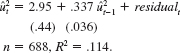
 Use the data in NYSE.RAW to answer these questions. <blockquote> (i) Estimate the model in equation and obtain the squared OLS residuals. Find the average, minimum, and maximum values of û<span class=sup>2</span><span class=sub>t</span> over the sample. (ii) Use the squared OLS residuals to estimate the following model of heteroske-dasticity:   Report the estimated coefficients, the reported standard errors, the R-squared, and the adjusted R-squared. (iii) Sketch the conditional variance as a function of the lagged return v For what value of return<span class=sub>-1</span> is the variance the smallest, and what is the variance? (iv) For predicting the dynamic variance, does the model in part (ii) produce any negative variance estimates? (v) Does the model in part (ii) seem to fit better or worse than the ARCH(1) model in Example 12.9? Explain. (vi) To the ARCH(1) regression in equation, add the second lag, û<span class=sup>2</span><span class=sub>t- 2</span>. Does this lag seem important? Does the ARCH(2) model fit better than the model in part (ii)? </blockquote>

 Use the data in NYSE.RAW to answer these questions. <blockquote> (i) Estimate the model in equation and obtain the squared OLS residuals. Find the average, minimum, and maximum values of û<span class=sup>2</span><span class=sub>t</span> over the sample. (ii) Use the squared OLS residuals to estimate the following model of heteroske-dasticity:   Report the estimated coefficients, the reported standard errors, the R-squared, and the adjusted R-squared. (iii) Sketch the conditional variance as a function of the lagged return v For what value of return<span class=sub>-1</span> is the variance the smallest, and what is the variance? (iv) For predicting the dynamic variance, does the model in part (ii) produce any negative variance estimates? (v) Does the model in part (ii) seem to fit better or worse than the ARCH(1) model in Example 12.9? Explain. (vi) To the ARCH(1) regression in equation, add the second lag, û<span class=sup>2</span><span class=sub>t- 2</span>. Does this lag seem important? Does the ARCH(2) model fit better than the model in part (ii)? </blockquote>

Explanation
like image
like image
no-answer
This question doesn’t have an expert verified answer yet, let Quizplus AI Copilot help.
close menu
Introductory Econometrics: A Modern Approach 6th Edition by Jeffrey M Wooldridge
cross icon



