


expand icon
book Introductory Econometrics: A Modern Approach 6th Edition by Jeffrey M Wooldridge cover

Introductory Econometrics: A Modern Approach 6th Edition by Jeffrey M Wooldridge

Edition 6ISBN: 130527010X
book Introductory Econometrics: A Modern Approach 6th Edition by Jeffrey M Wooldridge cover

Introductory Econometrics: A Modern Approach 6th Edition by Jeffrey M Wooldridge

Edition 6ISBN: 130527010X
Exercise 7

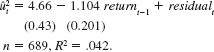
(i) Use NYSE.RAW to estimate equation. Let ?t. be the fitted values from this equation (the estimates of the conditional variance). How many ?t are negative?

(ii) Add return1 1 to (12.48) and again compute the fitted values, ?t . Are any ?t t negative?

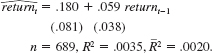
(iii) Use the ?t from part (ii) to estimate (12.47) by weighted least squares (as in Section 8.4). Compare your estimate of ?t with that in equation. Test H0: ?t = 0 and compare the outcome when OLS is used.

(iv) Now, estimate (12.47) by WLS, using the estimated ARCH model in (12.51) to obtain the ?t . Does this change your findings from part (iii)?
       <blockquote> (i) Use NYSE.RAW to estimate equation. Let ?<span class=sub>t</span>. be the fitted values from this equation (the estimates of the conditional variance). How many ?<span class=sub>t</span> are negative? (ii) Add return1 1 to (12.48) and again compute the fitted values, ?<span class=sub>t</span> . Are any ?<span class=sub>t</span> t negative? (iii) Use the ?<span class=sub>t</span> from part (ii) to estimate (12.47) by weighted least squares (as in Section 8.4). Compare your estimate of ?<span class=sub>t</span> with that in equation. Test H<span class=sub>0</span>: ?<span class=sub>t</span> = 0 and compare the outcome when OLS is used. (iv) Now, estimate (12.47) by WLS, using the estimated ARCH model in (12.51) to obtain the ?<span class=sub>t</span> . Does this change your findings from part (iii)? </blockquote>

       <blockquote> (i) Use NYSE.RAW to estimate equation. Let ?<span class=sub>t</span>. be the fitted values from this equation (the estimates of the conditional variance). How many ?<span class=sub>t</span> are negative? (ii) Add return1 1 to (12.48) and again compute the fitted values, ?<span class=sub>t</span> . Are any ?<span class=sub>t</span> t negative? (iii) Use the ?<span class=sub>t</span> from part (ii) to estimate (12.47) by weighted least squares (as in Section 8.4). Compare your estimate of ?<span class=sub>t</span> with that in equation. Test H<span class=sub>0</span>: ?<span class=sub>t</span> = 0 and compare the outcome when OLS is used. (iv) Now, estimate (12.47) by WLS, using the estimated ARCH model in (12.51) to obtain the ?<span class=sub>t</span> . Does this change your findings from part (iii)? </blockquote>

Step-by-step solution
Verified
like image
like image

Step 1 of 4

i)

After obtaining the residuals     <div class=answer> i) After obtaining the residuals   from equation   and then estimating the required equation, one can compute the fitted values   This is easily done in a single using command using most software packages. It turns out that 12 of 689 fitted values are negative. Among other things, this means one cannot directly apply weighted least squares using the heteroskedasticity function in the given equation. from equation     <div class=answer> i) After obtaining the residuals   from equation   and then estimating the required equation, one can compute the fitted values   This is easily done in a single using command using most software packages. It turns out that 12 of 689 fitted values are negative. Among other things, this means one cannot directly apply weighted least squares using the heteroskedasticity function in the given equation. and then estimating the required equation, one can compute the fitted values     <div class=answer> i) After obtaining the residuals   from equation   and then estimating the required equation, one can compute the fitted values   This is easily done in a single using command using most software packages. It turns out that 12 of 689 fitted values are negative. Among other things, this means one cannot directly apply weighted least squares using the heteroskedasticity function in the given equation.

This is easily done in a single using command using most software packages. It turns out that 12 of 689 fitted values are negative.

Among other things, this means one cannot directly apply weighted least squares using the heteroskedasticity function in the given equation.


Step 2 of 4


Step 3 of 4


Step 4 of 4

close menu
Introductory Econometrics: A Modern Approach 6th Edition by Jeffrey M Wooldridge
cross icon




