


expand icon
book Introductory Econometrics: A Modern Approach 6th Edition by Jeffrey M Wooldridge cover

Introductory Econometrics: A Modern Approach 6th Edition by Jeffrey M Wooldridge

Edition 6ISBN: 130527010X
book Introductory Econometrics: A Modern Approach 6th Edition by Jeffrey M Wooldridge cover

Introductory Econometrics: A Modern Approach 6th Edition by Jeffrey M Wooldridge

Edition 6ISBN: 130527010X
Exercise 19

C11.11 Okun’s Law—for example, Mankiw (1994, Chapter 2)—implies the following relationship between the annual percentage change in real GDP, pcrgdp, and the change in the annual unemployment rate, ?unem:

pcrgdp = 3 - 2 ?unem.

If the unemployment rate is stable, real GDP grows at 3% annually. For each percentage point increase in the unemployment rate, real GDP grows by two percentage

points less. (This should not be interpreted in any causal sense; it is more like a statistical description.)

To see if the data on the U.S. economy support Okun’s Law, we specify a model that allows deviations via an error term, pcrgdpt = ?0 + ?1?unemt + ut.

(i) Use the data in OKUN.RAW to estimate the equation. Do you get exactly 3 for the intercept and ?2 for the slope? Did you expect to?

(ii) Find the t statistic for testing H0: ?1 = ?2. Do you reject H0 against the two-sided alternative at any reasonable significance level?

(iii) Find the t statistic for testing H0: ?0 = 3. Do you reject H0 at the 5% level against he two-sided alternative? Is it a “strong” rejection?

(iv) Find the F statistic and p-value for testing H0: ?0 ? = 3, ?1 = ?2 against the alternative that H0 is false. Overall, would you say the data reject or tend to support

Okun’s law?

Step-by-step solution
Verified
like image
like image

Step 1 of 4

Consider     <div class=answer> Consider   is the annual percentage change in real GDP and   is the change in annual unemployment rate. Okun’s law is given by:   Estimating the equation,   The result is as follows:     It is evident that, exactly 3 for intercept and -2 for the slope is not obtained for the equation. It was not expected to obtain exactly 3 for intercept and -2 for the slope for the equation as the data for   and   is updated every year as the result, the coefficients are likely to change as the data update under evolving economic situation. is the annual percentage change in real GDP and    <div class=answer> Consider   is the annual percentage change in real GDP and   is the change in annual unemployment rate. Okun’s law is given by:   Estimating the equation,   The result is as follows:     It is evident that, exactly 3 for intercept and -2 for the slope is not obtained for the equation. It was not expected to obtain exactly 3 for intercept and -2 for the slope for the equation as the data for   and   is updated every year as the result, the coefficients are likely to change as the data update under evolving economic situation. is the change in annual unemployment rate. Okun’s law is given by:


    <div class=answer> Consider   is the annual percentage change in real GDP and   is the change in annual unemployment rate. Okun’s law is given by:   Estimating the equation,   The result is as follows:     It is evident that, exactly 3 for intercept and -2 for the slope is not obtained for the equation. It was not expected to obtain exactly 3 for intercept and -2 for the slope for the equation as the data for   and   is updated every year as the result, the coefficients are likely to change as the data update under evolving economic situation.

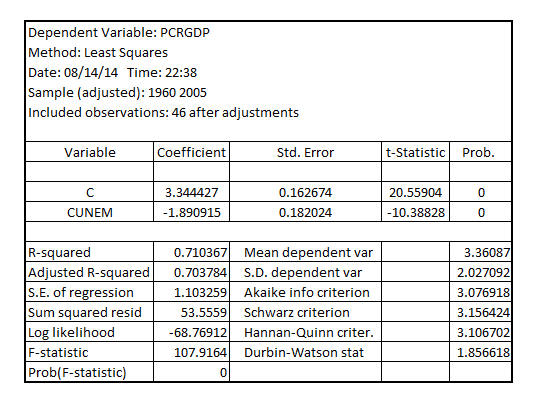
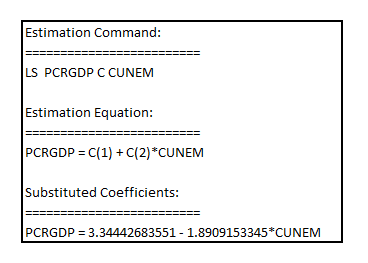
Estimating the equation,

    <div class=answer> Consider   is the annual percentage change in real GDP and   is the change in annual unemployment rate. Okun’s law is given by:   Estimating the equation,   The result is as follows:     It is evident that, exactly 3 for intercept and -2 for the slope is not obtained for the equation. It was not expected to obtain exactly 3 for intercept and -2 for the slope for the equation as the data for   and   is updated every year as the result, the coefficients are likely to change as the data update under evolving economic situation.

The result is as follows:

    <div class=answer> Consider   is the annual percentage change in real GDP and   is the change in annual unemployment rate. Okun’s law is given by:   Estimating the equation,   The result is as follows:     It is evident that, exactly 3 for intercept and -2 for the slope is not obtained for the equation. It was not expected to obtain exactly 3 for intercept and -2 for the slope for the equation as the data for   and   is updated every year as the result, the coefficients are likely to change as the data update under evolving economic situation.

    <div class=answer> Consider   is the annual percentage change in real GDP and   is the change in annual unemployment rate. Okun’s law is given by:   Estimating the equation,   The result is as follows:     It is evident that, exactly 3 for intercept and -2 for the slope is not obtained for the equation. It was not expected to obtain exactly 3 for intercept and -2 for the slope for the equation as the data for   and   is updated every year as the result, the coefficients are likely to change as the data update under evolving economic situation.

It is evident that, exactly 3 for intercept and -2 for the slope is not obtained for the equation. It was not expected to obtain exactly 3 for intercept and -2 for the slope for the equation as the data for     <div class=answer> Consider   is the annual percentage change in real GDP and   is the change in annual unemployment rate. Okun’s law is given by:   Estimating the equation,   The result is as follows:     It is evident that, exactly 3 for intercept and -2 for the slope is not obtained for the equation. It was not expected to obtain exactly 3 for intercept and -2 for the slope for the equation as the data for   and   is updated every year as the result, the coefficients are likely to change as the data update under evolving economic situation. and     <div class=answer> Consider   is the annual percentage change in real GDP and   is the change in annual unemployment rate. Okun’s law is given by:   Estimating the equation,   The result is as follows:     It is evident that, exactly 3 for intercept and -2 for the slope is not obtained for the equation. It was not expected to obtain exactly 3 for intercept and -2 for the slope for the equation as the data for   and   is updated every year as the result, the coefficients are likely to change as the data update under evolving economic situation. is updated every year as the result, the coefficients are likely to change as the data update under evolving economic situation.


Step 2 of 4


Step 3 of 4


Step 4 of 4

close menu
Introductory Econometrics: A Modern Approach 6th Edition by Jeffrey M Wooldridge
cross icon



