


expand icon
book Introductory Econometrics: A Modern Approach 6th Edition by Jeffrey M Wooldridge cover

Introductory Econometrics: A Modern Approach 6th Edition by Jeffrey M Wooldridge

Edition 6ISBN: 130527010X
book Introductory Econometrics: A Modern Approach 6th Edition by Jeffrey M Wooldridge cover

Introductory Econometrics: A Modern Approach 6th Edition by Jeffrey M Wooldridge

Edition 6ISBN: 130527010X
Exercise 15

Use the data in PHILLIPS.RAW for this exercise.

(i) Estimate an AR(1) model for the unemployment rate. Use this equation to predict the unemployment rate for 2004. Compare this with the actual unemployment rate for 2004. (You can find this information in a recent Economic Report of the President.)

(ii) Add a lag of inflation to the AR(1) model from part (i). Is inft-1 statistically significant?

(iii) Use the equation from part (ii) to predict the unemployment rate for 2004. Is the result better or worse than in the model from part (i)?

(iv) Use the method from Section 6.4 to construct a 95% prediction interval for the 2004 unemployment rate. Is the 2004 unemployment rate in the interval?

Step-by-step solution
Verified
like image
like image

Step 1 of 7

(i)

Estimating AR (1) model for the unemployment rate, the model is as follows:

    <div class=answer> (i) Estimating AR (1) model for the unemployment rate, the model is as follows:   The result is as follows:   The standard form of AR (1) model is,   In 2003, the unemployment rate is 6%. With the given AR (1) model, the predicted unemployment rate in 2004 is   The predicted unemployment rate in 2004 is 5.944%. The actual unemployment rate in 2004 is 5.5%
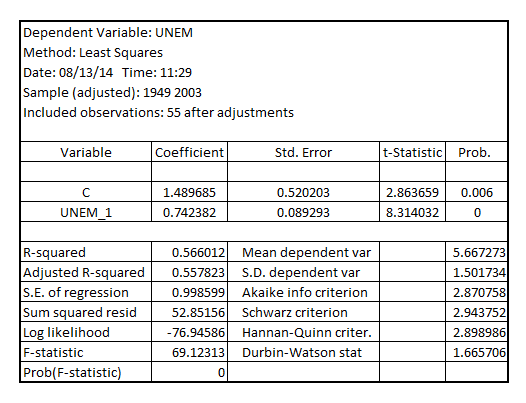

The result is as follows:

    <div class=answer> (i) Estimating AR (1) model for the unemployment rate, the model is as follows:   The result is as follows:   The standard form of AR (1) model is,   In 2003, the unemployment rate is 6%. With the given AR (1) model, the predicted unemployment rate in 2004 is   The predicted unemployment rate in 2004 is 5.944%. The actual unemployment rate in 2004 is 5.5%

The standard form of AR (1) model is,

    <div class=answer> (i) Estimating AR (1) model for the unemployment rate, the model is as follows:   The result is as follows:   The standard form of AR (1) model is,   In 2003, the unemployment rate is 6%. With the given AR (1) model, the predicted unemployment rate in 2004 is   The predicted unemployment rate in 2004 is 5.944%. The actual unemployment rate in 2004 is 5.5%

In 2003, the unemployment rate is 6%. With the given AR (1) model, the predicted unemployment rate in 2004 is

    <div class=answer> (i) Estimating AR (1) model for the unemployment rate, the model is as follows:   The result is as follows:   The standard form of AR (1) model is,   In 2003, the unemployment rate is 6%. With the given AR (1) model, the predicted unemployment rate in 2004 is   The predicted unemployment rate in 2004 is 5.944%. The actual unemployment rate in 2004 is 5.5%

The predicted unemployment rate in 2004 is 5.944%. The actual unemployment rate in 2004 is 5.5%


Step 2 of 7


Step 3 of 7


Step 4 of 7


Step 5 of 7


Step 6 of 7


Step 7 of 7

close menu
Introductory Econometrics: A Modern Approach 6th Edition by Jeffrey M Wooldridge
cross icon



