


expand icon
book Introductory Econometrics: A Modern Approach 6th Edition by Jeffrey M Wooldridge cover

Introductory Econometrics: A Modern Approach 6th Edition by Jeffrey M Wooldridge

Edition 6ISBN: 130527010X
book Introductory Econometrics: A Modern Approach 6th Edition by Jeffrey M Wooldridge cover

Introductory Econometrics: A Modern Approach 6th Edition by Jeffrey M Wooldridge

Edition 6ISBN: 130527010X
Exercise 1

Use the data in HSEINV.RAW for this exercise.

(i) Find the first order autocorrelation in log(invpc). Now, find the autocorrelation after linearly detrending log(invpc). Do the same for log(price). Which of the two series may have a unit root?

(ii) Based on your findings in part (i), estimate the equation log(invpct) ?0 + ?1?log(pricet) ?2t + ut

and report the results in standard form. Interpret the coefficient  Use the data in HSEINV.RAW for this exercise. <blockquote> (i) Find the first order autocorrelation in log(invpc). Now, find the autocorrelation after linearly detrending log(invpc). Do the same for log(price). Which of the two series may have a unit root? (ii) Based on your findings in part (i), estimate the equation log(invpct) ?0 + ?1?log(pricet) ?2t + ut and report the results in standard form. Interpret the coefficient   and determine whether it is statistically significant. (iii) Linearly detrend log(invpct) and use the detrended version as the dependent variable in the regression from part (ii) (see Section 10.5). What happens to R2? (iv) Now use ?log(invpct) as the dependent variable. How do your results change from part (ii)? Is the time trend still significant? Why or why not? </blockquote>   and determine whether it is statistically significant.

(iii) Linearly detrend log(invpct) and use the detrended version as the dependent variable in the regression from part (ii) (see Section 10.5). What happens to R2?

(iv) Now use ?log(invpct) as the dependent variable. How do your results change from part (ii)? Is the time trend still significant? Why or why not?

Step-by-step solution
Verified
like image
like image

Step 1 of 9

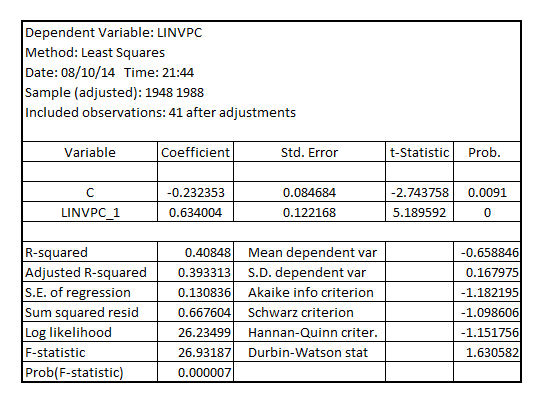
The first order autocorrelation in     <div class=answer> The first order autocorrelation in   is the coefficient of   in the AR(1) model as stated as: Consider,   , then AR(1) model is:   The result is as follows:   Hence, the first order autocorrelation in   is 0.634. is the coefficient of     <div class=answer> The first order autocorrelation in   is the coefficient of   in the AR(1) model as stated as: Consider,   , then AR(1) model is:   The result is as follows:   Hence, the first order autocorrelation in   is 0.634. in the AR(1) model as stated as:

Consider,     <div class=answer> The first order autocorrelation in   is the coefficient of   in the AR(1) model as stated as: Consider,   , then AR(1) model is:   The result is as follows:   Hence, the first order autocorrelation in   is 0.634. , then AR(1) model is:

    <div class=answer> The first order autocorrelation in   is the coefficient of   in the AR(1) model as stated as: Consider,   , then AR(1) model is:   The result is as follows:   Hence, the first order autocorrelation in   is 0.634.

The result is as follows:

    <div class=answer> The first order autocorrelation in   is the coefficient of   in the AR(1) model as stated as: Consider,   , then AR(1) model is:   The result is as follows:   Hence, the first order autocorrelation in   is 0.634.

Hence, the first order autocorrelation in     <div class=answer> The first order autocorrelation in   is the coefficient of   in the AR(1) model as stated as: Consider,   , then AR(1) model is:   The result is as follows:   Hence, the first order autocorrelation in   is 0.634. is 0.634.


Step 2 of 9


Step 3 of 9


Step 4 of 9


Step 5 of 9


Step 6 of 9


Step 7 of 9


Step 8 of 9


Step 9 of 9

close menu
Introductory Econometrics: A Modern Approach 6th Edition by Jeffrey M Wooldridge
cross icon




