expand icon
book Introductory Econometrics: A Modern Approach 6th Edition by Jeffrey M Wooldridge cover

Introductory Econometrics: A Modern Approach 6th Edition by Jeffrey M Wooldridge

Edition 6ISBN: 130527010X
book Introductory Econometrics: A Modern Approach 6th Edition by Jeffrey M Wooldridge cover

Introductory Econometrics: A Modern Approach 6th Edition by Jeffrey M Wooldridge

Edition 6ISBN: 130527010X
Exercise 4

Let gGDPt denote the annual percentage change in gross domestic product and let int t denote a short-term interest rate. Suppose that gGDP tis related to interest rates by

 Let gGDPt denote the annual percentage change in gross domestic product and let int t denote a short-term interest rate. Suppose that gGDP tis related to interest rates by   , where ut is uncorrelated with int,, intt_v and all other past values of interest rates. Suppose that the Federal Reserve follows the policy rule:   where ?1 > 0. (When last year's GDP growth is above 3%, the Fed increases interest rates to prevent an overheated economy.) If vt is uncorrelated with all past values of intt and ut, argue that intt must be correlated with ut_1. (Hint: Lag the first equation for one time period and substitute for gGDP<span class=sub>t-1</span> in the second equation.) Which Gauss-Markov assumption does this violate? ,

where ut is uncorrelated with int,, intt_v and all other past values of interest rates. Suppose that the Federal Reserve follows the policy rule:

 Let gGDPt denote the annual percentage change in gross domestic product and let int t denote a short-term interest rate. Suppose that gGDP tis related to interest rates by   , where ut is uncorrelated with int,, intt_v and all other past values of interest rates. Suppose that the Federal Reserve follows the policy rule:   where ?1 > 0. (When last year's GDP growth is above 3%, the Fed increases interest rates to prevent an overheated economy.) If vt is uncorrelated with all past values of intt and ut, argue that intt must be correlated with ut_1. (Hint: Lag the first equation for one time period and substitute for gGDP<span class=sub>t-1</span> in the second equation.) Which Gauss-Markov assumption does this violate?

where ?1 > 0. (When last year's GDP growth is above 3%, the Fed increases interest rates to prevent an "overheated" economy.) If vt is uncorrelated with all past values of intt and ut, argue that intt must be correlated with ut_1. (Hint: Lag the first equation for one time period and substitute for gGDPt-1 in the second equation.) Which Gauss-Markov assumption does this violate?

Step-by-step solution
Verified
like image
like image

Step 1 of 2

Consider     <div class=answer> Consider   as annual percentage change in gross domestic product. Given   is related to short term interest rate by:   , where   is uncorrelated with   and all other past values of interest rates. At one lag time period, such that, at   ,   is related to short term interest rate by   , where   is uncorrelated with   and all other past values of interest rates. That implies,   Now substitute for   in   , where   and   is uncorrelated with all the past values of   and   The result is:   In the equation   , When   is uncorrelated with all the past values of   and   ,   is uncorrelated with   and   , that implies,   Now, in order to observe whether   is correlated with   , consider the covariance of   with   The result is:   Since,   holds as given, it is concluded that there is correlation between   and   , Assume   Hence, it is concluded that   <sub> </sub>is correlated with   as annual percentage change in gross domestic product.


Given     <div class=answer> Consider   as annual percentage change in gross domestic product. Given   is related to short term interest rate by:   , where   is uncorrelated with   and all other past values of interest rates. At one lag time period, such that, at   ,   is related to short term interest rate by   , where   is uncorrelated with   and all other past values of interest rates. That implies,   Now substitute for   in   , where   and   is uncorrelated with all the past values of   and   The result is:   In the equation   , When   is uncorrelated with all the past values of   and   ,   is uncorrelated with   and   , that implies,   Now, in order to observe whether   is correlated with   , consider the covariance of   with   The result is:   Since,   holds as given, it is concluded that there is correlation between   and   , Assume   Hence, it is concluded that   <sub> </sub>is correlated with   is related to short term interest rate by:

    <div class=answer> Consider   as annual percentage change in gross domestic product. Given   is related to short term interest rate by:   , where   is uncorrelated with   and all other past values of interest rates. At one lag time period, such that, at   ,   is related to short term interest rate by   , where   is uncorrelated with   and all other past values of interest rates. That implies,   Now substitute for   in   , where   and   is uncorrelated with all the past values of   and   The result is:   In the equation   , When   is uncorrelated with all the past values of   and   ,   is uncorrelated with   and   , that implies,   Now, in order to observe whether   is correlated with   , consider the covariance of   with   The result is:   Since,   holds as given, it is concluded that there is correlation between   and   , Assume   Hence, it is concluded that   <sub> </sub>is correlated with   ,

where     <div class=answer> Consider   as annual percentage change in gross domestic product. Given   is related to short term interest rate by:   , where   is uncorrelated with   and all other past values of interest rates. At one lag time period, such that, at   ,   is related to short term interest rate by   , where   is uncorrelated with   and all other past values of interest rates. That implies,   Now substitute for   in   , where   and   is uncorrelated with all the past values of   and   The result is:   In the equation   , When   is uncorrelated with all the past values of   and   ,   is uncorrelated with   and   , that implies,   Now, in order to observe whether   is correlated with   , consider the covariance of   with   The result is:   Since,   holds as given, it is concluded that there is correlation between   and   , Assume   Hence, it is concluded that   <sub> </sub>is correlated with   is uncorrelated with    <div class=answer> Consider   as annual percentage change in gross domestic product. Given   is related to short term interest rate by:   , where   is uncorrelated with   and all other past values of interest rates. At one lag time period, such that, at   ,   is related to short term interest rate by   , where   is uncorrelated with   and all other past values of interest rates. That implies,   Now substitute for   in   , where   and   is uncorrelated with all the past values of   and   The result is:   In the equation   , When   is uncorrelated with all the past values of   and   ,   is uncorrelated with   and   , that implies,   Now, in order to observe whether   is correlated with   , consider the covariance of   with   The result is:   Since,   holds as given, it is concluded that there is correlation between   and   , Assume   Hence, it is concluded that   <sub> </sub>is correlated with   and all other past values of interest rates.

At one lag time period, such that, at    <div class=answer> Consider   as annual percentage change in gross domestic product. Given   is related to short term interest rate by:   , where   is uncorrelated with   and all other past values of interest rates. At one lag time period, such that, at   ,   is related to short term interest rate by   , where   is uncorrelated with   and all other past values of interest rates. That implies,   Now substitute for   in   , where   and   is uncorrelated with all the past values of   and   The result is:   In the equation   , When   is uncorrelated with all the past values of   and   ,   is uncorrelated with   and   , that implies,   Now, in order to observe whether   is correlated with   , consider the covariance of   with   The result is:   Since,   holds as given, it is concluded that there is correlation between   and   , Assume   Hence, it is concluded that   <sub> </sub>is correlated with   ,     <div class=answer> Consider   as annual percentage change in gross domestic product. Given   is related to short term interest rate by:   , where   is uncorrelated with   and all other past values of interest rates. At one lag time period, such that, at   ,   is related to short term interest rate by   , where   is uncorrelated with   and all other past values of interest rates. That implies,   Now substitute for   in   , where   and   is uncorrelated with all the past values of   and   The result is:   In the equation   , When   is uncorrelated with all the past values of   and   ,   is uncorrelated with   and   , that implies,   Now, in order to observe whether   is correlated with   , consider the covariance of   with   The result is:   Since,   holds as given, it is concluded that there is correlation between   and   , Assume   Hence, it is concluded that   <sub> </sub>is correlated with   is related to short term interest rate by

    <div class=answer> Consider   as annual percentage change in gross domestic product. Given   is related to short term interest rate by:   , where   is uncorrelated with   and all other past values of interest rates. At one lag time period, such that, at   ,   is related to short term interest rate by   , where   is uncorrelated with   and all other past values of interest rates. That implies,   Now substitute for   in   , where   and   is uncorrelated with all the past values of   and   The result is:   In the equation   , When   is uncorrelated with all the past values of   and   ,   is uncorrelated with   and   , that implies,   Now, in order to observe whether   is correlated with   , consider the covariance of   with   The result is:   Since,   holds as given, it is concluded that there is correlation between   and   , Assume   Hence, it is concluded that   <sub> </sub>is correlated with   ,

where     <div class=answer> Consider   as annual percentage change in gross domestic product. Given   is related to short term interest rate by:   , where   is uncorrelated with   and all other past values of interest rates. At one lag time period, such that, at   ,   is related to short term interest rate by   , where   is uncorrelated with   and all other past values of interest rates. That implies,   Now substitute for   in   , where   and   is uncorrelated with all the past values of   and   The result is:   In the equation   , When   is uncorrelated with all the past values of   and   ,   is uncorrelated with   and   , that implies,   Now, in order to observe whether   is correlated with   , consider the covariance of   with   The result is:   Since,   holds as given, it is concluded that there is correlation between   and   , Assume   Hence, it is concluded that   <sub> </sub>is correlated with   is uncorrelated with     <div class=answer> Consider   as annual percentage change in gross domestic product. Given   is related to short term interest rate by:   , where   is uncorrelated with   and all other past values of interest rates. At one lag time period, such that, at   ,   is related to short term interest rate by   , where   is uncorrelated with   and all other past values of interest rates. That implies,   Now substitute for   in   , where   and   is uncorrelated with all the past values of   and   The result is:   In the equation   , When   is uncorrelated with all the past values of   and   ,   is uncorrelated with   and   , that implies,   Now, in order to observe whether   is correlated with   , consider the covariance of   with   The result is:   Since,   holds as given, it is concluded that there is correlation between   and   , Assume   Hence, it is concluded that   <sub> </sub>is correlated with   and all other past values of interest rates.

That implies,

    <div class=answer> Consider   as annual percentage change in gross domestic product. Given   is related to short term interest rate by:   , where   is uncorrelated with   and all other past values of interest rates. At one lag time period, such that, at   ,   is related to short term interest rate by   , where   is uncorrelated with   and all other past values of interest rates. That implies,   Now substitute for   in   , where   and   is uncorrelated with all the past values of   and   The result is:   In the equation   , When   is uncorrelated with all the past values of   and   ,   is uncorrelated with   and   , that implies,   Now, in order to observe whether   is correlated with   , consider the covariance of   with   The result is:   Since,   holds as given, it is concluded that there is correlation between   and   , Assume   Hence, it is concluded that   <sub> </sub>is correlated with

Now substitute for     <div class=answer> Consider   as annual percentage change in gross domestic product. Given   is related to short term interest rate by:   , where   is uncorrelated with   and all other past values of interest rates. At one lag time period, such that, at   ,   is related to short term interest rate by   , where   is uncorrelated with   and all other past values of interest rates. That implies,   Now substitute for   in   , where   and   is uncorrelated with all the past values of   and   The result is:   In the equation   , When   is uncorrelated with all the past values of   and   ,   is uncorrelated with   and   , that implies,   Now, in order to observe whether   is correlated with   , consider the covariance of   with   The result is:   Since,   holds as given, it is concluded that there is correlation between   and   , Assume   Hence, it is concluded that   <sub> </sub>is correlated with   in    <div class=answer> Consider   as annual percentage change in gross domestic product. Given   is related to short term interest rate by:   , where   is uncorrelated with   and all other past values of interest rates. At one lag time period, such that, at   ,   is related to short term interest rate by   , where   is uncorrelated with   and all other past values of interest rates. That implies,   Now substitute for   in   , where   and   is uncorrelated with all the past values of   and   The result is:   In the equation   , When   is uncorrelated with all the past values of   and   ,   is uncorrelated with   and   , that implies,   Now, in order to observe whether   is correlated with   , consider the covariance of   with   The result is:   Since,   holds as given, it is concluded that there is correlation between   and   , Assume   Hence, it is concluded that   <sub> </sub>is correlated with   , where     <div class=answer> Consider   as annual percentage change in gross domestic product. Given   is related to short term interest rate by:   , where   is uncorrelated with   and all other past values of interest rates. At one lag time period, such that, at   ,   is related to short term interest rate by   , where   is uncorrelated with   and all other past values of interest rates. That implies,   Now substitute for   in   , where   and   is uncorrelated with all the past values of   and   The result is:   In the equation   , When   is uncorrelated with all the past values of   and   ,   is uncorrelated with   and   , that implies,   Now, in order to observe whether   is correlated with   , consider the covariance of   with   The result is:   Since,   holds as given, it is concluded that there is correlation between   and   , Assume   Hence, it is concluded that   <sub> </sub>is correlated with   and     <div class=answer> Consider   as annual percentage change in gross domestic product. Given   is related to short term interest rate by:   , where   is uncorrelated with   and all other past values of interest rates. At one lag time period, such that, at   ,   is related to short term interest rate by   , where   is uncorrelated with   and all other past values of interest rates. That implies,   Now substitute for   in   , where   and   is uncorrelated with all the past values of   and   The result is:   In the equation   , When   is uncorrelated with all the past values of   and   ,   is uncorrelated with   and   , that implies,   Now, in order to observe whether   is correlated with   , consider the covariance of   with   The result is:   Since,   holds as given, it is concluded that there is correlation between   and   , Assume   Hence, it is concluded that   <sub> </sub>is correlated with   is uncorrelated with all the past values of     <div class=answer> Consider   as annual percentage change in gross domestic product. Given   is related to short term interest rate by:   , where   is uncorrelated with   and all other past values of interest rates. At one lag time period, such that, at   ,   is related to short term interest rate by   , where   is uncorrelated with   and all other past values of interest rates. That implies,   Now substitute for   in   , where   and   is uncorrelated with all the past values of   and   The result is:   In the equation   , When   is uncorrelated with all the past values of   and   ,   is uncorrelated with   and   , that implies,   Now, in order to observe whether   is correlated with   , consider the covariance of   with   The result is:   Since,   holds as given, it is concluded that there is correlation between   and   , Assume   Hence, it is concluded that   <sub> </sub>is correlated with   and     <div class=answer> Consider   as annual percentage change in gross domestic product. Given   is related to short term interest rate by:   , where   is uncorrelated with   and all other past values of interest rates. At one lag time period, such that, at   ,   is related to short term interest rate by   , where   is uncorrelated with   and all other past values of interest rates. That implies,   Now substitute for   in   , where   and   is uncorrelated with all the past values of   and   The result is:   In the equation   , When   is uncorrelated with all the past values of   and   ,   is uncorrelated with   and   , that implies,   Now, in order to observe whether   is correlated with   , consider the covariance of   with   The result is:   Since,   holds as given, it is concluded that there is correlation between   and   , Assume   Hence, it is concluded that   <sub> </sub>is correlated with

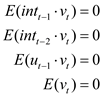
The result is:

    <div class=answer> Consider   as annual percentage change in gross domestic product. Given   is related to short term interest rate by:   , where   is uncorrelated with   and all other past values of interest rates. At one lag time period, such that, at   ,   is related to short term interest rate by   , where   is uncorrelated with   and all other past values of interest rates. That implies,   Now substitute for   in   , where   and   is uncorrelated with all the past values of   and   The result is:   In the equation   , When   is uncorrelated with all the past values of   and   ,   is uncorrelated with   and   , that implies,   Now, in order to observe whether   is correlated with   , consider the covariance of   with   The result is:   Since,   holds as given, it is concluded that there is correlation between   and   , Assume   Hence, it is concluded that   <sub> </sub>is correlated with

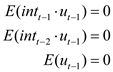
In the equation    <div class=answer> Consider   as annual percentage change in gross domestic product. Given   is related to short term interest rate by:   , where   is uncorrelated with   and all other past values of interest rates. At one lag time period, such that, at   ,   is related to short term interest rate by   , where   is uncorrelated with   and all other past values of interest rates. That implies,   Now substitute for   in   , where   and   is uncorrelated with all the past values of   and   The result is:   In the equation   , When   is uncorrelated with all the past values of   and   ,   is uncorrelated with   and   , that implies,   Now, in order to observe whether   is correlated with   , consider the covariance of   with   The result is:   Since,   holds as given, it is concluded that there is correlation between   and   , Assume   Hence, it is concluded that   <sub> </sub>is correlated with   ,

When     <div class=answer> Consider   as annual percentage change in gross domestic product. Given   is related to short term interest rate by:   , where   is uncorrelated with   and all other past values of interest rates. At one lag time period, such that, at   ,   is related to short term interest rate by   , where   is uncorrelated with   and all other past values of interest rates. That implies,   Now substitute for   in   , where   and   is uncorrelated with all the past values of   and   The result is:   In the equation   , When   is uncorrelated with all the past values of   and   ,   is uncorrelated with   and   , that implies,   Now, in order to observe whether   is correlated with   , consider the covariance of   with   The result is:   Since,   holds as given, it is concluded that there is correlation between   and   , Assume   Hence, it is concluded that   <sub> </sub>is correlated with   is uncorrelated with all the past values of     <div class=answer> Consider   as annual percentage change in gross domestic product. Given   is related to short term interest rate by:   , where   is uncorrelated with   and all other past values of interest rates. At one lag time period, such that, at   ,   is related to short term interest rate by   , where   is uncorrelated with   and all other past values of interest rates. That implies,   Now substitute for   in   , where   and   is uncorrelated with all the past values of   and   The result is:   In the equation   , When   is uncorrelated with all the past values of   and   ,   is uncorrelated with   and   , that implies,   Now, in order to observe whether   is correlated with   , consider the covariance of   with   The result is:   Since,   holds as given, it is concluded that there is correlation between   and   , Assume   Hence, it is concluded that   <sub> </sub>is correlated with   and    <div class=answer> Consider   as annual percentage change in gross domestic product. Given   is related to short term interest rate by:   , where   is uncorrelated with   and all other past values of interest rates. At one lag time period, such that, at   ,   is related to short term interest rate by   , where   is uncorrelated with   and all other past values of interest rates. That implies,   Now substitute for   in   , where   and   is uncorrelated with all the past values of   and   The result is:   In the equation   , When   is uncorrelated with all the past values of   and   ,   is uncorrelated with   and   , that implies,   Now, in order to observe whether   is correlated with   , consider the covariance of   with   The result is:   Since,   holds as given, it is concluded that there is correlation between   and   , Assume   Hence, it is concluded that   <sub> </sub>is correlated with   ,     <div class=answer> Consider   as annual percentage change in gross domestic product. Given   is related to short term interest rate by:   , where   is uncorrelated with   and all other past values of interest rates. At one lag time period, such that, at   ,   is related to short term interest rate by   , where   is uncorrelated with   and all other past values of interest rates. That implies,   Now substitute for   in   , where   and   is uncorrelated with all the past values of   and   The result is:   In the equation   , When   is uncorrelated with all the past values of   and   ,   is uncorrelated with   and   , that implies,   Now, in order to observe whether   is correlated with   , consider the covariance of   with   The result is:   Since,   holds as given, it is concluded that there is correlation between   and   , Assume   Hence, it is concluded that   <sub> </sub>is correlated with   is uncorrelated with     <div class=answer> Consider   as annual percentage change in gross domestic product. Given   is related to short term interest rate by:   , where   is uncorrelated with   and all other past values of interest rates. At one lag time period, such that, at   ,   is related to short term interest rate by   , where   is uncorrelated with   and all other past values of interest rates. That implies,   Now substitute for   in   , where   and   is uncorrelated with all the past values of   and   The result is:   In the equation   , When   is uncorrelated with all the past values of   and   ,   is uncorrelated with   and   , that implies,   Now, in order to observe whether   is correlated with   , consider the covariance of   with   The result is:   Since,   holds as given, it is concluded that there is correlation between   and   , Assume   Hence, it is concluded that   <sub> </sub>is correlated with   and    <div class=answer> Consider   as annual percentage change in gross domestic product. Given   is related to short term interest rate by:   , where   is uncorrelated with   and all other past values of interest rates. At one lag time period, such that, at   ,   is related to short term interest rate by   , where   is uncorrelated with   and all other past values of interest rates. That implies,   Now substitute for   in   , where   and   is uncorrelated with all the past values of   and   The result is:   In the equation   , When   is uncorrelated with all the past values of   and   ,   is uncorrelated with   and   , that implies,   Now, in order to observe whether   is correlated with   , consider the covariance of   with   The result is:   Since,   holds as given, it is concluded that there is correlation between   and   , Assume   Hence, it is concluded that   <sub> </sub>is correlated with   , that implies,

    <div class=answer> Consider   as annual percentage change in gross domestic product. Given   is related to short term interest rate by:   , where   is uncorrelated with   and all other past values of interest rates. At one lag time period, such that, at   ,   is related to short term interest rate by   , where   is uncorrelated with   and all other past values of interest rates. That implies,   Now substitute for   in   , where   and   is uncorrelated with all the past values of   and   The result is:   In the equation   , When   is uncorrelated with all the past values of   and   ,   is uncorrelated with   and   , that implies,   Now, in order to observe whether   is correlated with   , consider the covariance of   with   The result is:   Since,   holds as given, it is concluded that there is correlation between   and   , Assume   Hence, it is concluded that   <sub> </sub>is correlated with

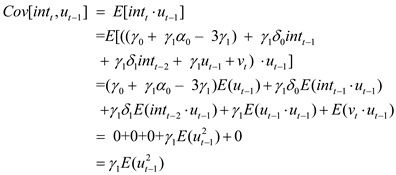
Now, in order to observe whether     <div class=answer> Consider   as annual percentage change in gross domestic product. Given   is related to short term interest rate by:   , where   is uncorrelated with   and all other past values of interest rates. At one lag time period, such that, at   ,   is related to short term interest rate by   , where   is uncorrelated with   and all other past values of interest rates. That implies,   Now substitute for   in   , where   and   is uncorrelated with all the past values of   and   The result is:   In the equation   , When   is uncorrelated with all the past values of   and   ,   is uncorrelated with   and   , that implies,   Now, in order to observe whether   is correlated with   , consider the covariance of   with   The result is:   Since,   holds as given, it is concluded that there is correlation between   and   , Assume   Hence, it is concluded that   <sub> </sub>is correlated with   is correlated with    <div class=answer> Consider   as annual percentage change in gross domestic product. Given   is related to short term interest rate by:   , where   is uncorrelated with   and all other past values of interest rates. At one lag time period, such that, at   ,   is related to short term interest rate by   , where   is uncorrelated with   and all other past values of interest rates. That implies,   Now substitute for   in   , where   and   is uncorrelated with all the past values of   and   The result is:   In the equation   , When   is uncorrelated with all the past values of   and   ,   is uncorrelated with   and   , that implies,   Now, in order to observe whether   is correlated with   , consider the covariance of   with   The result is:   Since,   holds as given, it is concluded that there is correlation between   and   , Assume   Hence, it is concluded that   <sub> </sub>is correlated with   , consider the covariance of     <div class=answer> Consider   as annual percentage change in gross domestic product. Given   is related to short term interest rate by:   , where   is uncorrelated with   and all other past values of interest rates. At one lag time period, such that, at   ,   is related to short term interest rate by   , where   is uncorrelated with   and all other past values of interest rates. That implies,   Now substitute for   in   , where   and   is uncorrelated with all the past values of   and   The result is:   In the equation   , When   is uncorrelated with all the past values of   and   ,   is uncorrelated with   and   , that implies,   Now, in order to observe whether   is correlated with   , consider the covariance of   with   The result is:   Since,   holds as given, it is concluded that there is correlation between   and   , Assume   Hence, it is concluded that   <sub> </sub>is correlated with   with     <div class=answer> Consider   as annual percentage change in gross domestic product. Given   is related to short term interest rate by:   , where   is uncorrelated with   and all other past values of interest rates. At one lag time period, such that, at   ,   is related to short term interest rate by   , where   is uncorrelated with   and all other past values of interest rates. That implies,   Now substitute for   in   , where   and   is uncorrelated with all the past values of   and   The result is:   In the equation   , When   is uncorrelated with all the past values of   and   ,   is uncorrelated with   and   , that implies,   Now, in order to observe whether   is correlated with   , consider the covariance of   with   The result is:   Since,   holds as given, it is concluded that there is correlation between   and   , Assume   Hence, it is concluded that   <sub> </sub>is correlated with

The result is:

    <div class=answer> Consider   as annual percentage change in gross domestic product. Given   is related to short term interest rate by:   , where   is uncorrelated with   and all other past values of interest rates. At one lag time period, such that, at   ,   is related to short term interest rate by   , where   is uncorrelated with   and all other past values of interest rates. That implies,   Now substitute for   in   , where   and   is uncorrelated with all the past values of   and   The result is:   In the equation   , When   is uncorrelated with all the past values of   and   ,   is uncorrelated with   and   , that implies,   Now, in order to observe whether   is correlated with   , consider the covariance of   with   The result is:   Since,   holds as given, it is concluded that there is correlation between   and   , Assume   Hence, it is concluded that   <sub> </sub>is correlated with

Since,     <div class=answer> Consider   as annual percentage change in gross domestic product. Given   is related to short term interest rate by:   , where   is uncorrelated with   and all other past values of interest rates. At one lag time period, such that, at   ,   is related to short term interest rate by   , where   is uncorrelated with   and all other past values of interest rates. That implies,   Now substitute for   in   , where   and   is uncorrelated with all the past values of   and   The result is:   In the equation   , When   is uncorrelated with all the past values of   and   ,   is uncorrelated with   and   , that implies,   Now, in order to observe whether   is correlated with   , consider the covariance of   with   The result is:   Since,   holds as given, it is concluded that there is correlation between   and   , Assume   Hence, it is concluded that   <sub> </sub>is correlated with   holds as given, it is concluded that there is correlation between     <div class=answer> Consider   as annual percentage change in gross domestic product. Given   is related to short term interest rate by:   , where   is uncorrelated with   and all other past values of interest rates. At one lag time period, such that, at   ,   is related to short term interest rate by   , where   is uncorrelated with   and all other past values of interest rates. That implies,   Now substitute for   in   , where   and   is uncorrelated with all the past values of   and   The result is:   In the equation   , When   is uncorrelated with all the past values of   and   ,   is uncorrelated with   and   , that implies,   Now, in order to observe whether   is correlated with   , consider the covariance of   with   The result is:   Since,   holds as given, it is concluded that there is correlation between   and   , Assume   Hence, it is concluded that   <sub> </sub>is correlated with   and    <div class=answer> Consider   as annual percentage change in gross domestic product. Given   is related to short term interest rate by:   , where   is uncorrelated with   and all other past values of interest rates. At one lag time period, such that, at   ,   is related to short term interest rate by   , where   is uncorrelated with   and all other past values of interest rates. That implies,   Now substitute for   in   , where   and   is uncorrelated with all the past values of   and   The result is:   In the equation   , When   is uncorrelated with all the past values of   and   ,   is uncorrelated with   and   , that implies,   Now, in order to observe whether   is correlated with   , consider the covariance of   with   The result is:   Since,   holds as given, it is concluded that there is correlation between   and   , Assume   Hence, it is concluded that   <sub> </sub>is correlated with   , Assume     <div class=answer> Consider   as annual percentage change in gross domestic product. Given   is related to short term interest rate by:   , where   is uncorrelated with   and all other past values of interest rates. At one lag time period, such that, at   ,   is related to short term interest rate by   , where   is uncorrelated with   and all other past values of interest rates. That implies,   Now substitute for   in   , where   and   is uncorrelated with all the past values of   and   The result is:   In the equation   , When   is uncorrelated with all the past values of   and   ,   is uncorrelated with   and   , that implies,   Now, in order to observe whether   is correlated with   , consider the covariance of   with   The result is:   Since,   holds as given, it is concluded that there is correlation between   and   , Assume   Hence, it is concluded that   <sub> </sub>is correlated with

Hence, it is concluded that    <div class=answer> Consider   as annual percentage change in gross domestic product. Given   is related to short term interest rate by:   , where   is uncorrelated with   and all other past values of interest rates. At one lag time period, such that, at   ,   is related to short term interest rate by   , where   is uncorrelated with   and all other past values of interest rates. That implies,   Now substitute for   in   , where   and   is uncorrelated with all the past values of   and   The result is:   In the equation   , When   is uncorrelated with all the past values of   and   ,   is uncorrelated with   and   , that implies,   Now, in order to observe whether   is correlated with   , consider the covariance of   with   The result is:   Since,   holds as given, it is concluded that there is correlation between   and   , Assume   Hence, it is concluded that   <sub> </sub>is correlated with   is correlated with     <div class=answer> Consider   as annual percentage change in gross domestic product. Given   is related to short term interest rate by:   , where   is uncorrelated with   and all other past values of interest rates. At one lag time period, such that, at   ,   is related to short term interest rate by   , where   is uncorrelated with   and all other past values of interest rates. That implies,   Now substitute for   in   , where   and   is uncorrelated with all the past values of   and   The result is:   In the equation   , When   is uncorrelated with all the past values of   and   ,   is uncorrelated with   and   , that implies,   Now, in order to observe whether   is correlated with   , consider the covariance of   with   The result is:   Since,   holds as given, it is concluded that there is correlation between   and   , Assume   Hence, it is concluded that   <sub> </sub>is correlated with


Step 2 of 2

close menu
Introductory Econometrics: A Modern Approach 6th Edition by Jeffrey M Wooldridge
cross icon