


expand icon
book Introductory Econometrics: A Modern Approach 6th Edition by Jeffrey M Wooldridge cover

Introductory Econometrics: A Modern Approach 6th Edition by Jeffrey M Wooldridge

Edition 6ISBN: 130527010X
book Introductory Econometrics: A Modern Approach 6th Edition by Jeffrey M Wooldridge cover

Introductory Econometrics: A Modern Approach 6th Edition by Jeffrey M Wooldridge

Edition 6ISBN: 130527010X
Exercise 21

Use the data for the year 1993 for this question, although you will need to first obtain the lagged murder rate, say mrdrte v

(i) Run the regression of mrdrte on exec, unem. What are the coefficient and t statistic on exec? Does this regression provide any evidence for a deterrent effect of capital punishment?

(ii) How many executions are reported for Texas during 1993? (Actually, this is the sum of executions for the current and past two years.) How does this compare with the other states? Add a dummy variable for Texas to the regression in part (i). Is its t statistic unusually large? From this, does it appear Texas is an "outlier"?

(iii) To the regression in part (i) add the lagged murder rate. What happens to ¡3exec and its statistical significance?

(iv) For the regression in part (iii), does it appear Texas is an outlier? What is the effect on ¡3exec from dropping Texas from the regression?

Step-by-step solution
Verified
like image
like image

Step 1 of 5

(i)

Estimating the regression model of    <div class=answer> (i) Estimating the regression model of   on   using the data for the year 1993 only, the result is:   The coefficient of   is 0.084923 and the respective t-statistic is 0.295124 Given that the coefficient of   is positive indicating that with an increase in execution, there is an increase in murders. Hence, there appears to be no deterrent effect of capital punishment on    <div class=answer> (i) Estimating the regression model of   on   using the data for the year 1993 only, the result is:   The coefficient of   is 0.084923 and the respective t-statistic is 0.295124 Given that the coefficient of   is positive indicating that with an increase in execution, there is an increase in murders. Hence, there appears to be no deterrent effect of capital punishment using the data for the year 1993 only, the result is:
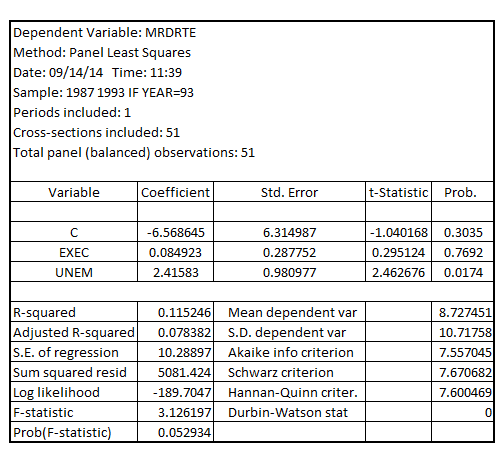
    <div class=answer> (i) Estimating the regression model of   on   using the data for the year 1993 only, the result is:   The coefficient of   is 0.084923 and the respective t-statistic is 0.295124 Given that the coefficient of   is positive indicating that with an increase in execution, there is an increase in murders. Hence, there appears to be no deterrent effect of capital punishment

The coefficient of     <div class=answer> (i) Estimating the regression model of   on   using the data for the year 1993 only, the result is:   The coefficient of   is 0.084923 and the respective t-statistic is 0.295124 Given that the coefficient of   is positive indicating that with an increase in execution, there is an increase in murders. Hence, there appears to be no deterrent effect of capital punishment is 0.084923 and the respective t-statistic is 0.295124

Given that the coefficient of     <div class=answer> (i) Estimating the regression model of   on   using the data for the year 1993 only, the result is:   The coefficient of   is 0.084923 and the respective t-statistic is 0.295124 Given that the coefficient of   is positive indicating that with an increase in execution, there is an increase in murders. Hence, there appears to be no deterrent effect of capital punishment is positive indicating that with an increase in execution, there is an increase in murders. Hence, there appears to be no deterrent effect of capital punishment


Step 2 of 5


Step 3 of 5


Step 4 of 5


Step 5 of 5

close menu
Introductory Econometrics: A Modern Approach 6th Edition by Jeffrey M Wooldridge
cross icon



