expand icon
book Introductory Econometrics: A Modern Approach 6th Edition by Jeffrey M Wooldridge cover

Introductory Econometrics: A Modern Approach 6th Edition by Jeffrey M Wooldridge

Edition 6ISBN: 130527010X
book Introductory Econometrics: A Modern Approach 6th Edition by Jeffrey M Wooldridge cover

Introductory Econometrics: A Modern Approach 6th Edition by Jeffrey M Wooldridge

Edition 6ISBN: 130527010X
Exercise 16

Suppose that log(y) follows a linear model with a linear form of heteroskedasticity. We write this as
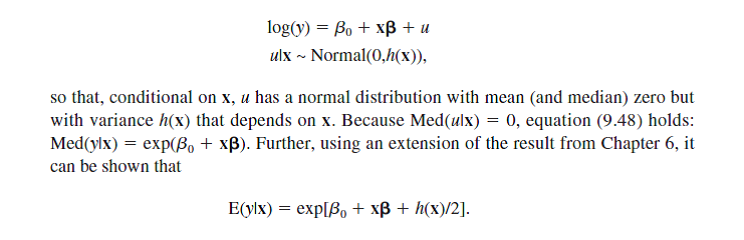
 Suppose that log(<i>y</i>) follows a linear model with a linear form of heteroskedasticity. We write this as   (i) Given that <i>h</i>( x ) can be any positive function, is it possible to conclude ?E(<i>y</i>| x )/?<i>x</i><sub>j</sub><i> </i>is the same sign as <i>   </i> (ii) Suppose <i>   </i>(and ignore the problem that linear functions are not necessarily always positive). Show that a particular variable, say <i>x</i><sub>1</sub>, can have a negative effect on Med(<i>y</i>| x ) but a positive effect on E(<i>y</i>| x ). (iii) Consider the case covered in Section 6.4, where <i>   </i>. How would you predict <i>y </i>using an estimate of E(<i>y</i>| x )? How would you predict <i>y </i>using an estimate of Med(<i>y</i>| x )? Which prediction is always larger?

(i) Given that h(x) can be any positive function, is it possible to conclude ?E(y|x)/?xj is the same sign as  Suppose that log(<i>y</i>) follows a linear model with a linear form of heteroskedasticity. We write this as   (i) Given that <i>h</i>( x ) can be any positive function, is it possible to conclude ?E(<i>y</i>| x )/?<i>x</i><sub>j</sub><i> </i>is the same sign as <i>   </i> (ii) Suppose <i>   </i>(and ignore the problem that linear functions are not necessarily always positive). Show that a particular variable, say <i>x</i><sub>1</sub>, can have a negative effect on Med(<i>y</i>| x ) but a positive effect on E(<i>y</i>| x ). (iii) Consider the case covered in Section 6.4, where <i>   </i>. How would you predict <i>y </i>using an estimate of E(<i>y</i>| x )? How would you predict <i>y </i>using an estimate of Med(<i>y</i>| x )? Which prediction is always larger?

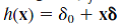
(ii) Suppose  Suppose that log(<i>y</i>) follows a linear model with a linear form of heteroskedasticity. We write this as   (i) Given that <i>h</i>( x ) can be any positive function, is it possible to conclude ?E(<i>y</i>| x )/?<i>x</i><sub>j</sub><i> </i>is the same sign as <i>   </i> (ii) Suppose <i>   </i>(and ignore the problem that linear functions are not necessarily always positive). Show that a particular variable, say <i>x</i><sub>1</sub>, can have a negative effect on Med(<i>y</i>| x ) but a positive effect on E(<i>y</i>| x ). (iii) Consider the case covered in Section 6.4, where <i>   </i>. How would you predict <i>y </i>using an estimate of E(<i>y</i>| x )? How would you predict <i>y </i>using an estimate of Med(<i>y</i>| x )? Which prediction is always larger? (and ignore the problem that linear functions are not necessarily always positive). Show that a particular variable, say x1, can have a negative effect on Med(y|x) but a positive effect on E(y|x).

(iii) Consider the case covered in Section 6.4, where  Suppose that log(<i>y</i>) follows a linear model with a linear form of heteroskedasticity. We write this as   (i) Given that <i>h</i>( x ) can be any positive function, is it possible to conclude ?E(<i>y</i>| x )/?<i>x</i><sub>j</sub><i> </i>is the same sign as <i>   </i> (ii) Suppose <i>   </i>(and ignore the problem that linear functions are not necessarily always positive). Show that a particular variable, say <i>x</i><sub>1</sub>, can have a negative effect on Med(<i>y</i>| x ) but a positive effect on E(<i>y</i>| x ). (iii) Consider the case covered in Section 6.4, where <i>   </i>. How would you predict <i>y </i>using an estimate of E(<i>y</i>| x )? How would you predict <i>y </i>using an estimate of Med(<i>y</i>| x )? Which prediction is always larger? . How would you predict y using an estimate of E(y|x)? How would you predict y using an estimate of Med(y|x)? Which prediction is always larger?

Step-by-step solution
Verified
like image
like image

Step 1 of 7

Consider, conditional on the explanatory variables,     <div class=answer> Consider, conditional on the explanatory variables,   and   satisfy the Gauss-Markov assumptions, the linear combination of the variables is given as:   And,   Also,   has the linear relationship with   :   And,   and     <div class=answer> Consider, conditional on the explanatory variables,   and   satisfy the Gauss-Markov assumptions, the linear combination of the variables is given as:   And,   Also,   has the linear relationship with   :   And,   satisfy the Gauss-Markov assumptions, the linear combination of the variables is given as:


    <div class=answer> Consider, conditional on the explanatory variables,   and   satisfy the Gauss-Markov assumptions, the linear combination of the variables is given as:   And,   Also,   has the linear relationship with   :   And,

And,

    <div class=answer> Consider, conditional on the explanatory variables,   and   satisfy the Gauss-Markov assumptions, the linear combination of the variables is given as:   And,   Also,   has the linear relationship with   :   And,

Also,     <div class=answer> Consider, conditional on the explanatory variables,   and   satisfy the Gauss-Markov assumptions, the linear combination of the variables is given as:   And,   Also,   has the linear relationship with   :   And,   has the linear relationship with    <div class=answer> Consider, conditional on the explanatory variables,   and   satisfy the Gauss-Markov assumptions, the linear combination of the variables is given as:   And,   Also,   has the linear relationship with   :   And,   :

    <div class=answer> Consider, conditional on the explanatory variables,   and   satisfy the Gauss-Markov assumptions, the linear combination of the variables is given as:   And,   Also,   has the linear relationship with   :   And,

And,

    <div class=answer> Consider, conditional on the explanatory variables,   and   satisfy the Gauss-Markov assumptions, the linear combination of the variables is given as:   And,   Also,   has the linear relationship with   :   And,


Step 2 of 7


Step 3 of 7


Step 4 of 7


Step 5 of 7


Step 6 of 7


Step 7 of 7

close menu
Introductory Econometrics: A Modern Approach 6th Edition by Jeffrey M Wooldridge
cross icon