


expand icon
book Introductory Econometrics: A Modern Approach 6th Edition by Jeffrey M Wooldridge cover

Introductory Econometrics: A Modern Approach 6th Edition by Jeffrey M Wooldridge

Edition 6ISBN: 130527010X
book Introductory Econometrics: A Modern Approach 6th Edition by Jeffrey M Wooldridge cover

Introductory Econometrics: A Modern Approach 6th Edition by Jeffrey M Wooldridge

Edition 6ISBN: 130527010X
Exercise 9

Use the data in RDCHEM.RAW to further examine the effects of outliers on OLS estimates and to see how LAD is less sensitive to outliers. The model is

rdintens = ?0+ ?1sales + ?2sales2 + ?3profmarg + u,

where you should first change sales to be in billions of dollars to make the estimates easier to interpret.

(i) Estimate the above equation by OLS, both with and without the firm having annual sales of almost $40 billion. Discuss any notable differences in the estimated coefficients.

(ii) Estimate the same equation by LAD, again with and without the largest firm. Discuss any important differences in estimated coefficients.

(iii) Based on your findings in (i) and (ii), would you say OLS or LAD is more resilient to outliers?

Step-by-step solution
Verified
like image
like image

Step 1 of 5

(i)

It shall be noted that there is one observation of the firm with annual sales of $ 39.709 bn which is almost equal to $40 bn

The OLS estimation of the model is to be proceeded with and without this observation

Case1: Including the firm having the annual sales of almost $40 bn

Estimating the model given by:

    <div class=answer> (i) It shall be noted that there is one observation of the firm with annual sales of $ 39.709 bn which is almost equal to $40 bn The OLS estimation of the model is to be proceeded with and without this observation Case1: Including the firm having the annual sales of almost $40 bn Estimating the model given by:   The result is:     Case2: Excluding the firm having the annual sales of almost $40 bn Estimating the model given by:   The result is:
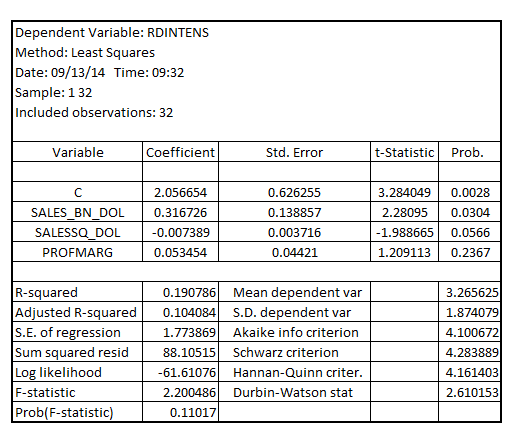
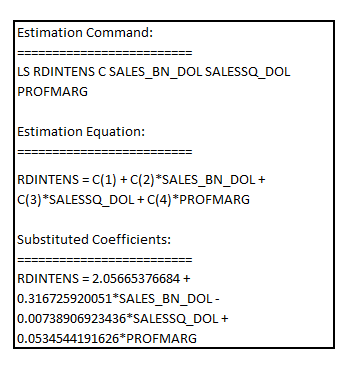
The result is:

    <div class=answer> (i) It shall be noted that there is one observation of the firm with annual sales of $ 39.709 bn which is almost equal to $40 bn The OLS estimation of the model is to be proceeded with and without this observation Case1: Including the firm having the annual sales of almost $40 bn Estimating the model given by:   The result is:     Case2: Excluding the firm having the annual sales of almost $40 bn Estimating the model given by:   The result is:

    <div class=answer> (i) It shall be noted that there is one observation of the firm with annual sales of $ 39.709 bn which is almost equal to $40 bn The OLS estimation of the model is to be proceeded with and without this observation Case1: Including the firm having the annual sales of almost $40 bn Estimating the model given by:   The result is:     Case2: Excluding the firm having the annual sales of almost $40 bn Estimating the model given by:   The result is:

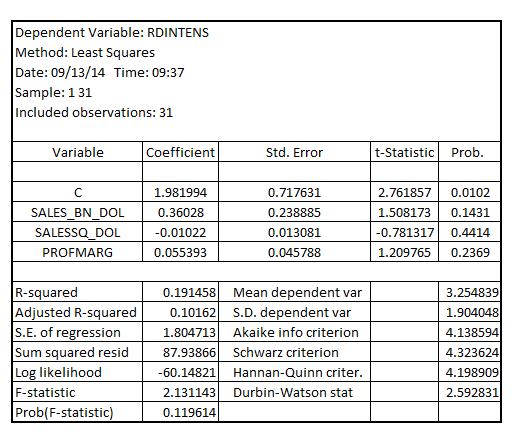
Case2: Excluding the firm having the annual sales of almost $40 bn

Estimating the model given by:

    <div class=answer> (i) It shall be noted that there is one observation of the firm with annual sales of $ 39.709 bn which is almost equal to $40 bn The OLS estimation of the model is to be proceeded with and without this observation Case1: Including the firm having the annual sales of almost $40 bn Estimating the model given by:   The result is:     Case2: Excluding the firm having the annual sales of almost $40 bn Estimating the model given by:   The result is:

The result is:

    <div class=answer> (i) It shall be noted that there is one observation of the firm with annual sales of $ 39.709 bn which is almost equal to $40 bn The OLS estimation of the model is to be proceeded with and without this observation Case1: Including the firm having the annual sales of almost $40 bn Estimating the model given by:   The result is:     Case2: Excluding the firm having the annual sales of almost $40 bn Estimating the model given by:   The result is:


Step 2 of 5


Step 3 of 5


Step 4 of 5


Step 5 of 5

close menu
Introductory Econometrics: A Modern Approach 6th Edition by Jeffrey M Wooldridge
cross icon



