





 Chat with AI


Introductory Econometrics: A Modern Approach 6th Edition by Jeffrey M Wooldridge
Edition 6ISBN: 130527010XIntroductory Econometrics: A Modern Approach 6th Edition by Jeffrey M Wooldridge
Edition 6ISBN: 130527010XUse the data set 401KSUBS.RAW for this exercise.
(i) Using OLS, estimate a linear probability model for e401k, using as explanatory variables inc, inc2, age, age2, and male. Obtain both the usual OLS standard errors and the heteroskedasticity-robust versions. Are there any important differences?
(ii) In the special case of the White test for heteroskedasticity, where we regress the squared OLS residuals on a quadratic in the OLS fitted values,
i = 1, ..., n, argue that the probability limit of the coefficient on ?i should be one, the probability limit of the coefficient on ?i2 should be — 1, and the probability limit of the intercept should be zero. {Hint: Remember that Var(y|x1, xk) = p(x)[1 — p(x)], where p(x) = ?0 + ?1x1 + ... + ?kxk.}
(iii) For the model estimated from part (i), obtain the White test and see if the coefficient estimates roughly correspond to the theoretical values described in part (ii).
(iv) After verifying that the fitted values from part (i) are all between zero and one, obtain the weighted least squares estimates of the linear probability model. Do they differ in important ways from the OLS estimates?
 Verified
Step 1 of 6
(i)
Estimate the model relating  to
to  using OLS. The result is as follows:
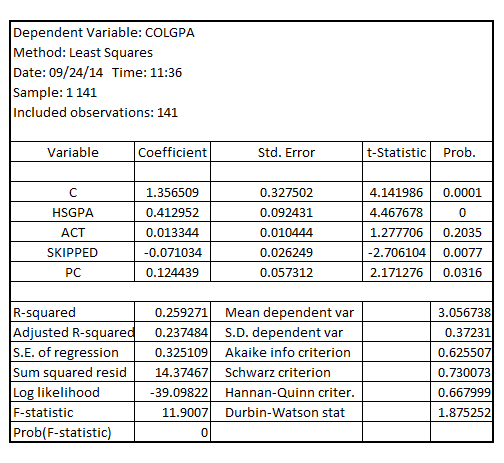
The residuals are obtained by taking the difference between actual and estimated
 .
.
That is:

Step 2 of 6
Step 3 of 6
Step 4 of 6
Step 5 of 6
Step 6 of 6


Why don’t you like this exercise?
Other






