


expand icon
book Introductory Econometrics: A Modern Approach 6th Edition by Jeffrey M Wooldridge cover

Introductory Econometrics: A Modern Approach 6th Edition by Jeffrey M Wooldridge

Edition 6ISBN: 130527010X
book Introductory Econometrics: A Modern Approach 6th Edition by Jeffrey M Wooldridge cover

Introductory Econometrics: A Modern Approach 6th Edition by Jeffrey M Wooldridge

Edition 6ISBN: 130527010X
Exercise 10

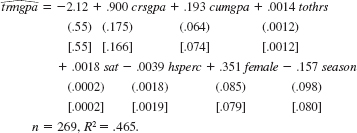
The variable smokes is a binary variable equal to one if a person smokes, and zero otherwise. Using the data in SMOKE.RAW, we estimate a linear probability model for smokes:
 The variable smokes is a binary variable equal to one if a person smokes, and zero otherwise. Using the data in SMOKE.RAW, we estimate a linear probability model for smokes:   The variable white equals one if the respondent is white, and zero otherwise; the other independent variables are defined in Example 8.7. Both the usual and heteroskedasticity-robust standard errors are reported. <blockquote> (i) Are there any important differences between the two sets of standard errors? (ii) Holding other factors fixed, if education increases by four years, what happens to the estimated probability of smoking? (iii) At what point does another year of age reduce the probability of smoking? (iv) Interpret the coefficient on the binary variable restaurn (a dummy variable equal to one if the person lives in a state with restaurant smoking restrictions). (v) Person number 206 in the data set has the following characteristics: cigpric = 67.44, income = 6,500, educ = 16, age = 77, restaurn = 0, white = 0, and smokes = 0. Compute the predicted probability of smoking for this person and comment on the result. </blockquote>

The variable white equals one if the respondent is white, and zero otherwise; the other independent variables are defined in Example 8.7. Both the usual and heteroskedasticity-robust standard errors are reported.

(i) Are there any important differences between the two sets of standard errors?

(ii) Holding other factors fixed, if education increases by four years, what happens to the estimated probability of smoking?

(iii) At what point does another year of age reduce the probability of smoking?

(iv) Interpret the coefficient on the binary variable restaurn (a dummy variable equal to one if the person lives in a state with restaurant smoking restrictions).

(v) Person number 206 in the data set has the following characteristics: cigpric = 67.44, income = 6,500, educ = 16, age = 77, restaurn = 0, white = 0, and smokes = 0. Compute the predicted probability of smoking for this person and comment on the result.

Step-by-step solution
Verified
like image
like image

Step 1 of 6

(i)

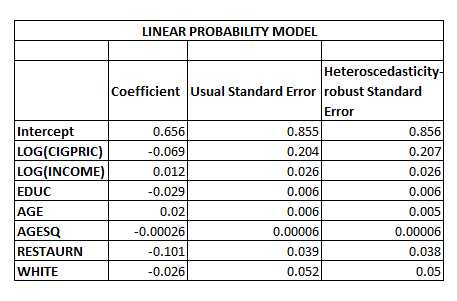
On comparing the usual standard error with the heteroscedasticity-robust standard error of the given model, the result is:

    <div class=answer> (i) On comparing the usual standard error with the heteroscedasticity-robust standard error of the given model, the result is:      It shall be noted that there are no important differences between the two sets of standard errors

    <div class=answer> (i) On comparing the usual standard error with the heteroscedasticity-robust standard error of the given model, the result is:      It shall be noted that there are no important differences between the two sets of standard errors

It shall be noted that there are no important differences between the two sets of standard errors


Step 2 of 6


Step 3 of 6


Step 4 of 6


Step 5 of 6


Step 6 of 6

close menu
Introductory Econometrics: A Modern Approach 6th Edition by Jeffrey M Wooldridge
cross icon



