





 Chat with AI


Introductory Econometrics: A Modern Approach 6th Edition by Jeffrey M Wooldridge
Edition 6ISBN: 130527010XIntroductory Econometrics: A Modern Approach 6th Edition by Jeffrey M Wooldridge
Edition 6ISBN: 130527010XUsing the data in GPA3.RAW, the following equation was estimated for the fall and second semester students:
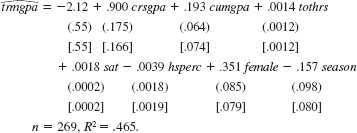
Here, trmgpa is term GPA, crsgpa is a weighted average of overall GPA in courses taken, cumgpa is GPA prior to the current semester, tothrs is total credit hours prior to the semester, sat is SAT score, hsperc is graduating percentile in high school class, female is a gender dummy, and season is a dummy variable equal to unity if the student's sport is in season during the fall. The usual and heteroskedasticity-robust standard errors are reported in parentheses and brackets, respectively.
(i) Do the variables crsgpa, cumgpa, and tothrs have the expected estimated effects? Which of these variables are statistically significant at the 5% level? Does it matter which standard errors are used?
(ii) Why does the hypothesis H0: ?crsgpa = 1 make sense? Test this hypothesis against the two-sided alternative at the 5% level, using both standard errors. Describe your conclusions.
(iii) Test whether there is an in-season effect on term GPA, using both standard errors. Does the significance level at which the null can be rejected depend on the standard error used?
 Verified
Step 1 of 4
(i)
The equation that is estimated for the fall and second semester students is given by:

In this model, the usual and heteroskedasticity-robust standard errors are reported in parentheses and brackets respectively
The t-statistic assuming usual and heteroskedasticity-robust standard error is as follows:
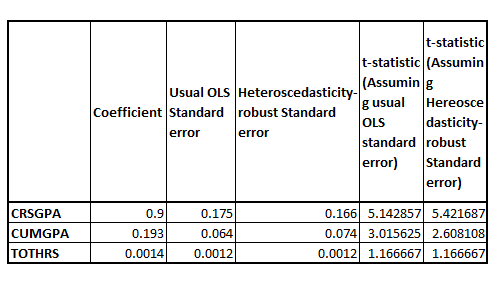

At 5% level of significance and at 261 degrees of freedom (df = n-k = 269-8=261), the critical t-statistic is 1.96
As far as variable  and
and are concerned, the t-statistic estimated is greater than 1.96 be it assuming usual OLS standard error or heteroskedasticity-robust standard error. This shows that the variables
 and
and are significant at 5% level of significance.
As far as variable is concerned, the t-statistic estimated is less than 1.96, be it assuming usual OLS standard error or heteroskedasticity-robust standard error. This shows that the variable
 is insignificant at 5% level of significance.
It shall be noted that it does not matter which standard errors are used in determining the statistical significance of the explanatory variables because the two sets of standard errors are not very different.
Step 2 of 4
Step 3 of 4
Step 4 of 4


Why don’t you like this exercise?
Other






