





 Chat with AI


Introductory Econometrics: A Modern Approach 6th Edition by Jeffrey M Wooldridge
Edition 6ISBN: 130527010XIntroductory Econometrics: A Modern Approach 6th Edition by Jeffrey M Wooldridge
Edition 6ISBN: 130527010XUse VOTE1.RAW for this exercise.
(i) Estimate a model with voteA as the dependent variable and prtystrA, democA, log(expendA), and log(expendB) as independent variables. Obtain the OLS residuals, h., and regress these on all of the independent variables. Explain why you obtain R2 = 0.
(ii) Now, compute the Breusch-Pagan test for heteroskedasticity. Use the F statistic version and report the p-value.
(iii) Compute the special case of the White test for heteroskedasticity, again using the F statistic form. How strong is the evidence for heteroskedasticity now?
 Verified
Step 1 of 5
(i)
Estimate the model with  as the dependent variable and
  as the independent variables using OLS. The result is as follows:
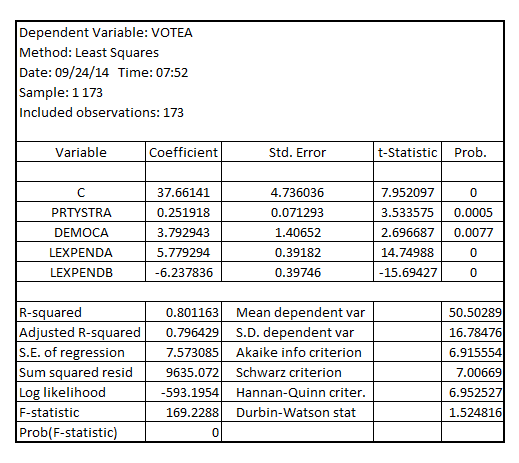
Estimate the error term from the model and regress it on  . The result is as follows:
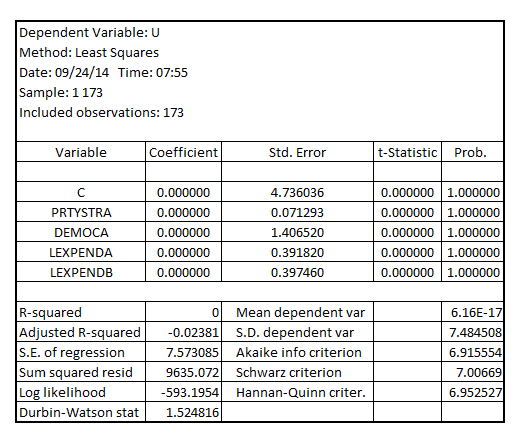
The R-squared is zero, that is, 
This is because at the first place, when the model with  as the dependent variable is estimated with
  as the independent variables using OLS, the OLS estimated the coefficients of
  such that the error term is uncorrelated with each of the independent variables
It shall be noted that in course of estimating the coefficients of the independent variables using OLS, it is assumed that the sum of the squares of the error term would be minimized
Step 2 of 5
Step 3 of 5
Step 4 of 5
Step 5 of 5


Why don’t you like this exercise?
Other






