





 Chat with AI


Introductory Econometrics: A Modern Approach 6th Edition by Jeffrey M Wooldridge
Edition 6ISBN: 130527010XIntroductory Econometrics: A Modern Approach 6th Edition by Jeffrey M Wooldridge
Edition 6ISBN: 130527010XUse the data in FERTIL2.RAW to answer this question.
(i) Find the smallest and largest values of children in the sample. What is the average of children? Does any woman have exactly the average number of children?
(ii) What percentage of women have electricity in the home?
(iii) Compute the average of children for those without electricity and do the same for those with electricity. Comment on what you find. Test whether the population means are the same using a simple regression.
(iv) From part (iii), can you infer that having electricity “causes” women to have fewer children? Explain.
(v) Estimate a multiple regression model of the kind reported in equation (7.37), but add age2, urban, and the three religious affiliation dummies. How does the estimated effect of having electricity compare with that in part (iii)? Is it still statistically significant?
(vi) To the equation in part (v), add an interaction between electric and educ. Is its coefficient statistically significant? What happens to the coefficient on electric?
(vii) The median and mode value for educ is 7. In the equation from part (vi), use the centered interaction term electric • (educ – 7) in place of electric • educ. What happens to the coefficient on electric compared with part (vi)? Why? How does the coefficient on electric compare with that in part (v)?
Reference: equation (7.37)

 Verified
Step 1 of 24
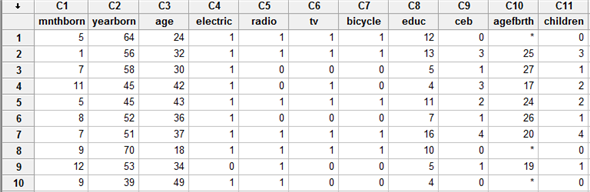
Consider the provided data set “FERTIL2” to solve the subparts and write down the whole data in to Minitab worksheet, the screenshot is shown below:
Step 2 of 24
Step 3 of 24
Step 4 of 24
Step 5 of 24
Step 6 of 24
Step 7 of 24
Step 8 of 24
Step 9 of 24
Step 10 of 24
Step 11 of 24
Step 12 of 24
Step 13 of 24
Step 14 of 24
Step 15 of 24
Step 16 of 24
Step 17 of 24
Step 18 of 24
Step 19 of 24
Step 20 of 24
Step 21 of 24
Step 22 of 24
Step 23 of 24
Step 24 of 24


Why don’t you like this exercise?
Other






