


expand icon
book Introductory Econometrics: A Modern Approach 6th Edition by Jeffrey M Wooldridge cover

Introductory Econometrics: A Modern Approach 6th Edition by Jeffrey M Wooldridge

Edition 6ISBN: 130527010X
book Introductory Econometrics: A Modern Approach 6th Edition by Jeffrey M Wooldridge cover

Introductory Econometrics: A Modern Approach 6th Edition by Jeffrey M Wooldridge

Edition 6ISBN: 130527010X
Exercise 13

Use the data in ATTEND.RAW for thiexercise.

(i) In the model of Example 6.3, argue that ?stndfnl/?priGPA?????2 + 2????4priGPA + ????6atndrte. Use equation (6.19) to estimate the partial effect when priGPA = 2.59 and atndrte = 82. Interpret your estimate.

(ii) Show that the equation can be written as stndfnl = ????0 + ????1atndrte + ????2priGPA + ???? 3ACT + ????4(priGPA - 2.59)2 + ????5 ACT2 + ????6 priGPA(atndrte - 82) + u,

where ????2 = ????2 + 2????4(2.59) + ????6(82). (Note that the intercept has changed, but this is unimportant.) Use this to obtain the standard error of  Use the data in ATTEND.RAW for thiexercise. <blockquote> (i) In the model of Example 6.3, argue that ?stndfnl/?priGPA?????<span class=sub>2</span> + 2????<span class=sub>4</span>priGPA + ????<span class=sub>6</span>atndrte. Use equation (6.19) to estimate the partial effect when priGPA = 2.59 and atndrte = 82. Interpret your estimate. (ii) Show that the equation can be written as stndfnl = ????<span class=sub>0</span> + ????<span class=sub>1</span>atndrte + ????<span class=sub>2</span>priGPA + ???? 3ACT + ????<span class=sub>4</span>(priGPA - 2.59)<span class=sup>2</span> + ????<span class=sub>5</span> ACT<span class=sup>2</span> + ????<span class=sub>6</span> priGPA(atndrte - 82) + u, where ????<span class=sub>2</span> = ????<span class=sub>2</span> + 2????<span class=sub>4</span>(2.59) + ????<span class=sub>6</span>(82). (Note that the intercept has changed, but this is unimportant.) Use this to obtain the standard error of   from part (i). (iii) Suppose that, in place of priGPA(atndrte - 82), you put (priGPA - 2.59)-(atndrte - 82). Now how do you interpret the coefficients on atndrte and priGPA? </blockquote>   from part (i).

(iii) Suppose that, in place of priGPA(atndrte - 82), you put (priGPA - 2.59)-(atndrte - 82). Now how do you interpret the coefficients on atndrte and priGPA?

Step-by-step solution
Verified
like image
like image

Step 1 of 3

(i)

Hold all variables except priGPA fixed and use the usual approximation    <div class=answer> (i) Hold all variables except <i>priGPA </i>fixed and use the usual approximation   , to get:   Dividing by ?<i>priGPA </i>as follows:   In equation (6.19)   . When <i>priGPA</i>= 2.59 and <i>atndrte</i>= 82, thus the partial estimate is calculated as follows:   The coefficient obtained is   showing a positive relation. , to get:

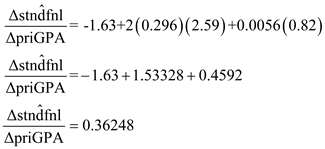
    <div class=answer> (i) Hold all variables except <i>priGPA </i>fixed and use the usual approximation   , to get:   Dividing by ?<i>priGPA </i>as follows:   In equation (6.19)   . When <i>priGPA</i>= 2.59 and <i>atndrte</i>= 82, thus the partial estimate is calculated as follows:   The coefficient obtained is   showing a positive relation.

Dividing by ?priGPA as follows:

    <div class=answer> (i) Hold all variables except <i>priGPA </i>fixed and use the usual approximation   , to get:   Dividing by ?<i>priGPA </i>as follows:   In equation (6.19)   . When <i>priGPA</i>= 2.59 and <i>atndrte</i>= 82, thus the partial estimate is calculated as follows:   The coefficient obtained is   showing a positive relation.

In equation (6.19)     <div class=answer> (i) Hold all variables except <i>priGPA </i>fixed and use the usual approximation   , to get:   Dividing by ?<i>priGPA </i>as follows:   In equation (6.19)   . When <i>priGPA</i>= 2.59 and <i>atndrte</i>= 82, thus the partial estimate is calculated as follows:   The coefficient obtained is   showing a positive relation. . When priGPA= 2.59 and atndrte= 82, thus the partial estimate is calculated as follows:

    <div class=answer> (i) Hold all variables except <i>priGPA </i>fixed and use the usual approximation   , to get:   Dividing by ?<i>priGPA </i>as follows:   In equation (6.19)   . When <i>priGPA</i>= 2.59 and <i>atndrte</i>= 82, thus the partial estimate is calculated as follows:   The coefficient obtained is   showing a positive relation.

The coefficient obtained is    <div class=answer> (i) Hold all variables except <i>priGPA </i>fixed and use the usual approximation   , to get:   Dividing by ?<i>priGPA </i>as follows:   In equation (6.19)   . When <i>priGPA</i>= 2.59 and <i>atndrte</i>= 82, thus the partial estimate is calculated as follows:   The coefficient obtained is   showing a positive relation. showing a positive relation.


Step 2 of 3


Step 3 of 3

close menu
Introductory Econometrics: A Modern Approach 6th Edition by Jeffrey M Wooldridge
cross icon






