


expand icon
book Introductory Econometrics: A Modern Approach 6th Edition by Jeffrey M Wooldridge cover

Introductory Econometrics: A Modern Approach 6th Edition by Jeffrey M Wooldridge

Edition 6ISBN: 130527010X
book Introductory Econometrics: A Modern Approach 6th Edition by Jeffrey M Wooldridge cover

Introductory Econometrics: A Modern Approach 6th Edition by Jeffrey M Wooldridge

Edition 6ISBN: 130527010X
Exercise 18

In Problem 3.3, we estimated the equation

 In Problem 3.3, we estimated the equation   where we now report standard errors along with the estimates. (i) Is either educ or age individually significant at the 5% level against a two-sided alternative? Show your work. <blockquote> (ii) Dropping educ and age from the equation gives   Are educ and age jointly significant in the original equation at the 5% level? Justify your answer. (iii) Does including educ and age in the model greatly affect the estimated tradeoff between sleeping and working? (iv) Suppose that the sleep equation contains heteroskedasticity. What does this mean about the tests computed in parts (i) and (ii)? </blockquote>

where we now report standard errors along with the estimates.

(i) Is either educ or age individually significant at the 5% level against a two-sided alternative? Show your work.

(ii) Dropping educ and age from the equation gives

 In Problem 3.3, we estimated the equation   where we now report standard errors along with the estimates. (i) Is either educ or age individually significant at the 5% level against a two-sided alternative? Show your work. <blockquote> (ii) Dropping educ and age from the equation gives   Are educ and age jointly significant in the original equation at the 5% level? Justify your answer. (iii) Does including educ and age in the model greatly affect the estimated tradeoff between sleeping and working? (iv) Suppose that the sleep equation contains heteroskedasticity. What does this mean about the tests computed in parts (i) and (ii)? </blockquote>

Are educ and age jointly significant in the original equation at the 5% level? Justify your answer.

(iii) Does including educ and age in the model greatly affect the estimated tradeoff between sleeping and working?

(iv) Suppose that the sleep equation contains heteroskedasticity. What does this mean about the tests computed in parts (i) and (ii)?
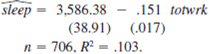
Step-by-step solution
Verified
like image
like image

Step 1 of 4

(i)

With df = 706 – 4 = 702, use the standard normal critical value (df = 8 from the table), which is 1.96 for a two-tailed test at the 5% level. The t-statistic is calculated as shown below:

    <div class=answer> (i) With <i>df </i>= 706 – 4 = 702, use the standard normal critical value (<i>df </i>= 8 from the table), which is 1.96 for a two-tailed test at the 5% level. The t-statistic is calculated as shown below:   Since,   Hence, researcher fails to reject   at the 5% level. Also, <i>t</i>-statistic for <i>age </i>is calculated below:   Hence,   So, <i>age </i>is also statistically insignificant at the 5% level.

Since,

    <div class=answer> (i) With <i>df </i>= 706 – 4 = 702, use the standard normal critical value (<i>df </i>= 8 from the table), which is 1.96 for a two-tailed test at the 5% level. The t-statistic is calculated as shown below:   Since,   Hence, researcher fails to reject   at the 5% level. Also, <i>t</i>-statistic for <i>age </i>is calculated below:   Hence,   So, <i>age </i>is also statistically insignificant at the 5% level.

Hence, researcher fails to reject    <div class=answer> (i) With <i>df </i>= 706 – 4 = 702, use the standard normal critical value (<i>df </i>= 8 from the table), which is 1.96 for a two-tailed test at the 5% level. The t-statistic is calculated as shown below:   Since,   Hence, researcher fails to reject   at the 5% level. Also, <i>t</i>-statistic for <i>age </i>is calculated below:   Hence,   So, <i>age </i>is also statistically insignificant at the 5% level. at the 5% level. Also, t-statistic for age is calculated below:

    <div class=answer> (i) With <i>df </i>= 706 – 4 = 702, use the standard normal critical value (<i>df </i>= 8 from the table), which is 1.96 for a two-tailed test at the 5% level. The t-statistic is calculated as shown below:   Since,   Hence, researcher fails to reject   at the 5% level. Also, <i>t</i>-statistic for <i>age </i>is calculated below:   Hence,   So, <i>age </i>is also statistically insignificant at the 5% level.

Hence,

    <div class=answer> (i) With <i>df </i>= 706 – 4 = 702, use the standard normal critical value (<i>df </i>= 8 from the table), which is 1.96 for a two-tailed test at the 5% level. The t-statistic is calculated as shown below:   Since,   Hence, researcher fails to reject   at the 5% level. Also, <i>t</i>-statistic for <i>age </i>is calculated below:   Hence,   So, <i>age </i>is also statistically insignificant at the 5% level.

So, age is also statistically insignificant at the 5% level.


Step 2 of 4


Step 3 of 4


Step 4 of 4

close menu
Introductory Econometrics: A Modern Approach 6th Edition by Jeffrey M Wooldridge
cross icon



