


expand icon
book Introductory Econometrics: A Modern Approach 6th Edition by Jeffrey M Wooldridge cover

Introductory Econometrics: A Modern Approach 6th Edition by Jeffrey M Wooldridge

Edition 6ISBN: 130527010X
book Introductory Econometrics: A Modern Approach 6th Edition by Jeffrey M Wooldridge cover

Introductory Econometrics: A Modern Approach 6th Edition by Jeffrey M Wooldridge

Edition 6ISBN: 130527010X
Exercise 5

Refer to Computer Exercise C2 in Chapter 3. Now, use the log of the housing price as the dependent variable:

 Refer to Computer Exercise C2 in Chapter 3. Now, use the log of the housing price as the dependent variable:   (i) You are interested in estimating and obtaining a confidence interval for the percentage change in <i>price </i>when a 150-square-foot bedroom is added to a house. In decimal form, this is <i>   </i> Use the data in HPRICE1.RAW to estimate <i>   </i> (ii) Write <i>   </i> in terms of <i>   </i>and <i>   </i>and plug this into the log(<i>price</i>) equation. (iii) Use part (ii) to obtain a standard error for <i>   </i> and use this standard error to construct a 95% confidence interval. Reference: Exercise C2: Use the data in HPRICE1.RAW to estimate the model <i>   </i> where <i>price </i>is the house price measured in thousands of dollars. (i) Write out the results in equation form. (ii) What is the estimated increase in price for a house with one more bedroom, holding square footage constant? (iii) What is the estimated increase in price for a house with an additional bedroom that is 140 square feet in size? Compare this to your answer in part (ii). (iv) What percentage of the variation in price is explained by square footage and number of bedrooms? (v) The first house in the sample has <i>sqrft </i>= 2,438 and <i>bdrms </i>= 4. Find the predicted selling price for this house from the OLS regression line. (vi) The actual selling price of the first house in the sample was $300,000 (so <i>price </i>= 300). Find the residual for this house. Does it suggest that the buyer underpaid or overpaid for the house?

(i) You are interested in estimating and obtaining a confidence interval for the percentage change in price when a 150-square-foot bedroom is added to a house. In decimal form, this is  Refer to Computer Exercise C2 in Chapter 3. Now, use the log of the housing price as the dependent variable:   (i) You are interested in estimating and obtaining a confidence interval for the percentage change in <i>price </i>when a 150-square-foot bedroom is added to a house. In decimal form, this is <i>   </i> Use the data in HPRICE1.RAW to estimate <i>   </i> (ii) Write <i>   </i> in terms of <i>   </i>and <i>   </i>and plug this into the log(<i>price</i>) equation. (iii) Use part (ii) to obtain a standard error for <i>   </i> and use this standard error to construct a 95% confidence interval. Reference: Exercise C2: Use the data in HPRICE1.RAW to estimate the model <i>   </i> where <i>price </i>is the house price measured in thousands of dollars. (i) Write out the results in equation form. (ii) What is the estimated increase in price for a house with one more bedroom, holding square footage constant? (iii) What is the estimated increase in price for a house with an additional bedroom that is 140 square feet in size? Compare this to your answer in part (ii). (iv) What percentage of the variation in price is explained by square footage and number of bedrooms? (v) The first house in the sample has <i>sqrft </i>= 2,438 and <i>bdrms </i>= 4. Find the predicted selling price for this house from the OLS regression line. (vi) The actual selling price of the first house in the sample was $300,000 (so <i>price </i>= 300). Find the residual for this house. Does it suggest that the buyer underpaid or overpaid for the house? Use the data in HPRICE1.RAW to estimate  Refer to Computer Exercise C2 in Chapter 3. Now, use the log of the housing price as the dependent variable:   (i) You are interested in estimating and obtaining a confidence interval for the percentage change in <i>price </i>when a 150-square-foot bedroom is added to a house. In decimal form, this is <i>   </i> Use the data in HPRICE1.RAW to estimate <i>   </i> (ii) Write <i>   </i> in terms of <i>   </i>and <i>   </i>and plug this into the log(<i>price</i>) equation. (iii) Use part (ii) to obtain a standard error for <i>   </i> and use this standard error to construct a 95% confidence interval. Reference: Exercise C2: Use the data in HPRICE1.RAW to estimate the model <i>   </i> where <i>price </i>is the house price measured in thousands of dollars. (i) Write out the results in equation form. (ii) What is the estimated increase in price for a house with one more bedroom, holding square footage constant? (iii) What is the estimated increase in price for a house with an additional bedroom that is 140 square feet in size? Compare this to your answer in part (ii). (iv) What percentage of the variation in price is explained by square footage and number of bedrooms? (v) The first house in the sample has <i>sqrft </i>= 2,438 and <i>bdrms </i>= 4. Find the predicted selling price for this house from the OLS regression line. (vi) The actual selling price of the first house in the sample was $300,000 (so <i>price </i>= 300). Find the residual for this house. Does it suggest that the buyer underpaid or overpaid for the house?


(ii) Write  Refer to Computer Exercise C2 in Chapter 3. Now, use the log of the housing price as the dependent variable:   (i) You are interested in estimating and obtaining a confidence interval for the percentage change in <i>price </i>when a 150-square-foot bedroom is added to a house. In decimal form, this is <i>   </i> Use the data in HPRICE1.RAW to estimate <i>   </i> (ii) Write <i>   </i> in terms of <i>   </i>and <i>   </i>and plug this into the log(<i>price</i>) equation. (iii) Use part (ii) to obtain a standard error for <i>   </i> and use this standard error to construct a 95% confidence interval. Reference: Exercise C2: Use the data in HPRICE1.RAW to estimate the model <i>   </i> where <i>price </i>is the house price measured in thousands of dollars. (i) Write out the results in equation form. (ii) What is the estimated increase in price for a house with one more bedroom, holding square footage constant? (iii) What is the estimated increase in price for a house with an additional bedroom that is 140 square feet in size? Compare this to your answer in part (ii). (iv) What percentage of the variation in price is explained by square footage and number of bedrooms? (v) The first house in the sample has <i>sqrft </i>= 2,438 and <i>bdrms </i>= 4. Find the predicted selling price for this house from the OLS regression line. (vi) The actual selling price of the first house in the sample was $300,000 (so <i>price </i>= 300). Find the residual for this house. Does it suggest that the buyer underpaid or overpaid for the house? in terms of  Refer to Computer Exercise C2 in Chapter 3. Now, use the log of the housing price as the dependent variable:   (i) You are interested in estimating and obtaining a confidence interval for the percentage change in <i>price </i>when a 150-square-foot bedroom is added to a house. In decimal form, this is <i>   </i> Use the data in HPRICE1.RAW to estimate <i>   </i> (ii) Write <i>   </i> in terms of <i>   </i>and <i>   </i>and plug this into the log(<i>price</i>) equation. (iii) Use part (ii) to obtain a standard error for <i>   </i> and use this standard error to construct a 95% confidence interval. Reference: Exercise C2: Use the data in HPRICE1.RAW to estimate the model <i>   </i> where <i>price </i>is the house price measured in thousands of dollars. (i) Write out the results in equation form. (ii) What is the estimated increase in price for a house with one more bedroom, holding square footage constant? (iii) What is the estimated increase in price for a house with an additional bedroom that is 140 square feet in size? Compare this to your answer in part (ii). (iv) What percentage of the variation in price is explained by square footage and number of bedrooms? (v) The first house in the sample has <i>sqrft </i>= 2,438 and <i>bdrms </i>= 4. Find the predicted selling price for this house from the OLS regression line. (vi) The actual selling price of the first house in the sample was $300,000 (so <i>price </i>= 300). Find the residual for this house. Does it suggest that the buyer underpaid or overpaid for the house? and  Refer to Computer Exercise C2 in Chapter 3. Now, use the log of the housing price as the dependent variable:   (i) You are interested in estimating and obtaining a confidence interval for the percentage change in <i>price </i>when a 150-square-foot bedroom is added to a house. In decimal form, this is <i>   </i> Use the data in HPRICE1.RAW to estimate <i>   </i> (ii) Write <i>   </i> in terms of <i>   </i>and <i>   </i>and plug this into the log(<i>price</i>) equation. (iii) Use part (ii) to obtain a standard error for <i>   </i> and use this standard error to construct a 95% confidence interval. Reference: Exercise C2: Use the data in HPRICE1.RAW to estimate the model <i>   </i> where <i>price </i>is the house price measured in thousands of dollars. (i) Write out the results in equation form. (ii) What is the estimated increase in price for a house with one more bedroom, holding square footage constant? (iii) What is the estimated increase in price for a house with an additional bedroom that is 140 square feet in size? Compare this to your answer in part (ii). (iv) What percentage of the variation in price is explained by square footage and number of bedrooms? (v) The first house in the sample has <i>sqrft </i>= 2,438 and <i>bdrms </i>= 4. Find the predicted selling price for this house from the OLS regression line. (vi) The actual selling price of the first house in the sample was $300,000 (so <i>price </i>= 300). Find the residual for this house. Does it suggest that the buyer underpaid or overpaid for the house? and plug this into the log(price) equation.

(iii) Use part (ii) to obtain a standard error for  Refer to Computer Exercise C2 in Chapter 3. Now, use the log of the housing price as the dependent variable:   (i) You are interested in estimating and obtaining a confidence interval for the percentage change in <i>price </i>when a 150-square-foot bedroom is added to a house. In decimal form, this is <i>   </i> Use the data in HPRICE1.RAW to estimate <i>   </i> (ii) Write <i>   </i> in terms of <i>   </i>and <i>   </i>and plug this into the log(<i>price</i>) equation. (iii) Use part (ii) to obtain a standard error for <i>   </i> and use this standard error to construct a 95% confidence interval. Reference: Exercise C2: Use the data in HPRICE1.RAW to estimate the model <i>   </i> where <i>price </i>is the house price measured in thousands of dollars. (i) Write out the results in equation form. (ii) What is the estimated increase in price for a house with one more bedroom, holding square footage constant? (iii) What is the estimated increase in price for a house with an additional bedroom that is 140 square feet in size? Compare this to your answer in part (ii). (iv) What percentage of the variation in price is explained by square footage and number of bedrooms? (v) The first house in the sample has <i>sqrft </i>= 2,438 and <i>bdrms </i>= 4. Find the predicted selling price for this house from the OLS regression line. (vi) The actual selling price of the first house in the sample was $300,000 (so <i>price </i>= 300). Find the residual for this house. Does it suggest that the buyer underpaid or overpaid for the house? and use this standard error to construct a 95% confidence interval.

Reference: Exercise C2:

Use the data in HPRICE1.RAW to estimate the model

 Refer to Computer Exercise C2 in Chapter 3. Now, use the log of the housing price as the dependent variable:   (i) You are interested in estimating and obtaining a confidence interval for the percentage change in <i>price </i>when a 150-square-foot bedroom is added to a house. In decimal form, this is <i>   </i> Use the data in HPRICE1.RAW to estimate <i>   </i> (ii) Write <i>   </i> in terms of <i>   </i>and <i>   </i>and plug this into the log(<i>price</i>) equation. (iii) Use part (ii) to obtain a standard error for <i>   </i> and use this standard error to construct a 95% confidence interval. Reference: Exercise C2: Use the data in HPRICE1.RAW to estimate the model <i>   </i> where <i>price </i>is the house price measured in thousands of dollars. (i) Write out the results in equation form. (ii) What is the estimated increase in price for a house with one more bedroom, holding square footage constant? (iii) What is the estimated increase in price for a house with an additional bedroom that is 140 square feet in size? Compare this to your answer in part (ii). (iv) What percentage of the variation in price is explained by square footage and number of bedrooms? (v) The first house in the sample has <i>sqrft </i>= 2,438 and <i>bdrms </i>= 4. Find the predicted selling price for this house from the OLS regression line. (vi) The actual selling price of the first house in the sample was $300,000 (so <i>price </i>= 300). Find the residual for this house. Does it suggest that the buyer underpaid or overpaid for the house?

where price is the house price measured in thousands of dollars.

(i) Write out the results in equation form.

(ii) What is the estimated increase in price for a house with one more bedroom, holding square footage constant?

(iii) What is the estimated increase in price for a house with an additional bedroom that is 140 square feet in size? Compare this to your answer in part (ii).

(iv) What percentage of the variation in price is explained by square footage and number of bedrooms?

(v) The first house in the sample has sqrft = 2,438 and bdrms = 4. Find the predicted selling price for this house from the OLS regression line.

(vi) The actual selling price of the first house in the sample was $300,000 (so price = 300). Find the residual for this house. Does it suggest that the buyer underpaid or overpaid for the house?

Step-by-step solution
Verified
like image
like image

Step 1 of 12

(i)

First, make column of “log (price)” by going to Calc > Calculator. In the appeared dialog box, enter values as shown below:
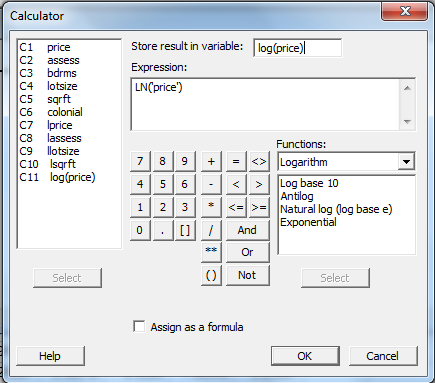
    <div class=answer> (i) First, make column of “log (price)” by going to Calc > Calculator . In the appeared dialog box, enter values as shown below:


Step 2 of 12


Step 3 of 12


Step 4 of 12


Step 5 of 12


Step 6 of 12


Step 7 of 12


Step 8 of 12


Step 9 of 12


Step 10 of 12


Step 11 of 12


Step 12 of 12

close menu
Introductory Econometrics: A Modern Approach 6th Edition by Jeffrey M Wooldridge
cross icon



