expand icon
book Introductory Econometrics: A Modern Approach 6th Edition by Jeffrey M Wooldridge cover

Introductory Econometrics: A Modern Approach 6th Edition by Jeffrey M Wooldridge

Edition 6ISBN: 130527010X
book Introductory Econometrics: A Modern Approach 6th Edition by Jeffrey M Wooldridge cover

Introductory Econometrics: A Modern Approach 6th Edition by Jeffrey M Wooldridge

Edition 6ISBN: 130527010X
Exercise 22

Consider the problem described at the end of Section 2.6: running a regression and only estimating an intercept.

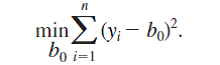
(i) Given a sample {yi : i = 1, 2, . . . , n}, let  Consider the problem described at the end of Section 2.6: running a regression and only estimating an intercept. (i) Given a sample {<i>y</i><sub>i</sub><i> </i>: <i>i </i>= 1, 2, . . . , <i>n</i>}, let <i>   </i>be the solution to   Show that   <i> </i>inside the squared residual and then doing a little algebra.) (ii) Define residuals <i>   </i>Argue that these residuals always sum to zero. be the solution to
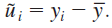
 Consider the problem described at the end of Section 2.6: running a regression and only estimating an intercept. (i) Given a sample {<i>y</i><sub>i</sub><i> </i>: <i>i </i>= 1, 2, . . . , <i>n</i>}, let <i>   </i>be the solution to   Show that   <i> </i>inside the squared residual and then doing a little algebra.) (ii) Define residuals <i>   </i>Argue that these residuals always sum to zero.

Show that  Consider the problem described at the end of Section 2.6: running a regression and only estimating an intercept. (i) Given a sample {<i>y</i><sub>i</sub><i> </i>: <i>i </i>= 1, 2, . . . , <i>n</i>}, let <i>   </i>be the solution to   Show that   <i> </i>inside the squared residual and then doing a little algebra.) (ii) Define residuals <i>   </i>Argue that these residuals always sum to zero. inside the squared residual and then doing a little algebra.)

(ii) Define residuals  Consider the problem described at the end of Section 2.6: running a regression and only estimating an intercept. (i) Given a sample {<i>y</i><sub>i</sub><i> </i>: <i>i </i>= 1, 2, . . . , <i>n</i>}, let <i>   </i>be the solution to   Show that   <i> </i>inside the squared residual and then doing a little algebra.) (ii) Define residuals <i>   </i>Argue that these residuals always sum to zero. Argue that these residuals always sum to zero.

Step-by-step solution
Verified
like image
like image

Step 1 of 2

a.

Consider a sample of data given below
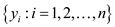
    <div class=answer> a. Consider a sample of data given below   Let the sample average be   . Hence   Since,   The second term is minimum when,   Hence the term is minimized when

Let the sample average be     <div class=answer> a. Consider a sample of data given below   Let the sample average be   . Hence   Since,   The second term is minimum when,   Hence the term is minimized when   .

Hence

    <div class=answer> a. Consider a sample of data given below   Let the sample average be   . Hence   Since,   The second term is minimum when,   Hence the term is minimized when

Since,

    <div class=answer> a. Consider a sample of data given below   Let the sample average be   . Hence   Since,   The second term is minimum when,   Hence the term is minimized when

The second term is minimum when,

    <div class=answer> a. Consider a sample of data given below   Let the sample average be   . Hence   Since,   The second term is minimum when,   Hence the term is minimized when

Hence the term is minimized when     <div class=answer> a. Consider a sample of data given below   Let the sample average be   . Hence   Since,   The second term is minimum when,   Hence the term is minimized when


Step 2 of 2

close menu
Introductory Econometrics: A Modern Approach 6th Edition by Jeffrey M Wooldridge
cross icon