


expand icon
book Introductory Econometrics: A Modern Approach 6th Edition by Jeffrey M Wooldridge cover

Introductory Econometrics: A Modern Approach 6th Edition by Jeffrey M Wooldridge

Edition 6ISBN: 130527010X
book Introductory Econometrics: A Modern Approach 6th Edition by Jeffrey M Wooldridge cover

Introductory Econometrics: A Modern Approach 6th Edition by Jeffrey M Wooldridge

Edition 6ISBN: 130527010X
Exercise 8

The New York Times (2/5/90) reported three-point shooting performance for the top 10 three-point shooters in the NBA. The following table summarizes these data:

Player

FGA-FGM

Mark Price

429-188

Trent Tucker

833-345

Dale Ellis

1,149-472

Craig Hodges

1,016-396

Danny Ainge

1,051-406

Byron Scott

676-260

Reggie Miller

416-159

Larry Bird

1,206-455

Jon Sundvold

440-166

Brian Taylor

417-157

Note: FGA = field goals attempted and FGM = field goals made.

For a given player, the outcome of a particular shot can be modeled as a Bernoulli (zero-one) variable: if Yi is the outcome of shot i, then Yi =1 if the shot is made, and Yi = 0 if the shot is missed. Let ? denote the probability of making any particular three-point shot attempt. The natural estimator of ? is  The New York Times (2/5/90) reported three-point shooting performance for the top 10 three-point shooters in the NBA. The following table summarizes these data: <table cellspacing=0 cellpadding=0 border=1>    <tbody>     <tr>      <td valign=top> Player </td>      <td valign=top> FGA-FGM </td>     </tr>     <tr>      <td valign=top> Mark Price </td>      <td valign=top> 429-188 </td>     </tr>     <tr>      <td valign=top> Trent Tucker </td>      <td valign=top> 833-345 </td>     </tr>     <tr>      <td valign=top> Dale Ellis </td>      <td valign=top> 1,149-472 </td>     </tr>     <tr>      <td valign=top> Craig Hodges </td>      <td valign=top> 1,016-396 </td>     </tr>     <tr>      <td valign=top> Danny Ainge </td>      <td valign=top> 1,051-406 </td>     </tr>     <tr>      <td valign=top> Byron Scott </td>      <td valign=top> 676-260 </td>     </tr>     <tr>      <td valign=top> Reggie Miller </td>      <td valign=top> 416-159 </td>     </tr>     <tr>      <td valign=top> Larry Bird </td>      <td valign=top> 1,206-455 </td>     </tr>     <tr>      <td valign=top> Jon Sundvold </td>      <td valign=top> 440-166 </td>     </tr>     <tr>      <td valign=top> Brian Taylor </td>      <td valign=top> 417-157 </td>     </tr>    </tbody>   </table> Note: FGA = field goals attempted and FGM = field goals made. For a given player, the outcome of a particular shot can be modeled as a Bernoulli (zero-one) variable: if Yi is the outcome of shot i, then Y<span class=sub>i</span> =1 if the shot is made, and Y<span class=sub>i</span> = 0 if the shot is missed. Let ? denote the probability of making any particular three-point shot attempt. The natural estimator of ? is   = FGM/FGA. <blockquote> (i) Estimate ? for Mark Price. (ii) Find the standard deviation of the estimator   in terms of and the number of shot attempts, n. (iii) The asymptotic distribution of (   -)/se(   )is standard normal, where se(   ) =   . Use this fact to test H<span class=sub>0</span>: ? = .5 against H<span class=sub>1</span>: ?= .5 for Mark Price. Use a 1% significance level. </blockquote>   = FGM/FGA.

(i) Estimate ? for Mark Price.

(ii) Find the standard deviation of the estimator  The New York Times (2/5/90) reported three-point shooting performance for the top 10 three-point shooters in the NBA. The following table summarizes these data: <table cellspacing=0 cellpadding=0 border=1>    <tbody>     <tr>      <td valign=top> Player </td>      <td valign=top> FGA-FGM </td>     </tr>     <tr>      <td valign=top> Mark Price </td>      <td valign=top> 429-188 </td>     </tr>     <tr>      <td valign=top> Trent Tucker </td>      <td valign=top> 833-345 </td>     </tr>     <tr>      <td valign=top> Dale Ellis </td>      <td valign=top> 1,149-472 </td>     </tr>     <tr>      <td valign=top> Craig Hodges </td>      <td valign=top> 1,016-396 </td>     </tr>     <tr>      <td valign=top> Danny Ainge </td>      <td valign=top> 1,051-406 </td>     </tr>     <tr>      <td valign=top> Byron Scott </td>      <td valign=top> 676-260 </td>     </tr>     <tr>      <td valign=top> Reggie Miller </td>      <td valign=top> 416-159 </td>     </tr>     <tr>      <td valign=top> Larry Bird </td>      <td valign=top> 1,206-455 </td>     </tr>     <tr>      <td valign=top> Jon Sundvold </td>      <td valign=top> 440-166 </td>     </tr>     <tr>      <td valign=top> Brian Taylor </td>      <td valign=top> 417-157 </td>     </tr>    </tbody>   </table> Note: FGA = field goals attempted and FGM = field goals made. For a given player, the outcome of a particular shot can be modeled as a Bernoulli (zero-one) variable: if Yi is the outcome of shot i, then Y<span class=sub>i</span> =1 if the shot is made, and Y<span class=sub>i</span> = 0 if the shot is missed. Let ? denote the probability of making any particular three-point shot attempt. The natural estimator of ? is   = FGM/FGA. <blockquote> (i) Estimate ? for Mark Price. (ii) Find the standard deviation of the estimator   in terms of and the number of shot attempts, n. (iii) The asymptotic distribution of (   -)/se(   )is standard normal, where se(   ) =   . Use this fact to test H<span class=sub>0</span>: ? = .5 against H<span class=sub>1</span>: ?= .5 for Mark Price. Use a 1% significance level. </blockquote>   in terms of and the number of shot attempts, n.

(iii) The asymptotic distribution of ( The New York Times (2/5/90) reported three-point shooting performance for the top 10 three-point shooters in the NBA. The following table summarizes these data: <table cellspacing=0 cellpadding=0 border=1>    <tbody>     <tr>      <td valign=top> Player </td>      <td valign=top> FGA-FGM </td>     </tr>     <tr>      <td valign=top> Mark Price </td>      <td valign=top> 429-188 </td>     </tr>     <tr>      <td valign=top> Trent Tucker </td>      <td valign=top> 833-345 </td>     </tr>     <tr>      <td valign=top> Dale Ellis </td>      <td valign=top> 1,149-472 </td>     </tr>     <tr>      <td valign=top> Craig Hodges </td>      <td valign=top> 1,016-396 </td>     </tr>     <tr>      <td valign=top> Danny Ainge </td>      <td valign=top> 1,051-406 </td>     </tr>     <tr>      <td valign=top> Byron Scott </td>      <td valign=top> 676-260 </td>     </tr>     <tr>      <td valign=top> Reggie Miller </td>      <td valign=top> 416-159 </td>     </tr>     <tr>      <td valign=top> Larry Bird </td>      <td valign=top> 1,206-455 </td>     </tr>     <tr>      <td valign=top> Jon Sundvold </td>      <td valign=top> 440-166 </td>     </tr>     <tr>      <td valign=top> Brian Taylor </td>      <td valign=top> 417-157 </td>     </tr>    </tbody>   </table> Note: FGA = field goals attempted and FGM = field goals made. For a given player, the outcome of a particular shot can be modeled as a Bernoulli (zero-one) variable: if Yi is the outcome of shot i, then Y<span class=sub>i</span> =1 if the shot is made, and Y<span class=sub>i</span> = 0 if the shot is missed. Let ? denote the probability of making any particular three-point shot attempt. The natural estimator of ? is   = FGM/FGA. <blockquote> (i) Estimate ? for Mark Price. (ii) Find the standard deviation of the estimator   in terms of and the number of shot attempts, n. (iii) The asymptotic distribution of (   -)/se(   )is standard normal, where se(   ) =   . Use this fact to test H<span class=sub>0</span>: ? = .5 against H<span class=sub>1</span>: ?= .5 for Mark Price. Use a 1% significance level. </blockquote>   -)/se( The New York Times (2/5/90) reported three-point shooting performance for the top 10 three-point shooters in the NBA. The following table summarizes these data: <table cellspacing=0 cellpadding=0 border=1>    <tbody>     <tr>      <td valign=top> Player </td>      <td valign=top> FGA-FGM </td>     </tr>     <tr>      <td valign=top> Mark Price </td>      <td valign=top> 429-188 </td>     </tr>     <tr>      <td valign=top> Trent Tucker </td>      <td valign=top> 833-345 </td>     </tr>     <tr>      <td valign=top> Dale Ellis </td>      <td valign=top> 1,149-472 </td>     </tr>     <tr>      <td valign=top> Craig Hodges </td>      <td valign=top> 1,016-396 </td>     </tr>     <tr>      <td valign=top> Danny Ainge </td>      <td valign=top> 1,051-406 </td>     </tr>     <tr>      <td valign=top> Byron Scott </td>      <td valign=top> 676-260 </td>     </tr>     <tr>      <td valign=top> Reggie Miller </td>      <td valign=top> 416-159 </td>     </tr>     <tr>      <td valign=top> Larry Bird </td>      <td valign=top> 1,206-455 </td>     </tr>     <tr>      <td valign=top> Jon Sundvold </td>      <td valign=top> 440-166 </td>     </tr>     <tr>      <td valign=top> Brian Taylor </td>      <td valign=top> 417-157 </td>     </tr>    </tbody>   </table> Note: FGA = field goals attempted and FGM = field goals made. For a given player, the outcome of a particular shot can be modeled as a Bernoulli (zero-one) variable: if Yi is the outcome of shot i, then Y<span class=sub>i</span> =1 if the shot is made, and Y<span class=sub>i</span> = 0 if the shot is missed. Let ? denote the probability of making any particular three-point shot attempt. The natural estimator of ? is   = FGM/FGA. <blockquote> (i) Estimate ? for Mark Price. (ii) Find the standard deviation of the estimator   in terms of and the number of shot attempts, n. (iii) The asymptotic distribution of (   -)/se(   )is standard normal, where se(   ) =   . Use this fact to test H<span class=sub>0</span>: ? = .5 against H<span class=sub>1</span>: ?= .5 for Mark Price. Use a 1% significance level. </blockquote>   )is standard normal, where se( The New York Times (2/5/90) reported three-point shooting performance for the top 10 three-point shooters in the NBA. The following table summarizes these data: <table cellspacing=0 cellpadding=0 border=1>    <tbody>     <tr>      <td valign=top> Player </td>      <td valign=top> FGA-FGM </td>     </tr>     <tr>      <td valign=top> Mark Price </td>      <td valign=top> 429-188 </td>     </tr>     <tr>      <td valign=top> Trent Tucker </td>      <td valign=top> 833-345 </td>     </tr>     <tr>      <td valign=top> Dale Ellis </td>      <td valign=top> 1,149-472 </td>     </tr>     <tr>      <td valign=top> Craig Hodges </td>      <td valign=top> 1,016-396 </td>     </tr>     <tr>      <td valign=top> Danny Ainge </td>      <td valign=top> 1,051-406 </td>     </tr>     <tr>      <td valign=top> Byron Scott </td>      <td valign=top> 676-260 </td>     </tr>     <tr>      <td valign=top> Reggie Miller </td>      <td valign=top> 416-159 </td>     </tr>     <tr>      <td valign=top> Larry Bird </td>      <td valign=top> 1,206-455 </td>     </tr>     <tr>      <td valign=top> Jon Sundvold </td>      <td valign=top> 440-166 </td>     </tr>     <tr>      <td valign=top> Brian Taylor </td>      <td valign=top> 417-157 </td>     </tr>    </tbody>   </table> Note: FGA = field goals attempted and FGM = field goals made. For a given player, the outcome of a particular shot can be modeled as a Bernoulli (zero-one) variable: if Yi is the outcome of shot i, then Y<span class=sub>i</span> =1 if the shot is made, and Y<span class=sub>i</span> = 0 if the shot is missed. Let ? denote the probability of making any particular three-point shot attempt. The natural estimator of ? is   = FGM/FGA. <blockquote> (i) Estimate ? for Mark Price. (ii) Find the standard deviation of the estimator   in terms of and the number of shot attempts, n. (iii) The asymptotic distribution of (   -)/se(   )is standard normal, where se(   ) =   . Use this fact to test H<span class=sub>0</span>: ? = .5 against H<span class=sub>1</span>: ?= .5 for Mark Price. Use a 1% significance level. </blockquote>   ) =  The New York Times (2/5/90) reported three-point shooting performance for the top 10 three-point shooters in the NBA. The following table summarizes these data: <table cellspacing=0 cellpadding=0 border=1>    <tbody>     <tr>      <td valign=top> Player </td>      <td valign=top> FGA-FGM </td>     </tr>     <tr>      <td valign=top> Mark Price </td>      <td valign=top> 429-188 </td>     </tr>     <tr>      <td valign=top> Trent Tucker </td>      <td valign=top> 833-345 </td>     </tr>     <tr>      <td valign=top> Dale Ellis </td>      <td valign=top> 1,149-472 </td>     </tr>     <tr>      <td valign=top> Craig Hodges </td>      <td valign=top> 1,016-396 </td>     </tr>     <tr>      <td valign=top> Danny Ainge </td>      <td valign=top> 1,051-406 </td>     </tr>     <tr>      <td valign=top> Byron Scott </td>      <td valign=top> 676-260 </td>     </tr>     <tr>      <td valign=top> Reggie Miller </td>      <td valign=top> 416-159 </td>     </tr>     <tr>      <td valign=top> Larry Bird </td>      <td valign=top> 1,206-455 </td>     </tr>     <tr>      <td valign=top> Jon Sundvold </td>      <td valign=top> 440-166 </td>     </tr>     <tr>      <td valign=top> Brian Taylor </td>      <td valign=top> 417-157 </td>     </tr>    </tbody>   </table> Note: FGA = field goals attempted and FGM = field goals made. For a given player, the outcome of a particular shot can be modeled as a Bernoulli (zero-one) variable: if Yi is the outcome of shot i, then Y<span class=sub>i</span> =1 if the shot is made, and Y<span class=sub>i</span> = 0 if the shot is missed. Let ? denote the probability of making any particular three-point shot attempt. The natural estimator of ? is   = FGM/FGA. <blockquote> (i) Estimate ? for Mark Price. (ii) Find the standard deviation of the estimator   in terms of and the number of shot attempts, n. (iii) The asymptotic distribution of (   -)/se(   )is standard normal, where se(   ) =   . Use this fact to test H<span class=sub>0</span>: ? = .5 against H<span class=sub>1</span>: ?= .5 for Mark Price. Use a 1% significance level. </blockquote>   . Use this fact to test H0: ? = .5 against H1: ?= .5 for Mark Price. Use a 1% significance level.

Step-by-step solution
Verified
like image
like image

Step 1 of 3

(i)

The natural estimator ? is defined as    <div class=answer> (i) The natural estimator ? is defined as   <i>. </i>For Mark Price, the value of <i>FGM </i>is 188 and the value of <i>FGA</i> is 429. Therefore, <i> </i> <i>   </i> The estimate ? for mark price is   <i>.</i> . For Mark Price, the value of FGM is 188 and the value of FGA is 429. Therefore,
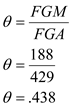
    <div class=answer> (i) The natural estimator ? is defined as   <i>. </i>For Mark Price, the value of <i>FGM </i>is 188 and the value of <i>FGA</i> is 429. Therefore, <i> </i> <i>   </i> The estimate ? for mark price is   <i>.</i>

The estimate ? for mark price is    <div class=answer> (i) The natural estimator ? is defined as   <i>. </i>For Mark Price, the value of <i>FGM </i>is 188 and the value of <i>FGA</i> is 429. Therefore, <i> </i> <i>   </i> The estimate ? for mark price is   <i>.</i> .


Step 2 of 3


Step 3 of 3

close menu
Introductory Econometrics: A Modern Approach 6th Edition by Jeffrey M Wooldridge
cross icon



