





 Chat with AI


Exercise Physiology: Theory and Application to Fitness and Performance 9th Edition by Scott Powers, Edward Howley
Edition 9ISBN: 0073523534Exercise Physiology: Theory and Application to Fitness and Performance 9th Edition by Scott Powers, Edward Howley
Edition 9ISBN: 0073523534Graph the ventilatory response in the transition from rest to constant-load submaximal exercise. What happens to ventilation if the exercise is prolonged and performed in a hot/humid environment? Why?
 Verified
Step 1 of 2
During a transition from rest to constant load submaximal exercise, changes occur in the pulmonary ventilation. At the beginning of the exercise, expired ventilation (VE) increases rapidly. It then becomes slower and reaches a steady-state. These changes are shown in graph 1 given below.
The arterial tensions of PCO2 and PO2 are relatively unchanged during the submaximal exercise. However, the arterial PO2 decreases and arterial PCO2 slightly increases in the transition from rest to steady-state exercise, as shown in graph 1.
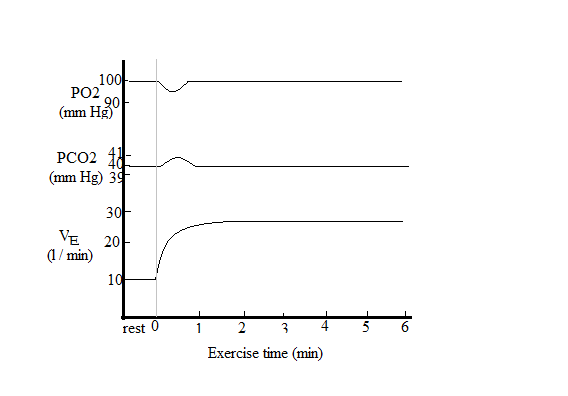
Graph 1: Changes in ventilation and partial pressures of O2 and CO2 n the transition from rest to steady-state submaximal exercise.
Step 2 of 2


Why don’t you like this exercise?
Other






