expand icon
book Fundamentals of Cost Accounting 3rd Edition by William N. Lanen, Shannon W. Anderson, Michael Maher cover

Fundamentals of Cost Accounting 3rd Edition by William N. Lanen, Shannon W. Anderson, Michael Maher

Edition 3ISBN: 0073527114
book Fundamentals of Cost Accounting 3rd Edition by William N. Lanen, Shannon W. Anderson, Michael Maher cover

Fundamentals of Cost Accounting 3rd Edition by William N. Lanen, Shannon W. Anderson, Michael Maher

Edition 3ISBN: 0073527114
Exercise 54

Estimated Net Realizable Value and Effects of Processing Further

Fletcher Fabrication, Inc., produces three products by a joint production process. Raw materials are put into production in Department X, and at the end of processing in this department, three products appear. Product A is sold at the split-off point with no further processing. Products B and C require further processing before they are sold. Product B is processed in Department Y, and product C is processed in Department Z. The company uses the estimated net realizable value method of allocating joint production costs. Following is a summary of costs and other data for the quarter ended June 30.

No inventories were on hand at the beginning of the quarter. No raw material was on hand at June 30. All units on hand at the end of the quarter were fully complete as to processing.

Products

A

B

C

Pounds sold  

  20,000

59,000

70,000

Pounds on hand at June 30 

  50,000

-0-

40,000

Sales revenues  

  $45,000

$265,500

$367,500

Departments

X

Y

Z

Raw material cost 

  $168,000

$ -0-

$ -0-

Direct labor cost  

  72,000

121,350

287,625

Manufacturing overhead  

  30,000

31,650

109,875

Required

a. Determine the following amounts for each product: (1) estimated net realizable value used for allocating joint costs, (2) joint costs allocated to each of the three products, (3) cost of goods sold, and (4) finished goods inventory costs, June 30.


b. Assume that the entire output of product A could be processed further at an additional cost of $6.00 per pound and then sold for $12.90 per pound. What would have been the effect on operating profits if all of product A output for the quarter had been further processed and then sold rather than being sold at the split-off point?


c. Write a memo to management indicating whether the company should process product A further and why.

Step-by-step solution
Verified
like image
like image

Step 1 of 5

a.

?


Departments


Production Costs

X


Y


Z


Raw materials?

$168,000


Direct labor?

72,000


$121,350


$  287,625


Manufacturing overhead?

 30,000


 31,650


  109,875


Total?

$270,000


$153,000


$397,500

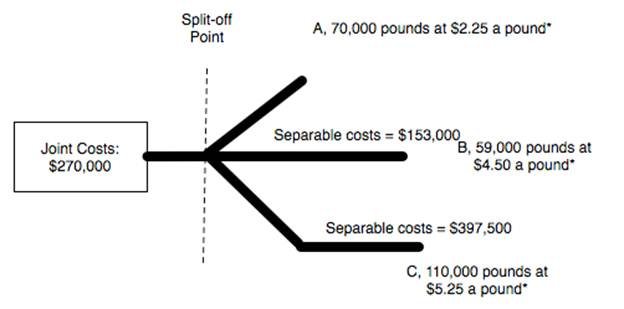
?A diagram of the problem follows:

    <div class=answer> a. <table cellspacing=1 cellpadding=1 border=0>     <tbody>      <tr>       <td valign=top> ? </td>       <td valign=top><p align=center><span class=italics> </span> </td>       <td colspan=5 style=border:solid windowtext 1.0pt;border-left:none;border-right:none;border-top:none;padding:0cm 5.4pt 0cm 5.4pt valign=top align=center><p align=center>Departments </td>      </tr>      <tr>       <td valign=top>   </td>       <td valign=top align=left> Production Costs </td>       <td valign=top align=center><p align=center>X </td>       <td valign=top align=center><p align=center>  </td>       <td valign=top align=center><p align=center>Y </td>       <td valign=top align=center><p align=center>  </td>       <td valign=top align=center><p align=center>Z </td>      </tr>      <tr>       <td valign=top>   </td>       <td valign=top align=left> Raw materials? </td>       <td valign=top align=right> $168,000 </td>       <td valign=top align=right><p align=right>  </td>       <td valign=top align=right> — </td>       <td valign=top align=right><p align=right>  </td>       <td valign=top align=right> — </td>      </tr>      <tr>       <td valign=top>   </td>       <td valign=top align=left> Direct labor? </td>       <td valign=top align=right> 72,000 </td>       <td valign=top align=right><p align=right>  </td>       <td valign=top align=right> $121,350 </td>       <td valign=top align=right><p align=right>  </td>       <td valign=top align=right> ea360854_4292_442f_ac8e_76d35a8668da_SMCC1699_11nbsp; 287,625 </td>      </tr>      <tr>       <td valign=top>   </td>       <td valign=top align=left> Manufacturing overhead? </td>       <td valign=top align=right> <span class=underline> 30,000</span> </td>       <td valign=top align=right><p align=right><span class=underline> </span> </td>       <td valign=top align=right> <span class=underline> 31,650</span> </td>       <td valign=top align=right><p align=right><span class=underline> </span> </td>       <td valign=top align=right> <span class=underline>  109,875</span> </td>      </tr>      <tr>       <td valign=top>   </td>       <td valign=top align=left> Total? </td>       <td valign=top align=right> <span class=underline>$270,000</span> </td>       <td valign=top align=right><p align=right><span class=underline> </span> </td>       <td valign=top align=right> <span class=underline>$153,000</span> </td>       <td valign=top align=right><p align=right><span class=underline> </span> </td>       <td valign=top align=right> <span class=underline>$397,500</span> </td>      </tr>     </tbody>    </table> ?A diagram of the problem follows:   *$2.25 = $45,000 ÷ 20,000 lbs; $4.50 = $265,500 ÷ 59,000 lbs; $5.25 = $367,500 ÷ 70,000 lbs. <table cellspacing=1 cellpadding=1 border=0>     <tbody>      <tr>       <td valign=top>   </td>       <td valign=top><p align=center><span class=italics> </span> </td>       <td valign=top align=center><p align=center>Product A </td>       <td valign=top align=center>   </td>       <td valign=top align=center><p align=center>Product B </td>       <td valign=top align=center>   </td>       <td valign=top align=center><p align=center>Product C </td>       <td valign=top align=center>   </td>       <td valign=top align=center><p align=center>Total </td>      </tr>      <tr>       <td valign=top align=left> 1. </td>       <td valign=top align=left> Selling price per pound: </td>       <td valign=top align=left>   </td>       <td valign=top>   </td>       <td valign=top>   </td>       <td valign=top>   </td>       <td valign=top><p align=right>  </td>       <td valign=top><p align=right>  </td>       <td valign=top><p align=right>  </td>      </tr>      <tr>       <td valign=top align=left>   </td>       <td valign=top align=left> ?X: $45,000 ¸ 20,000? </td>       <td valign=top align=left><p align=left>$2.25 </td>       <td valign=top>   </td>       <td valign=top>   </td>       <td valign=top>   </td>       <td valign=top>   </td>       <td valign=top>   </td>       <td valign=top>   </td>      </tr>      <tr>       <td valign=top align=left>   </td>       <td valign=top align=left> ?Z: $367,500 ¸ 70,000? </td>       <td valign=top align=left><p align=left>  </td>       <td valign=top>   </td>       <td valign=top>   </td>       <td valign=top>   </td>       <td valign=top align=right> $5.25 </td>       <td valign=top>   </td>       <td valign=top>   </td>      </tr>      <tr>       <td valign=top align=left>   </td>       <td colspan=2 valign=top align=left> Multiply by pounds produced: </td>       <td valign=top>   </td>       <td valign=top>   </td>       <td valign=top>   </td>       <td valign=top>   </td>       <td valign=top>   </td>       <td valign=top>   </td>      </tr>      <tr>       <td valign=top>   </td>       <td valign=top align=left> ?A: 20,000 + 50,000? </td>       <td valign=top align=right> x 70,000 </td>       <td valign=top align=right>   </td>       <td valign=top align=right>   </td>       <td valign=top align=right>   </td>       <td valign=top align=right>   </td>       <td valign=top align=right>   </td>       <td valign=top align=right>   </td>      </tr>      <tr>       <td valign=top>   </td>       <td valign=top align=left> ?C: 70,000 + 40,000? </td>       <td valign=top align=right> ?? </td>       <td valign=top align=right>   </td>       <td valign=top align=right> ?? </td>       <td valign=top align=right>   </td>       <td valign=top align=right> <span class=underline>x 110,000</span> </td>       <td valign=top align=right>   </td>       <td valign=top align=right>   </td>      </tr>      <tr>       <td valign=top>   </td>       <td valign=top align=left> Gross sales values? </td>       <td valign=top align=right> $157,500 </td>       <td valign=top align=right>   </td>       <td valign=top align=right> $265,500<span class=sup>a</span> </td>       <td valign=top align=right>   </td>       <td valign=top align=right> $577,500<span class=sup>b</span> </td>       <td valign=top align=right>   </td>       <td valign=top align=right>   </td>      </tr>      <tr>       <td valign=top align=left>   </td>       <td colspan=2 valign=top align=left> Less costs of separate processing: </td>       <td valign=top align=right><p align=right>  </td>       <td valign=top align=right><p align=right>  </td>       <td valign=top align=right><p align=right>  </td>       <td valign=top align=right><p align=right>  </td>       <td valign=top align=right><p align=right>  </td>       <td valign=top align=right><p align=right>  </td>      </tr>      <tr>       <td valign=top>   </td>       <td valign=top align=left> ?A: —? </td>       <td valign=top align=right> — </td>       <td valign=top align=right>   </td>       <td valign=top align=right> — </td>       <td valign=top align=right>   </td>       <td valign=top align=right> — </td>       <td valign=top align=right>   </td>       <td valign=top align=right>   </td>      </tr>      <tr>       <td valign=top>   </td>       <td valign=top align=left> ?B: $121,350 + $31,650? </td>       <td valign=top align=right> — </td>       <td valign=top align=right>   </td>       <td valign=top align=right> 153,000 </td>       <td valign=top align=right>   </td>       <td valign=top align=right> — </td>       <td valign=top align=right>   </td>       <td valign=top align=right>   </td>      </tr>      <tr>       <td valign=top>   </td>       <td valign=top align=left> ?C: $287,625 + $109,875? </td>       <td valign=top align=right> <span class=underline>         —</span> </td>       <td valign=top align=right> <span class=underline> </span> </td>       <td valign=top align=right> <span class=underline>        —</span> </td>       <td valign=top align=right> <span class=underline> </span> </td>       <td valign=top align=right> <span class=underline>397,500</span> </td>       <td valign=top align=right>   </td>       <td valign=top align=right>   </td>      </tr>      <tr>       <td valign=top>   </td>       <td valign=top align=left> Estimated net realizable values at split-off point? </td>       <td valign=top align=right> <span class=underline>$157,500</span> </td>       <td valign=top align=right> <span class=underline> </span> </td>       <td valign=top align=right> <span class=underline>$ 112,500</span> </td>       <td valign=top align=right> <span class=underline> </span> </td>       <td valign=top align=right> <span class=underline>$180,000</span> </td>       <td valign=top align=right> <span class=underline> </span> </td>       <td valign=top align=right> <span class=underline>$450,000</span> </td>      </tr>      <tr>       <td valign=top>   </td>       <td valign=top align=left> Percentage of total? </td>       <td valign=top align=right> 35% </td>       <td valign=top align=right>   </td>       <td valign=top align=right> 25% </td>       <td valign=top align=right>   </td>       <td valign=top align=right> 40% </td>       <td valign=top align=right>   </td>       <td valign=top align=right> 100% </td>      </tr>     </tbody>    </table> <span class=sup>a</span> Given <table cellspacing=1 cellpadding=1 border=0>     <tbody>      <tr>       <td valign=top align=left> <span class=sup>b</span> Or: $367,500 </td>       <td valign=top align=center><p align=center>x </td>       <td valign=top align=left> (110,000 ÷ 70,000) </td>       <td valign=top align=center><p align=center>= </td>       <td valign=top align=left> $577,500 </td>      </tr>     </tbody>    </table>

*$2.25 = $45,000 ÷ 20,000 lbs; $4.50 = $265,500 ÷ 59,000 lbs;

$5.25 = $367,500 ÷ 70,000 lbs.


Product A


Product B


Product C


Total

1.

Selling price per pound:


?X: $45,000 ¸ 20,000?

$2.25


?Z: $367,500 ¸ 70,000?


$5.25


Multiply by pounds produced:


?A: 20,000 + 50,000?

x 70,000


?C: 70,000 + 40,000?

??


??


x 110,000


Gross sales values?

$157,500


$265,500a


$577,500b


Less costs of separate processing:


?A: —?


?B: $121,350 + $31,650?


153,000


?C: $287,625 + $109,875?

         —


        —


397,500


Estimated net realizable values at split-off point?

$157,500


$ 112,500


$180,000


$450,000


Percentage of total?

35%


25%


40%


100%

a Given

b Or: $367,500

x

(110,000 ÷ 70,000)

=

$577,500


Step 2 of 5


Step 3 of 5


Step 4 of 5


Step 5 of 5

close menu
Fundamentals of Cost Accounting 3rd Edition by William N. Lanen, Shannon W. Anderson, Michael Maher
cross icon